fatima khan 1
Topic:-
fatima khan 2
1) Introduction.
2) Mimicry.
3) Types of mimicry
• Batesian mimicry
• Mullerian mimicry
• Wasmannian mimicry
• Peckhamian mimicry
• Self-mimicry
4) Animations
fatima khan 3
• One way or another, many animals must avoid being
eaten by predators.
• Some animals are bad tasting or dangerous &
predators learn to recognize them by their bright color
patterns & leave them alone.
• Animals which are good tasting & cannot defend
themselves directly must resort to other ways to avoid
being eaten.
• One way is to look like animal which is bad tasting or
dangerous; the predator learns to avoid all those
animals that look like noxious ones.
fatima khan 4
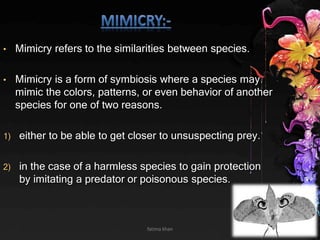
• Mimicry refers to the similarities between species.
• Mimicry is a form of symbiosis where a species may
mimic the colors, patterns, or even behavior of another
species for one of two reasons.
1) either to be able to get closer to unsuspecting prey.
2) in the case of a harmless species to gain protection
by imitating a predator or poisonous species.
fatima khan 5
• Mostly in mimetic relationships the advantage is one
sided, i.e. one species (the mimic) gaining
advantage from a resemblance to the other (the
model).
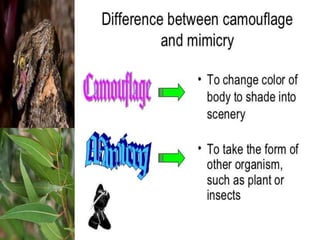
• Comparing mimicry with camouflage or deceptive
behavior, protection by mimicry is the most effective.
• The mimicking species does not have to change its
behavior or stay against a safe background to
disguise itself.
fatima khan 6
fatima khan 7
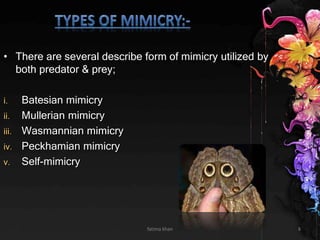
• There are several describe form of mimicry utilized by
both predator & prey;
i. Batesian mimicry
ii. Mullerian mimicry
iii. Wasmannian mimicry
iv. Peckhamian mimicry
v. Self-mimicry
fatima khan 8
• Batesian mimicry is a type of mimicry in which
palatable animal mimics the bad-tasting or noxious
prey enough so that predators may not distinguish
b/w them.
• After several attempts of distasteful encounters
predators learn to avoid such appearance.
• It is called Batesian mimicry in honor of English
naturalist Henry.W.Bates who published an
explanation of this mimicry in 1862.
fatima khan 9
fatima khan 10
fatima khan 11
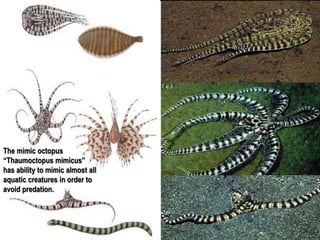
The mimic octopus
“Thaumoctopus mimicus”
has ability to mimic almost all
aquatic creatures in order to
avoid predation.
• Mullerian mimicry is a form of protective mimicry in
which two or more distasteful or harmful species,
especially of insects, closely resemble each other and
are therefore avoided equally by all their natural
predators. [After Fritz (Johann Friedrich Theodor)
Müller (1821-1897), German-born Brazilian zoologist.]
fatima khan 12
• The initial learning experience of the predator often
results in death or damage to the inedible individual
that provided the lesson; there is thus some cost to
the species that teaches the predator of its
inedibility.
• There is little or no inherited recognition by certain
predators.
fatima khan 13
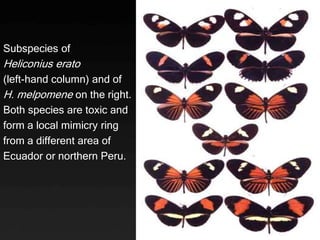
Subspecies of
Heliconius erato
(left-hand column) and of
H. melpomene on the right.
Both species are toxic and
form a local mimicry ring
from a different area of
Ecuador or northern Peru.
fatima khan 14
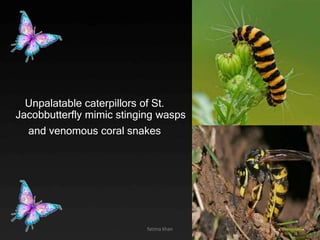
Unpalatable caterpillors of St.
Jacobbutterfly mimic stinging wasps
and venomous coral snakes
fatima khan 15
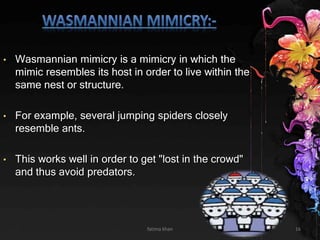
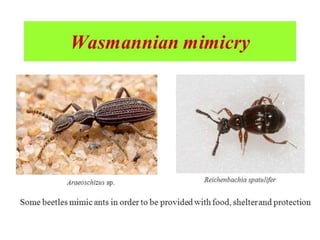
• Wasmannian mimicry is a mimicry in which the
mimic resembles its host in order to live within the
same nest or structure.
• For example, several jumping spiders closely
resemble ants.
• This works well in order to get "lost in the crowd"
and thus avoid predators.
fatima khan 16
fatima khan 17
fatima khan 18
• Also known as “ AGGRESSIVE MIMICRY” in which
predator mimics its prey in order to catch it.
• Bolas spiders are type of aggressive mimic.
• They produce chemicals that mimic the
sex pheromones of particular moth species.
• When male moths approach what they perceive to
be a female in order to mate with her, they are
caught by the bolus spider and become prey.
fatima khan 19
fatima khan 20
Anglar fish (Antenarius sp.)
displays a lure resembling a
small fish
fatima khan 21
• Self mimicry is a mimicry in which species have one
body part that mimics another to increase survival
during an attack or helps predators appear
innocuous to allow the prey extra seconds to
escape.
fatima khan 22
• Some insects have the
markings on their tails.
• Those markings effectively
making the insects appear to
be something that is facing
the opposite direction.
• A confused predator, when
striking at the mimic, most
likely comes up with nothing
more than a piece of wing and
the insects get a chance to
escape.
23
• There are butterflies that have what look like
antennae on the rear of the wings. If birds peck
at the rear edge of wings, the head is protected
and the butterfly has more time to get
away. The second picture shows a butterfly
with bite marks on its hind wings. These
aren't side effects from a HCA supplement
,either.
fatima khan 24
• Planthopper rests on tree trunk heading
downwards. When moves, it moves
backwards. Together with the eye-patterns
on it forewing tips, it gives the impression of
its tail is its head. This orient predators to a
less vulnerable part of the body.
fatima khan 25
fatima khan 26
fatima khan 27

mimicry

  • 1.
  • 2.
  • 3.
    1) Introduction. 2) Mimicry. 3)Types of mimicry • Batesian mimicry • Mullerian mimicry • Wasmannian mimicry • Peckhamian mimicry • Self-mimicry 4) Animations fatima khan 3
  • 4.
    • One wayor another, many animals must avoid being eaten by predators. • Some animals are bad tasting or dangerous & predators learn to recognize them by their bright color patterns & leave them alone. • Animals which are good tasting & cannot defend themselves directly must resort to other ways to avoid being eaten. • One way is to look like animal which is bad tasting or dangerous; the predator learns to avoid all those animals that look like noxious ones. fatima khan 4
  • 5.
    • Mimicry refersto the similarities between species. • Mimicry is a form of symbiosis where a species may mimic the colors, patterns, or even behavior of another species for one of two reasons. 1) either to be able to get closer to unsuspecting prey. 2) in the case of a harmless species to gain protection by imitating a predator or poisonous species. fatima khan 5
  • 6.
    • Mostly inmimetic relationships the advantage is one sided, i.e. one species (the mimic) gaining advantage from a resemblance to the other (the model). • Comparing mimicry with camouflage or deceptive behavior, protection by mimicry is the most effective. • The mimicking species does not have to change its behavior or stay against a safe background to disguise itself. fatima khan 6
  • 7.
  • 8.
    • There areseveral describe form of mimicry utilized by both predator & prey; i. Batesian mimicry ii. Mullerian mimicry iii. Wasmannian mimicry iv. Peckhamian mimicry v. Self-mimicry fatima khan 8
  • 9.
    • Batesian mimicryis a type of mimicry in which palatable animal mimics the bad-tasting or noxious prey enough so that predators may not distinguish b/w them. • After several attempts of distasteful encounters predators learn to avoid such appearance. • It is called Batesian mimicry in honor of English naturalist Henry.W.Bates who published an explanation of this mimicry in 1862. fatima khan 9
  • 10.
  • 11.
    fatima khan 11 Themimic octopus “Thaumoctopus mimicus” has ability to mimic almost all aquatic creatures in order to avoid predation.
  • 12.
    • Mullerian mimicryis a form of protective mimicry in which two or more distasteful or harmful species, especially of insects, closely resemble each other and are therefore avoided equally by all their natural predators. [After Fritz (Johann Friedrich Theodor) Müller (1821-1897), German-born Brazilian zoologist.] fatima khan 12
  • 13.
    • The initiallearning experience of the predator often results in death or damage to the inedible individual that provided the lesson; there is thus some cost to the species that teaches the predator of its inedibility. • There is little or no inherited recognition by certain predators. fatima khan 13
  • 14.
    Subspecies of Heliconius erato (left-handcolumn) and of H. melpomene on the right. Both species are toxic and form a local mimicry ring from a different area of Ecuador or northern Peru. fatima khan 14
  • 15.
    Unpalatable caterpillors ofSt. Jacobbutterfly mimic stinging wasps and venomous coral snakes fatima khan 15
  • 16.
    • Wasmannian mimicryis a mimicry in which the mimic resembles its host in order to live within the same nest or structure. • For example, several jumping spiders closely resemble ants. • This works well in order to get "lost in the crowd" and thus avoid predators. fatima khan 16
  • 17.
  • 18.
  • 19.
    • Also knownas “ AGGRESSIVE MIMICRY” in which predator mimics its prey in order to catch it. • Bolas spiders are type of aggressive mimic. • They produce chemicals that mimic the sex pheromones of particular moth species. • When male moths approach what they perceive to be a female in order to mate with her, they are caught by the bolus spider and become prey. fatima khan 19
  • 20.
  • 21.
    Anglar fish (Antenariussp.) displays a lure resembling a small fish fatima khan 21
  • 22.
    • Self mimicryis a mimicry in which species have one body part that mimics another to increase survival during an attack or helps predators appear innocuous to allow the prey extra seconds to escape. fatima khan 22
  • 23.
    • Some insectshave the markings on their tails. • Those markings effectively making the insects appear to be something that is facing the opposite direction. • A confused predator, when striking at the mimic, most likely comes up with nothing more than a piece of wing and the insects get a chance to escape. 23
  • 24.
    • There arebutterflies that have what look like antennae on the rear of the wings. If birds peck at the rear edge of wings, the head is protected and the butterfly has more time to get away. The second picture shows a butterfly with bite marks on its hind wings. These aren't side effects from a HCA supplement ,either. fatima khan 24 • Planthopper rests on tree trunk heading downwards. When moves, it moves backwards. Together with the eye-patterns on it forewing tips, it gives the impression of its tail is its head. This orient predators to a less vulnerable part of the body.
  • 25.
  • 26.
  • 27.