• In evolutionarybiology, mimicry is an evolved resemblance between an organism and another
object, often an organism of another species. Mimicry may evolve between different species, or
between individuals of the same species. Often, mimicry functions to protect a species from
predators, making it an antipredator adaptation.
• Mimicry evolves if a receiver (such as a predator) perceives the similarity between a mimic (the
organism that has a resemblance) and a model (the organism it resembles) and as a result changes its
behaviour in a way that provides a selective advantage to the mimic.
• The resemblances that evolve in mimicry can be visual, acoustic, chemical, tactile, or electric, or
combinations of these sensory modalities.
• Mimicry may be to the advantage of both organisms that share a resemblance, in which case it is a
form of mutualism; or mimicry can be to the detriment of one, making it parasitic or competitive.
The evolutionary convergence between groups is driven by the selective action of a signal-receiver or
dupe.
• Birds, for example, use sight to identify palatable insects, whilst avoiding the noxious ones. Over
time, palatable insects may evolve to resemble noxious ones, making them mimics and the noxious
ones models. In the case of mutualism, sometimes both groups are referred to as "co-mimics". It is
often thought that models must be more abundant than mimics, but this is not so.[5]
Mimicry may
involve numerous species; many harmless species such as hoverflies are Batesian mimics of strongly
defended species such as wasps, while many such well-defended species form Mullerian mimicry
rings, all resembling each other. Mimicry between prey species and their predators often involves
three or more species.
3.
• In itsbroadest definition, mimicry can include non-living models. The specific
terms masquerade and mimesis are sometimes used when the models are
inanimate.[7][3][8]
For example, animals such as flower mantises, planthoppers,
comma and geometer moth caterpillars resemble twigs, bark, leaves, bird
droppings or flowers.
• Many animals bear eyespots, which are hypothesized to resemble the eyes of
larger animals. They may not resemble any specific organism's eyes, and
whether or not animals respond to them as eyes is also unclear.
• Nonetheless, eyespots are the subject of a rich contemporary literature.
• The model is usually another species, except in automimicry, where members
of the species mimic other members, or other parts of their own bodies, and in
inter-sexual mimicry, where members of one sex mimic members of the other.[5]
4.
• Mimicry canresult in an evolutionary arms race if mimicry negatively affects the
model, and the model can evolve a different appearance from the mimic.
• Mimicry should not be confused with other forms of convergent evolution that
occurs when species come to resemble each other by adapting to similar
lifestyles that have nothing to do with a common signal receiver.
• Mimics may have different models for different life cycle stages, or they may be
polymorphic, with different individuals imitating different models, such as in
Heliconius butterflies. Models themselves may have more than one mimic,
though frequency dependent selectionfavours mimicry where models
outnumber mimics. Models tend to be relatively closely related organisms,but
mimicry of vastly different species is also known.
• Most known mimics are insects, though many other examples including
vertebrates are also known. Plants and fungi may also be mimics, though less
research has been carried out in this area.
5.
Classification
• Many typesof mimicry have been described.
• An overview of each follows, highlighting the similarities and differences between the various
forms.
• Classification is often based on function with respect to the mimic (e.g., avoiding harm).
• Some cases may belong to more than one class, e.g., automimicry and aggressive mimicry are not
mutually exclusive, as one describes the species relationship between model and mimic, while
the other describes the function for the mimic (obtaining food).
• The terminology used is not without debate and attempts to clarify have led to new terms being
included.
• The term "masquerade" is sometimes used when the model is inanimate but it is differentiated
from "crypsis" in its strict sense by the potential response of the signal receiver.
• In crypsis the receiver is assumed to not respond while a masquerader confuses the recognition
system of the receiver that would otherwise seek the signaller.
• In the other forms of mimicry, the signal is not filtered out by the sensory system of the receiver.
These are not mutually exclusive and in the evolution of wasp-like appearance, it has been
argued that insects evolve to masquerade wasps since predatory wasps do not attack each other
but this mimetic resemblance also deters vertebrate predators.
6.
Defensive
Defensive or protectivemimicry takes place when organisms are able to avoid
harmful encounters by deceiving enemies into treating them as something else.
• The first three such cases discussed here entail mimicry of animals protected by
warning coloration:
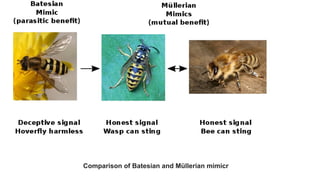
• Batesian mimicry, where a harmless mimic poses as harmful.
• Müllerian mimicry, where two or more harmful species mutually advertise
themselves as harmful.
• Mertensian mimicry, where a deadly mimic resembles a less harmful but
lesson-teaching model.
• The fourth case, Vavilovian mimicry, where weeds resemble crops, involves
humans as the agent of selection.
7.
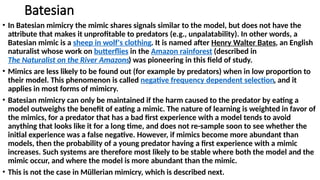
Batesian
• In Batesianmimicry the mimic shares signals similar to the model, but does not have the
attribute that makes it unprofitable to predators (e.g., unpalatability). In other words, a
Batesian mimic is a sheep in wolf's clothing. It is named after Henry Walter Bates, an English
naturalist whose work on butterflies in the Amazon rainforest (described in
The Naturalist on the River Amazons) was pioneering in this field of study.
• Mimics are less likely to be found out (for example by predators) when in low proportion to
their model. This phenomenon is called negative frequency dependent selection, and it
applies in most forms of mimicry.
• Batesian mimicry can only be maintained if the harm caused to the predator by eating a
model outweighs the benefit of eating a mimic. The nature of learning is weighted in favor of
the mimics, for a predator that has a bad first experience with a model tends to avoid
anything that looks like it for a long time, and does not re-sample soon to see whether the
initial experience was a false negative. However, if mimics become more abundant than
models, then the probability of a young predator having a first experience with a mimic
increases. Such systems are therefore most likely to be stable where both the model and the
mimic occur, and where the model is more abundant than the mimic.
• This is not the case in Müllerian mimicry, which is described next.
• There aremany Batesian mimics in the order Lepidoptera. Consul fabius and Eresia
eunice imitate unpalatable Heliconiusbutterflies such as H. ismenius.[28]
Limenitis
arthemis imitate the poisonous pipeline swallowtail (Battus philenor). Several
palatable moths produce ultrasonic click calls to mimic unpalatable tiger moths.
• Octopuses of the genus Thaumoctopus (the mimic octopus) are able to intentionally
alter their body shape and coloration to resemble dangerous sea snakes or lionfish.
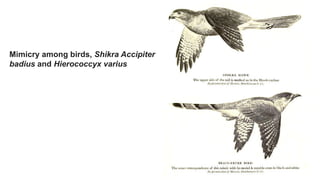
• In the Amazon, the helmeted woodpecker (Dryocopus galeatus), a rare species which
lives in the Atlantic Forest of Brazil, Paraguay, and Argentina, has a similar red crest,
black back, and barred underside to two larger woodpeckers: Dryocopus lineatus and
Campephilus robustus. This mimicry reduces attacks on Dryocopus galeatus from
other animals. Scientists had falsely believed that D. galeatus was a close cousin of
the other two species, because of the visual similarity, and because the three species
live in the same habitat and eat similar food.
• Batesian mimicry also occurs in the plant kingdom, such as the chameleon vine, which
adapts its leaf shape and colour to match that of the plant it is climbing, such that its
edible leaves appear to be the less desirable leaves of its host.
10.
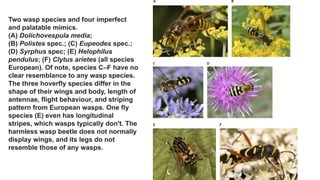
Two wasp speciesand four imperfect
and palatable mimics.
(A) Dolichovespula media;
(B) Polistes spec.; (C) Eupeodes spec.;
(D) Syrphus spec; (E) Helophilus
pendulus; (F) Clytus arietes (all species
European). Of note, species C–F have no
clear resemblance to any wasp species.
The three hoverfly species differ in the
shape of their wings and body, length of
antennae, flight behaviour, and striping
pattern from European wasps. One fly
species (E) even has longitudinal
stripes, which wasps typically don't. The
harmless wasp beetle does not normally
display wings, and its legs do not
resemble those of any wasps.
11.
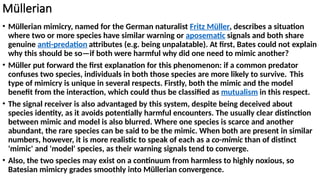
Müllerian
• Müllerian mimicry,named for the German naturalist Fritz Müller, describes a situation
where two or more species have similar warning or aposematic signals and both share
genuine anti-predation attributes (e.g. being unpalatable). At first, Bates could not explain
why this should be so—if both were harmful why did one need to mimic another?
• Müller put forward the first explanation for this phenomenon: if a common predator
confuses two species, individuals in both those species are more likely to survive. This
type of mimicry is unique in several respects. Firstly, both the mimic and the model
benefit from the interaction, which could thus be classified as mutualism in this respect.
• The signal receiver is also advantaged by this system, despite being deceived about
species identity, as it avoids potentially harmful encounters. The usually clear distinction
between mimic and model is also blurred. Where one species is scarce and another
abundant, the rare species can be said to be the mimic. When both are present in similar
numbers, however, it is more realistic to speak of each as a co-mimic than of distinct
'mimic' and 'model' species, as their warning signals tend to converge.
• Also, the two species may exist on a continuum from harmless to highly noxious, so
Batesian mimicry grades smoothly into Müllerian convergence.
12.
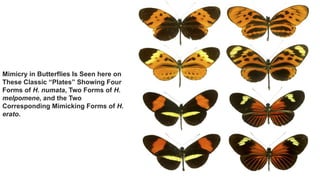
Mimicry in ButterfliesIs Seen here on
These Classic “Plates” Showing Four
Forms of H. numata, Two Forms of H.
melpomene, and the Two
Corresponding Mimicking Forms of H.
erato.
13.
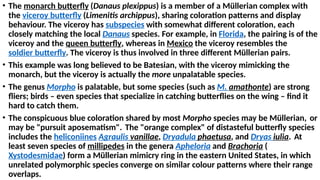
• The monarchbutterfly (Danaus plexippus) is a member of a Müllerian complex with
the viceroy butterfly (Limenitis archippus), sharing coloration patterns and display
behaviour. The viceroy has subspecies with somewhat different coloration, each
closely matching the local Danaus species. For example, in Florida, the pairing is of the
viceroy and the queen butterfly, whereas in Mexico the viceroy resembles the
soldier butterfly. The viceroy is thus involved in three different Müllerian pairs.
• This example was long believed to be Batesian, with the viceroy mimicking the
monarch, but the viceroy is actually the more unpalatable species.
• The genus Morpho is palatable, but some species (such as M. amathonte) are strong
fliers; birds – even species that specialize in catching butterflies on the wing – find it
hard to catch them.
• The conspicuous blue coloration shared by most Morpho species may be Müllerian, or
may be "pursuit aposematism". The "orange complex" of distasteful butterfly species
includes the heliconiines Agraulis vanillae, Dryadula phaetusa, and Dryas iulia. At
least seven species of millipedes in the genera Apheloria and Brachoria (
Xystodesmidae) form a Müllerian mimicry ring in the eastern United States, in which
unrelated polymorphic species converge on similar colour patterns where their range
overlaps.
Emsleyan/Mertensian
• Emsleyan[8]
or Mertensianmimicry describes the unusual case where a deadly prey mimics a
less dangerous species. It was first proposed by M. G. Emsley as a possible answer for the
theoretical difficulties a predator species faces when associating an aposematic phenotype of
potentially dangerous animals, such as the coral snake, with unprofitability when the
predator has an increased risk of death, negating any learned behaviour. The theory was
developed by the German biologist Wolfgang Wickler in a chapter of Mimicry in Plants and
Animals, who named it after the German herpetologist Robert Mertens.
• Sheppard points out that Hecht and Marien put forward a similar hypothesis ten years
earlier. This scenario is a little more difficult to understand, since in other types of mimicry it
is usually the most harmful species that is the model. But if a predator dies, it cannot learn to
recognize a warning signal, e.g., bright colours in a certain pattern. In other words, there is no
advantage in being aposematic for an organism that is likely to kill any predator it succeeds in
poisoning; such an animal is better off being camouflaged, to avoid attacks altogether.
• If, however, there were some other species that were harmful but not deadly as well as
aposematic, the predator could learn to recognize its particular warning colours and avoid
such animals. A deadly species could then profit by mimicking the less dangerous aposematic
organism if this reduces the number of attacks.
16.
Emsleyan/Mertensian
• The exceptionhere, ignoring any chance of animals learning by watching a conspecific die (see
Jouventin et al. for a discussion of observational learning and mimicry), is the possibility of not
having to learn that it is harmful in the first place: instinctive genetic programming to be wary of
certain signals. In this case, other organisms could benefit from this programming, and Batesian or
Müllerian mimics of it could potentially evolve.
• In fact, it has been shown that some species do have an innate recognition of certain aposematic
warnings. Hand-reared turquoise-browed motmots (Eumomota superciliosa), avian predators,
instinctively avoid snakes with red and yellow rings.
• Other colours with the same pattern, and even red and yellow stripes with the same width as
rings, were tolerated. However, models with red and yellow rings were feared, with the birds
flying away and giving alarm calls in some cases. This provides an alternative explanation to
Mertensian mimicry. See Greene and McDiarmid for a review of the subject.
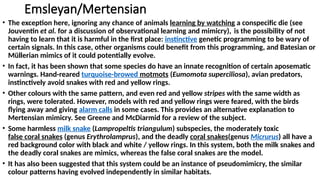
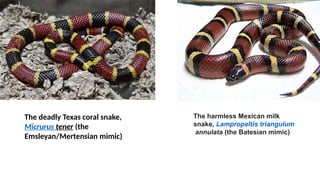
• Some harmless milk snake (Lampropeltis triangulum) subspecies, the moderately toxic
false coral snakes (genus Erythrolamprus), and the deadly coral snakes(genus Micrurus) all have a
red background color with black and white / yellow rings. In this system, both the milk snakes and
the deadly coral snakes are mimics, whereas the false coral snakes are the model.
• It has also been suggested that this system could be an instance of pseudomimicry, the similar
colour patterns having evolved independently in similar habitats.
17.
The deadly Texascoral snake,
Micrurus tener (the
Emsleyan/Mertensian mimic)
The harmless Mexican milk
snake, Lampropeltis triangulum
annulata (the Batesian mimic)
18.
Wasmannian
• In Wasmannianmimicry, the mimic resembles a model that it lives along with in
a nest or colony.
• Most of the models here are social insects such as ants, termites, bees and
wasps.
19.
Vavilovian
• Vavilovian mimicryis found in weeds that come to share characteristics with a domesticated plant
through artificial selection.[8]
It is named after Russian botanist and geneticist Nikolai Vavilov. Selection
against the weed may occur either by manually killing the weed, or by separating its seeds from those of
the crop by winnowing.
• Vavilovian mimicry presents an illustration of unintentional (or rather 'anti-intentional')
selection by man. Weeders do not want to select weeds and their seeds that look increasingly like
cultivated plants, yet there is no other option. For example, early barnyard grass, Echinochloa oryzoides,
is a weed in rice fields and looks similar to rice; its seeds are often mixed in rice and have become
difficult to separate through Vavilovian mimicry.[54]
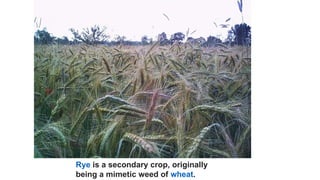
Vavilovian mimics may eventually be domesticated
themselves, as in the case of rye in wheat; Vavilov called these weed-crops secondary crops.
• Vavilovian mimicry can be classified as defensive mimicry, in that the weed mimics a protected species.
This bears strong similarity to Batesian mimicry in that the weed does not share the properties that give
the model its protection, and both the model and the dupe (in this case people) are harmed by its
presence. There are some key differences, though; in Batesian mimicry, the model and signal receiver
are enemies (the predator would eat the protected species if it could), whereas here the crop and its
human growers are in a mutualistic relationship: the crop benefits from being dispersed and protected
by people, despite being eaten by them. In fact, the crop's only "protection" relevant here is its
usefulness to humans. Secondly, the weed is not eaten, but simply destroyed. The only motivation for
killing the weed is its effect on crop yields. Finally, this type of mimicry does not occur in ecosystems
unaltered by humans.
20.
Rye is asecondary crop, originally
being a mimetic weed of wheat.
21.
Gilbertian
• Gilbertian mimicryinvolves only two species. The potential host (or prey) drives away
its parasite (or predator) by mimicking it, the reverse of host-parasite aggressive
mimicry. It was coined by Pasteur as a phrase for such rare mimicry systems, and is
named after the American ecologist Lawrence E. Gilbert.
• Gilbertian mimicry occurs in the genus Passiflora. The leaves of this plant contain
toxins that deter herbivorous animals. However, some Heliconius butterfly larvae have
evolved enzymes that break down these toxins, allowing them to specialize on this
genus. This has created further selection pressure on the host plants, which have
evolved stipules that mimic mature Heliconius eggs near the point of hatching. These
butterflies tend to avoid laying eggs near existing ones, which helps avoid exploitative
intraspecific competition between caterpillars — those that lay on vacant leaves
provide their offspring with a greater chance of survival. Most Heliconius larvae are
cannibalistic, meaning that on leaves older eggs hatch first and eat the new arrivals.
Thus, it seems that such plants have evolved egg dummies under selection pressure
from these grazing herbivore enemies. In addition, the decoy eggs are also nectaries,
attracting predators of the caterpillars such as ants and wasps as a further defence.
22.
Browerian
• Browerian mimicry,named after Lincoln P. Brower and Jane Van Zandt Brower, is
a postulated form of automimicry; where the model belongs to the same species
as the mimic. This is the analogue of Batesian mimicry within a single species,
and occurs when there is a palatability spectrum within a population. Examples
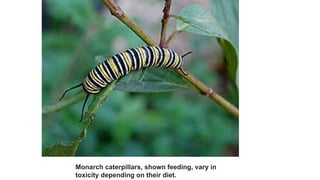
include the monarch and the queen from the Danainae subfamily, which feed on
milkweed species of varying toxicity. These species store toxins from its host
plant, which are maintained even in the adult (imago) form. As levels of toxin
vary depending on diet during the larval stage, some individuals are more toxic
than others. Less palatable organisms, therefore, mimic more dangerous
individuals, with their likeness already perfected.
• This is not always the case, however. In sexually dimorphic species, one sex may
be more of a threat than the other, which could mimic the protected sex.
Evidence for this possibility is provided by the behaviour of a monkey from
Gabon, which regularly ate male moths of the genus Anaphe, but promptly
stopped after it tasted a noxious female.
Aggressive
• Predators
• Aggressivemimicry is found in predators or parasites that share some of the
characteristics of a harmless species, allowing them to avoid detection by their
prey or host; this can be compared with the story of the wolf in sheep's clothing
as long as it is understood that no conscious deceptive intent is involved.
• The mimic may resemble the prey or host itself, or another organism that is either
neutral or beneficial to the signal receiver. In this class of mimicry, the model may
be affected negatively, positively or not at all.
• Just as parasites can be treated as a form of predator, host-parasite mimicry is
treated here as a subclass of aggressive mimicry.
25.
• The mimicmay have a particular significance for duped prey. One such case is spiders, amongst
which aggressive mimicry is quite common both in luring prey and disguising stealthily
approaching predators.
• One case is the golden orb weaver (Nephila clavipes), which spins a conspicuous golden colored
web in well-lit areas.
• Experiments show that bees are able to associate the webs with danger when the yellow pigment
is not present, as occurs in less well-lit areas where the web is much harder to see.
• Other colours were also learned and avoided, but bees seemed least able to effectively associate
yellow-pigmented webs with danger.
• Yellow is the colour of many nectar-bearing flowers, however, so perhaps avoiding yellow is not
worthwhile.
• Another form of mimicry is based not on colour but pattern. Species such as the silver argiope (
Argiope argentata) employ prominent patterns in the middle of their webs, such as zigzags.
• These may reflect ultraviolet light, and mimic the pattern seen in many flowers known as
nectar guides.
• Spiders change their web day to day, which can be explained by the ability of bees to remember
web patterns.
• Bees are able to associate a certain pattern with a spatial location, meaning the spider must spin a
new pattern regularly or suffer diminishing prey capture.
26.
• A caseof the latter situation is a species of cleaner fish and its mimic, though in this example
the model is greatly disadvantaged by the presence of the mimic.
• Cleaner fish are the allies of many other species, which allow them to eat their parasites and
dead skin.
• Some allow the cleaner to venture inside their body to hunt these parasites.
• However, one species of cleaner, the bluestreak cleaner wrasse(Labroides dimidiatus), is the
unknowing model of a mimetic species, the sabre-toothed blenny (Aspidontus taeniatus).
• This wrasse resides in coral reefs in the Indianand the Pacific Oceans, and is recognized by
other fishes that then let it clean them.
• Its imposter, a species of blenny, lives in the Indian Ocean—and not only looks like it in terms
of size and coloration, but even mimics the cleaner's "dance".
• Having fooled its prey into letting its guard down, it then bites it, tearing off a piece of its fin
before fleeing.
• Fish grazed on in this fashion soon learn to distinguish mimic from model, but because the
similarity is close between the two they become much more cautious of the model as well, so
both are affected.
• Due to victims' ability to discriminate between foe and helper, the blennies have evolved
close similarity, right down to the regional level.
27.
• Another interestingexample that does not involve any luring is the
zone-tailed hawk, which resembles the turkey vulture.
• It flies amongst the vultures, suddenly breaking from the formation
and ambushing its prey.
• Here the hawk's presence is of no evident significance to the
vultures, affecting them neither negatively or positively.
28.
Parasites
• Parasites canalso be aggressive mimics, though the situation is somewhat different from those outlined
previously.
• Some predators have a feature that draws prey; parasites can also mimic their hosts' natural prey, but are
eaten themselves, a pathway into their host.
• Leucochloridium, a genus of flatworm, matures in the digestive system of songbirds, their eggs then passing
out of the bird in the faeces.
• They are then taken up by Succinea, a terrestrial snail. The eggs develop in this intermediate host, and must
then find a suitable bird to mature in.
• Since the host birds do not eat snails, the sporocyst has another strategy to reach its host's intestine.
• They are brightly coloured and move in a pulsating fashion.
• A sporocyst-sac pulsates in the snail's eye stalks,[69][70]
coming to resemble an irresistible meal for a songbird.
In this way, it can bridge the gap between hosts, allowing it to complete its life cycle.
• A nematode (Myrmeconema neotropicum) changes the colour of the abdomen of workers of the canopy
ant Cephalotes atratus to make it appear like the ripe fruits of Hyeronima alchorneoides.
• It also changes the behaviour of the ant so that the gaster (rear part) is held raised.
• This presumably increases the chances of the ant being eaten by birds.
• The droppings of birds are collected by other ants and fed to their brood, thereby helping to spread the
nematode.
29.
• In anunusual case, planidium larvae of some beetles of the genus
Meloe form a group and produce a pheromone that mimics the sex
attractant of its host bee species.
• When a male bee arrives and attempts to mate with the mass of
larvae, they climb onto his abdomen.
• From there, they transfer to a female bee, and from there to the bee
nest to parasitize the bee larvae.
30.
• Host-parasite mimicryis a two species system where a parasite mimics its own host.
• Cuckoos are a canonical example of brood parasitism, a form of parasitism where the mother
has its offspring raised by another unwitting individual, often from a different species, cutting
down the biological mother's parental investment in the process.
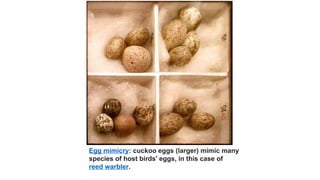
• The ability to lay eggs that mimic the host eggs is the key adaptation.
• The adaptation to different hosts is inherited through the female line in so-called gentes
(gens, singular).
• Cases of intraspecific brood parasitism, where a female lays in a conspecific's nest, as
illustrated by the goldeneye duck (Bucephala clangula), do not represent a case of mimicry.
• A different mechanism is chemical mimicry, as seen in the parasitic butterfly Phengaris rebeli,
which parasitizes the ant species Myrmica schencki by releasing chemicals that fool the
worker ants to believe that the caterpillar larvae are ant larvae, and enable the P. rebeli larvae
to be brought directly into the M. schencki nest.
• Parasitic (cuckoo) bumblebees (formerly Psithyrus, now included in Bombus) resemble their
hosts more closely than would be expected by chance, at least in areas like Europe where
parasite-host co-speciation is common.
• However, this is explainable as Müllerian mimicry, rather than requiring the parasite's
coloration to deceive the host and thus constitute aggressive mimicry.
31.
Egg mimicry: cuckooeggs (larger) mimic many
species of host birds' eggs, in this case of
reed warbler.
32.
Reproductive
• Reproductive mimicryoccurs when the actions of the dupe directly aid in the
mimic's reproduction.
• This is common in plants with deceptive flowers that do not provide the reward
they seem to offer and it may occur in Papua New Guinea fireflies, in which the
signal of Pteroptyx effulgens is used by P. tarsalis to form aggregations to
attract females.
• Other forms of mimicry have a reproductive component, such as Vavilovian
mimicry involving seeds, vocal mimicry in birds, and aggressive and Batesian
mimicry in brood parasite-host systems.
33.
Flowers
• Bakerian mimicry,named after Herbert G. Baker, is a form of automimicry where female
flowers mimic male flowers of their own species, cheating pollinators out of a reward.
• This reproductive mimicry may not be readily apparent as members of the same species may
still exhibit some degree of sexual dimorphism. It is common in many species of Caricaceae.
• Like Bakerian mimicry, Dodsonian mimicry is a form of reproductive floral mimicry, but the
model belongs to a different species than the mimic.
• The name refers to Calaway H. Dodson.
• By providing similar sensory signals as the model flower, it can lure its pollinators.
• Like Bakerian mimics, no nectar is provided. Epidendrum ibaguense (Orchidaceae) resembles
flowers of Lantana camara and Asclepias curassavica, and is pollinated by monarch butterflies
and perhaps hummingbirds.
• Similar cases are seen in some other species of the same family.
• The mimetic species may still have pollinators of its own though. For example, a
lamellicorn beetle, which usually pollinates correspondingly colored Cistus flowers, is also
known to aid in pollination of Ophrys species that are normally pollinated by bees.
34.
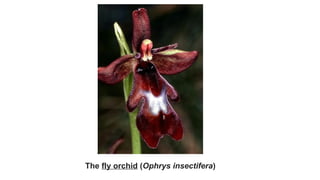
Pseudocopulation
• Pseudocopulation occurswhen a flower mimics a female of a certain insect species,
inducing the males to try to copulate with the flower.
• This is much like the aggressive mimicry in fireflies described previously, but with a
more benign outcome for the pollinator.
• This form of mimicry has been called Pouyannian mimicry, after
Maurice-Alexandre Pouyanne, who first described the phenomenon.
• It is most common in orchids, which mimic females of the order Hymenoptera
(generally bees and wasps), and may account for around 60% of pollinations.
• Depending on the morphology of the flower, a pollen sac called a pollinia is
attached to the head or abdomen of the male.
• This is then transferred to the stigma of the next flower the male tries to
inseminate, resulting in pollination.
• Visual mimicry is the most obvious sign of this deception for humans, but the visual
aspect may be minor or non-existent.
Automimicry
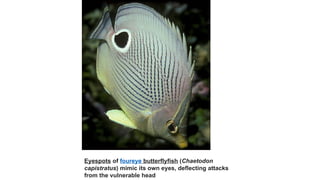
• Automimicry orintraspecific mimicry occurs within a single species. One
form of such mimicry is where one part of an organism's body resembles
another part. For example, the tails of some snakes resemble their heads;
they move backwards when threatened and present the predator with the
tail, improving their chances of escape without fatal harm. Some fishes
have eyespots near their tails, and when mildly alarmed swim slowly
backwards, presenting the tail as a head. Some insects such as some
lycaenidbutterflies have tail patterns and appendages of various degrees of
sophistication that promote attacks at the rear rather than at the head.
Several species of pygmy owl bear "false eyes" on the back of the head,
misleading predators into reacting as though they were the subject of an
aggressive stare.
37.
Eyespots of foureyebutterflyfish (Chaetodon
capistratus) mimic its own eyes, deflecting attacks
from the vulnerable head
38.
• Some writersuse the term "automimicry" when the mimic imitates
other morphs within the same species.
• For example, in a species where males mimic females or vice versa,
this may be an instance of sexual mimicry in
evolutionary game theory.
• Examples are found in some species of birds, fishes, and lizards.
• Quite elaborate strategies along these lines are known, such as the
well-known "scissors, paper, rock" mimicry in Uta stansburiana, but
there are qualitatively different examples in many other species,
such as some Platysaurus.
39.
• Many speciesof insects are toxic or distasteful when they have fed on certain
plants that contain chemicals of particular classes, but not when they have fed on
plants that lack those chemicals.
• For instance, some species of the subfamily Danainae feed on various species of
the Asclepiadoideae in the family Apocynaceae, which render them poisonous and
emetic to most predators.
• Such insects frequently are aposematically coloured and patterned.
• When feeding on innocuous plants however, they are harmless and nutritious, but
a bird that once has sampled a toxic specimen is unlikely to eat harmless
specimens that have the same aposematic coloration.
• When regarded as mimicry of toxic members of the same species, this too may be
seen as automimicry.
40.
• Some speciesof caterpillar, such as many hawkmoths (Sphingidae), have
eyespots on their anterior abdominal segments.
• When alarmed, they retract the head and the thoracic segments into the body,
leaving the apparently threatening large eyes at the front of the visible part of
the body.
• Many insects have filamentous "tails" at the ends of their wings and patterns of
markings on the wings themselves.
• These combine to create a "false head".
• This misdirects predators such as birds and jumping spiders (Salticidae).
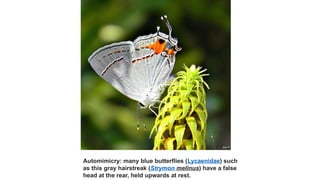
• Spectacular examples occur in the hairstreak butterflies; when perching on a
twig or flower, they commonly do so upside down and shift their rear wings
repeatedly, causing antenna-like movements of the "tails" on their wings.
• Studies of rear-wing damage support the hypothesis that this strategy is
effective in deflecting attacks from the insect's head.
41.
Automimicry: many bluebutterflies (Lycaenidae) such
as this gray hairstreak (Strymon melinus) have a false
head at the rear, held upwards at rest.
42.
Other forms
• Someforms of mimicry do not fit easily within the classification given above.[101]
Floral
mimicry is induced by the discomycete fungusMonilinia vaccinii-corymbosi.
• In this unusual case, a fungal plant pathogen infects leaves of blueberries, causing them
to secrete sugars, in effect mimicking the nectar of flowers.
• To the naked eye the leaves do not look like flowers, yet they still attract pollinating
insects like bees using an ultraviolet signal.
• This case is unusual, in that the fungus benefits from the deception but it is the leaves
that act as mimics, being harmed in the process.
• It is similar to host-parasite mimicry, but the host does not receive the signal. It has a
little in common with automimicry, but the plant does not benefit from the mimicry, and
the action of the pathogen is required to produce it.
![• In evolutionary biology, mimicry is an evolved resemblance between an organism and another
object, often an organism of another species. Mimicry may evolve between different species, or
between individuals of the same species. Often, mimicry functions to protect a species from
predators, making it an antipredator adaptation.
• Mimicry evolves if a receiver (such as a predator) perceives the similarity between a mimic (the
organism that has a resemblance) and a model (the organism it resembles) and as a result changes its
behaviour in a way that provides a selective advantage to the mimic.
• The resemblances that evolve in mimicry can be visual, acoustic, chemical, tactile, or electric, or
combinations of these sensory modalities.
• Mimicry may be to the advantage of both organisms that share a resemblance, in which case it is a
form of mutualism; or mimicry can be to the detriment of one, making it parasitic or competitive.
The evolutionary convergence between groups is driven by the selective action of a signal-receiver or
dupe.
• Birds, for example, use sight to identify palatable insects, whilst avoiding the noxious ones. Over
time, palatable insects may evolve to resemble noxious ones, making them mimics and the noxious
ones models. In the case of mutualism, sometimes both groups are referred to as "co-mimics". It is
often thought that models must be more abundant than mimics, but this is not so.[5]
Mimicry may
involve numerous species; many harmless species such as hoverflies are Batesian mimics of strongly
defended species such as wasps, while many such well-defended species form Mullerian mimicry
rings, all resembling each other. Mimicry between prey species and their predators often involves
three or more species.](https://image.slidesharecdn.com/10-mimicrytypesandevolutionaryimportance-250506133858-1e6b4b87/85/10-Mimicry-Types-and-evolutionary-importance-pptx-2-320.jpg)
![• In its broadest definition, mimicry can include non-living models. The specific
terms masquerade and mimesis are sometimes used when the models are
inanimate.[7][3][8]
For example, animals such as flower mantises, planthoppers,
comma and geometer moth caterpillars resemble twigs, bark, leaves, bird
droppings or flowers.
• Many animals bear eyespots, which are hypothesized to resemble the eyes of
larger animals. They may not resemble any specific organism's eyes, and
whether or not animals respond to them as eyes is also unclear.
• Nonetheless, eyespots are the subject of a rich contemporary literature.
• The model is usually another species, except in automimicry, where members
of the species mimic other members, or other parts of their own bodies, and in
inter-sexual mimicry, where members of one sex mimic members of the other.[5]](https://image.slidesharecdn.com/10-mimicrytypesandevolutionaryimportance-250506133858-1e6b4b87/85/10-Mimicry-Types-and-evolutionary-importance-pptx-3-320.jpg)
![• There are many Batesian mimics in the order Lepidoptera. Consul fabius and Eresia
eunice imitate unpalatable Heliconiusbutterflies such as H. ismenius.[28]
Limenitis
arthemis imitate the poisonous pipeline swallowtail (Battus philenor). Several
palatable moths produce ultrasonic click calls to mimic unpalatable tiger moths.
• Octopuses of the genus Thaumoctopus (the mimic octopus) are able to intentionally
alter their body shape and coloration to resemble dangerous sea snakes or lionfish.
• In the Amazon, the helmeted woodpecker (Dryocopus galeatus), a rare species which
lives in the Atlantic Forest of Brazil, Paraguay, and Argentina, has a similar red crest,
black back, and barred underside to two larger woodpeckers: Dryocopus lineatus and
Campephilus robustus. This mimicry reduces attacks on Dryocopus galeatus from
other animals. Scientists had falsely believed that D. galeatus was a close cousin of
the other two species, because of the visual similarity, and because the three species
live in the same habitat and eat similar food.
• Batesian mimicry also occurs in the plant kingdom, such as the chameleon vine, which
adapts its leaf shape and colour to match that of the plant it is climbing, such that its
edible leaves appear to be the less desirable leaves of its host.](https://image.slidesharecdn.com/10-mimicrytypesandevolutionaryimportance-250506133858-1e6b4b87/85/10-Mimicry-Types-and-evolutionary-importance-pptx-9-320.jpg)
![Emsleyan/Mertensian
• Emsleyan[8]
or Mertensian mimicry describes the unusual case where a deadly prey mimics a
less dangerous species. It was first proposed by M. G. Emsley as a possible answer for the
theoretical difficulties a predator species faces when associating an aposematic phenotype of
potentially dangerous animals, such as the coral snake, with unprofitability when the
predator has an increased risk of death, negating any learned behaviour. The theory was
developed by the German biologist Wolfgang Wickler in a chapter of Mimicry in Plants and
Animals, who named it after the German herpetologist Robert Mertens.
• Sheppard points out that Hecht and Marien put forward a similar hypothesis ten years
earlier. This scenario is a little more difficult to understand, since in other types of mimicry it
is usually the most harmful species that is the model. But if a predator dies, it cannot learn to
recognize a warning signal, e.g., bright colours in a certain pattern. In other words, there is no
advantage in being aposematic for an organism that is likely to kill any predator it succeeds in
poisoning; such an animal is better off being camouflaged, to avoid attacks altogether.
• If, however, there were some other species that were harmful but not deadly as well as
aposematic, the predator could learn to recognize its particular warning colours and avoid
such animals. A deadly species could then profit by mimicking the less dangerous aposematic
organism if this reduces the number of attacks.](https://image.slidesharecdn.com/10-mimicrytypesandevolutionaryimportance-250506133858-1e6b4b87/85/10-Mimicry-Types-and-evolutionary-importance-pptx-15-320.jpg)
![Vavilovian
• Vavilovian mimicry is found in weeds that come to share characteristics with a domesticated plant
through artificial selection.[8]
It is named after Russian botanist and geneticist Nikolai Vavilov. Selection
against the weed may occur either by manually killing the weed, or by separating its seeds from those of
the crop by winnowing.
• Vavilovian mimicry presents an illustration of unintentional (or rather 'anti-intentional')
selection by man. Weeders do not want to select weeds and their seeds that look increasingly like
cultivated plants, yet there is no other option. For example, early barnyard grass, Echinochloa oryzoides,
is a weed in rice fields and looks similar to rice; its seeds are often mixed in rice and have become
difficult to separate through Vavilovian mimicry.[54]
Vavilovian mimics may eventually be domesticated
themselves, as in the case of rye in wheat; Vavilov called these weed-crops secondary crops.
• Vavilovian mimicry can be classified as defensive mimicry, in that the weed mimics a protected species.
This bears strong similarity to Batesian mimicry in that the weed does not share the properties that give
the model its protection, and both the model and the dupe (in this case people) are harmed by its
presence. There are some key differences, though; in Batesian mimicry, the model and signal receiver
are enemies (the predator would eat the protected species if it could), whereas here the crop and its
human growers are in a mutualistic relationship: the crop benefits from being dispersed and protected
by people, despite being eaten by them. In fact, the crop's only "protection" relevant here is its
usefulness to humans. Secondly, the weed is not eaten, but simply destroyed. The only motivation for
killing the weed is its effect on crop yields. Finally, this type of mimicry does not occur in ecosystems
unaltered by humans.](https://image.slidesharecdn.com/10-mimicrytypesandevolutionaryimportance-250506133858-1e6b4b87/85/10-Mimicry-Types-and-evolutionary-importance-pptx-19-320.jpg)
![Parasites
• Parasites can also be aggressive mimics, though the situation is somewhat different from those outlined
previously.
• Some predators have a feature that draws prey; parasites can also mimic their hosts' natural prey, but are
eaten themselves, a pathway into their host.
• Leucochloridium, a genus of flatworm, matures in the digestive system of songbirds, their eggs then passing
out of the bird in the faeces.
• They are then taken up by Succinea, a terrestrial snail. The eggs develop in this intermediate host, and must
then find a suitable bird to mature in.
• Since the host birds do not eat snails, the sporocyst has another strategy to reach its host's intestine.
• They are brightly coloured and move in a pulsating fashion.
• A sporocyst-sac pulsates in the snail's eye stalks,[69][70]
coming to resemble an irresistible meal for a songbird.
In this way, it can bridge the gap between hosts, allowing it to complete its life cycle.
• A nematode (Myrmeconema neotropicum) changes the colour of the abdomen of workers of the canopy
ant Cephalotes atratus to make it appear like the ripe fruits of Hyeronima alchorneoides.
• It also changes the behaviour of the ant so that the gaster (rear part) is held raised.
• This presumably increases the chances of the ant being eaten by birds.
• The droppings of birds are collected by other ants and fed to their brood, thereby helping to spread the
nematode.](https://image.slidesharecdn.com/10-mimicrytypesandevolutionaryimportance-250506133858-1e6b4b87/85/10-Mimicry-Types-and-evolutionary-importance-pptx-28-320.jpg)
![Other forms
• Some forms of mimicry do not fit easily within the classification given above.[101]
Floral
mimicry is induced by the discomycete fungusMonilinia vaccinii-corymbosi.
• In this unusual case, a fungal plant pathogen infects leaves of blueberries, causing them
to secrete sugars, in effect mimicking the nectar of flowers.
• To the naked eye the leaves do not look like flowers, yet they still attract pollinating
insects like bees using an ultraviolet signal.
• This case is unusual, in that the fungus benefits from the deception but it is the leaves
that act as mimics, being harmed in the process.
• It is similar to host-parasite mimicry, but the host does not receive the signal. It has a
little in common with automimicry, but the plant does not benefit from the mimicry, and
the action of the pathogen is required to produce it.](https://image.slidesharecdn.com/10-mimicrytypesandevolutionaryimportance-250506133858-1e6b4b87/85/10-Mimicry-Types-and-evolutionary-importance-pptx-42-320.jpg)


