University of agricultural sciences Raichur
ENT-504 Insect ecology
Mimicry in insects
Submitted to:
Dr. shivaleela
Assistant professor
Dept. of entomology presented by:
Coa, Raichur gayatri
Flow of
presentation
INTRODUCTION
Mimicry and its types
Examples of mimicry
Case study
conclusion
Introduction
Mimicry is an evolved resemblance between an organism and another object, often an organism
of another species. Mimicry may evolve between different species, or between individuals of the
same species .
Mimicry evolves if a receiver (such as a predator) perceives the similarity between a mimic (the
organism that has a resemblance) and a model (the organism it resembles) and as a result
changes its behavior in a way that provides a selective advantage to the mimic .
The resemblances that evolve in mimicry can be visual, acoustic, chemical, tactile, or electric, or
combinations of these sensory modalities . Mimicry may be to the advantage of both organisms
that share a resemblance, in which case it is a form of mutualism
2023 Mimicry in insects 3
https://en.Wikipedia.org/wiki/mimi
cry
Mimicry
Mimicry is the process by which one species of
organism, the mimic, copies the appearance of another
species, the model. The mimic may resemble the
model in color, shape, size, or behavior.
The model is usually not harmful to the mimic, but the
mimic may have evolved to look like the model in order
to avoid being eaten or attacked.
Concept of mimicry was given by
Henry Walter Bates in 1862
https://infinitylearn.com/sur
ge/biology/mimicry/
Significance of mimicry
• The main significance of mimicry is to
protect the animals against enemies.
• Mimicry used for self defense which
increases the survival value of organisms.
20XX presentation title 5
1)Natural selection: According to
Weismann, the natural selection is the only
known factor in the production of mimicry.
2) Sharp sudden mutation and its
preservation by natural selection.
3) Due to the direct action occurred upon
the organism by food, moisture, cold etc.
4) Due to physiological response, such as
color sensation.
20XX presentation title 6
Causes of mimicry
1.Batesian mimicry
2.Mullerian mimicry
20XX presentation title 7
Types of mimicry
It is form of protective mimicry in which a
species that is edible or harmless closely
resembles an inedible or harmful species and
therefore is avoided by predators.
It is named after the English naturalist
Henry Walter Bates, after his work on
butterflies in the rainforests of Brazil.
2023 Mimicry in insects 8
Batesian mimicry
2023 Mimicry in insects 9
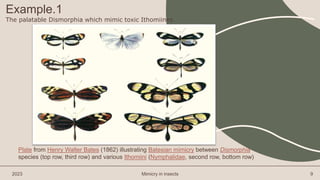
Example.1
The palatable Dismorphia which mimic toxic Ithomiines.
Plate from Henry Walter Bates (1862) illustrating Batesian mimicry between Dismorphia
species (top row, third row) and various Ithomiini (Nymphalidae, second row, bottom row)
2023 Mimicry in insects 10
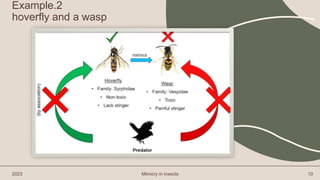
Example.2
hoverfly and a wasp
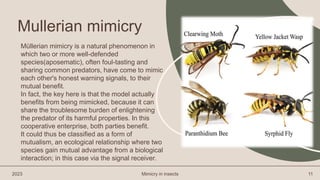
Müllerian mimicry is a natural phenomenon in
which two or more well-defended
species(aposematic), often foul-tasting and
sharing common predators, have come to mimic
each other's honest warning signals, to their
mutual benefit.
In fact, the key here is that the model actually
benefits from being mimicked, because it can
share the troublesome burden of enlightening
the predator of its harmful properties. In this
cooperative enterprise, both parties benefit.
It could thus be classified as a form of
mutualism, an ecological relationship where two
species gain mutual advantage from a biological
interaction; in this case via the signal receiver.
2023 Mimicry in insects 11
Mullerian mimicry
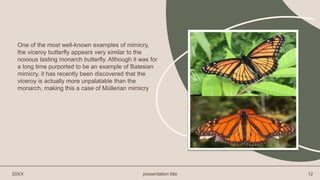
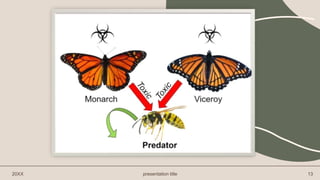
One of the most well-known examples of mimicry,
the viceroy butterfly appears very similar to the
noxious tasting monarch butterfly. Although it was for
a long time purported to be an example of Batesian
mimicry, it has recently been discovered that the
viceroy is actually more unpalatable than the
monarch, making this a case of Müllerian mimicry
20XX presentation title 12
20XX presentation title 13
20XX presentation title 14
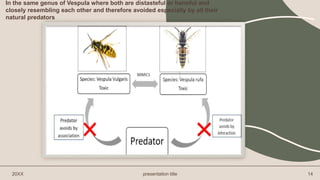
In the same genus of Vespula where both are distasteful or harmful and
closely resembling each other and therefore avoided especially by all their
natural predators
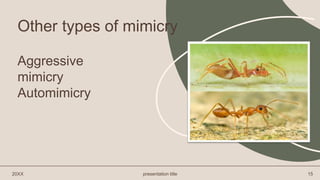
Aggressive
mimicry
Automimicry
20XX presentation title 15
Other types of mimicry
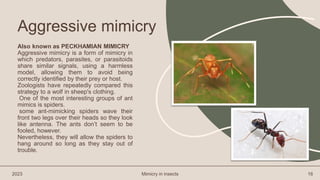
Also known as PECKHAMIAN MIMICRY
Aggressive mimicry is a form of mimicry in
which predators, parasites, or parasitoids
share similar signals, using a harmless
model, allowing them to avoid being
correctly identified by their prey or host.
Zoologists have repeatedly compared this
strategy to a wolf in sheep's clothing.
One of the most interesting groups of ant
mimics is spiders.
some ant-mimicking spiders wave their
front two legs over their heads so they look
like antenna. The ants don’t seem to be
fooled, however.
Nevertheless, they will allow the spiders to
hang around so long as they stay out of
trouble.
2023 Mimicry in insects 16
Aggressive mimicry
The automimicry (also known as
intraspecific mimicry) is a special case
of mimicry that takes place when an
organism transforms some part of
its body in order to seems like
another part of its own body or even
of the body of another member of
its species (e.g. a male that mimics a
trait from females).
The objectives of this type of mimicry
are to obtain some benefit from other
organisms or maybe to be unnoticed
by their predators or preys.
20XX presentation title 17
Automimicry
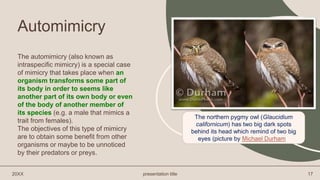
The northern pygmy owl (Glaucidium
californicum) has two big dark spots
behind its head which remind of two big
eyes (picture by Michael Durham).
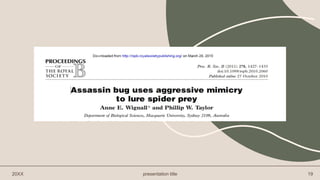
Case study
20XX presentation title 19
20XX presentation title 20
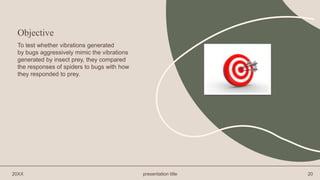
To test whether vibrations generated
by bugs aggressively mimic the vibrations
generated by insect prey, they compared
the responses of spiders to bugs with how
they responded to prey.
Objective
They collected juvenile and adult bugs from Macquarie
University grounds on the day before testing.
vinegar fly maintained in laboratory cultures, and Aphids that
is often found in the webs of Achaearanea sp. in nature .
For recording techniques they used sound-attenuating
chamber (1.8 1.8 2 m) on a vibration-isolating table
(Kinetic Systems, USA) under full spectrum lighting and
fishers exact test.
2023 Mimicry in insects 21
Materials and Methods
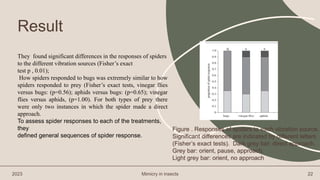
They found significant differences in the responses of spiders
to the different vibration sources (Fisher’s exact
test p , 0.01);
How spiders responded to bugs was extremely similar to how
spiders responded to prey (Fisher’s exact tests, vinegar flies
versus bugs: (p=0.56); aphids versus bugs: (p=0.65); vinegar
flies versus aphids, (p=1.00). For both types of prey there
were only two instances in which the spider made a direct
approach.
To assess spider responses to each of the treatments,
they
defined general sequences of spider response.
2023 Mimicry in insects 22
Result
Figure . Responses of spiders to each vibration source.
Significant differences are indicated by different letters
(Fisher’s exact tests). Dark grey bar: direct approach.
Grey bar: orient, pause, approach.
Light grey bar: orient, no approach
2023 Mimicry in insects 23
Figure 2. Representative waveforms of vibrations
generated by (a) bug plucking web, (b) single aphid
vibration making a small leg or body movement, (c)
single vinegar fly vibration making a small leg or body
movement,
(d) aphid impacting web, ( e) vinegar fly impacting web,
(i) aphid wing beats in web and ( j) vinegar fly wing beats
in web.
conclusion
Vibrations generated by bugs occupied a narrower
band of frequencies compared with the much more
variable
and often higher-frequency vibrations from both
types of prey. Rather than aggressively mimicking a
specific
prey model, bugs are best interpreted as general mimics
that exploit a bias in spiders to approach prey-like
vibrations in the web.
Overall aggressive mimicry is an intriguing phenomenon
in insect ecology that holds exceptional potential for
scientific research .
By studying aggressive mimicry, we can gain a better
understanding of the complex interactions between
species in their natural environments.
2023 Mimicry in insects 24
THANK YOU

Mimicry in insects (gak).pptx

  • 1.
    University of agriculturalsciences Raichur ENT-504 Insect ecology Mimicry in insects Submitted to: Dr. shivaleela Assistant professor Dept. of entomology presented by: Coa, Raichur gayatri
  • 2.
    Flow of presentation INTRODUCTION Mimicry andits types Examples of mimicry Case study conclusion
  • 3.
    Introduction Mimicry is anevolved resemblance between an organism and another object, often an organism of another species. Mimicry may evolve between different species, or between individuals of the same species . Mimicry evolves if a receiver (such as a predator) perceives the similarity between a mimic (the organism that has a resemblance) and a model (the organism it resembles) and as a result changes its behavior in a way that provides a selective advantage to the mimic . The resemblances that evolve in mimicry can be visual, acoustic, chemical, tactile, or electric, or combinations of these sensory modalities . Mimicry may be to the advantage of both organisms that share a resemblance, in which case it is a form of mutualism 2023 Mimicry in insects 3 https://en.Wikipedia.org/wiki/mimi cry
  • 4.
    Mimicry Mimicry is theprocess by which one species of organism, the mimic, copies the appearance of another species, the model. The mimic may resemble the model in color, shape, size, or behavior. The model is usually not harmful to the mimic, but the mimic may have evolved to look like the model in order to avoid being eaten or attacked. Concept of mimicry was given by Henry Walter Bates in 1862 https://infinitylearn.com/sur ge/biology/mimicry/
  • 5.
    Significance of mimicry •The main significance of mimicry is to protect the animals against enemies. • Mimicry used for self defense which increases the survival value of organisms. 20XX presentation title 5
  • 6.
    1)Natural selection: Accordingto Weismann, the natural selection is the only known factor in the production of mimicry. 2) Sharp sudden mutation and its preservation by natural selection. 3) Due to the direct action occurred upon the organism by food, moisture, cold etc. 4) Due to physiological response, such as color sensation. 20XX presentation title 6 Causes of mimicry
  • 7.
    1.Batesian mimicry 2.Mullerian mimicry 20XXpresentation title 7 Types of mimicry
  • 8.
    It is formof protective mimicry in which a species that is edible or harmless closely resembles an inedible or harmful species and therefore is avoided by predators. It is named after the English naturalist Henry Walter Bates, after his work on butterflies in the rainforests of Brazil. 2023 Mimicry in insects 8 Batesian mimicry
  • 9.
    2023 Mimicry ininsects 9 Example.1 The palatable Dismorphia which mimic toxic Ithomiines. Plate from Henry Walter Bates (1862) illustrating Batesian mimicry between Dismorphia species (top row, third row) and various Ithomiini (Nymphalidae, second row, bottom row)
  • 10.
    2023 Mimicry ininsects 10 Example.2 hoverfly and a wasp
  • 11.
    Müllerian mimicry isa natural phenomenon in which two or more well-defended species(aposematic), often foul-tasting and sharing common predators, have come to mimic each other's honest warning signals, to their mutual benefit. In fact, the key here is that the model actually benefits from being mimicked, because it can share the troublesome burden of enlightening the predator of its harmful properties. In this cooperative enterprise, both parties benefit. It could thus be classified as a form of mutualism, an ecological relationship where two species gain mutual advantage from a biological interaction; in this case via the signal receiver. 2023 Mimicry in insects 11 Mullerian mimicry
  • 12.
    One of themost well-known examples of mimicry, the viceroy butterfly appears very similar to the noxious tasting monarch butterfly. Although it was for a long time purported to be an example of Batesian mimicry, it has recently been discovered that the viceroy is actually more unpalatable than the monarch, making this a case of Müllerian mimicry 20XX presentation title 12
  • 13.
  • 14.
    20XX presentation title14 In the same genus of Vespula where both are distasteful or harmful and closely resembling each other and therefore avoided especially by all their natural predators
  • 15.
  • 16.
    Also known asPECKHAMIAN MIMICRY Aggressive mimicry is a form of mimicry in which predators, parasites, or parasitoids share similar signals, using a harmless model, allowing them to avoid being correctly identified by their prey or host. Zoologists have repeatedly compared this strategy to a wolf in sheep's clothing. One of the most interesting groups of ant mimics is spiders. some ant-mimicking spiders wave their front two legs over their heads so they look like antenna. The ants don’t seem to be fooled, however. Nevertheless, they will allow the spiders to hang around so long as they stay out of trouble. 2023 Mimicry in insects 16 Aggressive mimicry
  • 17.
    The automimicry (alsoknown as intraspecific mimicry) is a special case of mimicry that takes place when an organism transforms some part of its body in order to seems like another part of its own body or even of the body of another member of its species (e.g. a male that mimics a trait from females). The objectives of this type of mimicry are to obtain some benefit from other organisms or maybe to be unnoticed by their predators or preys. 20XX presentation title 17 Automimicry The northern pygmy owl (Glaucidium californicum) has two big dark spots behind its head which remind of two big eyes (picture by Michael Durham).
  • 18.
  • 19.
  • 20.
    20XX presentation title20 To test whether vibrations generated by bugs aggressively mimic the vibrations generated by insect prey, they compared the responses of spiders to bugs with how they responded to prey. Objective
  • 21.
    They collected juvenileand adult bugs from Macquarie University grounds on the day before testing. vinegar fly maintained in laboratory cultures, and Aphids that is often found in the webs of Achaearanea sp. in nature . For recording techniques they used sound-attenuating chamber (1.8 1.8 2 m) on a vibration-isolating table (Kinetic Systems, USA) under full spectrum lighting and fishers exact test. 2023 Mimicry in insects 21 Materials and Methods
  • 22.
    They found significantdifferences in the responses of spiders to the different vibration sources (Fisher’s exact test p , 0.01); How spiders responded to bugs was extremely similar to how spiders responded to prey (Fisher’s exact tests, vinegar flies versus bugs: (p=0.56); aphids versus bugs: (p=0.65); vinegar flies versus aphids, (p=1.00). For both types of prey there were only two instances in which the spider made a direct approach. To assess spider responses to each of the treatments, they defined general sequences of spider response. 2023 Mimicry in insects 22 Result Figure . Responses of spiders to each vibration source. Significant differences are indicated by different letters (Fisher’s exact tests). Dark grey bar: direct approach. Grey bar: orient, pause, approach. Light grey bar: orient, no approach
  • 23.
    2023 Mimicry ininsects 23 Figure 2. Representative waveforms of vibrations generated by (a) bug plucking web, (b) single aphid vibration making a small leg or body movement, (c) single vinegar fly vibration making a small leg or body movement, (d) aphid impacting web, ( e) vinegar fly impacting web, (i) aphid wing beats in web and ( j) vinegar fly wing beats in web.
  • 24.
    conclusion Vibrations generated bybugs occupied a narrower band of frequencies compared with the much more variable and often higher-frequency vibrations from both types of prey. Rather than aggressively mimicking a specific prey model, bugs are best interpreted as general mimics that exploit a bias in spiders to approach prey-like vibrations in the web. Overall aggressive mimicry is an intriguing phenomenon in insect ecology that holds exceptional potential for scientific research . By studying aggressive mimicry, we can gain a better understanding of the complex interactions between species in their natural environments. 2023 Mimicry in insects 24
  • 25.