Sher-e-Kashmir
University of Agricultural Sciences and Technology of Kashmir
Name of Student Saika Manzoor
Registration No. 10/Ag(Entom)23-D
Division Entomology
Date of seminar 06/02/2024
Doctoral seminar
Imitative Strategies in
Insects: The Mechanism of
Mimicry
01
02
03
04
05
06
07
Introduction
Batesian mimicry
Mullerian mimicry
Cryptic Coloration
and Camouflage
Evolution of
mimicry
Case studies
Conclusion
List of contents
Introduction
• Mimicry in insects is a fascinating evolutionary adaptation
that involves one species (mimic) evolving to resemble
another (model), often for protective purposes.
• Insects have evolved several strategies in prey-predator
interactions due to selective pressures, such as mimicry and
camouflage
Hanlon, 2007
• Both Mimicry and Camouflage enable insects to effectively reduce
the probability of detection by prey and predators, insects have
evolved such strategies through various pathways including
utilizing specialized morphologies.
• English naturalist Henry walter bates (1862) propounded the theory
of mimicry. He defined mimicry as the resemblance in external
appearance, shape and colour between members of widely distinct
families.
Batesian Mimicry
• Batesian mimicry occurs when a harmless or edible species evolves to
imitate the appearance of a harmful or unpalatable species.
• Mechanism: The mimicking species gains protection from predators
by adopting the warning signals (such as coloration or patterns) of the
model species. This reduces the likelihood of predation since
predators learn to avoid the model species.
Ruxton et al., 2018
Types of mimicry
Batesian mimicry, where harmless species mimic harmful ones, is
commonly observed in
Wasp mimicry
Bee mimicry
Ant mimicry
An example of Batesian mimicry, with hoverflies and wasps. Hoverflies are generally harmless; however, by
mimicking the clear bright yellow warning systems of more dangerous species like wasps and bees, they avoid
being eaten by predators such as birds.
Carde, 2009.
Wasp mimicry
• Hover Fly
• Eupeodes spp.
• Diptera: Syrphidae
• Mimicry:
• Due to their similarities in color
and relative shape hover flies are
easily mistaken for wasps.
Boppre et al., 2017
Why insects mimic bees?
• Bees are widely recognized for their defensive capabilities,
including stinging, and many predators have learned to avoid them.
• By resembling bees, which are perceived as potentially harmful,
these mimics reduce the likelihood of being attacked or consumed
by predators
• Unlike honeybees, bumblebees stingers are not barbed, so they can
sting multiple times.
Ant mimicry
Bees Mimicry
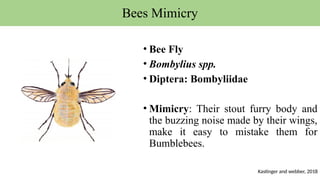
• Bee Fly
• Bombylius spp.
• Diptera: Bombyliidae
• Mimicry: Their stout furry body and
the buzzing noise made by their wings,
make it easy to mistake them for
Bumblebees.
Kastinger and webber, 2018
• Bee Beetle
• Trichius spp.
• Coleoptera: Scarabaeidae
• Mimicry: Bee Beetles avoid
predation by mimicking the
physical characteristics of the
bumblebee.
Bees Mimicry
Wilson et al., 2018
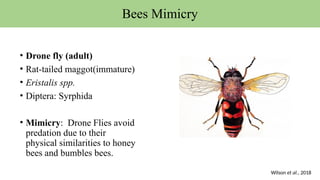
• Drone fly (adult)
• Rat-tailed maggot(immature)
• Eristalis spp.
• Diptera: Syrphida
• Mimicry: Drone Flies avoid
predation due to their
physical similarities to honey
bees and bumbles bees.
Bees Mimicry
Wilson et al., 2018
Why insects mimic ants?
• Ants have powerful defense mechanisms such as acid taste,
aggressive biting, painful sting, and group defense thus, ants are
generally not subject to predation.
• Insects that mimic ants gain several advantages, including
protection from predators and access to resources.
Ant mimicry
Hespenheide, 2014
Ants Mimicry
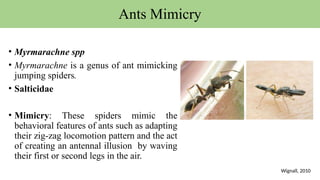
• Myrmarachne spp
• Myrmarachne is a genus of ant mimicking
jumping spiders.
• Salticidae
• Mimicry: These spiders mimic the
behavioral features of ants such as adapting
their zig-zag locomotion pattern and the act
of creating an antennal illusion by waving
their first or second legs in the air.
Wignall, 2010
Ants mimicry
• Macroxiphus sp.
• Orthoptera: Tettigonidae
• Cricket nymph mimics an ant to
ward off predators
• Mimicry: Their long antennae are
camouflaged to appear short, being
black only at the base and they are
vibrated like ant antennae
Mullerian Mimicry
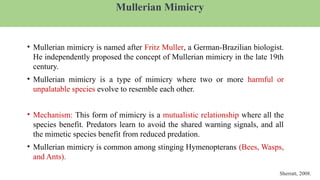
• Mullerian mimicry is named after Fritz Muller, a German-Brazilian biologist.
He independently proposed the concept of Mullerian mimicry in the late 19th
century.
• Mullerian mimicry is a type of mimicry where two or more harmful or
unpalatable species evolve to resemble each other.
• Mechanism: This form of mimicry is a mutualistic relationship where all the
species benefit. Predators learn to avoid the shared warning signals, and all
the mimetic species benefit from reduced predation.
• Mullerian mimicry is common among stinging Hymenopterans (Bees, Wasps,
and Ants).
Sherratt, 2008.
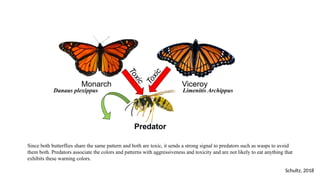
Danaus plexippus Limenitis Archippus
Schultz, 2018
Since both butterflies share the same pattern and both are toxic, it sends a strong signal to predators such as wasps to avoid
them both. Predators associate the colors and patterns with aggressiveness and toxicity and are not likely to eat anything that
exhibits these warning colors.
• Yellowjacket
• Vespula spp.
• Hymenoptera: Vespidae
• Mimicry:
• A variety of harmless insects have evolved to mimic
the coloration and markings of yellowjackets in order
to avoid predation.
• The yellow and black coloration and markings of
yellowjackets serve as a warning to other organisms
that they are potentially harmful.
Mullerian Mimicry
• Both cryptic coloration and camouflage are remarkable examples of
evolutionary adaptations that enhance an organism's chances of
survival in their natural environment.
• In insects, this includes the use of colors, patterns, and textures to
blend in with their surroundings, to avoid predators by looking like
part of their environment.
Cryptic Coloration and Camouflage
Fuente, 2012
Example of wing colour patterns with a role in antipredator defences. (A) cryptic butterfly Steroma bega (Nymphalidae: Satyrinae) (B) Caligo
butterfly (Nymphalidae: Brassolinae) that harbour conspicuous eyespot that have a deimatic or deflective function to predators (C) conspicuous
coloured butterfly (Nymphalidae: Heliconiinae), here the wing pattern signals unpalatability to predators(D) Arawacus butterfly (Lycaenidae)
harbours a false head with movement deflects predators’ attacks.
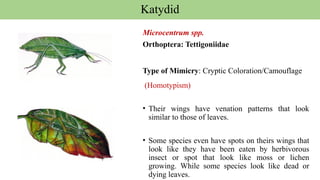
Microcentrum spp.
Orthoptera: Tettigoniidae
Type of Mimicry: Cryptic Coloration/Camouflage
(Homotypism)
• Their wings have venation patterns that look
similar to those of leaves.
• Some species even have spots on theirs wings that
look like they have been eaten by herbivorous
insect or spot that look like moss or lichen
growing. While some species look like dead or
dying leaves.
Katydid
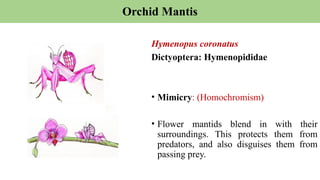
Orchid Mantis
Hymenopus coronatus
Dictyoptera: Hymenopididae
• Mimicry: (Homochromism)
• Flower mantids blend in with their
surroundings. This protects them from
predators, and also disguises them from
passing prey.
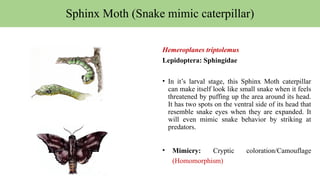
Hemeroplanes triptolemus
Lepidoptera: Sphingidae
• In it’s larval stage, this Sphinx Moth caterpillar
can make itself look like small snake when it feels
threatened by puffing up the area around its head.
It has two spots on the ventral side of its head that
resemble snake eyes when they are expanded. It
will even mimic snake behavior by striking at
predators.
• Mimicry: Cryptic coloration/Camouflage
(Homomorphism)
Sphinx Moth (Snake mimic caterpillar)
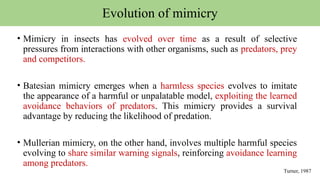
Evolution of mimicry
• Mimicry in insects has evolved over time as a result of selective
pressures from interactions with other organisms, such as predators, prey
and competitors.
• Batesian mimicry emerges when a harmless species evolves to imitate
the appearance of a harmful or unpalatable model, exploiting the learned
avoidance behaviors of predators. This mimicry provides a survival
advantage by reducing the likelihood of predation.
• Mullerian mimicry, on the other hand, involves multiple harmful species
evolving to share similar warning signals, reinforcing avoidance learning
among predators.
Turner, 1987
• Predator Learning
Mimicry evolves as a response to the learning abilities of predators. Mimics gain
an advantage by exploiting the predator's ability to associate certain visual or
chemical cues with danger.
• Selective Pressures
Natural selection favors individuals that better mimic the harmful or unpalatable
model. Over time, populations of mimics with more accurate mimicry traits are
more likely to survive and reproduce.
Factors influencing the evolution of mimicry in insects
• Gene Flow
Gene flow within populations can contribute to the spread of mimicry traits.
Individuals with successful mimicry traits are more likely to pass on their genes to
the next generation.
• Ecological Context
The presence of specific predators, the availability of resources, and the overall
ecological context influence the evolution of mimicry. Mimicry may be more
prevalent in environments with a high abundance of predators or where certain prey
species are more abundant.
Case Studies
• Researchers presented black-thorax and white-thorax flies to mantids over
two weeks, altering the evasiveness of the flies by cutting wings based on
color patterns. Each mantid had one training treatment, and there were 20
mantids per treatment. The study aimed to observe the influence on evasive
behavior during predator interactions.
Henry and Sherratt, 2023
Selection for evasive mimicry imposed by an arthropod predator
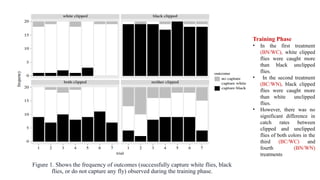
Figure 1. Shows the frequency of outcomes (successfully capture white flies, black
flies, or do not capture any fly) observed during the training phase.
Training Phase
• In the first treatment
(BN/WC), white clipped
flies were caught more
than black unclipped
flies.
• In the second treatment
(BC/WN), black clipped
flies were caught more
than white unclipped
flies.
• However, there was no
significant difference in
catch rates between
clipped and unclipped
flies of both colors in the
third (BC/WC) and
fourth (BN/WN)
treatments
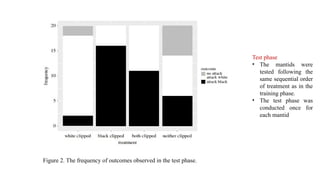
Test phase
• The mantids were
tested following the
same sequential order
of treatment as in the
training phase.
• The test phase was
conducted once for
each mantid
Figure 2. The frequency of outcomes observed in the test phase.
• The results suggest that the training treatments influenced the mantids
preferences and behaviors during the test phase, leading to variations in the
likelihood of attacking black or white flies.
• The findings from the test phase of the experiment indicate that mantids possess
the ability to learn and adjust their predatory behavior based on their past
experiences.
• This study provides evidence for the concept of evasive mimicry and highlights
the role of arthropod predators in the evolution of warning signals and mimicry.
Results
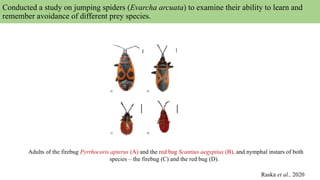
Conducted a study on jumping spiders (Evarcha arcuata) to examine their ability to learn and
remember avoidance of different prey species.
Raska et al., 2020
Adults of the firebug Pyrrhocoris apterus (A) and the red bug Scantius aegyptius (B), and nymphal instars of both
species – the firebug (C) and the red bug (D).
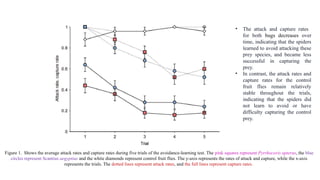
Figure 1. Shows the average attack rates and capture rates during five trials of the avoidance-learning test. The pink squares represent Pyrrhocoris apterus, the blue
circles represent Scantius aegyptius and the white diamonds represent control fruit flies. The y-axis represents the rates of attack and capture, while the x-axis
represents the trials. The dotted lines represent attack rates, and the full lines represent capture rates.
• The attack and capture rates
for both bugs decreases over
time, indicating that the spiders
learned to avoid attacking these
prey species, and became less
successful in capturing the
prey.
• In contrast, the attack rates and
capture rates for the control
fruit flies remain relatively
stable throughout the trials,
indicating that the spiders did
not learn to avoid or have
difficulty capturing the control
prey.
The findings indicate that the spiders rapidly learned to avoid both the true bug
species, as evidenced by significant decreases in attack rates and capture rates over
time. The stability in attack and capture rates in case of fruit flies suggests that
spiders did not perceive fruit flies as dangerous prey.
Pyrrhocoris apterus may be better defended against spiders compared to Scantius
aegyptius, but the difference was only marginally significant.
The results suggest that the mimetic relationship between the two species is most
likely Mullerian, which means that both species benefit from their resemblance to
each other.
Results
 In conclusion, mimicry in insects is a fascinating and diverse phenomenon
that showcases the intricate mechanisms through which these organisms
have adapted to their environments
 Understanding the mechanisms of mimicry provides insights into the
complex strategies employed by insects for self-preservation and
reproduction.
 As ongoing research continues to unravel new facets of mimicry, it
enhances our comprehension of the intricate relationships that govern the
survival and success of insects in diverse habitats.
Conclusion
Nature has its own way of
playing hide and seek!
Thank you