1
By Eduardo Castañeda
Radio Resource Management for
Millimeter Wave & Massive MIMO
2
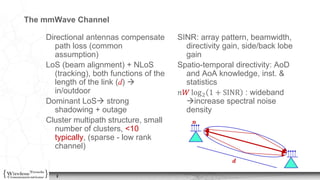
The mmWave Channel
Directional antennas compensate
path loss (common
assumption)
LoS (beam alignment) + NLoS
(tracking), both functions of the
length of the link (d) 
in/outdoor
Dominant LoS strong
shadowing + outage
Cluster multipath structure, small
number of clusters, <10
typically, (sparse - low rank
channel)
SINR: array pattern, beamwidth,
directivity gain, side/back lobe
gain
Spatio-temporal directivity: AoD
and AoA knowledge, inst. &
statistics
𝑛𝑊 log2 1 + SINR : wideband
increase spectral noise
density
𝒅
𝒏
𝒏
3
The mmWave Channel
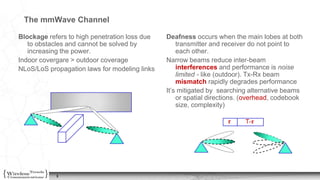
Blockage refers to high penetration loss due
to obstacles and cannot be solved by
increasing the power.
Indoor covergare > outdoor coverage
NLoS/LoS propagation laws for modeling links
Deafness occurs when the main lobes at both
transmitter and receiver do not point to
each other.
Narrow beams reduce inter-beam
interferences and performance is noise
limited - like (outdoor). Tx-Rx beam
mismatch rapidly degrades performance
It’s mitigated by searching alternative beams
or spatial directions. (overhead, codebook
size, complexity)
𝝉 T-𝝉
4
Heterogeneous Bands
Millimeter waves can be used for
high data rates.
Microwave can be used for control
and signaling, since they provide
more reliability. Those services
require low rates.
Robust services over microwaves,
e.g., broadcasting and network
synchronization.
Decoupling Control/User planes, or
UL in microW and DL in mmW
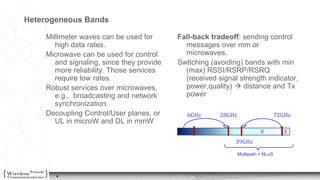
Fall-back tradeoff: sending control
messages over mm or
microwaves.
Swtiching (avoiding) bands with min
(max) RSSI/RSRP/RSRQ
(received signal strength indicator,
power,quality)  distance and Tx
power
6GHz 28GHz 72GHz
39GHz
Multipath + NLoS
EV
5
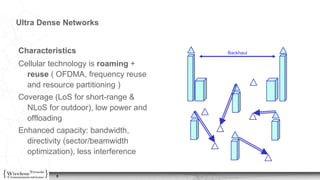
Ultra Dense Networks
Characteristics
Cellular technology is roaming +
reuse ( OFDMA, frequency reuse
and resource partitioning )
Coverage (LoS for short-range &
NLoS for outdoor), low power and
offloading
Enhanced capacity: bandwidth,
directivity (sector/beamwidth
optimization), less interference
Backhaul
6
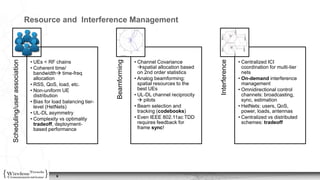
Resource and Interference Management
Scheduling/userassociation
• UEs < RF chains
• Coherent time/
bandwidth time-freq
allocation
• RSS, QoS, load, etc.
• Non-uniform UE
distribution
• Bias for load balancing tier-
level (HetNets)
• UL-DL asymmetry
• Complexity vs optimality
tradeoff, deployment-
based performance
Beamforming
• Channel Covariance
spatial allocation based
on 2nd order statistics
• Analog beamforming:
spatial resources to the
best UEs
• UL-DL channel reciprocity
 pilots
• Beam selection and
tracking (codebooks)
• Even IEEE 802.11ac TDD
requires feedback for
frame sync!
Interference
• Centralized ICI
coordination for multi-tier
nets
• On-demand interference
management
• Omnidirectional control
channels: broadcasting,
sync, estimation
• HetNets: users, QoS,
power, loads, antennas
• Centralized vs distributed
schemes: tradeoff
7
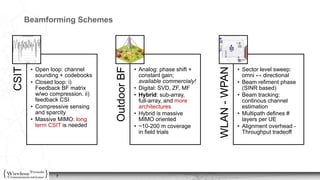
Beamforming SchemesCSIT
• Open loop: channel
sounding + codebooks
• Closed loop: i)
Feedback BF matrix
w/wo compression. ii)
feedback CSI
• Compressive sensing
and sparcity
• Massive MIMO: long
term CSIT is needed OutdoorBF
• Analog: phase shift +
constant gain;
available commercialy!
• Digital: SVD, ZF, MF
• Hybrid: sub-array,
full-array, and more
architectures
• Hybrid is massive
MIMO oriented
• ~10-200 m coverage
in field trials
WLAN-WPAN
• Sector level sweep:
omni ↔ directional
• Beam refiment phase
(SINR based)
• Beam tracking:
continous channel
estimation
• Multipath defines #
layers per UE
• Alignment overhead -
Throughput tradeoff
8
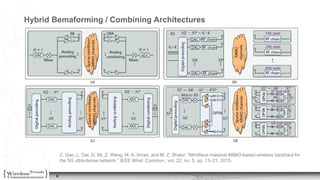
Hybrid Bemaforming / Combining Architectures
Z. Gao, L. Dai, D. Mi, Z. Wang, M. A. Imran, and M. Z. Shakir, “MmWave massive-MIMO-based wireless backhaul for
the 5G ultra-dense network,” IEEE Wirel. Commun., vol. 22, no. 5, pp. 13–21, 2015.
9
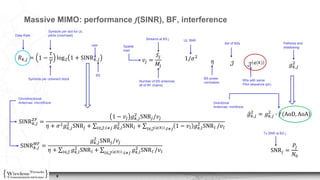
Massive MIMO: performance f(SINR), BF, interference
𝑅 𝑘,𝑗 = 1 −
𝜏
𝑇
log2 1 + SINR 𝑘,𝑗
SINR 𝑘,𝑗
𝑍𝐹
=
1 − 𝑣𝑗 𝑔 𝑘,𝑗
2
SNR𝑗/𝑣𝑗
𝜂 + 𝜎2 𝑔 𝑘,𝑗
2
SNR𝑗 + 𝑙∈𝒥:𝑙≠𝑗 𝑔 𝑘,𝑙
2
SNR 𝑙 + 𝑙∈𝒥 𝑞(𝑘) :𝑙≠𝑗
1 − 𝑣𝑙 𝑔 𝑘,𝑙
2
SNR 𝑙 /𝑣𝑙
SINR 𝑘,𝑗
𝑀𝐹
=
𝑔 𝑘,𝑗
2
SNR𝑗/𝑣𝑗
𝜂 + 𝑙∈𝒥 𝑔 𝑘,𝑙
2
SNR 𝑙 + 𝑙∈𝒥 𝑞(𝑘) :𝑙≠𝑗
𝑔 𝑘,𝑙
2
SNR 𝑙 /𝑣𝑙 SNR𝑗 =
𝑃𝑗
𝑁0
𝑣𝑗 =
𝑆𝑗
𝑀𝑗
Symbols per slot for UL
pilots (overhead)
Symbols per coherent block
user
BS
Number of BS antennas
(# of RF chains)
Streams at BS j
Spatial
load
𝑔 𝑘,𝑗
2
Pathloss and
shadowing
𝜂
BS power
normalizer
𝒥 𝒥 𝑞(𝑘)
Set of BSs
BSs with same
Pilot sequence q(k)
1/𝜎2
UL SNR
Tx SNR at BS j
Omnidirectional
Antennas: microWave
𝑔 𝑘,𝑗
2
= 𝑔 𝑘,𝑗
2
∙ 𝑓(AoD, AoA)
Directional
Antennas: mmWave
Data Rate
10
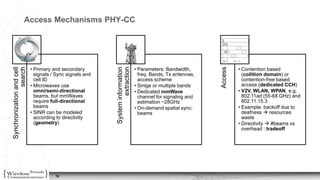
Access Mechanisms PHY-CC
Synchronizationandcell
search
• Primary and secondary
signals / Sync signals and
cell ID
• Microwaves use
omni/semi-directional
beams, but mmWaves
require full-directional
beams
• SINR can be modeled
according to directivity
(geometry) Systeminformation
extraction
• Parameters: Bandwidth,
freq. Bands, Tx antennas,
access scheme
• Sinlge or multiple bands
• Dedicated mmWave
channel for signaling and
estimation ~28GHz
• On-demand spatial sync:
beams
Access
• Contention based
(collition domain) or
contention-free based
access (dedicated CCH)
• V2V, WLAN, WPAN, e.g.
802.11ad (55-68 GHz) and
802.11.15.3
• Example: backoff due to
deafness  resources
waste
• Directivity  #beams vs
overhead : tradeoff
11
Mobility ManagementHandover
• Handovers in dense
deployments may be
frequent
• Limitations of RSS,
local load neglected
• Beam mismatch 
triggers HO
• Dedicated backhaul
resources for the BSs
in soft or hard HO
Noise+Delay
• Increase of
overhead/delay due
to reassociation,
beam refiment and
CSI acquisition
• Cloud cell
(centralized arch.) 
low latency
• Phase noise and
Doppler effect
increases with 𝑓𝑐
Robustness
• UE association with
multiple BS.
• Dual connectivity -
association but one
Tx per UE  reduce
complexity
• Dynamic cell setting
+ user centric RRM
[ Athanasiou2015 ]
12
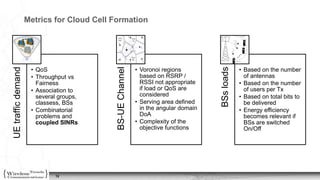
Metrics for Cloud Cell FormationUEtrafficdemand
• QoS
• Throughput vs
Fairness
• Association to
several groups,
classess, BSs
• Combinatorial
problems and
coupled SINRs BS-UEChannel
• Voronoi regions
based on RSRP /
RSSI not appropriate
if load or QoS are
considered
• Serving area defined
in the angular domain
DoA
• Complexity of the
objective functions
BSsloads
• Based on the number
of antennas
• Based on the number
of users per Tx
• Based on total bits to
be delivered
• Energy efficiency
becomes relevant if
BSs are switched
On/Off
13
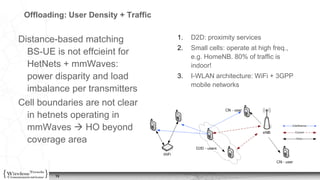
Offloading: User Density + Traffic
Distance-based matching
BS-UE is not effcieint for
HetNets + mmWaves:
power disparity and load
imbalance per transmitters
Cell boundaries are not clear
in hetnets operating in
mmWaves  HO beyond
coverage area
1. D2D: proximity services
2. Small cells: operate at high freq.,
e.g. HomeNB. 80% of traffic is
indoor!
3. I-WLAN architecture: WiFi + 3GPP
mobile networks
14
Summary
Identified characteristics of the wireless channel in mmWave
Candidate frequency bands for cellular communications and
services
Discussion of several process RM for mmWave:
Scheduling: SINR modeling and parametrization
Beamforming: channel estimation and hybrid architectures
Interference management
Mobility + Handover
Dynamic Cloud Cell formation
Offloading Techniques
14
15
References
1. H. Shokri-Ghadikolaei, C. Fischione, G. Fodor, P. Popovski, and M. Zorzi, “Millimeter Wave Cellular Networks: A MAC Layer
Perspective,” IEEE Trans. Commun., vol. 63, no. 10, pp. 3437–3458, Oct. 2015.
2. S. Kutty and D. Sen, “Beamforming for Millimeter Wave Communications: An Inclusive Survey,” IEEE Commun. Surv.
Tutorials, vol. 18, no. 2, pp. 949–973, Jan. 2016.
3. D. Liu, L. Wang, Y. Chen, M. Elkashlan, K.-K. Wong, R. Schober, and L. Hanzo, “User Association in 5G Networks: A Survey
and an Outlook,” IEEE Commun. Surv. Tutorials, vol. 18, no. 2, pp. 1018–1044, Jan. 2016.
4. R. Baldemair, T. Irnich, K. Balachandran, E. Dahlman, G. Mildh, and Y. Selén, “Ultra-Dense Networks in Millimeter-Wave
Frequencies,” IEEE Commun. Mag., no. January, pp. 202–208, 2015.
5. G. Athanasiou, P. C. Weeraddana, C. Fischione, and L. Tassiulas, “Optimizing Client Association for Load Balancing and
Fairness in Millimeter-Wave Wireless Networks,” IEEE/ACM Trans. Netw., vol. 23, no. 3, pp. 836–850, Jun. 2015.
6. N. Saquib, E. Hossain, Long Bao Le, and Dong In Kim, “Interference management in OFDMA femtocell networks: issues and
approaches,” IEEE Wirel. Commun., vol. 19, no. 3, pp. 86–95, Jun. 2012.
7. S. Kutty and D. Sen, “Beamforming for Millimeter Wave Communications: An Inclusive Survey,” IEEE Commun. Surv.
Tutorials, vol. 18, no. 2, pp. 949–973, Jan. 2016.
8. A. Adhikary, E. Al Safadi, M. K. Samimi, R. Wang, G. Caire, T. S. Rappaport, and A. F. Molisch, “Joint Spatial Division and
Multiplexing for mm-Wave Channels,” IEEE J. Sel. Areas Commun., vol. 32, no. 6, pp. 1239–1255, Jun. 2014.
9. D. Bethanabhotla, O. Y. Bursalioglu, H. C. Papadopoulos, and G. Caire, “Optimal User-Cell Association for Massive MIMO
Wireless Networks,” IEEE Trans. Wirel. Commun., vol. 15, no. 3, pp. 1835–1850, Mar. 2016.
10. S. Yost, “mmWave : Battle of the Bands,” National Instruments, White Paper, 2016.
15

Radio Resource Management for Millimeter Wave & Massive MIMO

  • 1.
    1 By Eduardo Castañeda RadioResource Management for Millimeter Wave & Massive MIMO
  • 2.
    2 The mmWave Channel Directionalantennas compensate path loss (common assumption) LoS (beam alignment) + NLoS (tracking), both functions of the length of the link (d)  in/outdoor Dominant LoS strong shadowing + outage Cluster multipath structure, small number of clusters, <10 typically, (sparse - low rank channel) SINR: array pattern, beamwidth, directivity gain, side/back lobe gain Spatio-temporal directivity: AoD and AoA knowledge, inst. & statistics 𝑛𝑊 log2 1 + SINR : wideband increase spectral noise density 𝒅 𝒏 𝒏
  • 3.
    3 The mmWave Channel Blockagerefers to high penetration loss due to obstacles and cannot be solved by increasing the power. Indoor covergare > outdoor coverage NLoS/LoS propagation laws for modeling links Deafness occurs when the main lobes at both transmitter and receiver do not point to each other. Narrow beams reduce inter-beam interferences and performance is noise limited - like (outdoor). Tx-Rx beam mismatch rapidly degrades performance It’s mitigated by searching alternative beams or spatial directions. (overhead, codebook size, complexity) 𝝉 T-𝝉
  • 4.
    4 Heterogeneous Bands Millimeter wavescan be used for high data rates. Microwave can be used for control and signaling, since they provide more reliability. Those services require low rates. Robust services over microwaves, e.g., broadcasting and network synchronization. Decoupling Control/User planes, or UL in microW and DL in mmW Fall-back tradeoff: sending control messages over mm or microwaves. Swtiching (avoiding) bands with min (max) RSSI/RSRP/RSRQ (received signal strength indicator, power,quality)  distance and Tx power 6GHz 28GHz 72GHz 39GHz Multipath + NLoS EV
  • 5.
    5 Ultra Dense Networks Characteristics Cellulartechnology is roaming + reuse ( OFDMA, frequency reuse and resource partitioning ) Coverage (LoS for short-range & NLoS for outdoor), low power and offloading Enhanced capacity: bandwidth, directivity (sector/beamwidth optimization), less interference Backhaul
  • 6.
    6 Resource and InterferenceManagement Scheduling/userassociation • UEs < RF chains • Coherent time/ bandwidth time-freq allocation • RSS, QoS, load, etc. • Non-uniform UE distribution • Bias for load balancing tier- level (HetNets) • UL-DL asymmetry • Complexity vs optimality tradeoff, deployment- based performance Beamforming • Channel Covariance spatial allocation based on 2nd order statistics • Analog beamforming: spatial resources to the best UEs • UL-DL channel reciprocity  pilots • Beam selection and tracking (codebooks) • Even IEEE 802.11ac TDD requires feedback for frame sync! Interference • Centralized ICI coordination for multi-tier nets • On-demand interference management • Omnidirectional control channels: broadcasting, sync, estimation • HetNets: users, QoS, power, loads, antennas • Centralized vs distributed schemes: tradeoff
  • 7.
    7 Beamforming SchemesCSIT • Openloop: channel sounding + codebooks • Closed loop: i) Feedback BF matrix w/wo compression. ii) feedback CSI • Compressive sensing and sparcity • Massive MIMO: long term CSIT is needed OutdoorBF • Analog: phase shift + constant gain; available commercialy! • Digital: SVD, ZF, MF • Hybrid: sub-array, full-array, and more architectures • Hybrid is massive MIMO oriented • ~10-200 m coverage in field trials WLAN-WPAN • Sector level sweep: omni ↔ directional • Beam refiment phase (SINR based) • Beam tracking: continous channel estimation • Multipath defines # layers per UE • Alignment overhead - Throughput tradeoff
  • 8.
    8 Hybrid Bemaforming /Combining Architectures Z. Gao, L. Dai, D. Mi, Z. Wang, M. A. Imran, and M. Z. Shakir, “MmWave massive-MIMO-based wireless backhaul for the 5G ultra-dense network,” IEEE Wirel. Commun., vol. 22, no. 5, pp. 13–21, 2015.
  • 9.
    9 Massive MIMO: performancef(SINR), BF, interference 𝑅 𝑘,𝑗 = 1 − 𝜏 𝑇 log2 1 + SINR 𝑘,𝑗 SINR 𝑘,𝑗 𝑍𝐹 = 1 − 𝑣𝑗 𝑔 𝑘,𝑗 2 SNR𝑗/𝑣𝑗 𝜂 + 𝜎2 𝑔 𝑘,𝑗 2 SNR𝑗 + 𝑙∈𝒥:𝑙≠𝑗 𝑔 𝑘,𝑙 2 SNR 𝑙 + 𝑙∈𝒥 𝑞(𝑘) :𝑙≠𝑗 1 − 𝑣𝑙 𝑔 𝑘,𝑙 2 SNR 𝑙 /𝑣𝑙 SINR 𝑘,𝑗 𝑀𝐹 = 𝑔 𝑘,𝑗 2 SNR𝑗/𝑣𝑗 𝜂 + 𝑙∈𝒥 𝑔 𝑘,𝑙 2 SNR 𝑙 + 𝑙∈𝒥 𝑞(𝑘) :𝑙≠𝑗 𝑔 𝑘,𝑙 2 SNR 𝑙 /𝑣𝑙 SNR𝑗 = 𝑃𝑗 𝑁0 𝑣𝑗 = 𝑆𝑗 𝑀𝑗 Symbols per slot for UL pilots (overhead) Symbols per coherent block user BS Number of BS antennas (# of RF chains) Streams at BS j Spatial load 𝑔 𝑘,𝑗 2 Pathloss and shadowing 𝜂 BS power normalizer 𝒥 𝒥 𝑞(𝑘) Set of BSs BSs with same Pilot sequence q(k) 1/𝜎2 UL SNR Tx SNR at BS j Omnidirectional Antennas: microWave 𝑔 𝑘,𝑗 2 = 𝑔 𝑘,𝑗 2 ∙ 𝑓(AoD, AoA) Directional Antennas: mmWave Data Rate
  • 10.
    10 Access Mechanisms PHY-CC Synchronizationandcell search •Primary and secondary signals / Sync signals and cell ID • Microwaves use omni/semi-directional beams, but mmWaves require full-directional beams • SINR can be modeled according to directivity (geometry) Systeminformation extraction • Parameters: Bandwidth, freq. Bands, Tx antennas, access scheme • Sinlge or multiple bands • Dedicated mmWave channel for signaling and estimation ~28GHz • On-demand spatial sync: beams Access • Contention based (collition domain) or contention-free based access (dedicated CCH) • V2V, WLAN, WPAN, e.g. 802.11ad (55-68 GHz) and 802.11.15.3 • Example: backoff due to deafness  resources waste • Directivity  #beams vs overhead : tradeoff
  • 11.
    11 Mobility ManagementHandover • Handoversin dense deployments may be frequent • Limitations of RSS, local load neglected • Beam mismatch  triggers HO • Dedicated backhaul resources for the BSs in soft or hard HO Noise+Delay • Increase of overhead/delay due to reassociation, beam refiment and CSI acquisition • Cloud cell (centralized arch.)  low latency • Phase noise and Doppler effect increases with 𝑓𝑐 Robustness • UE association with multiple BS. • Dual connectivity - association but one Tx per UE  reduce complexity • Dynamic cell setting + user centric RRM [ Athanasiou2015 ]
  • 12.
    12 Metrics for CloudCell FormationUEtrafficdemand • QoS • Throughput vs Fairness • Association to several groups, classess, BSs • Combinatorial problems and coupled SINRs BS-UEChannel • Voronoi regions based on RSRP / RSSI not appropriate if load or QoS are considered • Serving area defined in the angular domain DoA • Complexity of the objective functions BSsloads • Based on the number of antennas • Based on the number of users per Tx • Based on total bits to be delivered • Energy efficiency becomes relevant if BSs are switched On/Off
  • 13.
    13 Offloading: User Density+ Traffic Distance-based matching BS-UE is not effcieint for HetNets + mmWaves: power disparity and load imbalance per transmitters Cell boundaries are not clear in hetnets operating in mmWaves  HO beyond coverage area 1. D2D: proximity services 2. Small cells: operate at high freq., e.g. HomeNB. 80% of traffic is indoor! 3. I-WLAN architecture: WiFi + 3GPP mobile networks
  • 14.
    14 Summary Identified characteristics ofthe wireless channel in mmWave Candidate frequency bands for cellular communications and services Discussion of several process RM for mmWave: Scheduling: SINR modeling and parametrization Beamforming: channel estimation and hybrid architectures Interference management Mobility + Handover Dynamic Cloud Cell formation Offloading Techniques 14
  • 15.
    15 References 1. H. Shokri-Ghadikolaei,C. Fischione, G. Fodor, P. Popovski, and M. Zorzi, “Millimeter Wave Cellular Networks: A MAC Layer Perspective,” IEEE Trans. Commun., vol. 63, no. 10, pp. 3437–3458, Oct. 2015. 2. S. Kutty and D. Sen, “Beamforming for Millimeter Wave Communications: An Inclusive Survey,” IEEE Commun. Surv. Tutorials, vol. 18, no. 2, pp. 949–973, Jan. 2016. 3. D. Liu, L. Wang, Y. Chen, M. Elkashlan, K.-K. Wong, R. Schober, and L. Hanzo, “User Association in 5G Networks: A Survey and an Outlook,” IEEE Commun. Surv. Tutorials, vol. 18, no. 2, pp. 1018–1044, Jan. 2016. 4. R. Baldemair, T. Irnich, K. Balachandran, E. Dahlman, G. Mildh, and Y. Selén, “Ultra-Dense Networks in Millimeter-Wave Frequencies,” IEEE Commun. Mag., no. January, pp. 202–208, 2015. 5. G. Athanasiou, P. C. Weeraddana, C. Fischione, and L. Tassiulas, “Optimizing Client Association for Load Balancing and Fairness in Millimeter-Wave Wireless Networks,” IEEE/ACM Trans. Netw., vol. 23, no. 3, pp. 836–850, Jun. 2015. 6. N. Saquib, E. Hossain, Long Bao Le, and Dong In Kim, “Interference management in OFDMA femtocell networks: issues and approaches,” IEEE Wirel. Commun., vol. 19, no. 3, pp. 86–95, Jun. 2012. 7. S. Kutty and D. Sen, “Beamforming for Millimeter Wave Communications: An Inclusive Survey,” IEEE Commun. Surv. Tutorials, vol. 18, no. 2, pp. 949–973, Jan. 2016. 8. A. Adhikary, E. Al Safadi, M. K. Samimi, R. Wang, G. Caire, T. S. Rappaport, and A. F. Molisch, “Joint Spatial Division and Multiplexing for mm-Wave Channels,” IEEE J. Sel. Areas Commun., vol. 32, no. 6, pp. 1239–1255, Jun. 2014. 9. D. Bethanabhotla, O. Y. Bursalioglu, H. C. Papadopoulos, and G. Caire, “Optimal User-Cell Association for Massive MIMO Wireless Networks,” IEEE Trans. Wirel. Commun., vol. 15, no. 3, pp. 1835–1850, Mar. 2016. 10. S. Yost, “mmWave : Battle of the Bands,” National Instruments, White Paper, 2016. 15