VISHNU PRASAD J
WHAT WILL 5G BE ?
INTRODUCTION
 5G :5th generation of cellular technology.
 It is a packet switched wireless s/m.
 Will have wide coverage and high throughput.
 Will have high carrier freq ,massive bandwidth.
 Core n/w will be intelligent and flexible.
 Uses OFDM & mmWave for high data rate.
 Expected to be launched in 2020
WHAT IS 5G?
KEY FEATURES OF 5G
 High speed , high capacity & low cost per bit.
 Downloading & uploading speed of at least 100mbps.
 Support interactive multimedia, voice , video streaming
(HD) online gaming etc..efficiently.
 Global access , service portability.
 Increased dialling speed ,less power requirement.
 Dynamic information rate.
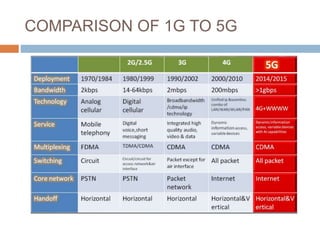
COMPARISON OF 1G TO 5G
ENGINEERING REQUIREMENTS
FOR 5G
 Data rate
Data rates can be measured by,
a)Aggregate data rate: average data network can
serve.
b)Edge data rate: worst data rate.
c)Peak data rate: maximum data network can give.
 Latency
- Measure of time of output after input is given .
- For 5G it is expected to be 1ms.
 Energy & Cost consideration
 Device types & Quantities
KEY CONCEPTS
 One of the main objective of 5G is to attain a data rate
which is 1000X that of previous generation.
 This is achieved by the combination of the following,
a) Extreme Densification & Offloading
- Improves the area spectral efficiency.
b) Moving in to mmWave (millimeterwave)
- Increases the bandwidth & uses WIFI’s unlicensed
spectrum
c) MIMO (multiple in multiple out)
- Increases spectral efficiency to support more
bits/s/Hz/node
a)EXTREME DENSIFICATION AND
OFFLOADING
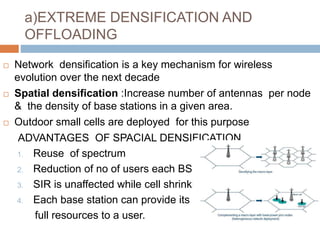
 Network densification is a key mechanism for wireless
evolution over the next decade
 Spatial densification :Increase number of antennas per node
& the density of base stations in a given area.
 Outdoor small cells are deployed for this purpose
ADVANTAGES OF SPACIAL DENSIFICATION
1. Reuse of spectrum
2. Reduction of no of users each BS.
3. SIR is unaffected while cell shrinking .
4. Each base station can provide its
full resources to a user.
CHALLENGES OF SPACIAL DENSIFICATION
1) Preserving the cell splitting gain
 The small cells tend to become lightly loaded than macrocells
as network densifies .
 As a result signal to interference noise ratio will increase.
 The high power transmission from macrocells shrinks the
coverage of small cells.
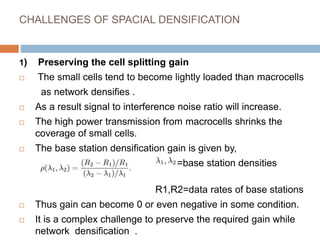
 The base station densification gain is given by,
=base station densities
(low&high)
R1,R2=data rates of base stations
 Thus gain can become 0 or even negative in some condition.
 It is a complex challenge to preserve the required gain while
network densification .
CHALLENGES OF SPACIAL DENSIFICATION(CONT..)
2) Determining appropriate association b/w user and BS
 In 5G networks will become heterogeneous.
 With 5G there will be also 4G, 3G several WIFI’s or even
D2D
 Determining which standard & spectrum is needed & which
BS and user to associate will be a complex task.
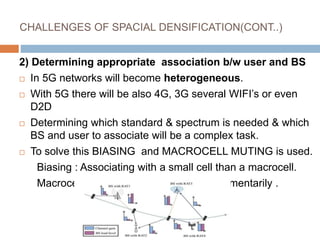
 To solve this BIASING and MACROCELL MUTING is used.
Biasing : Associating with a small cell than a macrocell.
Macrocell muting: Shutting macrocell momentarily .
MOBILITY AND COST
MOBILITY
 A hefty share of data is given to indoor users.
 The support of mobility and always on connectivity is a
difficult task.
 Highly mobile users are restricted to macrocells .
 Forcing to tolerate lower rates.
COST
 With high data rates cost will also increase.
 Different companies will charge differently.
 Equipments for MIMO ,mmWave etc..also increases the
cost .
 Can be solved by using shared WIFI hotspots like in
FON.
b) MILLIMETER WAVE
 Since limited spectrum is available for commercial cellular
cellular systems, most research is now to increase spectral
efficiency by using densification , MIMO etc..
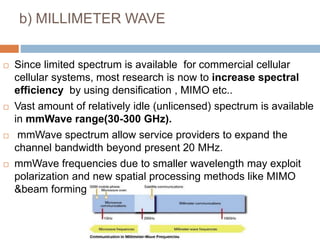
 Vast amount of relatively idle (unlicensed) spectrum is available
in mmWave range(30-300 GHz).
 mmWave spectrum allow service providers to expand the
channel bandwidth beyond present 20 MHz.
 mmWave frequencies due to smaller wavelength may exploit
polarization and new spatial processing methods like MIMO
&beam forming.
ADVANTAGES & CHALLENGES OF
mmWave
ADVANTAGES
 Millimeter wave’s larger bandwidth is able to provide higher transmission
rate and is more immune to interference.
 Extremely high frequencies allows multiple short-distance usage at the
same frequency without interference (D2D communication).
 It requires narrow bandwidth .For the size of the antenna when the
frequency is increased , the beam width decreases.
 It reduces hardware size , ie higher the frequency lower will be the
antenna size.
CHALLENGES
 PATHLOSS: When frequency is increased from 3-30 GHz 20 dB of
power loss is added.
 BLOCKING: mmWave has reduced diffraction and are susceptible to
blockages.(blockage loss=15-40 dB)
 ATMOSPHERIC ABSORPTION: There are interference with oxygen and
CHALLENGES OF mmWave(cont..)
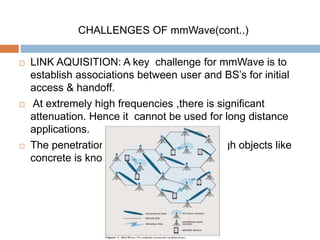
 LINK AQUISITION: A key challenge for mmWave is to
establish associations between user and BS’s for initial
access & handoff.
 At extremely high frequencies ,there is significant
attenuation. Hence it cannot be used for long distance
applications.
 The penetration power of mmWave through objects like
concrete is known less.
c) MASSIVE MIMO
 MIMO stands for multiple in multiple out.
 It is a method to multiply the capacity of a radio link using
multiple transit and receive antennas to exploit multipath
propagation.
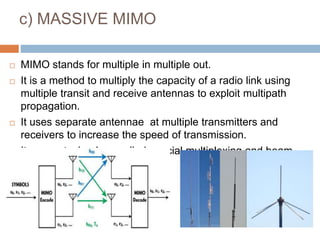
 It uses separate antennae at multiple transmitters and
receivers to increase the speed of transmission.
 It uses a technology called spacial multiplexing and beam
forming
HOW MIMO WORKS
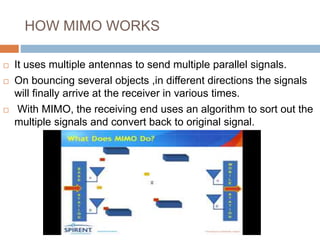
 It uses multiple antennas to send multiple parallel signals.
 On bouncing several objects ,in different directions the signals
will finally arrive at the receiver in various times.
 With MIMO, the receiving end uses an algorithm to sort out the
multiple signals and convert back to original signal.
CHALLENGES OF MIMO
 High power amplifiers are needed to feed the antennas.
 Scalability, antenna correlations, mutual coupling & cost
needed to be taken care of.
 BS’s need to be modifies for planar 2D arrays.
 The antennas need to be much smaller to support mmWave.
DESIGN ISSUES FOR 5G
 To lower latency,energy consumption &cost in 5G we
go for
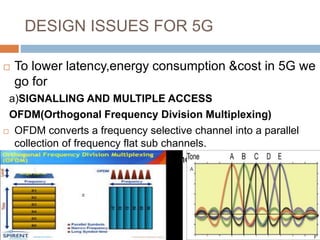
a)SIGNALLING AND MULTIPLE ACCESS
OFDM(Orthogonal Frequency Division Multiplexing)
 OFDM converts a frequency selective channel into a parallel
collection of frequency flat sub channels.
 OFDM uses bandwidth efficiently and reduces inter symbol
interference.
DRAWBACKS OF OFDM
 High peak to average ratio.
 OFDM’s spectral efficiency can be improved more.
 Difficult to develop efficient power amplifiers for mmWave.
 More complex.
b)CLOUD BASED NETWORKING
 The movement of data to clouds so that it can be accessed
from anywhere via variety of platform.
 This lead to NFV AND SDN.
NFV(Network function virtualization)
 NFV enables networks to run on cloud
computing rather than hardware.
 Cost can be reduced.
SDN(Software Defined
Networking)

Allows network administrator
s to manage network
services through changing
the network by application
request.
SPECTRUM REGULATION AND
STANDARDISATION FOR 5G
 Spectrum policy and allocation
-Exclusive licenses: TV & commercial radio allocations are
moved to
small bands releasing spectrum for wireless communication.
-Unlicensed Spectrum: Industrial, medical, military, scientific
bands..
-Spectrum Sharing: Spectrum sharing is done between
parties.
CONCLUSION
 The new coming 5G technology will be
available in the market at affordable rates, high
peak future & much reliability than preceding
technologies

What will 5 g be

  • 2.
  • 3.
    INTRODUCTION  5G :5thgeneration of cellular technology.  It is a packet switched wireless s/m.  Will have wide coverage and high throughput.  Will have high carrier freq ,massive bandwidth.  Core n/w will be intelligent and flexible.  Uses OFDM & mmWave for high data rate.  Expected to be launched in 2020 WHAT IS 5G?
  • 4.
    KEY FEATURES OF5G  High speed , high capacity & low cost per bit.  Downloading & uploading speed of at least 100mbps.  Support interactive multimedia, voice , video streaming (HD) online gaming etc..efficiently.  Global access , service portability.  Increased dialling speed ,less power requirement.  Dynamic information rate.
  • 5.
  • 6.
    ENGINEERING REQUIREMENTS FOR 5G Data rate Data rates can be measured by, a)Aggregate data rate: average data network can serve. b)Edge data rate: worst data rate. c)Peak data rate: maximum data network can give.  Latency - Measure of time of output after input is given . - For 5G it is expected to be 1ms.  Energy & Cost consideration  Device types & Quantities
  • 7.
    KEY CONCEPTS  Oneof the main objective of 5G is to attain a data rate which is 1000X that of previous generation.  This is achieved by the combination of the following, a) Extreme Densification & Offloading - Improves the area spectral efficiency. b) Moving in to mmWave (millimeterwave) - Increases the bandwidth & uses WIFI’s unlicensed spectrum c) MIMO (multiple in multiple out) - Increases spectral efficiency to support more bits/s/Hz/node
  • 8.
    a)EXTREME DENSIFICATION AND OFFLOADING Network densification is a key mechanism for wireless evolution over the next decade  Spatial densification :Increase number of antennas per node & the density of base stations in a given area.  Outdoor small cells are deployed for this purpose ADVANTAGES OF SPACIAL DENSIFICATION 1. Reuse of spectrum 2. Reduction of no of users each BS. 3. SIR is unaffected while cell shrinking . 4. Each base station can provide its full resources to a user.
  • 9.
    CHALLENGES OF SPACIALDENSIFICATION 1) Preserving the cell splitting gain  The small cells tend to become lightly loaded than macrocells as network densifies .  As a result signal to interference noise ratio will increase.  The high power transmission from macrocells shrinks the coverage of small cells.  The base station densification gain is given by, =base station densities (low&high) R1,R2=data rates of base stations  Thus gain can become 0 or even negative in some condition.  It is a complex challenge to preserve the required gain while network densification .
  • 10.
    CHALLENGES OF SPACIALDENSIFICATION(CONT..) 2) Determining appropriate association b/w user and BS  In 5G networks will become heterogeneous.  With 5G there will be also 4G, 3G several WIFI’s or even D2D  Determining which standard & spectrum is needed & which BS and user to associate will be a complex task.  To solve this BIASING and MACROCELL MUTING is used. Biasing : Associating with a small cell than a macrocell. Macrocell muting: Shutting macrocell momentarily .
  • 11.
    MOBILITY AND COST MOBILITY A hefty share of data is given to indoor users.  The support of mobility and always on connectivity is a difficult task.  Highly mobile users are restricted to macrocells .  Forcing to tolerate lower rates. COST  With high data rates cost will also increase.  Different companies will charge differently.  Equipments for MIMO ,mmWave etc..also increases the cost .  Can be solved by using shared WIFI hotspots like in FON.
  • 12.
    b) MILLIMETER WAVE Since limited spectrum is available for commercial cellular cellular systems, most research is now to increase spectral efficiency by using densification , MIMO etc..  Vast amount of relatively idle (unlicensed) spectrum is available in mmWave range(30-300 GHz).  mmWave spectrum allow service providers to expand the channel bandwidth beyond present 20 MHz.  mmWave frequencies due to smaller wavelength may exploit polarization and new spatial processing methods like MIMO &beam forming.
  • 13.
    ADVANTAGES & CHALLENGESOF mmWave ADVANTAGES  Millimeter wave’s larger bandwidth is able to provide higher transmission rate and is more immune to interference.  Extremely high frequencies allows multiple short-distance usage at the same frequency without interference (D2D communication).  It requires narrow bandwidth .For the size of the antenna when the frequency is increased , the beam width decreases.  It reduces hardware size , ie higher the frequency lower will be the antenna size. CHALLENGES  PATHLOSS: When frequency is increased from 3-30 GHz 20 dB of power loss is added.  BLOCKING: mmWave has reduced diffraction and are susceptible to blockages.(blockage loss=15-40 dB)  ATMOSPHERIC ABSORPTION: There are interference with oxygen and
  • 14.
    CHALLENGES OF mmWave(cont..) LINK AQUISITION: A key challenge for mmWave is to establish associations between user and BS’s for initial access & handoff.  At extremely high frequencies ,there is significant attenuation. Hence it cannot be used for long distance applications.  The penetration power of mmWave through objects like concrete is known less.
  • 15.
    c) MASSIVE MIMO MIMO stands for multiple in multiple out.  It is a method to multiply the capacity of a radio link using multiple transit and receive antennas to exploit multipath propagation.  It uses separate antennae at multiple transmitters and receivers to increase the speed of transmission.  It uses a technology called spacial multiplexing and beam forming
  • 16.
    HOW MIMO WORKS It uses multiple antennas to send multiple parallel signals.  On bouncing several objects ,in different directions the signals will finally arrive at the receiver in various times.  With MIMO, the receiving end uses an algorithm to sort out the multiple signals and convert back to original signal.
  • 17.
    CHALLENGES OF MIMO High power amplifiers are needed to feed the antennas.  Scalability, antenna correlations, mutual coupling & cost needed to be taken care of.  BS’s need to be modifies for planar 2D arrays.  The antennas need to be much smaller to support mmWave.
  • 18.
    DESIGN ISSUES FOR5G  To lower latency,energy consumption &cost in 5G we go for a)SIGNALLING AND MULTIPLE ACCESS OFDM(Orthogonal Frequency Division Multiplexing)  OFDM converts a frequency selective channel into a parallel collection of frequency flat sub channels.  OFDM uses bandwidth efficiently and reduces inter symbol interference.
  • 19.
    DRAWBACKS OF OFDM High peak to average ratio.  OFDM’s spectral efficiency can be improved more.  Difficult to develop efficient power amplifiers for mmWave.  More complex.
  • 20.
    b)CLOUD BASED NETWORKING The movement of data to clouds so that it can be accessed from anywhere via variety of platform.  This lead to NFV AND SDN. NFV(Network function virtualization)  NFV enables networks to run on cloud computing rather than hardware.  Cost can be reduced. SDN(Software Defined Networking)  Allows network administrator s to manage network services through changing the network by application request.
  • 21.
    SPECTRUM REGULATION AND STANDARDISATIONFOR 5G  Spectrum policy and allocation -Exclusive licenses: TV & commercial radio allocations are moved to small bands releasing spectrum for wireless communication. -Unlicensed Spectrum: Industrial, medical, military, scientific bands.. -Spectrum Sharing: Spectrum sharing is done between parties.
  • 22.
    CONCLUSION  The newcoming 5G technology will be available in the market at affordable rates, high peak future & much reliability than preceding technologies