Research accomplishment (2003 ~ )

Semiconductor & Integrated Circuit Lab
Millimeter-wave INovation Technology research center

Taejong Baek
Department of Electronics and Electrical Engineering
Graduate School
Dongguk University

Semiconductor & Integrated Circuit Lab

Millimeter-wave INnovation Technology research center

Dongguk University
Research field

1

Semiconductor & Integrated Circuit Lab

Millimeter-wave INnovation Technology research center

Dongguk University
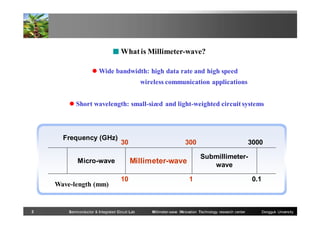
■ What is Millimeter-wave?
 Wide bandwidth: high data rate and high speed
wireless communication applications
 Short wavelength: small-sized and light-weighted circuit systems

Frequency (GHz)

30

2

10

Semiconductor & Integrated Circuit Lab

3000
Submillimeterwave

Millimeter-wave

Micro-wave

Wave-length (mm)

300

1

Millimeter-wave INnovation Technology research center

0.1

Dongguk University
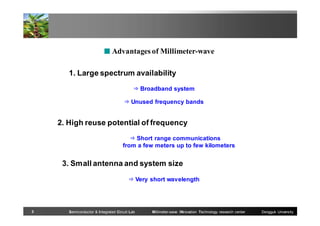
■ Advantages of Millimeter-wave

1. Large spectrum availability
⇒ Broadband system
⇒ Unused frequency bands

2. High reuse potential of frequency
⇒ Short range communications
from a few meters up to few kilometers

3. Small antenna and system size
⇒ Very short wavelength

3

Semiconductor & Integrated Circuit Lab

Millimeter-wave INnovation Technology research center

Dongguk University
■

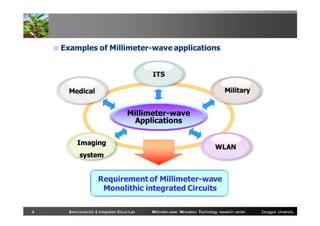
Examples of Millimeter-wave applications

ITS
Military

Medical

Millimeter-wave
Applications
Imaging

WLAN

system

Requirement of Millimeter-wave
Monolithic integrated Circuits
4

Semiconductor & Integrated Circuit Lab

Millimeter-wave INnovation Technology research center

Dongguk University
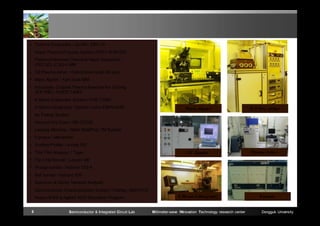
 Thermal Evaporator / ULVAC EBV-10
 Rapid Thermal Process System (RTP) / KVR-020
 Plasma Enhanced Chemical Vapor Deposition
(PECVD) JCSS-41MR
 O2 Plasma Asher / Oxford plasma lab 80 plus
 Mask Aligner / Karl Suss MA6
 Inductively Coupled Plasma Reactive Ion Etching
(ICP-RIE) / KVICP-T4083
 E-Beam Evaporator System / KVE-T5560
 E-Beam Lithography System / Leica EBPG-4HR

Mask Aligner

ICP-Dry etcher

FC Bonder

Plasma Asher

 Au Plating System
 Vacuum Dry Oven / SB-CD520
 Lapping Machine / Allied MultiPrep TM System
 Furnace / Metritherm
 Surface Profiler / a-step 200
 Thin Film Analyzer / Tyger
 Flip Chip Bonder / Laurier M9
 Wedge bonder / Hybond 572-A
 Ball bonder / Hybond 626
 Spectrum & Vector Network Analyzer
 Semiconductor Characterization System / Keithley 4200-PCS
 Ansys HFSS & Agilent ADS Simulation Program
5

Semiconductor & Integrated Circuit Lab

E-Beam Lithography

Millimeter-wave INnovation Technology research center

Furnace

Dongguk University
GaAs-based 70 nm MHEMTs

6

Semiconductor & Integrated Circuit Lab

Millimeter-wave INnovation Technology research center

Dongguk University
GaAs-based 70 nm MHEMTs
■

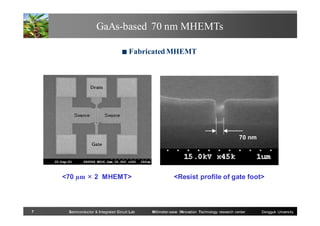
Fabricated MHEMT

70 nm

<70 µm × 2 MHEMT>

7

Semiconductor & Integrated Circuit Lab

<Resist profile of gate foot>

Millimeter-wave INnovation Technology research center

Dongguk University
Development of MMIC Libraries
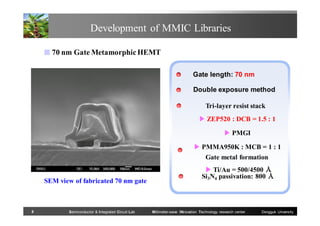
■ 70 nm Gate Metamorphic HEMT
Gate length: 70 nm
Double exposure method
Tri-layer resist stack
▶ ZEP520 : DCB = 1.5 : 1
▶ PMGI
▶ PMMA950K : MCB = 1 : 1
Gate metal formation

SEM view of fabricated 70 nm gate

8

Semiconductor & Integrated Circuit Lab

▶ Ti/Au = 500/4500 Å
Si3N4 passivation: 800 Å

Millimeter-wave INnovation Technology research center

Dongguk University
GaAs-based 70 nm MHEMTs
■

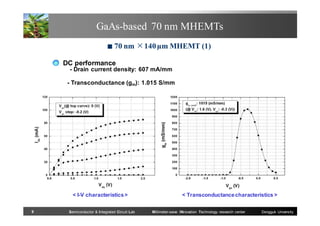
70 nm ×140 µm MHEMT (1)

DC performance
- Drain current density: 607 mA/mm
- Transconductance (gm): 1.015 S/mm

< I-V characteristics >
9

Semiconductor & Integrated Circuit Lab

< Transconductance characteristics >
Millimeter-wave INnovation Technology research center

Dongguk University
GaAs-based 70 nm MHEMTs
■

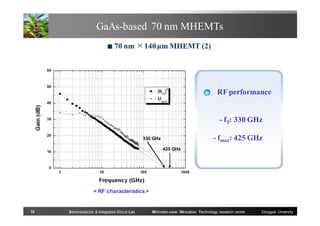
70 nm ×140 µm MHEMT (2)

RF performance

- fT: 330 GHz
- fmax: 425 GHz

330 GHz
425 GHz

< RF characteristics >

10

Semiconductor & Integrated Circuit Lab

Millimeter-wave INnovation Technology research center

Dongguk University
GaAs-based 70 nm MHEMTs
■ fT

comparison of HEMTs
[1] Y. Yamashita et al., IEEE Electron Device Letters,
vol. 23, no. 10, pp. 573-575, 2002.
[2] K. Shinohara et al., IEEE Electron Device Letters,
vol. 25, no. 5, pp. 241-243, 2004.
[3] T. Suemitsu et al., IEEE Trans. on Electron Devices,

[1]

vol. 49, no. 10, pp. 1694-1700, 2002.
[2]

[4] K. Shinohara et al., IEEE Electron Device Letters,
vol. 22, no. 11, pp. 507-509, 2001.

This
work

[4]

[5] K. Shinohara et al., IEEE MTT-S Digest,
vol. 3, pp. 2159-2162, 2001.
[6] S. Bollaert et al., IEE Electronics Letters,
vol. 38, no. 8, pp. 389-391, 2002.

[3]
[5]

[8]
[6]

[7] T. Parenty et al., Indium Phosphide and
[9]

[7]
[10]

Related Materials, pp. 626-629, 2001.
[8] A. Leuther et al., Indium Phosphide and
Related Materials, pp. 215-218, 2003.
[9] H. Wang et al., IEEE IEDM Digest,
pp. 239-242, 1993.
[10] Y. C. Lien et al., IEEE Electron Device Letters,
vol. 25, no. 6, pp. 348-350, 2004.
This work: Sung Chan Kim et al.,
IEEE Electron Device Letters,
vol. 27, no. 1, pp. 28-30, 2006.

11

Semiconductor & Integrated Circuit Lab

Millimeter-wave INnovation Technology research center

Dongguk University
DAML
(Dielectric-supported Air-gapped Microstrip Line)

12

Semiconductor & Integrated Circuit Lab

Millimeter-wave INnovation Technology research center

Dongguk University
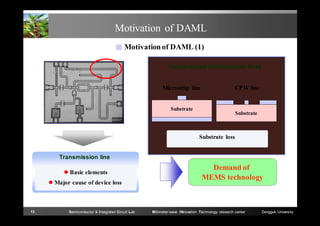
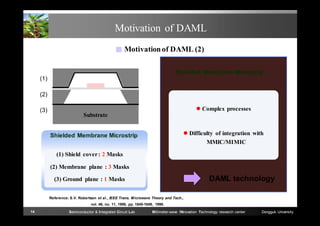
Motivation of DAML
■ Motivation of DAML (1)
Conventional transmission lines

Microstrip line

CPW line

Substrate

Substrate

Substrate loss
Transmission line
 Basic elements
 Major cause of device loss

13

Semiconductor & Integrated Circuit Lab

Demand of
MEMS technology

Millimeter-wave INnovation Technology research center

Dongguk University
Motivation of DAML
■ Motivation of DAML (2)
Shielded Membrane Microstrip
(1)

Substrate 1

(2)

Substrate 2

(3)

 Complex processes
Substrate
 Difficulty of integration with
MMIC/MIMIC

Shielded Membrane Microstrip
(1) Shield cover : 2 Masks
(2) Membrane plane : 3 Masks

DAML technology

(3) Ground plane : 1 Masks
Reference: S.V. Robertson et al., IEEE Trans. Microwave Theory and Tech.,
vol. 46, no. 11, 1998, pp. 1845-1849, 1998.
14

Semiconductor & Integrated Circuit Lab

Millimeter-wave INnovation Technology research center

Dongguk University
DAML
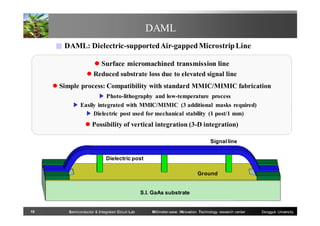
■ DAML: Dielectric-supported Air-gapped Microstrip Line

 Surface micromachined transmission line
 Reduced substrate loss due to elevated signal line
 Simple process: Compatibility with standard MMIC/MIMIC fabrication
▶ Photo-lithography and low-temperature process
▶ Easily integrated with MMIC/MIMIC (3 additional masks required)
▶ Dielectric post used for mechanical stability (1 post/1 mm)

 Possibility of vertical integration (3-D integration)
Signal line
Dielectric post
Ground

S.I. GaAs substrate

15

Semiconductor & Integrated Circuit Lab

Millimeter-wave INnovation Technology research center

Dongguk University
DAML
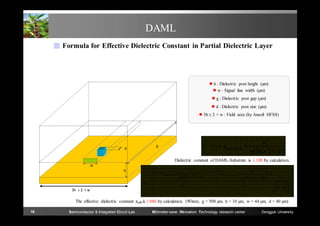
■ Formula for Effective Dielectric Constant in Partial Dielectric Layer

 h : Dielectric post height (µm)
 w : Signal line width (µm)
 g : Dielectric post gap (µm)
 d : Dielectric post size (µm)
 3hⅹ2 + w : Field area (by Ansoft HFSS)

g

d

d2
 r  1   polyimide 
g (3h  2  w)
Dielectric constant of DAML-Substrate is 1.108 by calculation.

w
h

 eff
3h ⅹ2 + w



d2

d2
 1   polyimide 
  1 1  


 1
polyimide



g (3h  2  w) 
g (3h  2  w) 
1





2
2
h

1 12

w












The effective dielectric constant εe ff is 1.086 by calculation. (Where, g = 500 µm, h = 10 µm, w = 44 µm, d = 40 µm)
16

Semiconductor & Integrated Circuit Lab

Millimeter-wave INnovation Technology research center

Dongguk University
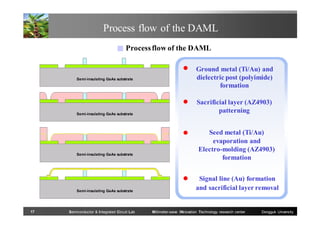
Process flow of the DAML
■ Process flow of the DAML


Ground metal (Ti/Au) and
dielectric post (polyimide)
formation



Sacrificial layer (AZ4903)
patterning



Seed metal (Ti/Au)
evaporation and
Electro-molding (AZ4903)
formation



Signal line (Au) formation
and sacrificial layer removal

Semi-insulating GaAs substrate

Semi-insulating GaAs substrate

Semi-insulating GaAs substrate

Semi-insulating GaAs substrate

17

Semiconductor & Integrated Circuit Lab

Millimeter-wave INnovation Technology research center

Dongguk University
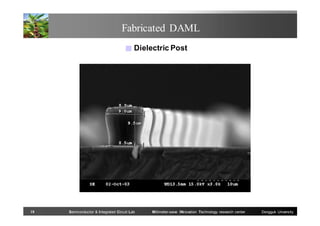
Fabricated DAML
■ Dielectric Post

18

Semiconductor & Integrated Circuit Lab

Millimeter-wave INnovation Technology research center

Dongguk University
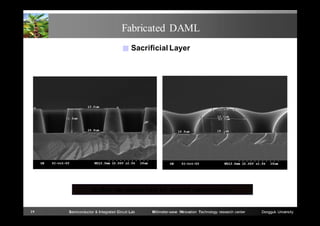
Fabricated DAML
■ Sacrificial Layer

Reflow the photoresist for smooth metal overlay

19

Semiconductor & Integrated Circuit Lab

Millimeter-wave INnovation Technology research center

Dongguk University
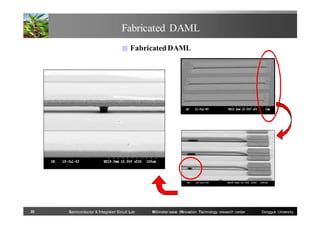
Fabricated DAML
■ Fabricated DAML

20

Semiconductor & Integrated Circuit Lab

Millimeter-wave INnovation Technology research center

Dongguk University
DAML Characteristic
■ Comparison of transmission lines
[1] K. Nishikawa et al., IEEE MTT-S Digest, vol. 3,
2001, pp. 1881-1884.
[2] G.E. Ponchak et al., IEEE Trans. Components,
Packaging, and Manufacturing Technology-B,
vol. 21, no. 2, pp. 171-176, 1998.
[3] Suidong Yang et al., IEEE Trans. Microwave
Theory and Techniques,
vol. 46, no. 5, pp. 623-631, 1998.
[4] Y.C. Shih et al., Microwave Journal,
pp. 95-105, 1991.
[5] Youngwoo Kwon et al., IEEE Microwave
and Wireless Components Letters,
vol. 11, no. 2, pp. 59-61, 2001.
[6] S.V. Robertson et al., IEEE Trans. Microwave
Theory and Techniques,
vol. 46, no. 11, 1998, pp. 1845-1849, 1998.

This work: H. S. Lee et al.,
IEE Electronics Letters,
vol. 39, no. 25, pp. 1827-1828, 2003.
This work: Sung-Chan Kim et al., IEEE Microwave
and Wireless Components Letters,
vol. 15, no. 10, pp. 652-654, 2005.
21

Semiconductor & Integrated Circuit Lab

Millimeter-wave INnovation Technology research center

Dongguk University
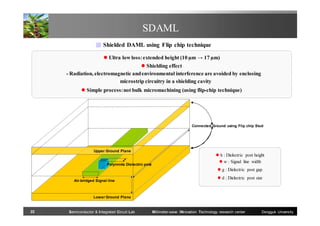
SDAML
■ Shielded DAML using Flip chip technique
 Ultra low loss: extended height (10 µm → 17 µm)
 Shielding effect
- Radiation, electromagnetic and environmental interference are avoided by enclosing
microstrip circuitry in a shielding cavity
 Simple process: not bulk micromachining (using flip-chip technique)

Connected Ground using Flip chip Stud

Upper Ground Plane

Polyimide Dielectric post

 h : Dielectric post height
 w : Signal line width
 g : Dielectric post gap

Air-bridged Signal line

 d : Dielectric post size

Lower Ground Plane

22

Semiconductor & Integrated Circuit Lab

Millimeter-wave INnovation Technology research center

Dongguk University
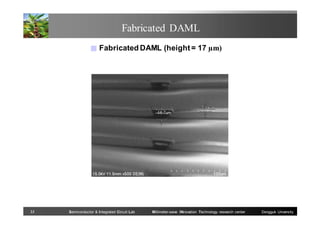
Fabricated DAML
■ Fabricated DAML (height = 17 µm)

23

Semiconductor & Integrated Circuit Lab

Millimeter-wave INnovation Technology research center

Dongguk University
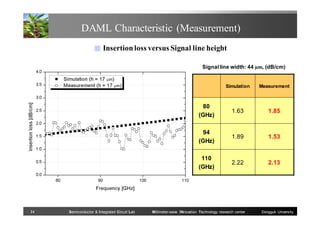
DAML Characteristic (Measurement)
■ Insertion loss versus Signal line height
Signal line width: 44 µm, (dB/cm)

Simulation

80
(GHz)

1.85

1.89

1.53

110
(GHz)

Semiconductor & Integrated Circuit Lab

1.63

94
(GHz)

24

Measurement

2.22

2.13

Millimeter-wave INnovation Technology research center

Dongguk University
SDAML Characteristic
■ Comparison of original DAML
4.0

DAML (h = 10 m)
DAML (h = 17 m )
SDAML (h = 17 m)

60
(GHz)

94
(GHz)

120
(GHz)

DAML
(10 µm)

1.87

2.56

3.1

DAML
(17 µm)

1.27

1.89

2.42

SDAML
(17 µm)

3.5

1.07

1.41

1.67

Insertion loss [dB/cm]

3.0
2.5
2.0
1.5
1.0
0.5
0.0
0

20

40

60

80

100

120

140

Frequency [GHz]

25

Semiconductor & Integrated Circuit Lab

Millimeter-wave INnovation Technology research center

Dongguk University
Passive Device using DAML Technology
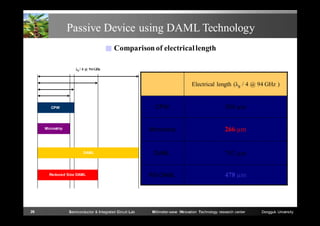
■ Comparison of electrical length
λg / 4 @ 94 GHz

Electrical length (λg / 4 @ 94 GHz )

CPW

Microstrip

DAML

Reduced Size DAML

26

Semiconductor & Integrated Circuit Lab

304 µm

Microstrip

CPW

266 µm

DAML

792 µm

RS-DAML

478 µm

Millimeter-wave INnovation Technology research center

Dongguk University
Passive Device using DAML Technology
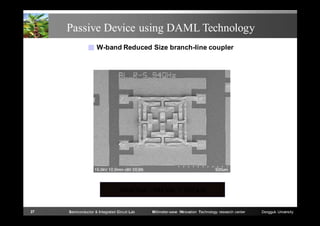
■ W-band Reduced Size branch-line coupler

Total Size : 604 µm × 520 µm
27

Semiconductor & Integrated Circuit Lab

Millimeter-wave INnovation Technology research center

Dongguk University
Passive Device using DAML Technology
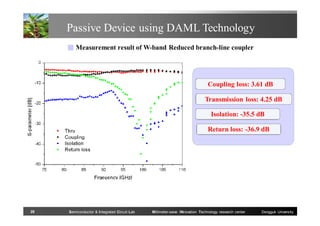
■ Measurement result of W-band Reduced branch-line coupler

Coupling loss: 3.61 dB
Transmission loss: 4.25 dB
Isolation: -35.5 dB
Return loss: -36.9 dB

28

Semiconductor & Integrated Circuit Lab

Millimeter-wave INnovation Technology research center

Dongguk University
Passive Device using DAML Technology
■

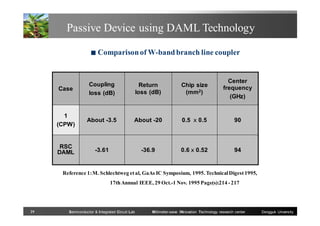
Comparison of W-band branch line coupler

Case

Coupling
loss (dB)

Return
loss (dB)

Chip size
(mm2)

Center
frequency
(GHz)

1
(CPW)

About -3.5

About -20

0.5 ⅹ0.5

90

RSC
DAML

-3.61

-36.9

0.6ⅹ0.52

94

Reference 1: M. Schlechtweg et al, GaAs IC Symposium, 1995. Technical Digest 1995,
17th Annual IEEE, 29 Oct.-1 Nov. 1995 Page(s):214 - 217

29

Semiconductor & Integrated Circuit Lab

Millimeter-wave INnovation Technology research center

Dongguk University
W-band Hybrid Ring Coupler
■

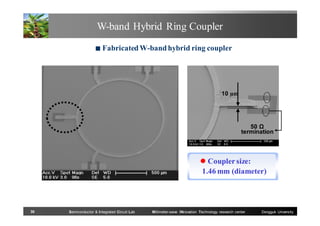
Fabricated W-band hybrid ring coupler

10 µm

50 Ω
termination

 Coupler size:
1.46 mm (diameter)

30

Semiconductor & Integrated Circuit Lab

Millimeter-wave INnovation Technology research center

Dongguk University
W-band Hybrid Ring Coupler
■

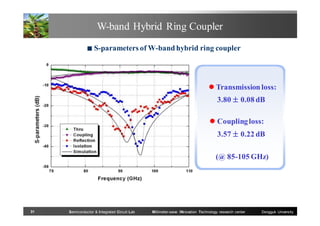
S-parameters of W-band hybrid ring coupler

 Transmission loss:
3.80 ± 0.08 dB
 Coupling loss:
3.57 ± 0.22 dB
(@ 85-105 GHz)

31

Semiconductor & Integrated Circuit Lab

Millimeter-wave INnovation Technology research center

Dongguk University
Hybrid Ring Coupler
■

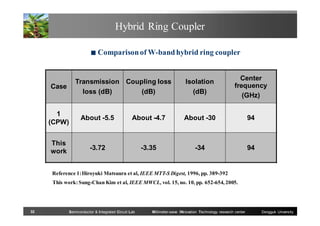
Comparison of W-band hybrid ring coupler

Case

Transmission Coupling loss
loss (dB)
(dB)

Isolation
(dB)

Center
frequency
(GHz)

1
(CPW)

About -5.5

About -4.7

About -30

94

This
work

-3.72

-3.35

-34

94

Reference 1: Hiroyuki Matsuura et al, IEEE MTT-S Digest, 1996, pp. 389-392
This work: Sung-Chan Kim et al, IEEE MWCL, vol. 15, no. 10, pp. 652-654, 2005.

32

Semiconductor & Integrated Circuit Lab

Millimeter-wave INnovation Technology research center

Dongguk University
Passive Device using DAML Technology
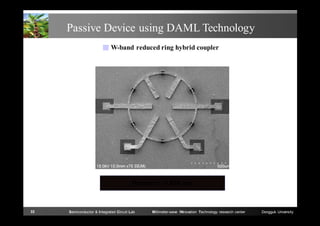
■ W-band reduced ring hybrid coupler

Diameter : 0.888 mm

33

Semiconductor & Integrated Circuit Lab

Millimeter-wave INnovation Technology research center

Dongguk University
Passive Device using DAML Technology
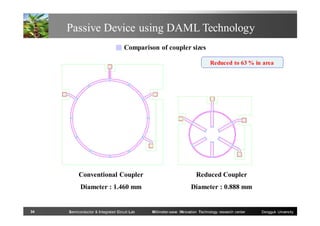
■ Comparison of coupler sizes
Reduced to 63 % in area

Conventional Coupler
Diameter : 1.460 mm

34

Reduced Coupler
Diameter : 0.888 mm

Semiconductor & Integrated Circuit Lab

Millimeter-wave INnovation Technology research center

Dongguk University
Passive Device using DAML Technology
■ Measurement result of W-band reduced ring hybrid coupler
0

0
-10

S-parameter [dB]

S-parameter [dB]

-20

-30

-40

-50

S21Thru
S31coupling
S23Isolation

-60
75

80

85

-10

-20

-30

S11
S22
S33

-40

90

95

100

105

Frequency [GHz]

Insertion loss

110

70

75

80

85

90

95

100

105

115

Frequency [GHz]

Return loss

Coupling loss: 4.35 dB

Isolation: -48.23 dB

Transmission loss: 4.44 dB
35

110

Return loss: below -25 dB (all port)

Semiconductor & Integrated Circuit Lab

Millimeter-wave INnovation Technology research center

Dongguk University
Passive Device using DAML Technology
■

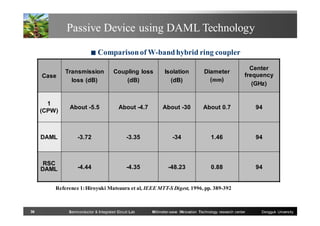
Comparison of W-band hybrid ring coupler

Case

Transmission
loss (dB)

Coupling loss
(dB)

Isolation
(dB)

Diameter
(mm)

Center
frequency
(GHz)

1
(CPW)

About -5.5

About -4.7

About -30

About 0.7

94

DAML

-3.72

-3.35

-34

1.46

94

RSC
DAML

-4.44

-4.35

-48.23

0.88

94

Reference 1: Hiroyuki Matsuura et al, IEEE MTT-S Digest, 1996, pp. 389-392

36

Semiconductor & Integrated Circuit Lab

Millimeter-wave INnovation Technology research center

Dongguk University
Passive Device using DAML Technology
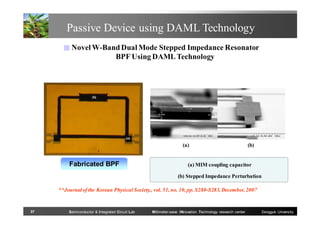
■ Novel W-Band Dual Mode Stepped Impedance Resonator

BPF Using DAML Technology

(b)

(a)

(a)

Fabricated BPF

(b)

(a) MIM coupling capacitor
(b) Stepped Impedance Perturbation

**Journal of the Korean Physical Society., vol. 51, no. 10, pp. S280-S283, December, 2007

37

Semiconductor & Integrated Circuit Lab

Millimeter-wave INnovation Technology research center

Dongguk University
Passive Device using DAML Technology
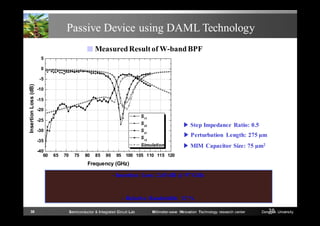
■ Measured Result of W-band BPF
5
0

Insertion Loss (dB)

-5
-10
-15
-20
S11

-25

S22

-30
-35

▶ Step Impedance Ratio: 0.5

S21
S12

-40
60

▶ Perturbation Length: 275 µm

Simulation
65

70

75

80

85

90

95

▶ MIM Capacitor Size: 75 µm2

100 105 110 115 120

Frequency (GHz)

- Insertion Loss: 2.65 dB @ 97 GHz

- Relative Bandwidth: 12 %
38

Semiconductor & Integrated Circuit Lab

Millimeter-wave INnovation Technology research center

38
Dongguk University
Passive Device using DAML Technology
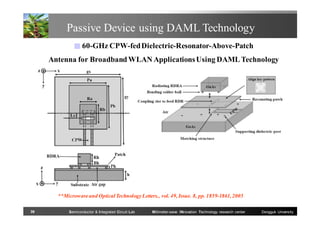
■ 60-GHz CPW-fed Dielectric-Resonator-Above-Patch

Antenna for Broadband WLAN Applications Using DAML Technology

**Microwave and Optical Technology Letters., vol. 49, Issue. 8, pp. 1859-1861, 2005
39

Semiconductor & Integrated Circuit Lab

Millimeter-wave INnovation Technology research center

Dongguk University
Passive Device using DAML Technology
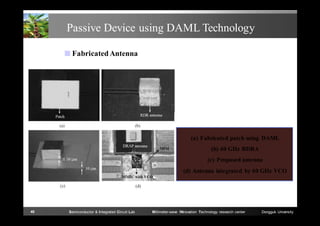
■ Fabricated Antenna

(a) Fabricated patch using DAML
(b) 60 GHz RDRA
(c) Proposed antenna
(d) Antenna integrated by 60 GHz VCO

40

Semiconductor & Integrated Circuit Lab

Millimeter-wave INnovation Technology research center

Dongguk University
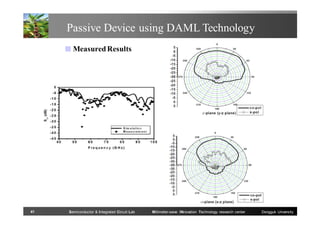
Passive Device using DAML Technology
■ Measured Results

41

Semiconductor & Integrated Circuit Lab

Millimeter-wave INnovation Technology research center

Dongguk University
3-D W-band Single Balanced
Active Mixer

42

Semiconductor & Integrated Circuit Lab

Millimeter-wave INnovation Technology research center

Dongguk University
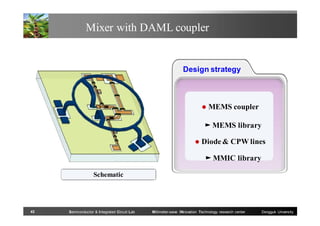
Mixer with DAML coupler

Design strategy



MEMS coupler

► MEMS library


Diode & CPW lines
► MMIC library

Schematic

43

Semiconductor & Integrated Circuit Lab

Millimeter-wave INnovation Technology research center

Dongguk University
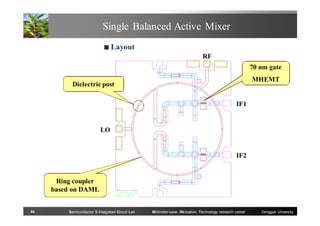
Single Balanced Active Mixer
■

Layout
RF
70 nm gate
MHEMT

Dielectric post
IF1

LO

IF2

Ring coupler
based on DAML

44

Semiconductor & Integrated Circuit Lab

Millimeter-wave INnovation Technology research center

Dongguk University
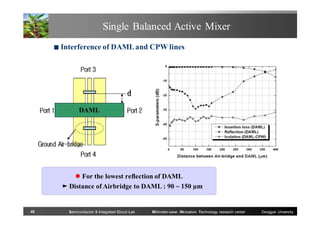
Single Balanced Active Mixer
■

Interference of DAML and CPW lines

DAML

 For the lowest reflection of DAML
► Distance of Airbridge to DAML : 90 ~ 150 µm

45

Semiconductor & Integrated Circuit Lab

Millimeter-wave INnovation Technology research center

Dongguk University
Single Balanced Active Mixer
■

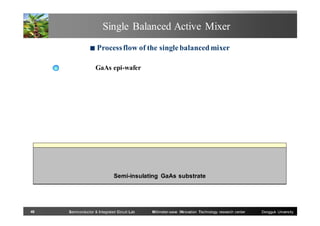
Process flow of the single balanced mixer
GaAs epi-wafer

Semi-insulating GaAs substrate

46

Semiconductor & Integrated Circuit Lab

Millimeter-wave INnovation Technology research center

Dongguk University
Single Balanced Active Mixer

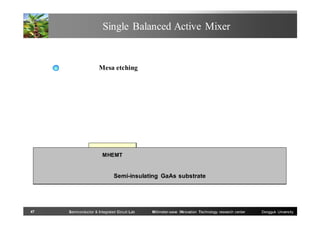
Mesa etching

MHEMT

Semi-insulating GaAs substrate

47

Semiconductor & Integrated Circuit Lab

Millimeter-wave INnovation Technology research center

Dongguk University
Single Balanced Active Mixer

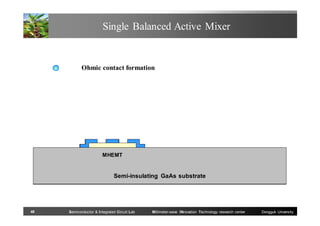
Ohmic contact formation

MHEMT

Semi-insulating GaAs substrate

48

Semiconductor & Integrated Circuit Lab

Millimeter-wave INnovation Technology research center

Dongguk University
Single Balanced Active Mixer

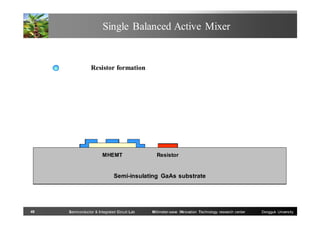
Resistor formation

MHEMT

Resistor

Semi-insulating GaAs substrate

49

Semiconductor & Integrated Circuit Lab

Millimeter-wave INnovation Technology research center

Dongguk University
Single Balanced Active Mixer

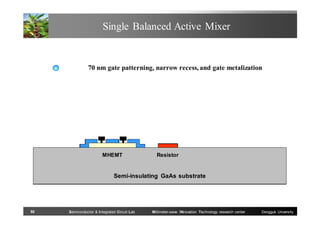
70 nm gate patterning, narrow recess, and gate metalization

MHEMT

Resistor

Semi-insulating GaAs substrate

50

Semiconductor & Integrated Circuit Lab

Millimeter-wave INnovation Technology research center

Dongguk University
Single Balanced Active Mixer

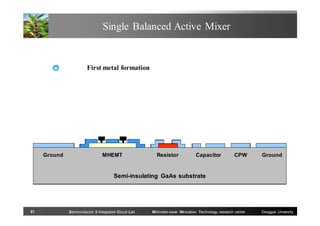
First metal formation

Ground

MHEMT

Resistor

Capacitor

CPW

Ground

Semi-insulating GaAs substrate

51

Semiconductor & Integrated Circuit Lab

Millimeter-wave INnovation Technology research center

Dongguk University
Single Balanced Active Mixer

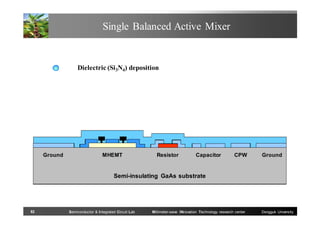
Dielectric (Si3N4) deposition

Ground

MHEMT

Resistor

Capacitor

CPW

Ground

Semi-insulating GaAs substrate

52

Semiconductor & Integrated Circuit Lab

Millimeter-wave INnovation Technology research center

Dongguk University
Single Balanced Active Mixer

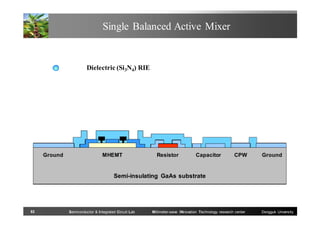
Dielectric (Si3N4) RIE

Ground

MHEMT

Resistor

Capacitor

CPW

Ground

Semi-insulating GaAs substrate

53

Semiconductor & Integrated Circuit Lab

Millimeter-wave INnovation Technology research center

Dongguk University
Single Balanced Active Mixer

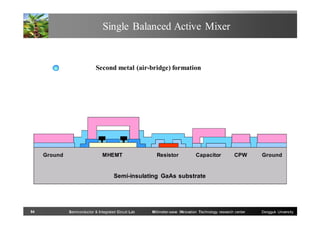
Second metal (air-bridge) formation

Ground

MHEMT

Resistor

Capacitor

CPW

Ground

Semi-insulating GaAs substrate

54

Semiconductor & Integrated Circuit Lab

Millimeter-wave INnovation Technology research center

Dongguk University
Single Balanced Active Mixer

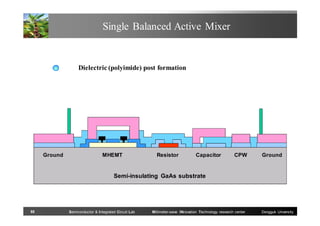
Dielectric (polyimide) post formation

Ground

MHEMT

Resistor

Capacitor

CPW

Ground

Semi-insulating GaAs substrate

55

Semiconductor & Integrated Circuit Lab

Millimeter-wave INnovation Technology research center

Dongguk University
Single Balanced Active Mixer

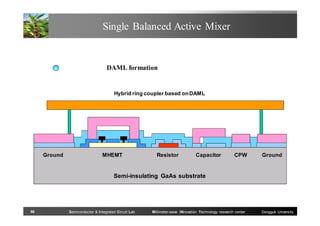
DAML formation

Hybrid ring coupler based on DAML

Ground

MHEMT

Resistor

Capacitor

CPW

Ground

Semi-insulating GaAs substrate

56

Semiconductor & Integrated Circuit Lab

Millimeter-wave INnovation Technology research center

Dongguk University
Single Balanced Active Mixer
■

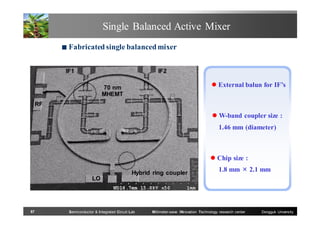
Fabricated single balanced mixer

IF1

IF2

 External balun for IF’s

70 nm
MHEMT
RF

 W-band coupler size :
1.46 mm (diameter)

 Chip size :
Hybrid ring coupler

1.8 mm × 2.1 mm

LO

57

Semiconductor & Integrated Circuit Lab

Millimeter-wave INnovation Technology research center

Dongguk University
Single Balanced Active Mixer
■

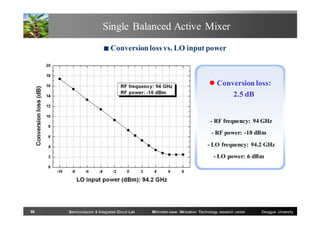
Conversion loss vs. LO input power

 Conversion loss:
2.5 dB

- RF frequency: 94 GHz
- RF power: -10 dBm
- LO frequency: 94.2 GHz
- LO power: 6 dBm

58

Semiconductor & Integrated Circuit Lab

Millimeter-wave INnovation Technology research center

Dongguk University
Single Balanced Active Mixer
■

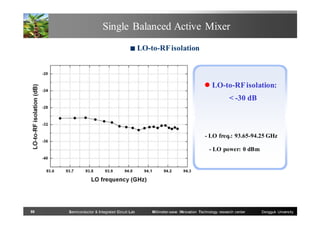
LO-to-RF isolation

 LO-to-RF isolation:
< -30 dB

- LO freq.: 93.65-94.25 GHz
- LO power: 0 dBm

59

Semiconductor & Integrated Circuit Lab

Millimeter-wave INnovation Technology research center

Dongguk University
Single Balanced Active Mixer
■

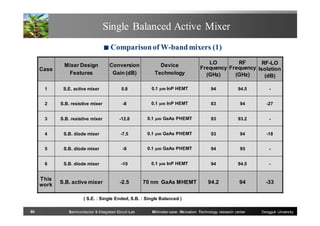
Comparison of W-band mixers (1)
LO
RF
RF-LO
Frequency Frequency Isolation
(GHz)
(GHz)
(dB)

Case

Mixer Design
Features

Conversion
Gain (dB)

Device
Technology

1

S.E. active mixer

0.8

0.1 µm InP HEMT

94

94.5

-

2

S.B. resistive mixer

-8

0.1 µm InP HEMT

83

94

-27

3

S.B. resistive mixer

-12.8

0.1 µm GaAs PHEMT

93

93.2

-

4

S.B. diode mixer

-7.5

0.1 µm GaAs PHEMT

93

94

-18

5

S.B. diode mixer

-9

0.1 µm GaAs PHEMT

94

95

-

6

S.B. diode mixer

-10

0.1 µm InP HEMT

94

94.5

-

This
work

S.B. active mixer

-2.5

70 nm GaAs MHEMT

94.2

94

-33

( S.E. : Single Ended, S.B. : Single Balanced )
60

Semiconductor & Integrated Circuit Lab

Millimeter-wave INnovation Technology research center

Dongguk University
Single Balanced Active Mixer
■

Comparison of W-band mixers (2)
Single balanced active mixer:

Low conversion loss: high-performance 70 nm MHEMTs
High isolation: hybrid ring coupler based on DAML
- References
[1] Robinder S. Virk et al., IEEE MTT-S Digest, 1997, pp. 435-438.
[2] A. R. Barnes et al., IEEE MTT-S Digest, 2002, pp. 1867-1870.
[3] K. W. Chang et al., IEEE Microwave and Guided Wave Letters, vol. 4, no. 9, pp. 301-302, 1994.
[4] K. W. Chang et al., IEEE Transactions on Microwave Theory and Techniques, vol. 39, no. 12, pp. 1972-1979, 1991.
[5] K. W. Chang et al., Proc. IEEE Microwave and Millimeter-wave Monolithic Circuits Symposium, 1993, pp. 41-44.
[6] Robinder S. Virk et al., IEEE MTT-S Digest, 1997, pp. 435-438.
This work: Sung Chan Kim et al., IEEE Electron Device Letters, vol. 27, no. 1, pp. 28-30, 2006.

61

Semiconductor & Integrated Circuit Lab

Millimeter-wave INnovation Technology research center

Dongguk University
A transceiver module for FM-CW radar sensors
using 94 GHz dot-type Schottky diode mixer

Taejong Baek
Department of Electronics and Electrical Engineering
Graduate School
Dongguk University

Semiconductor & Integrated Circuit Lab

Millimeter-wave INnovation Technology research center

Dongguk University
Introduction

63

Semiconductor & Integrated Circuit Lab

Millimeter-wave INnovation Technology research center

Dongguk University
Introduction

64

Semiconductor & Integrated Circuit Lab

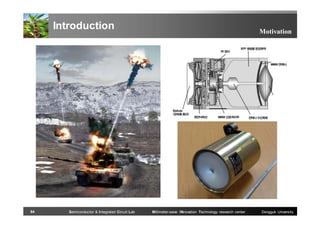
Motivation

Millimeter-wave INnovation Technology research center

Dongguk University
Introduction

Passive & Active

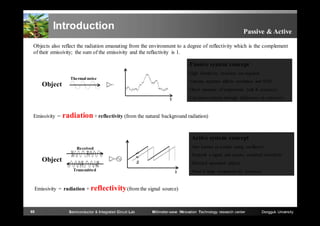
Objects also reflect the radiation emanating from the environment to a degree of reflectivity which is the complement
of their emissivity; the sum of the emissivity and the reflectivity is 1.

Passive system concept
High Sensitivity receivers are required
Thermal noise

Antenna aperture affects resolution and SNR

Object

Direct measure of temperature (sub K accuracy)
Can detect objects through differences in emissivity

T

Emissivity =

radiation + reflectivity (from the natural background radiation)
Active system concept
Also known as a radar (using oscillator)

Received

Transmit a signal and receive scattered waveform

Object

Detected unwanted objects
Transmitted

T

Need to large computational resources

Emissivity = radiation + reflectivity (from the signal source)

65

Semiconductor & Integrated Circuit Lab

Millimeter-wave INnovation Technology research center

Dongguk University
InP Gunn Diode

66

Semiconductor & Integrated Circuit Lab

Millimeter-wave INnovation Technology research center

Dongguk University
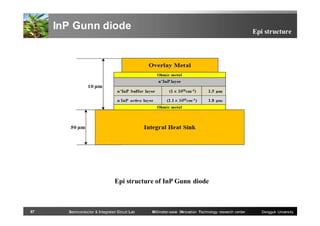
InP Gunn diode

Epi structure

Epi structure of InP Gunn diode

67

Semiconductor & Integrated Circuit Lab

Millimeter-wave INnovation Technology research center

Dongguk University
InP Gunn diode
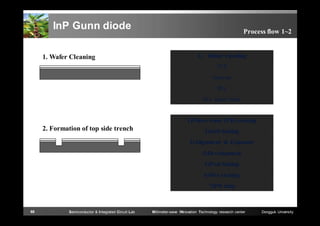
1. Wafer Cleaning

Process flow 1~2

1) Initial cleaning
TCE
Acetone
IPA
D.I. water rinse

1)Photo resist (PR) coating

2. Formation of top side trench

2)Soft baking
3)Alignment & Exposure
4)Development
5)Post baking
6)Wet etching
7)PR strip

68

Semiconductor & Integrated Circuit Lab

Millimeter-wave INnovation Technology research center

Dongguk University
InP Gunn diode
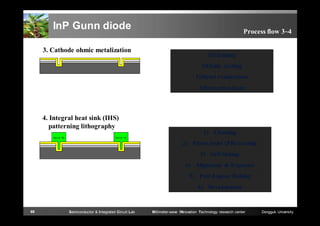
3. Cathode ohmic metalization

Process flow 3~4

1)Cleaning
2)Oxide etching
3)Metal evaporation
4)Protection layer

4. Integral heat sink (IHS)
patterning lithography
1) Cleaning
2) Photo resist (PR) coating
3) Soft baking
4) Alignment & Exposure
5) Post Expose Baking
6) Development

69

Semiconductor & Integrated Circuit Lab

Millimeter-wave INnovation Technology research center

Dongguk University
InP Gunn diode

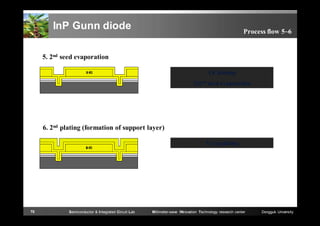
Process flow 5~6

5. 2nd seed evaporation
1)Cleaning
2)2nd seed evaporation

6. 2nd plating (formation of support layer)
1) Au plating

70

Semiconductor & Integrated Circuit Lab

Millimeter-wave INnovation Technology research center

Dongguk University
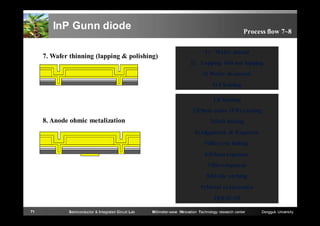
InP Gunn diode

Process flow 7~8

7. Wafer thinning (lapping & polishing)

1) Wafer mount
2) Lapping 640 um lapping
3) Wafer de-mount
4) Cleaning
1)Cleaning
2)Photo resist (PR) coating

8. Anode ohmic metalization

3)Soft baking
4)Alignment & Exposure
5)Reverse baking
6)Flood exposure
7)Development
8)Oxide etching
9)Metal evaporation
10)Lift-off

71

Semiconductor & Integrated Circuit Lab

Millimeter-wave INnovation Technology research center

Dongguk University
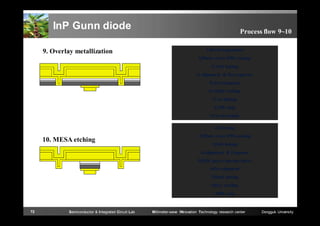
InP Gunn diode
9. Overlay metallization

Process flow 9~10
1)Seed evaporation
2)Photo resist (PR) coating
3) Soft baking
4) Alignment & Pre-exposure
5) Development
6) Oxide etching
7) Au plating
8) PR strip
9) Seed etching
1)Cleaning

10. MESA etching

2)Photo resist (PR) coating
3)Soft baking
4)Alignment & Exposure
5)PEB (post exposure bake)
6)Development
7)Hard baking
8)Dry etching
9)PR strip

72

Semiconductor & Integrated Circuit Lab

Millimeter-wave INnovation Technology research center

Dongguk University
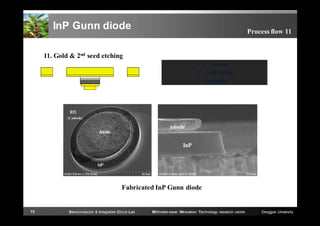
InP Gunn diode

Process flow 11

11. Gold & 2nd seed etching
1)
2)

Cleaning
Oxide etching

3) Au etching

(Cathode)

anode
InP

Fabricated InP Gunn diode

73

Semiconductor & Integrated Circuit Lab

Millimeter-wave INnovation Technology research center

Dongguk University
Packaged Diode

74

Semiconductor & Integrated Circuit Lab

Millimeter-wave INnovation Technology research center

Dongguk University
InP Gunn diode

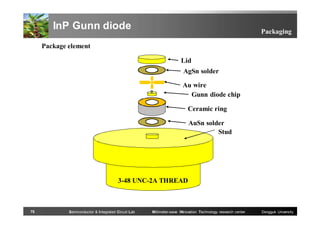
Packaging

Package element
Lid
AgSn solder
Au wire
Gunn diode chip
Ceramic ring
AuSn solder
Stud

3-48 UNC-2A THREAD

75

Semiconductor & Integrated Circuit Lab

Millimeter-wave INnovation Technology research center

Dongguk University
InP Gunn diode

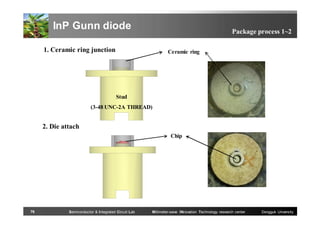
Package process 1~2

1. Ceramic ring junction

Ceramic ring

Stud
(3-48 UNC-2A THREAD)

2. Die attach
Chip

76

Semiconductor & Integrated Circuit Lab

Millimeter-wave INnovation Technology research center

Dongguk University
InP Gunn diode

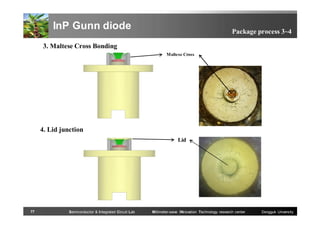
Package process 3~4

3. Maltese Cross Bonding
Maltese Cross

4. Lid junction
Lid

77

Semiconductor & Integrated Circuit Lab

Millimeter-wave INnovation Technology research center

Dongguk University
InP Gunn diode

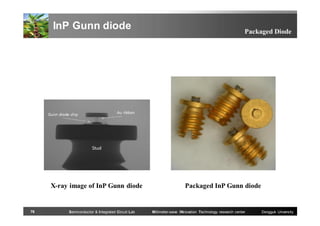
X-ray image of InP Gunn diode

78

Semiconductor & Integrated Circuit Lab

Packaged Diode

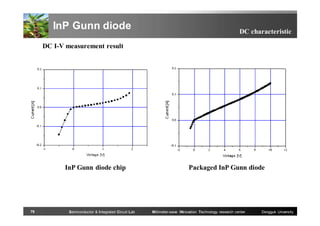
Packaged InP Gunn diode

Millimeter-wave INnovation Technology research center

Dongguk University
InP Gunn diode

DC characteristic

DC I-V measurement result

InP Gunn diode chip

79

Semiconductor & Integrated Circuit Lab

Packaged InP Gunn diode

Millimeter-wave INnovation Technology research center

Dongguk University
InP Gunn diode

RF characteristic

Measurement results of packaged InP Gunn diode

Chip number

Voltage [V]

Current [mA]

Oscillation frequency [GHz]

Output Power [dBm]

1

12.4

299

94

17.8

2

11.7

260

93.98

16

3

9.7

299

94.25

15.6

4

10.9

349

93.9

16.6

5

9.3

349

93.8

16.4

Oscillation characteristics of fabricated InP Gunn diode

80

Semiconductor & Integrated Circuit Lab

Millimeter-wave INnovation Technology research center

Dongguk University
Transceiver

81

Semiconductor & Integrated Circuit Lab

Millimeter-wave INnovation Technology research center

Dongguk University
82

Semiconductor & Integrated Circuit Lab

Millimeter-wave INnovation Technology research center

Dongguk University
83

Semiconductor & Integrated Circuit Lab

Millimeter-wave INnovation Technology research center

Dongguk University
84

Semiconductor & Integrated Circuit Lab

Millimeter-wave INnovation Technology research center

Dongguk University
85

Semiconductor & Integrated Circuit Lab

Millimeter-wave INnovation Technology research center

Dongguk University
86

Semiconductor & Integrated Circuit Lab

Millimeter-wave INnovation Technology research center

Dongguk University
87

Semiconductor & Integrated Circuit Lab

Millimeter-wave INnovation Technology research center

Dongguk University
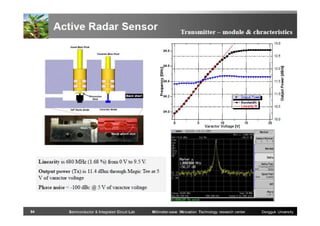
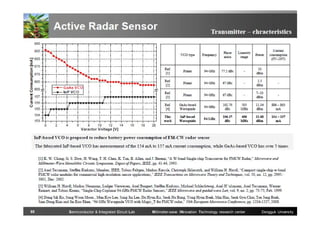
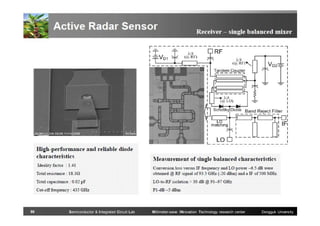
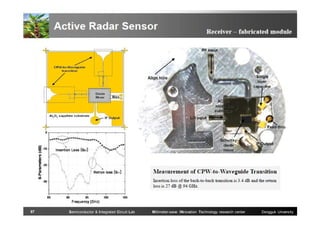
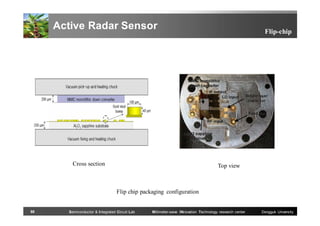
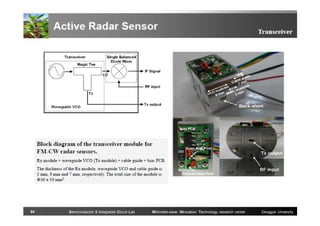
Active Radar Sensor

Cross section

Flip-chip

Top view

Flip chip packaging configuration

88

Semiconductor & Integrated Circuit Lab

Millimeter-wave INnovation Technology research center

Dongguk University
Active Radar Sensor
(a)

(b)

Flip-chip
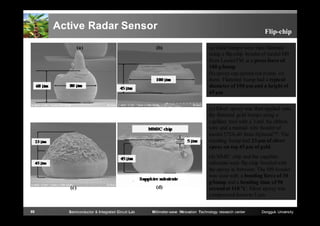
(a) Gold bumps were then flattened
using a flip-chip bonder of model M9
from LaurierTM at a press force of
100 g/bump
(b) epoxy can spread out evenly on
them. Flattened bump had a typical
diameter of 100 μm and a height of
45 μm
(c) Silver epoxy was then applied onto
the flattened gold bumps using a
capillary tool with a 3-mil Au ribbon
wire and a manual wire bonder of
model 572A-40 from HybondTM . The
resulting bump had 23 μm of silver
epoxy on top 45 μm of gold.

(c)

89

Semiconductor & Integrated Circuit Lab

(d)

(d) MMIC chip and the sapphire
substrate were flip-chip bonded with
the epoxy in between. The M9 bonder
was used with a bonding force of 30
g/bump and a bonding time of 90
second at 110 °C. Silver epoxy was
compressed down to 5 μm.

Millimeter-wave INnovation Technology research center

Dongguk University
Active Radar Sensor

RF Characteristic
0

S-parameter [dB]

-5
-10
-15
-20
-25
-30

Insertion loss
Return loss

-35
75

80

85

90

95

100

105

110

115

Frequency [dB]
Reference

Bump material

Bonding condition

Loss/frequency

[1]

Au

350℃, 20 g/pillar

0.2 dB/77 GHz

[2]

Au

275℃, 230 N/mm2

0.2 dB/NA

This work

Au / Ag epoxy

110℃, 30g/bump

0.205 dB/94 GHz

[1] Aoki, S.; Someta, H.; Yokokawa, S.; Ono, K.; Hirose, T.; Ohashi, Y.;, “A flip chip bonding technology using gold pillars for
millimeter-wave applications,” in Proc. IEEE MTT-S Int. Microw. Symp. Dig. 1997, vol. 2, pp. 731-734, 1997.
[2] Heinrich, W.; Jentzsch, A.; Richter, H.;, “Flip-chip interconnects for frequencies up to W band,” Electron. Lett., vol. 37, issue 3, pp.
180-181, 2001.
90

Semiconductor & Integrated Circuit Lab

Millimeter-wave INnovation Technology research center

Dongguk University
Active Radar Sensor

91

Semiconductor & Integrated Circuit Lab

Millimeter-wave INnovation Technology research center

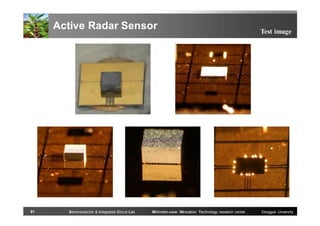
Test image

Dongguk University
Active Radar Sensor

Shear test

The shear tests were performed using a model 4000 series shear test machine from DageTM , widely used
to measure the interconnection strength between the MMIC chip and the sapphire substrate. The speed of
the shear blade was 300 μm/s, with the tip located at 40 μm above the surface of the sapphire substrate.
The flip-chip bonded die, which used proposed low-temperature flip-chip bonding method and 20 bumps
of 100 μm diameter, was separated at a force of 900 g.
Bonding temperature

Die shear strength [mg/ ㎛2]

100℃

1.55

150℃

2.19

200℃

4.38

ACP

220℃

1.05

ACF

220℃

1.07

[3]

CuSn

260℃

2.17

This work

Au/Ag epoxy

110℃

5.73

Reference

[1]

Bump material

Indium

[2]

[1] Kun-Mo Chu, Jung-Sub Lee, Han Seo Cho, Hyo-Hoon Park, Duk Young Jeon, “A fluxless flip-chip bonding for VCSEL arrays using
silver-coated indium solder bumps,” IEEE Trans. Electronics Packag. Manuf., vol. 27, no. 4, pp. 246-253, 2004.
[2] Tan Ai Min, Sharon Pei-Siang Lim and Charles Lee, “Development of solder replacement flip chip using anisotropic conductive
adhesives,” in Proc. 5 th Electron. Packag. Tech. Conf. 2003, pp. 390-396, 2003.
[3] Katsuyuki Sakuma, Jun Mizuno, Noriyasu Nagai, Naoko Unami, and Shuichi Shoji, “Effects of Vacuum Ultraviolet Surface
Treatment on the Bonding Interconnections for Flip Chip and 3-D Integration.” IEEE Trans. Electronics Packag. Manuf., vol. 33, no. 3,
pp. 212-220, 2010.

92

Semiconductor & Integrated Circuit Lab

Millimeter-wave INnovation Technology research center

Dongguk University
93

Semiconductor & Integrated Circuit Lab

Millimeter-wave INnovation Technology research center

Dongguk University
94

Semiconductor & Integrated Circuit Lab

Millimeter-wave INnovation Technology research center

Dongguk University
Studies of the Millimeter-Wave Radiometric
Sensor and Fabricated Passive Imaging System

Taejong Baek
Advisor : Jin-Koo Rhee
Department of Electronics and Electrical Engineering
Graduate School
Dongguk University

Semiconductor & Integrated Circuit Lab

Millimeter-wave INnovation Technology research center

Dongguk University
Introduction

96

Semiconductor & Integrated Circuit Lab

Millimeter-wave INnovation Technology research center

Dongguk University
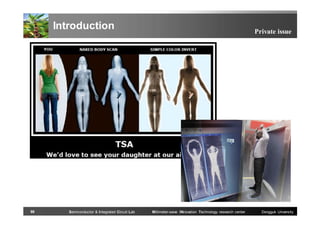
Introduction

Motivation

The increased threats of criminal or terrorist action in recent years have led to the development of many techniques for
the detection of concealed weapons, contraband, explosives or other threats.

Traditional method
Metal detectors
X-ray imaging systems

Insufficient for modern and health threats!
Plastic and liquid explosive
Plastic or ceramic guns and knives
Ionizing radiation

Advanced method
Millimeter-wave/terahertz security systems

97

Semiconductor & Integrated Circuit Lab

Millimeter-wave INnovation Technology research center

Dongguk University
Introduction

98

Semiconductor & Integrated Circuit Lab

Private issue

Millimeter-wave INnovation Technology research center

Dongguk University
Background and Theory

Radiation law

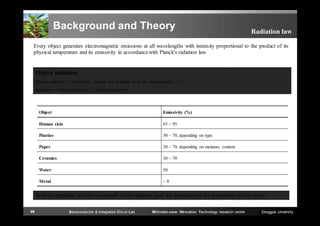
Every object generates electromagnetic emissions at all wavelengths with intensity proportional to the product of its
physical temperature and its emissivity in accordance with Planck's radiation law.

Object radiation
Object emissivity + reflectivity (reflect the radiation form the environment) = 1
Radiation = Object reflectivity + Object emissivity

Object

Emissivity (%)

Human skin

65 ~ 95

Plastics

30 ~ 70, depending on type

Paper

30 ~ 70, depending on moisture content

Ceramics

30 ~ 70

Water

50

Metal

~0

Both the amplitude and the wavelength of the radiation peak are dependent on the temperature of the object.
99

Semiconductor & Integrated Circuit Lab

Millimeter-wave INnovation Technology research center

Dongguk University
System Arrangement

Target Specification

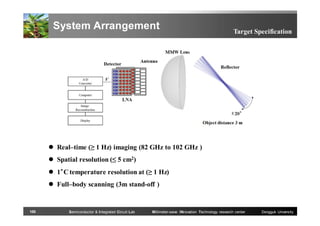
 Real–time (≥ 1 Hz) imaging (82 GHz to 102 GHz )
 Spatial resolution (≤ 5 cm2)
 1°C temperature resolution at (≥ 1 Hz)
 Full–body scanning (3m stand-off )

100

Semiconductor & Integrated Circuit Lab

Millimeter-wave INnovation Technology research center

Dongguk University
System Arrangement

NETD

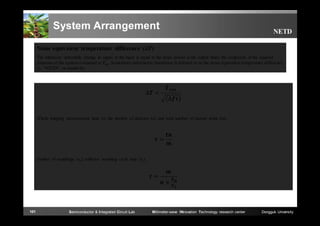
Noise equivalent temperature difference (∆ )
The minimum detectable change in signal at the input is equal to the noise power at the output times the reciprocal of the squared
response of the system evaluated at Tsys. Sometimes radiometric resolution is referred to as the noise equivalent temperature difference,
i.e. “NETD”, or sensitivity.

∆ =

∆

Whole imaging measurement time (t), the number of detector (n), and total number of picture point (m):

=
number of samplings (sn ), reflector scanning cycle time (rt ):

=

101

Semiconductor & Integrated Circuit Lab

×

Millimeter-wave INnovation Technology research center

Dongguk University
System Arrangement

Integration Time

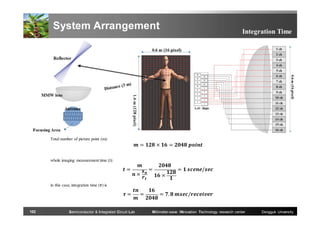
Total number of picture point (m):

=

×

=


whole imaging measurement time (t):

=

×

=

= 	

/

×

in this case, integration time ( ) is

=
102

Semiconductor & Integrated Circuit Lab

=

= . 	

/

Millimeter-wave INnovation Technology research center

Dongguk University
System Arrangement

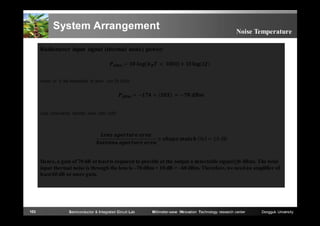
Noise Temperature

Radiometer input signal (thermal noise) power:
=

(

	 × 	1000)	+	10

(∆ )

where Δf is the bandwidth in hertz (set 20 GHz)

=−

+

	≈ −


Lens concentrate thermal noise ratio (dB)


×


	 % = 10	dB

Hence, a gain of 70 dB at least is required to provide at the output a detectable signal (≥0 dBm). The total
input thermal noise is through the lens is –70 dBm + 10 dB = –60 dBm. Therefore, we need an amplifier of
least 60 dB or more gain.

103

Semiconductor & Integrated Circuit Lab

Millimeter-wave INnovation Technology research center

Dongguk University
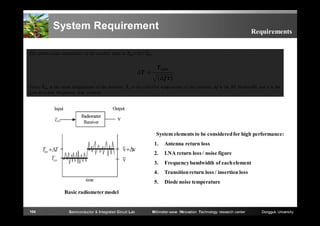
System Requirement

Requirements

The system noise temperature at the receiver input is Tsys= TA+ Trec

∆ =

∆

where Trec is the noise temperature of the detector, TA is the effective temperature of the antenna, Δf is the RF bandwidth and τ is the
post-detection integration time constant.

System elements to be considered for high performance:
1.

Antenna return loss

2.

LNA return loss / noise figure

3.

Frequency bandwidth of each element

4.

Transition return loss / insertion loss

5.

Diode noise temperature

Basic radiometer model

104

Semiconductor & Integrated Circuit Lab

Millimeter-wave INnovation Technology research center

Dongguk University
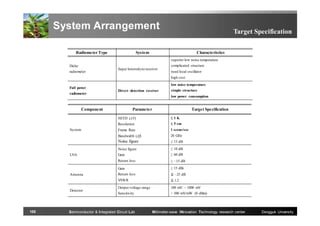
System Arrangement
Radiometer Type

Target Specification

System

Characteristics
superior low noise temperature
complicated structure

Dicke
radiometer

Super heterodyne receiver

need local oscillator
high cost

Full power
radiometer

low noise temperature
Direct– detection receiver

simple structure
low power consumption

Component

Parameter

Target Specification

NETD (ΔT)
Resolution

≤ 15 dB
≤ 10 dB

Gain

≥ 60 dB
≤ – 15 dB

Gain

≥ 15 dBi

Return loss

≦ – 25 dB

VSWR

105

20 GHz

Return loss

Detector

1 scene/sec

Noise figure

Antenna

Frame Rate

Noise figure
LNA

≤ 5 cm

Bandwidth (Δf)

System

≤1K

≦ 1.2

Output voltage range

100 mV ~ 1000 mV

Sensitivity

> 500 mV/mW (0 dBm)

Semiconductor & Integrated Circuit Lab

Millimeter-wave INnovation Technology research center

Dongguk University
Development of
Radiometer Receiver

106

Semiconductor & Integrated Circuit Lab

Millimeter-wave INnovation Technology research center

Dongguk University
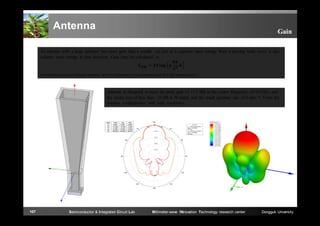
Antenna

Gain

An antenna with a large aperture has more gain than a smaller on; just as it captures more energy from a passing radio wave, it also
radiates more energy in that direction. Gain may be calculated as
=
with reference to an isotropic radiator; ƞ is the efficiency of the antenna and A is the aperture area.

Antenna is designed to have the peak gain of 17.5 dBi at the center frequency of 94 GHz, and
the return loss of less than -25 dB in W-band, and the small aperture size of 6 mm × 9 mm for
antenna configuration with high resolution.

107

Semiconductor & Integrated Circuit Lab

Millimeter-wave INnovation Technology research center

Dongguk University
Antenna

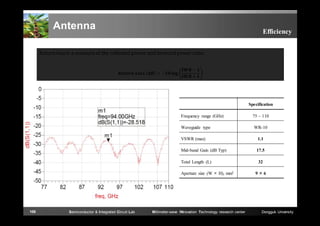
Efficiency

Return	loss	is	a	measure	of	the	reflected	power	and	forward	power	ratio.


=−

−
+

Specification
Frequency range (GHz)
Waveguide type

75 ~ 110
WR-10

VSWR (max)

1.1

Mid-band Gain (dB Typ)

17.5

Total Length (L)
Aperture size (W × H), mm2

108

Semiconductor & Integrated Circuit Lab

Millimeter-wave INnovation Technology research center

32
9×6

Dongguk University
Antenna

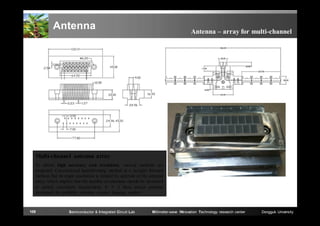
Antenna – array for multi-channel

Multi-channel antenna array
To obtain high accuracy and resolution, various methods are
proposed. Conventional beamforming method is a straight forward
method, but its angle resolution is limited by aperture of the antenna
array, which implies that the number of antennas should be increased
to satisfy resolution requirement. 8 × 2 horn arrays antenna
developed for available real-time passive imaging system.

109

Semiconductor & Integrated Circuit Lab

Millimeter-wave INnovation Technology research center

Dongguk University
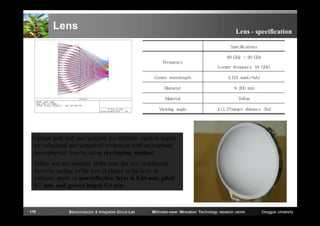
Lens

Lens - specification
Specifications
89 GHz ~ 99 GHz
Frequency
(center frequency 94 GHz)
Center wavelength

3.191 mm(c=υλ)

Diameter

≤ 200 mm

Material

Teflon

Viewing angle

±11.3°(target distance 3m)

Optical path and spot-patterns for different incident angles
are calculated and compared without or with an extended
hemispherical lens by using ray-tracing method.
Teflon was the material of the lens, the lens is reflected
from the surface of the lens is placed in the hole. In
addition, depth of non-reflective layer is 0.66 mm, pitch
0.7 mm, and groove length 0.4 mm.

110

Semiconductor & Integrated Circuit Lab

Millimeter-wave INnovation Technology research center

Dongguk University
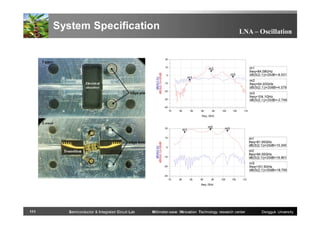
System Specification

111

Semiconductor & Integrated Circuit Lab

LNA – Oscillation

Millimeter-wave INnovation Technology research center

Dongguk University
LNA

LNA module – 4-stage
80
60

S11

S-Parameter [dB]

40

S21
S12

20

S22

0

-20
-40
-60
-80
80

85

90

95

Frequency [GHz]

100

105

110

4-stage LNA module measured characteristics
Average linear gain: 65.8 dB @ 81 ~ 102 GHz
68.2 dB @ 94 GHz

112

Semiconductor & Integrated Circuit Lab

Millimeter-wave INnovation Technology research center

Dongguk University
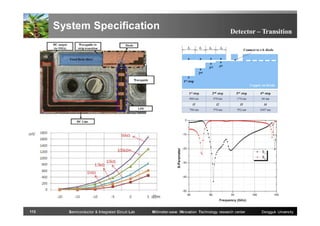
System Specification

113

Semiconductor & Integrated Circuit Lab

Detector – Transition

Millimeter-wave INnovation Technology research center

Dongguk University
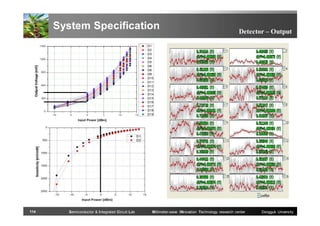
System Specification

114

Semiconductor & Integrated Circuit Lab

Detector – Output

Millimeter-wave INnovation Technology research center

Dongguk University
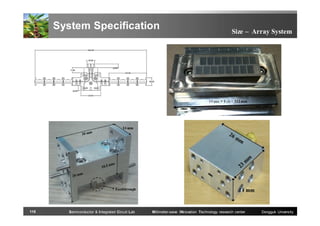
System Specification

115

Semiconductor & Integrated Circuit Lab

Size – Array System

Millimeter-wave INnovation Technology research center

Dongguk University
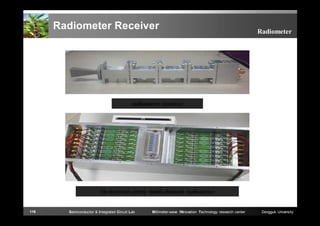
Radiometer Receiver

Radiometer

radiometer receiver

16 receivers array multi-channel radiometer

116

Semiconductor & Integrated Circuit Lab

Millimeter-wave INnovation Technology research center

Dongguk University
Development of
Security Screening System

117

Semiconductor & Integrated Circuit Lab

Millimeter-wave INnovation Technology research center

Dongguk University
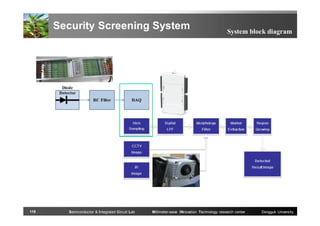
Security Screening System

118

Semiconductor & Integrated Circuit Lab

System block diagram

Millimeter-wave INnovation Technology research center

Dongguk University
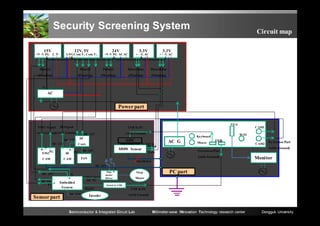
Security Screening System
15V
+V -V FG

12V, 5V

24V

LNG Com V2 Com V1

L N

+V-V FG ACAC

3.3V

Circuit map

3.3V

+ - G AC

+ - G AC

Power2

Power2

Power2

DirectLine

DirectLine

(Floating)

(Floating)

(Floating)

(Floating)

(Floating)

G

AC

Power part

VGA

IR Signal

NTSC Signal

(with Ground) (with Ground)
DC 12V
DC 12V
FG
NTSC
CAM

(with Ground)

DC 12V
DC

FG

CAM

WiFi

Ke yboard

ADC

Cont.
IR

CAM1

USB To PC

MMW Sensor

DC 12V

1~16 Ch.
Drain

AC G

Mouse

USB

To S ensor Part

Gate

(with Ground)

FAN
Shield box

CAM2

To S ensor Part
(with Ground)

Monitor

DC 24V
G

DC 15V
DC 5V

G

G
Embedded
S ystem

Sensor part

DC 15V

Control signal

DC 5V

Step
motor
Driver

Ste p

PC part

Motor

Serial to USB

RS232

Encoder

USB To PC
(with Ground)

Semiconductor & Integrated Circuit Lab

Millimeter-wave INnovation Technology research center

Dongguk University
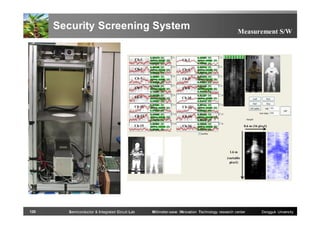
Security Screening System

Ch-1

Ch-6

Ch-7

Ch-8

Ch-9

Ch-10

Ch-11

Ch-12

Ch-13

Ch-14

Ch-15

Ch-16

IR

Ch-4

Ch-5

CCD

Ch-2

Ch-3

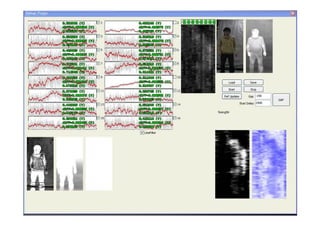
Measurement S/W

0.6 m (16 pixel)

1.6 m
(variable
pixel)

120

Semiconductor & Integrated Circuit Lab

Millimeter-wave INnovation Technology research center

Dongguk University
Comparison with
Commercial MMW Imaging

121

Semiconductor & Integrated Circuit Lab

Millimeter-wave INnovation Technology research center

Dongguk University
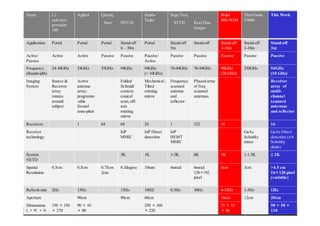
Name

L3
safeview
provision
100

Agilent

Brijot
BIS-WDS

ThruVision
T4000

This Work

Application

Portal

Portal

Portal

Stand-off

Stand-off
3-10m

Stand-off
3-10m

Stand-off
3m

Active/
Passive

Active

Active

Passive

Passive

Passive

Passive

Passive

Frequency
(Bandwidth)

24-30GHz

24GHz

94GHz
(> 10GHz)

76-94GHz

76-94GHz

90GHz
(20 GHz)

250GHz

94GHz
(10 GHz)

Imaging
System

Source &
Receiver
array
rotates
around
subject

Active
antenna
array:
programm
-able
fresnel
zone-plate

Folded
Schmidt
camera:
conical
scan, offaxis
rotating
mirror

Mechanical :
Tilted
rotating
mirror

Frequency
scanned
antenna
and
reflector

Phased array
of freq
scanned
antennas

64

24

1

232

Receiver
technology

InP
MMIC

InP Direct
detection

InP
HEMT
MMIC

System
NETD

5K

1K

1-3K

6K

0.3degree

10mm

6mrad

0.5Hz

Receivers

Qinetiq

Smiths
Tadar

Sago Trex
ST150

Real Time
Imager

Stand-off
8 – 30m

Portal

Stand-off
5m

Passive

Passive

Passive/
Active

35GHz

94GHz

base

1

64

Spatial
Resolution

0.5cm

0.5cm

Refresh rate

2Hz

15Hz

15Hz

10HZ

90cm

80cm

60cm

Aperture
Dimensions
L× W × H
122

0.75cm
2cm

SPO 20

150 × 150
90 × 10
× 270 Semiconductor & Integrated Circuit Lab
× 90

Receiver
array of
multichannel
scanned
antennas
and reflector
16

16
GaAs
Schottky
mixer

GaAs Direct
detection (z-b
Schottky
diode)

1K

1-1.5K

≤ 2K

6mrad
128×192
pixel

5cm

3cm

>4.5 cm
16×128 pixel
(variable)

30Hz

4-10Hz

1-3Hz

1Hz

18cm

12cm

20cm

250 × 160
71 × 33
× 220
× 48
Millimeter-wave INnovation Technology research center

50 × 50 ×
110
Dongguk University
Discussion

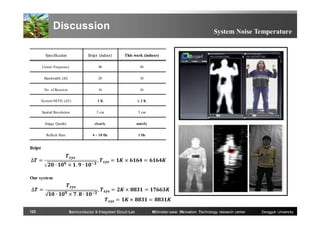
System Noise Temperature

Specification

Brijot (indoor)

This work (indoor)

Center Frequency

90

94

Bandwidth (Δf)

20

10

No. of Receiver

16

16

System NETD (ΔT)

1K

≤2K

Spatial Resolution

5 cm

5 cm

Image Quality

clearly

noisily

Reflesh Rate

4 ~ 10 Hz

1 Hz

Brijot

∆ =

∙

× . ∙

∙

× . ∙

,

=

×

=

,

=

×

=

Our system

∆ =

123

=

×

Semiconductor & Integrated Circuit Lab

=
Millimeter-wave INnovation Technology research center

Dongguk University
Video Demo

124

Semiconductor & Integrated Circuit Lab

Millimeter-wave INnovation Technology research center

Dongguk University
Video Demo

125

Semiconductor & Integrated Circuit Lab

2011. 01. 31.

Millimeter-wave INnovation Technology research center

Dongguk University
Conclusion

126

Semiconductor & Integrated Circuit Lab

Millimeter-wave INnovation Technology research center

Dongguk University
Conclusion

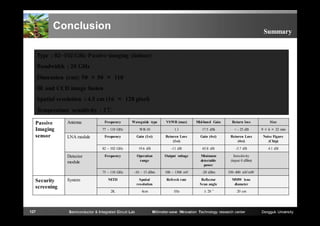
Summary

Type : 82~102 GHz Passive imaging (indoor)
Bandwidth : 20 GHz
Dimension (cm): 50 × 50 × 110
IR and CCD image fusion
Spatial resolution : 4.5 cm (16 × 128 pixel)
Temperature sensitivity : 2℃
Antenna

127

System

Mid-band Gain

Return loss

Size

WR-10

1.1

17.5 dBi

< - 25 dB

9 × 6 × 32 mm

Frequency

Gain (1st)

Returen Loss
(1st)

Gain (4st)

Returen Loss
(4st)

Noise Figure
(Chip)

19.6 dB

-11 dB

65.8 dB

-5.7 dB

4.1 dB

Frequency

Operation
range

Output voltage

Minimum
detectable
power

Sensitivity
(input 0 dBm)

-10 ~ 15 dBm

100 ~ 1500 mV

-20 dBm

350~400 mV/mW

NETD

Spatial
resolution

Refresh rate

Reflector
Scan angle

MMW lens
diameter

2K

Security
screening

VSWR (max)

75 ~ 110 GHz

Detector
module

Waveguide type

77 ~ 110 GHz

LNA module

Frequency

82 ~ 102 GHz

Passive
Imaging
sensor

4cm

1Hz

± 20 °

20 cm

Semiconductor & Integrated Circuit Lab

Millimeter-wave INnovation Technology research center

Dongguk University

20130723 research accomplishment_ud

  • 1.
    Research accomplishment (2003~ ) Semiconductor & Integrated Circuit Lab Millimeter-wave INovation Technology research center Taejong Baek Department of Electronics and Electrical Engineering Graduate School Dongguk University Semiconductor & Integrated Circuit Lab Millimeter-wave INnovation Technology research center Dongguk University
  • 2.
    Research field 1 Semiconductor &Integrated Circuit Lab Millimeter-wave INnovation Technology research center Dongguk University
  • 3.
    ■ What isMillimeter-wave?  Wide bandwidth: high data rate and high speed wireless communication applications  Short wavelength: small-sized and light-weighted circuit systems Frequency (GHz) 30 2 10 Semiconductor & Integrated Circuit Lab 3000 Submillimeterwave Millimeter-wave Micro-wave Wave-length (mm) 300 1 Millimeter-wave INnovation Technology research center 0.1 Dongguk University
  • 4.
    ■ Advantages ofMillimeter-wave 1. Large spectrum availability ⇒ Broadband system ⇒ Unused frequency bands 2. High reuse potential of frequency ⇒ Short range communications from a few meters up to few kilometers 3. Small antenna and system size ⇒ Very short wavelength 3 Semiconductor & Integrated Circuit Lab Millimeter-wave INnovation Technology research center Dongguk University
  • 5.
    ■ Examples of Millimeter-waveapplications ITS Military Medical Millimeter-wave Applications Imaging WLAN system Requirement of Millimeter-wave Monolithic integrated Circuits 4 Semiconductor & Integrated Circuit Lab Millimeter-wave INnovation Technology research center Dongguk University
  • 6.
     Thermal Evaporator/ ULVAC EBV-10  Rapid Thermal Process System (RTP) / KVR-020  Plasma Enhanced Chemical Vapor Deposition (PECVD) JCSS-41MR  O2 Plasma Asher / Oxford plasma lab 80 plus  Mask Aligner / Karl Suss MA6  Inductively Coupled Plasma Reactive Ion Etching (ICP-RIE) / KVICP-T4083  E-Beam Evaporator System / KVE-T5560  E-Beam Lithography System / Leica EBPG-4HR Mask Aligner ICP-Dry etcher FC Bonder Plasma Asher  Au Plating System  Vacuum Dry Oven / SB-CD520  Lapping Machine / Allied MultiPrep TM System  Furnace / Metritherm  Surface Profiler / a-step 200  Thin Film Analyzer / Tyger  Flip Chip Bonder / Laurier M9  Wedge bonder / Hybond 572-A  Ball bonder / Hybond 626  Spectrum & Vector Network Analyzer  Semiconductor Characterization System / Keithley 4200-PCS  Ansys HFSS & Agilent ADS Simulation Program 5 Semiconductor & Integrated Circuit Lab E-Beam Lithography Millimeter-wave INnovation Technology research center Furnace Dongguk University
  • 7.
    GaAs-based 70 nmMHEMTs 6 Semiconductor & Integrated Circuit Lab Millimeter-wave INnovation Technology research center Dongguk University
  • 8.
    GaAs-based 70 nmMHEMTs ■ Fabricated MHEMT 70 nm <70 µm × 2 MHEMT> 7 Semiconductor & Integrated Circuit Lab <Resist profile of gate foot> Millimeter-wave INnovation Technology research center Dongguk University
  • 9.
    Development of MMICLibraries ■ 70 nm Gate Metamorphic HEMT Gate length: 70 nm Double exposure method Tri-layer resist stack ▶ ZEP520 : DCB = 1.5 : 1 ▶ PMGI ▶ PMMA950K : MCB = 1 : 1 Gate metal formation SEM view of fabricated 70 nm gate 8 Semiconductor & Integrated Circuit Lab ▶ Ti/Au = 500/4500 Å Si3N4 passivation: 800 Å Millimeter-wave INnovation Technology research center Dongguk University
  • 10.
    GaAs-based 70 nmMHEMTs ■ 70 nm ×140 µm MHEMT (1) DC performance - Drain current density: 607 mA/mm - Transconductance (gm): 1.015 S/mm < I-V characteristics > 9 Semiconductor & Integrated Circuit Lab < Transconductance characteristics > Millimeter-wave INnovation Technology research center Dongguk University
  • 11.
    GaAs-based 70 nmMHEMTs ■ 70 nm ×140 µm MHEMT (2) RF performance - fT: 330 GHz - fmax: 425 GHz 330 GHz 425 GHz < RF characteristics > 10 Semiconductor & Integrated Circuit Lab Millimeter-wave INnovation Technology research center Dongguk University
  • 12.
    GaAs-based 70 nmMHEMTs ■ fT comparison of HEMTs [1] Y. Yamashita et al., IEEE Electron Device Letters, vol. 23, no. 10, pp. 573-575, 2002. [2] K. Shinohara et al., IEEE Electron Device Letters, vol. 25, no. 5, pp. 241-243, 2004. [3] T. Suemitsu et al., IEEE Trans. on Electron Devices, [1] vol. 49, no. 10, pp. 1694-1700, 2002. [2] [4] K. Shinohara et al., IEEE Electron Device Letters, vol. 22, no. 11, pp. 507-509, 2001. This work [4] [5] K. Shinohara et al., IEEE MTT-S Digest, vol. 3, pp. 2159-2162, 2001. [6] S. Bollaert et al., IEE Electronics Letters, vol. 38, no. 8, pp. 389-391, 2002. [3] [5] [8] [6] [7] T. Parenty et al., Indium Phosphide and [9] [7] [10] Related Materials, pp. 626-629, 2001. [8] A. Leuther et al., Indium Phosphide and Related Materials, pp. 215-218, 2003. [9] H. Wang et al., IEEE IEDM Digest, pp. 239-242, 1993. [10] Y. C. Lien et al., IEEE Electron Device Letters, vol. 25, no. 6, pp. 348-350, 2004. This work: Sung Chan Kim et al., IEEE Electron Device Letters, vol. 27, no. 1, pp. 28-30, 2006. 11 Semiconductor & Integrated Circuit Lab Millimeter-wave INnovation Technology research center Dongguk University
  • 13.
    DAML (Dielectric-supported Air-gapped MicrostripLine) 12 Semiconductor & Integrated Circuit Lab Millimeter-wave INnovation Technology research center Dongguk University
  • 14.
    Motivation of DAML ■Motivation of DAML (1) Conventional transmission lines Microstrip line CPW line Substrate Substrate Substrate loss Transmission line  Basic elements  Major cause of device loss 13 Semiconductor & Integrated Circuit Lab Demand of MEMS technology Millimeter-wave INnovation Technology research center Dongguk University
  • 15.
    Motivation of DAML ■Motivation of DAML (2) Shielded Membrane Microstrip (1) Substrate 1 (2) Substrate 2 (3)  Complex processes Substrate  Difficulty of integration with MMIC/MIMIC Shielded Membrane Microstrip (1) Shield cover : 2 Masks (2) Membrane plane : 3 Masks DAML technology (3) Ground plane : 1 Masks Reference: S.V. Robertson et al., IEEE Trans. Microwave Theory and Tech., vol. 46, no. 11, 1998, pp. 1845-1849, 1998. 14 Semiconductor & Integrated Circuit Lab Millimeter-wave INnovation Technology research center Dongguk University
  • 16.
    DAML ■ DAML: Dielectric-supportedAir-gapped Microstrip Line  Surface micromachined transmission line  Reduced substrate loss due to elevated signal line  Simple process: Compatibility with standard MMIC/MIMIC fabrication ▶ Photo-lithography and low-temperature process ▶ Easily integrated with MMIC/MIMIC (3 additional masks required) ▶ Dielectric post used for mechanical stability (1 post/1 mm)  Possibility of vertical integration (3-D integration) Signal line Dielectric post Ground S.I. GaAs substrate 15 Semiconductor & Integrated Circuit Lab Millimeter-wave INnovation Technology research center Dongguk University
  • 17.
    DAML ■ Formula forEffective Dielectric Constant in Partial Dielectric Layer  h : Dielectric post height (µm)  w : Signal line width (µm)  g : Dielectric post gap (µm)  d : Dielectric post size (µm)  3hⅹ2 + w : Field area (by Ansoft HFSS) g d d2  r  1   polyimide  g (3h  2  w) Dielectric constant of DAML-Substrate is 1.108 by calculation. w h  eff 3h ⅹ2 + w   d2  d2  1   polyimide    1 1      1 polyimide    g (3h  2  w)  g (3h  2  w)  1      2 2 h  1 12  w           The effective dielectric constant εe ff is 1.086 by calculation. (Where, g = 500 µm, h = 10 µm, w = 44 µm, d = 40 µm) 16 Semiconductor & Integrated Circuit Lab Millimeter-wave INnovation Technology research center Dongguk University
  • 18.
    Process flow ofthe DAML ■ Process flow of the DAML  Ground metal (Ti/Au) and dielectric post (polyimide) formation  Sacrificial layer (AZ4903) patterning  Seed metal (Ti/Au) evaporation and Electro-molding (AZ4903) formation  Signal line (Au) formation and sacrificial layer removal Semi-insulating GaAs substrate Semi-insulating GaAs substrate Semi-insulating GaAs substrate Semi-insulating GaAs substrate 17 Semiconductor & Integrated Circuit Lab Millimeter-wave INnovation Technology research center Dongguk University
  • 19.
    Fabricated DAML ■ DielectricPost 18 Semiconductor & Integrated Circuit Lab Millimeter-wave INnovation Technology research center Dongguk University
  • 20.
    Fabricated DAML ■ SacrificialLayer Reflow the photoresist for smooth metal overlay 19 Semiconductor & Integrated Circuit Lab Millimeter-wave INnovation Technology research center Dongguk University
  • 21.
    Fabricated DAML ■ FabricatedDAML 20 Semiconductor & Integrated Circuit Lab Millimeter-wave INnovation Technology research center Dongguk University
  • 22.
    DAML Characteristic ■ Comparisonof transmission lines [1] K. Nishikawa et al., IEEE MTT-S Digest, vol. 3, 2001, pp. 1881-1884. [2] G.E. Ponchak et al., IEEE Trans. Components, Packaging, and Manufacturing Technology-B, vol. 21, no. 2, pp. 171-176, 1998. [3] Suidong Yang et al., IEEE Trans. Microwave Theory and Techniques, vol. 46, no. 5, pp. 623-631, 1998. [4] Y.C. Shih et al., Microwave Journal, pp. 95-105, 1991. [5] Youngwoo Kwon et al., IEEE Microwave and Wireless Components Letters, vol. 11, no. 2, pp. 59-61, 2001. [6] S.V. Robertson et al., IEEE Trans. Microwave Theory and Techniques, vol. 46, no. 11, 1998, pp. 1845-1849, 1998. This work: H. S. Lee et al., IEE Electronics Letters, vol. 39, no. 25, pp. 1827-1828, 2003. This work: Sung-Chan Kim et al., IEEE Microwave and Wireless Components Letters, vol. 15, no. 10, pp. 652-654, 2005. 21 Semiconductor & Integrated Circuit Lab Millimeter-wave INnovation Technology research center Dongguk University
  • 23.
    SDAML ■ Shielded DAMLusing Flip chip technique  Ultra low loss: extended height (10 µm → 17 µm)  Shielding effect - Radiation, electromagnetic and environmental interference are avoided by enclosing microstrip circuitry in a shielding cavity  Simple process: not bulk micromachining (using flip-chip technique) Connected Ground using Flip chip Stud Upper Ground Plane Polyimide Dielectric post  h : Dielectric post height  w : Signal line width  g : Dielectric post gap Air-bridged Signal line  d : Dielectric post size Lower Ground Plane 22 Semiconductor & Integrated Circuit Lab Millimeter-wave INnovation Technology research center Dongguk University
  • 24.
    Fabricated DAML ■ FabricatedDAML (height = 17 µm) 23 Semiconductor & Integrated Circuit Lab Millimeter-wave INnovation Technology research center Dongguk University
  • 25.
    DAML Characteristic (Measurement) ■Insertion loss versus Signal line height Signal line width: 44 µm, (dB/cm) Simulation 80 (GHz) 1.85 1.89 1.53 110 (GHz) Semiconductor & Integrated Circuit Lab 1.63 94 (GHz) 24 Measurement 2.22 2.13 Millimeter-wave INnovation Technology research center Dongguk University
  • 26.
    SDAML Characteristic ■ Comparisonof original DAML 4.0 DAML (h = 10 m) DAML (h = 17 m ) SDAML (h = 17 m) 60 (GHz) 94 (GHz) 120 (GHz) DAML (10 µm) 1.87 2.56 3.1 DAML (17 µm) 1.27 1.89 2.42 SDAML (17 µm) 3.5 1.07 1.41 1.67 Insertion loss [dB/cm] 3.0 2.5 2.0 1.5 1.0 0.5 0.0 0 20 40 60 80 100 120 140 Frequency [GHz] 25 Semiconductor & Integrated Circuit Lab Millimeter-wave INnovation Technology research center Dongguk University
  • 27.
    Passive Device usingDAML Technology ■ Comparison of electrical length λg / 4 @ 94 GHz Electrical length (λg / 4 @ 94 GHz ) CPW Microstrip DAML Reduced Size DAML 26 Semiconductor & Integrated Circuit Lab 304 µm Microstrip CPW 266 µm DAML 792 µm RS-DAML 478 µm Millimeter-wave INnovation Technology research center Dongguk University
  • 28.
    Passive Device usingDAML Technology ■ W-band Reduced Size branch-line coupler Total Size : 604 µm × 520 µm 27 Semiconductor & Integrated Circuit Lab Millimeter-wave INnovation Technology research center Dongguk University
  • 29.
    Passive Device usingDAML Technology ■ Measurement result of W-band Reduced branch-line coupler Coupling loss: 3.61 dB Transmission loss: 4.25 dB Isolation: -35.5 dB Return loss: -36.9 dB 28 Semiconductor & Integrated Circuit Lab Millimeter-wave INnovation Technology research center Dongguk University
  • 30.
    Passive Device usingDAML Technology ■ Comparison of W-band branch line coupler Case Coupling loss (dB) Return loss (dB) Chip size (mm2) Center frequency (GHz) 1 (CPW) About -3.5 About -20 0.5 ⅹ0.5 90 RSC DAML -3.61 -36.9 0.6ⅹ0.52 94 Reference 1: M. Schlechtweg et al, GaAs IC Symposium, 1995. Technical Digest 1995, 17th Annual IEEE, 29 Oct.-1 Nov. 1995 Page(s):214 - 217 29 Semiconductor & Integrated Circuit Lab Millimeter-wave INnovation Technology research center Dongguk University
  • 31.
    W-band Hybrid RingCoupler ■ Fabricated W-band hybrid ring coupler 10 µm 50 Ω termination  Coupler size: 1.46 mm (diameter) 30 Semiconductor & Integrated Circuit Lab Millimeter-wave INnovation Technology research center Dongguk University
  • 32.
    W-band Hybrid RingCoupler ■ S-parameters of W-band hybrid ring coupler  Transmission loss: 3.80 ± 0.08 dB  Coupling loss: 3.57 ± 0.22 dB (@ 85-105 GHz) 31 Semiconductor & Integrated Circuit Lab Millimeter-wave INnovation Technology research center Dongguk University
  • 33.
    Hybrid Ring Coupler ■ Comparisonof W-band hybrid ring coupler Case Transmission Coupling loss loss (dB) (dB) Isolation (dB) Center frequency (GHz) 1 (CPW) About -5.5 About -4.7 About -30 94 This work -3.72 -3.35 -34 94 Reference 1: Hiroyuki Matsuura et al, IEEE MTT-S Digest, 1996, pp. 389-392 This work: Sung-Chan Kim et al, IEEE MWCL, vol. 15, no. 10, pp. 652-654, 2005. 32 Semiconductor & Integrated Circuit Lab Millimeter-wave INnovation Technology research center Dongguk University
  • 34.
    Passive Device usingDAML Technology ■ W-band reduced ring hybrid coupler Diameter : 0.888 mm 33 Semiconductor & Integrated Circuit Lab Millimeter-wave INnovation Technology research center Dongguk University
  • 35.
    Passive Device usingDAML Technology ■ Comparison of coupler sizes Reduced to 63 % in area Conventional Coupler Diameter : 1.460 mm 34 Reduced Coupler Diameter : 0.888 mm Semiconductor & Integrated Circuit Lab Millimeter-wave INnovation Technology research center Dongguk University
  • 36.
    Passive Device usingDAML Technology ■ Measurement result of W-band reduced ring hybrid coupler 0 0 -10 S-parameter [dB] S-parameter [dB] -20 -30 -40 -50 S21Thru S31coupling S23Isolation -60 75 80 85 -10 -20 -30 S11 S22 S33 -40 90 95 100 105 Frequency [GHz] Insertion loss 110 70 75 80 85 90 95 100 105 115 Frequency [GHz] Return loss Coupling loss: 4.35 dB Isolation: -48.23 dB Transmission loss: 4.44 dB 35 110 Return loss: below -25 dB (all port) Semiconductor & Integrated Circuit Lab Millimeter-wave INnovation Technology research center Dongguk University
  • 37.
    Passive Device usingDAML Technology ■ Comparison of W-band hybrid ring coupler Case Transmission loss (dB) Coupling loss (dB) Isolation (dB) Diameter (mm) Center frequency (GHz) 1 (CPW) About -5.5 About -4.7 About -30 About 0.7 94 DAML -3.72 -3.35 -34 1.46 94 RSC DAML -4.44 -4.35 -48.23 0.88 94 Reference 1: Hiroyuki Matsuura et al, IEEE MTT-S Digest, 1996, pp. 389-392 36 Semiconductor & Integrated Circuit Lab Millimeter-wave INnovation Technology research center Dongguk University
  • 38.
    Passive Device usingDAML Technology ■ Novel W-Band Dual Mode Stepped Impedance Resonator BPF Using DAML Technology (b) (a) (a) Fabricated BPF (b) (a) MIM coupling capacitor (b) Stepped Impedance Perturbation **Journal of the Korean Physical Society., vol. 51, no. 10, pp. S280-S283, December, 2007 37 Semiconductor & Integrated Circuit Lab Millimeter-wave INnovation Technology research center Dongguk University
  • 39.
    Passive Device usingDAML Technology ■ Measured Result of W-band BPF 5 0 Insertion Loss (dB) -5 -10 -15 -20 S11 -25 S22 -30 -35 ▶ Step Impedance Ratio: 0.5 S21 S12 -40 60 ▶ Perturbation Length: 275 µm Simulation 65 70 75 80 85 90 95 ▶ MIM Capacitor Size: 75 µm2 100 105 110 115 120 Frequency (GHz) - Insertion Loss: 2.65 dB @ 97 GHz - Relative Bandwidth: 12 % 38 Semiconductor & Integrated Circuit Lab Millimeter-wave INnovation Technology research center 38 Dongguk University
  • 40.
    Passive Device usingDAML Technology ■ 60-GHz CPW-fed Dielectric-Resonator-Above-Patch Antenna for Broadband WLAN Applications Using DAML Technology **Microwave and Optical Technology Letters., vol. 49, Issue. 8, pp. 1859-1861, 2005 39 Semiconductor & Integrated Circuit Lab Millimeter-wave INnovation Technology research center Dongguk University
  • 41.
    Passive Device usingDAML Technology ■ Fabricated Antenna (a) Fabricated patch using DAML (b) 60 GHz RDRA (c) Proposed antenna (d) Antenna integrated by 60 GHz VCO 40 Semiconductor & Integrated Circuit Lab Millimeter-wave INnovation Technology research center Dongguk University
  • 42.
    Passive Device usingDAML Technology ■ Measured Results 41 Semiconductor & Integrated Circuit Lab Millimeter-wave INnovation Technology research center Dongguk University
  • 43.
    3-D W-band SingleBalanced Active Mixer 42 Semiconductor & Integrated Circuit Lab Millimeter-wave INnovation Technology research center Dongguk University
  • 44.
    Mixer with DAMLcoupler Design strategy  MEMS coupler ► MEMS library  Diode & CPW lines ► MMIC library Schematic 43 Semiconductor & Integrated Circuit Lab Millimeter-wave INnovation Technology research center Dongguk University
  • 45.
    Single Balanced ActiveMixer ■ Layout RF 70 nm gate MHEMT Dielectric post IF1 LO IF2 Ring coupler based on DAML 44 Semiconductor & Integrated Circuit Lab Millimeter-wave INnovation Technology research center Dongguk University
  • 46.
    Single Balanced ActiveMixer ■ Interference of DAML and CPW lines DAML  For the lowest reflection of DAML ► Distance of Airbridge to DAML : 90 ~ 150 µm 45 Semiconductor & Integrated Circuit Lab Millimeter-wave INnovation Technology research center Dongguk University
  • 47.
    Single Balanced ActiveMixer ■ Process flow of the single balanced mixer GaAs epi-wafer Semi-insulating GaAs substrate 46 Semiconductor & Integrated Circuit Lab Millimeter-wave INnovation Technology research center Dongguk University
  • 48.
    Single Balanced ActiveMixer Mesa etching MHEMT Semi-insulating GaAs substrate 47 Semiconductor & Integrated Circuit Lab Millimeter-wave INnovation Technology research center Dongguk University
  • 49.
    Single Balanced ActiveMixer Ohmic contact formation MHEMT Semi-insulating GaAs substrate 48 Semiconductor & Integrated Circuit Lab Millimeter-wave INnovation Technology research center Dongguk University
  • 50.
    Single Balanced ActiveMixer Resistor formation MHEMT Resistor Semi-insulating GaAs substrate 49 Semiconductor & Integrated Circuit Lab Millimeter-wave INnovation Technology research center Dongguk University
  • 51.
    Single Balanced ActiveMixer 70 nm gate patterning, narrow recess, and gate metalization MHEMT Resistor Semi-insulating GaAs substrate 50 Semiconductor & Integrated Circuit Lab Millimeter-wave INnovation Technology research center Dongguk University
  • 52.
    Single Balanced ActiveMixer First metal formation Ground MHEMT Resistor Capacitor CPW Ground Semi-insulating GaAs substrate 51 Semiconductor & Integrated Circuit Lab Millimeter-wave INnovation Technology research center Dongguk University
  • 53.
    Single Balanced ActiveMixer Dielectric (Si3N4) deposition Ground MHEMT Resistor Capacitor CPW Ground Semi-insulating GaAs substrate 52 Semiconductor & Integrated Circuit Lab Millimeter-wave INnovation Technology research center Dongguk University
  • 54.
    Single Balanced ActiveMixer Dielectric (Si3N4) RIE Ground MHEMT Resistor Capacitor CPW Ground Semi-insulating GaAs substrate 53 Semiconductor & Integrated Circuit Lab Millimeter-wave INnovation Technology research center Dongguk University
  • 55.
    Single Balanced ActiveMixer Second metal (air-bridge) formation Ground MHEMT Resistor Capacitor CPW Ground Semi-insulating GaAs substrate 54 Semiconductor & Integrated Circuit Lab Millimeter-wave INnovation Technology research center Dongguk University
  • 56.
    Single Balanced ActiveMixer Dielectric (polyimide) post formation Ground MHEMT Resistor Capacitor CPW Ground Semi-insulating GaAs substrate 55 Semiconductor & Integrated Circuit Lab Millimeter-wave INnovation Technology research center Dongguk University
  • 57.
    Single Balanced ActiveMixer DAML formation Hybrid ring coupler based on DAML Ground MHEMT Resistor Capacitor CPW Ground Semi-insulating GaAs substrate 56 Semiconductor & Integrated Circuit Lab Millimeter-wave INnovation Technology research center Dongguk University
  • 58.
    Single Balanced ActiveMixer ■ Fabricated single balanced mixer IF1 IF2  External balun for IF’s 70 nm MHEMT RF  W-band coupler size : 1.46 mm (diameter)  Chip size : Hybrid ring coupler 1.8 mm × 2.1 mm LO 57 Semiconductor & Integrated Circuit Lab Millimeter-wave INnovation Technology research center Dongguk University
  • 59.
    Single Balanced ActiveMixer ■ Conversion loss vs. LO input power  Conversion loss: 2.5 dB - RF frequency: 94 GHz - RF power: -10 dBm - LO frequency: 94.2 GHz - LO power: 6 dBm 58 Semiconductor & Integrated Circuit Lab Millimeter-wave INnovation Technology research center Dongguk University
  • 60.
    Single Balanced ActiveMixer ■ LO-to-RF isolation  LO-to-RF isolation: < -30 dB - LO freq.: 93.65-94.25 GHz - LO power: 0 dBm 59 Semiconductor & Integrated Circuit Lab Millimeter-wave INnovation Technology research center Dongguk University
  • 61.
    Single Balanced ActiveMixer ■ Comparison of W-band mixers (1) LO RF RF-LO Frequency Frequency Isolation (GHz) (GHz) (dB) Case Mixer Design Features Conversion Gain (dB) Device Technology 1 S.E. active mixer 0.8 0.1 µm InP HEMT 94 94.5 - 2 S.B. resistive mixer -8 0.1 µm InP HEMT 83 94 -27 3 S.B. resistive mixer -12.8 0.1 µm GaAs PHEMT 93 93.2 - 4 S.B. diode mixer -7.5 0.1 µm GaAs PHEMT 93 94 -18 5 S.B. diode mixer -9 0.1 µm GaAs PHEMT 94 95 - 6 S.B. diode mixer -10 0.1 µm InP HEMT 94 94.5 - This work S.B. active mixer -2.5 70 nm GaAs MHEMT 94.2 94 -33 ( S.E. : Single Ended, S.B. : Single Balanced ) 60 Semiconductor & Integrated Circuit Lab Millimeter-wave INnovation Technology research center Dongguk University
  • 62.
    Single Balanced ActiveMixer ■ Comparison of W-band mixers (2) Single balanced active mixer: Low conversion loss: high-performance 70 nm MHEMTs High isolation: hybrid ring coupler based on DAML - References [1] Robinder S. Virk et al., IEEE MTT-S Digest, 1997, pp. 435-438. [2] A. R. Barnes et al., IEEE MTT-S Digest, 2002, pp. 1867-1870. [3] K. W. Chang et al., IEEE Microwave and Guided Wave Letters, vol. 4, no. 9, pp. 301-302, 1994. [4] K. W. Chang et al., IEEE Transactions on Microwave Theory and Techniques, vol. 39, no. 12, pp. 1972-1979, 1991. [5] K. W. Chang et al., Proc. IEEE Microwave and Millimeter-wave Monolithic Circuits Symposium, 1993, pp. 41-44. [6] Robinder S. Virk et al., IEEE MTT-S Digest, 1997, pp. 435-438. This work: Sung Chan Kim et al., IEEE Electron Device Letters, vol. 27, no. 1, pp. 28-30, 2006. 61 Semiconductor & Integrated Circuit Lab Millimeter-wave INnovation Technology research center Dongguk University
  • 63.
    A transceiver modulefor FM-CW radar sensors using 94 GHz dot-type Schottky diode mixer Taejong Baek Department of Electronics and Electrical Engineering Graduate School Dongguk University Semiconductor & Integrated Circuit Lab Millimeter-wave INnovation Technology research center Dongguk University
  • 64.
    Introduction 63 Semiconductor & IntegratedCircuit Lab Millimeter-wave INnovation Technology research center Dongguk University
  • 65.
    Introduction 64 Semiconductor & IntegratedCircuit Lab Motivation Millimeter-wave INnovation Technology research center Dongguk University
  • 66.
    Introduction Passive & Active Objectsalso reflect the radiation emanating from the environment to a degree of reflectivity which is the complement of their emissivity; the sum of the emissivity and the reflectivity is 1. Passive system concept High Sensitivity receivers are required Thermal noise Antenna aperture affects resolution and SNR Object Direct measure of temperature (sub K accuracy) Can detect objects through differences in emissivity T Emissivity = radiation + reflectivity (from the natural background radiation) Active system concept Also known as a radar (using oscillator) Received Transmit a signal and receive scattered waveform Object Detected unwanted objects Transmitted T Need to large computational resources Emissivity = radiation + reflectivity (from the signal source) 65 Semiconductor & Integrated Circuit Lab Millimeter-wave INnovation Technology research center Dongguk University
  • 67.
    InP Gunn Diode 66 Semiconductor& Integrated Circuit Lab Millimeter-wave INnovation Technology research center Dongguk University
  • 68.
    InP Gunn diode Epistructure Epi structure of InP Gunn diode 67 Semiconductor & Integrated Circuit Lab Millimeter-wave INnovation Technology research center Dongguk University
  • 69.
    InP Gunn diode 1.Wafer Cleaning Process flow 1~2 1) Initial cleaning TCE Acetone IPA D.I. water rinse 1)Photo resist (PR) coating 2. Formation of top side trench 2)Soft baking 3)Alignment & Exposure 4)Development 5)Post baking 6)Wet etching 7)PR strip 68 Semiconductor & Integrated Circuit Lab Millimeter-wave INnovation Technology research center Dongguk University
  • 70.
    InP Gunn diode 3.Cathode ohmic metalization Process flow 3~4 1)Cleaning 2)Oxide etching 3)Metal evaporation 4)Protection layer 4. Integral heat sink (IHS) patterning lithography 1) Cleaning 2) Photo resist (PR) coating 3) Soft baking 4) Alignment & Exposure 5) Post Expose Baking 6) Development 69 Semiconductor & Integrated Circuit Lab Millimeter-wave INnovation Technology research center Dongguk University
  • 71.
    InP Gunn diode Processflow 5~6 5. 2nd seed evaporation 1)Cleaning 2)2nd seed evaporation 6. 2nd plating (formation of support layer) 1) Au plating 70 Semiconductor & Integrated Circuit Lab Millimeter-wave INnovation Technology research center Dongguk University
  • 72.
    InP Gunn diode Processflow 7~8 7. Wafer thinning (lapping & polishing) 1) Wafer mount 2) Lapping 640 um lapping 3) Wafer de-mount 4) Cleaning 1)Cleaning 2)Photo resist (PR) coating 8. Anode ohmic metalization 3)Soft baking 4)Alignment & Exposure 5)Reverse baking 6)Flood exposure 7)Development 8)Oxide etching 9)Metal evaporation 10)Lift-off 71 Semiconductor & Integrated Circuit Lab Millimeter-wave INnovation Technology research center Dongguk University
  • 73.
    InP Gunn diode 9.Overlay metallization Process flow 9~10 1)Seed evaporation 2)Photo resist (PR) coating 3) Soft baking 4) Alignment & Pre-exposure 5) Development 6) Oxide etching 7) Au plating 8) PR strip 9) Seed etching 1)Cleaning 10. MESA etching 2)Photo resist (PR) coating 3)Soft baking 4)Alignment & Exposure 5)PEB (post exposure bake) 6)Development 7)Hard baking 8)Dry etching 9)PR strip 72 Semiconductor & Integrated Circuit Lab Millimeter-wave INnovation Technology research center Dongguk University
  • 74.
    InP Gunn diode Processflow 11 11. Gold & 2nd seed etching 1) 2) Cleaning Oxide etching 3) Au etching (Cathode) anode InP Fabricated InP Gunn diode 73 Semiconductor & Integrated Circuit Lab Millimeter-wave INnovation Technology research center Dongguk University
  • 75.
    Packaged Diode 74 Semiconductor &Integrated Circuit Lab Millimeter-wave INnovation Technology research center Dongguk University
  • 76.
    InP Gunn diode Packaging Packageelement Lid AgSn solder Au wire Gunn diode chip Ceramic ring AuSn solder Stud 3-48 UNC-2A THREAD 75 Semiconductor & Integrated Circuit Lab Millimeter-wave INnovation Technology research center Dongguk University
  • 77.
    InP Gunn diode Packageprocess 1~2 1. Ceramic ring junction Ceramic ring Stud (3-48 UNC-2A THREAD) 2. Die attach Chip 76 Semiconductor & Integrated Circuit Lab Millimeter-wave INnovation Technology research center Dongguk University
  • 78.
    InP Gunn diode Packageprocess 3~4 3. Maltese Cross Bonding Maltese Cross 4. Lid junction Lid 77 Semiconductor & Integrated Circuit Lab Millimeter-wave INnovation Technology research center Dongguk University
  • 79.
    InP Gunn diode X-rayimage of InP Gunn diode 78 Semiconductor & Integrated Circuit Lab Packaged Diode Packaged InP Gunn diode Millimeter-wave INnovation Technology research center Dongguk University
  • 80.
    InP Gunn diode DCcharacteristic DC I-V measurement result InP Gunn diode chip 79 Semiconductor & Integrated Circuit Lab Packaged InP Gunn diode Millimeter-wave INnovation Technology research center Dongguk University
  • 81.
    InP Gunn diode RFcharacteristic Measurement results of packaged InP Gunn diode Chip number Voltage [V] Current [mA] Oscillation frequency [GHz] Output Power [dBm] 1 12.4 299 94 17.8 2 11.7 260 93.98 16 3 9.7 299 94.25 15.6 4 10.9 349 93.9 16.6 5 9.3 349 93.8 16.4 Oscillation characteristics of fabricated InP Gunn diode 80 Semiconductor & Integrated Circuit Lab Millimeter-wave INnovation Technology research center Dongguk University
  • 82.
    Transceiver 81 Semiconductor & IntegratedCircuit Lab Millimeter-wave INnovation Technology research center Dongguk University
  • 83.
    82 Semiconductor & IntegratedCircuit Lab Millimeter-wave INnovation Technology research center Dongguk University
  • 84.
    83 Semiconductor & IntegratedCircuit Lab Millimeter-wave INnovation Technology research center Dongguk University
  • 85.
    84 Semiconductor & IntegratedCircuit Lab Millimeter-wave INnovation Technology research center Dongguk University
  • 86.
    85 Semiconductor & IntegratedCircuit Lab Millimeter-wave INnovation Technology research center Dongguk University
  • 87.
    86 Semiconductor & IntegratedCircuit Lab Millimeter-wave INnovation Technology research center Dongguk University
  • 88.
    87 Semiconductor & IntegratedCircuit Lab Millimeter-wave INnovation Technology research center Dongguk University
  • 89.
    Active Radar Sensor Crosssection Flip-chip Top view Flip chip packaging configuration 88 Semiconductor & Integrated Circuit Lab Millimeter-wave INnovation Technology research center Dongguk University
  • 90.
    Active Radar Sensor (a) (b) Flip-chip (a)Gold bumps were then flattened using a flip-chip bonder of model M9 from LaurierTM at a press force of 100 g/bump (b) epoxy can spread out evenly on them. Flattened bump had a typical diameter of 100 μm and a height of 45 μm (c) Silver epoxy was then applied onto the flattened gold bumps using a capillary tool with a 3-mil Au ribbon wire and a manual wire bonder of model 572A-40 from HybondTM . The resulting bump had 23 μm of silver epoxy on top 45 μm of gold. (c) 89 Semiconductor & Integrated Circuit Lab (d) (d) MMIC chip and the sapphire substrate were flip-chip bonded with the epoxy in between. The M9 bonder was used with a bonding force of 30 g/bump and a bonding time of 90 second at 110 °C. Silver epoxy was compressed down to 5 μm. Millimeter-wave INnovation Technology research center Dongguk University
  • 91.
    Active Radar Sensor RFCharacteristic 0 S-parameter [dB] -5 -10 -15 -20 -25 -30 Insertion loss Return loss -35 75 80 85 90 95 100 105 110 115 Frequency [dB] Reference Bump material Bonding condition Loss/frequency [1] Au 350℃, 20 g/pillar 0.2 dB/77 GHz [2] Au 275℃, 230 N/mm2 0.2 dB/NA This work Au / Ag epoxy 110℃, 30g/bump 0.205 dB/94 GHz [1] Aoki, S.; Someta, H.; Yokokawa, S.; Ono, K.; Hirose, T.; Ohashi, Y.;, “A flip chip bonding technology using gold pillars for millimeter-wave applications,” in Proc. IEEE MTT-S Int. Microw. Symp. Dig. 1997, vol. 2, pp. 731-734, 1997. [2] Heinrich, W.; Jentzsch, A.; Richter, H.;, “Flip-chip interconnects for frequencies up to W band,” Electron. Lett., vol. 37, issue 3, pp. 180-181, 2001. 90 Semiconductor & Integrated Circuit Lab Millimeter-wave INnovation Technology research center Dongguk University
  • 92.
    Active Radar Sensor 91 Semiconductor& Integrated Circuit Lab Millimeter-wave INnovation Technology research center Test image Dongguk University
  • 93.
    Active Radar Sensor Sheartest The shear tests were performed using a model 4000 series shear test machine from DageTM , widely used to measure the interconnection strength between the MMIC chip and the sapphire substrate. The speed of the shear blade was 300 μm/s, with the tip located at 40 μm above the surface of the sapphire substrate. The flip-chip bonded die, which used proposed low-temperature flip-chip bonding method and 20 bumps of 100 μm diameter, was separated at a force of 900 g. Bonding temperature Die shear strength [mg/ ㎛2] 100℃ 1.55 150℃ 2.19 200℃ 4.38 ACP 220℃ 1.05 ACF 220℃ 1.07 [3] CuSn 260℃ 2.17 This work Au/Ag epoxy 110℃ 5.73 Reference [1] Bump material Indium [2] [1] Kun-Mo Chu, Jung-Sub Lee, Han Seo Cho, Hyo-Hoon Park, Duk Young Jeon, “A fluxless flip-chip bonding for VCSEL arrays using silver-coated indium solder bumps,” IEEE Trans. Electronics Packag. Manuf., vol. 27, no. 4, pp. 246-253, 2004. [2] Tan Ai Min, Sharon Pei-Siang Lim and Charles Lee, “Development of solder replacement flip chip using anisotropic conductive adhesives,” in Proc. 5 th Electron. Packag. Tech. Conf. 2003, pp. 390-396, 2003. [3] Katsuyuki Sakuma, Jun Mizuno, Noriyasu Nagai, Naoko Unami, and Shuichi Shoji, “Effects of Vacuum Ultraviolet Surface Treatment on the Bonding Interconnections for Flip Chip and 3-D Integration.” IEEE Trans. Electronics Packag. Manuf., vol. 33, no. 3, pp. 212-220, 2010. 92 Semiconductor & Integrated Circuit Lab Millimeter-wave INnovation Technology research center Dongguk University
  • 94.
    93 Semiconductor & IntegratedCircuit Lab Millimeter-wave INnovation Technology research center Dongguk University
  • 95.
    94 Semiconductor & IntegratedCircuit Lab Millimeter-wave INnovation Technology research center Dongguk University
  • 96.
    Studies of theMillimeter-Wave Radiometric Sensor and Fabricated Passive Imaging System Taejong Baek Advisor : Jin-Koo Rhee Department of Electronics and Electrical Engineering Graduate School Dongguk University Semiconductor & Integrated Circuit Lab Millimeter-wave INnovation Technology research center Dongguk University
  • 97.
    Introduction 96 Semiconductor & IntegratedCircuit Lab Millimeter-wave INnovation Technology research center Dongguk University
  • 98.
    Introduction Motivation The increased threatsof criminal or terrorist action in recent years have led to the development of many techniques for the detection of concealed weapons, contraband, explosives or other threats. Traditional method Metal detectors X-ray imaging systems Insufficient for modern and health threats! Plastic and liquid explosive Plastic or ceramic guns and knives Ionizing radiation Advanced method Millimeter-wave/terahertz security systems 97 Semiconductor & Integrated Circuit Lab Millimeter-wave INnovation Technology research center Dongguk University
  • 99.
    Introduction 98 Semiconductor & IntegratedCircuit Lab Private issue Millimeter-wave INnovation Technology research center Dongguk University
  • 100.
    Background and Theory Radiationlaw Every object generates electromagnetic emissions at all wavelengths with intensity proportional to the product of its physical temperature and its emissivity in accordance with Planck's radiation law. Object radiation Object emissivity + reflectivity (reflect the radiation form the environment) = 1 Radiation = Object reflectivity + Object emissivity Object Emissivity (%) Human skin 65 ~ 95 Plastics 30 ~ 70, depending on type Paper 30 ~ 70, depending on moisture content Ceramics 30 ~ 70 Water 50 Metal ~0 Both the amplitude and the wavelength of the radiation peak are dependent on the temperature of the object. 99 Semiconductor & Integrated Circuit Lab Millimeter-wave INnovation Technology research center Dongguk University
  • 101.
    System Arrangement Target Specification Real–time (≥ 1 Hz) imaging (82 GHz to 102 GHz )  Spatial resolution (≤ 5 cm2)  1°C temperature resolution at (≥ 1 Hz)  Full–body scanning (3m stand-off ) 100 Semiconductor & Integrated Circuit Lab Millimeter-wave INnovation Technology research center Dongguk University
  • 102.
    System Arrangement NETD Noise equivalenttemperature difference (∆ ) The minimum detectable change in signal at the input is equal to the noise power at the output times the reciprocal of the squared response of the system evaluated at Tsys. Sometimes radiometric resolution is referred to as the noise equivalent temperature difference, i.e. “NETD”, or sensitivity. ∆ = ∆ Whole imaging measurement time (t), the number of detector (n), and total number of picture point (m): = number of samplings (sn ), reflector scanning cycle time (rt ): = 101 Semiconductor & Integrated Circuit Lab × Millimeter-wave INnovation Technology research center Dongguk University
  • 103.
    System Arrangement Integration Time Totalnumber of picture point (m): = × = whole imaging measurement time (t): = × = = / × in this case, integration time ( ) is = 102 Semiconductor & Integrated Circuit Lab = = . / Millimeter-wave INnovation Technology research center Dongguk University
  • 104.
    System Arrangement Noise Temperature Radiometerinput signal (thermal noise) power: = ( × 1000) + 10 (∆ ) where Δf is the bandwidth in hertz (set 20 GHz) =− + ≈ − Lens concentrate thermal noise ratio (dB) × % = 10 dB Hence, a gain of 70 dB at least is required to provide at the output a detectable signal (≥0 dBm). The total input thermal noise is through the lens is –70 dBm + 10 dB = –60 dBm. Therefore, we need an amplifier of least 60 dB or more gain. 103 Semiconductor & Integrated Circuit Lab Millimeter-wave INnovation Technology research center Dongguk University
  • 105.
    System Requirement Requirements The systemnoise temperature at the receiver input is Tsys= TA+ Trec ∆ = ∆ where Trec is the noise temperature of the detector, TA is the effective temperature of the antenna, Δf is the RF bandwidth and τ is the post-detection integration time constant. System elements to be considered for high performance: 1. Antenna return loss 2. LNA return loss / noise figure 3. Frequency bandwidth of each element 4. Transition return loss / insertion loss 5. Diode noise temperature Basic radiometer model 104 Semiconductor & Integrated Circuit Lab Millimeter-wave INnovation Technology research center Dongguk University
  • 106.
    System Arrangement Radiometer Type TargetSpecification System Characteristics superior low noise temperature complicated structure Dicke radiometer Super heterodyne receiver need local oscillator high cost Full power radiometer low noise temperature Direct– detection receiver simple structure low power consumption Component Parameter Target Specification NETD (ΔT) Resolution ≤ 15 dB ≤ 10 dB Gain ≥ 60 dB ≤ – 15 dB Gain ≥ 15 dBi Return loss ≦ – 25 dB VSWR 105 20 GHz Return loss Detector 1 scene/sec Noise figure Antenna Frame Rate Noise figure LNA ≤ 5 cm Bandwidth (Δf) System ≤1K ≦ 1.2 Output voltage range 100 mV ~ 1000 mV Sensitivity > 500 mV/mW (0 dBm) Semiconductor & Integrated Circuit Lab Millimeter-wave INnovation Technology research center Dongguk University
  • 107.
    Development of Radiometer Receiver 106 Semiconductor& Integrated Circuit Lab Millimeter-wave INnovation Technology research center Dongguk University
  • 108.
    Antenna Gain An antenna witha large aperture has more gain than a smaller on; just as it captures more energy from a passing radio wave, it also radiates more energy in that direction. Gain may be calculated as = with reference to an isotropic radiator; ƞ is the efficiency of the antenna and A is the aperture area. Antenna is designed to have the peak gain of 17.5 dBi at the center frequency of 94 GHz, and the return loss of less than -25 dB in W-band, and the small aperture size of 6 mm × 9 mm for antenna configuration with high resolution. 107 Semiconductor & Integrated Circuit Lab Millimeter-wave INnovation Technology research center Dongguk University
  • 109.
    Antenna Efficiency Return loss is a measure of the reflected power and forward power ratio. =− − + Specification Frequency range (GHz) Waveguidetype 75 ~ 110 WR-10 VSWR (max) 1.1 Mid-band Gain (dB Typ) 17.5 Total Length (L) Aperture size (W × H), mm2 108 Semiconductor & Integrated Circuit Lab Millimeter-wave INnovation Technology research center 32 9×6 Dongguk University
  • 110.
    Antenna Antenna – arrayfor multi-channel Multi-channel antenna array To obtain high accuracy and resolution, various methods are proposed. Conventional beamforming method is a straight forward method, but its angle resolution is limited by aperture of the antenna array, which implies that the number of antennas should be increased to satisfy resolution requirement. 8 × 2 horn arrays antenna developed for available real-time passive imaging system. 109 Semiconductor & Integrated Circuit Lab Millimeter-wave INnovation Technology research center Dongguk University
  • 111.
    Lens Lens - specification Specifications 89GHz ~ 99 GHz Frequency (center frequency 94 GHz) Center wavelength 3.191 mm(c=υλ) Diameter ≤ 200 mm Material Teflon Viewing angle ±11.3°(target distance 3m) Optical path and spot-patterns for different incident angles are calculated and compared without or with an extended hemispherical lens by using ray-tracing method. Teflon was the material of the lens, the lens is reflected from the surface of the lens is placed in the hole. In addition, depth of non-reflective layer is 0.66 mm, pitch 0.7 mm, and groove length 0.4 mm. 110 Semiconductor & Integrated Circuit Lab Millimeter-wave INnovation Technology research center Dongguk University
  • 112.
    System Specification 111 Semiconductor &Integrated Circuit Lab LNA – Oscillation Millimeter-wave INnovation Technology research center Dongguk University
  • 113.
    LNA LNA module –4-stage 80 60 S11 S-Parameter [dB] 40 S21 S12 20 S22 0 -20 -40 -60 -80 80 85 90 95 Frequency [GHz] 100 105 110 4-stage LNA module measured characteristics Average linear gain: 65.8 dB @ 81 ~ 102 GHz 68.2 dB @ 94 GHz 112 Semiconductor & Integrated Circuit Lab Millimeter-wave INnovation Technology research center Dongguk University
  • 114.
    System Specification 113 Semiconductor &Integrated Circuit Lab Detector – Transition Millimeter-wave INnovation Technology research center Dongguk University
  • 115.
    System Specification 114 Semiconductor &Integrated Circuit Lab Detector – Output Millimeter-wave INnovation Technology research center Dongguk University
  • 116.
    System Specification 115 Semiconductor &Integrated Circuit Lab Size – Array System Millimeter-wave INnovation Technology research center Dongguk University
  • 117.
    Radiometer Receiver Radiometer radiometer receiver 16receivers array multi-channel radiometer 116 Semiconductor & Integrated Circuit Lab Millimeter-wave INnovation Technology research center Dongguk University
  • 118.
    Development of Security ScreeningSystem 117 Semiconductor & Integrated Circuit Lab Millimeter-wave INnovation Technology research center Dongguk University
  • 119.
    Security Screening System 118 Semiconductor& Integrated Circuit Lab System block diagram Millimeter-wave INnovation Technology research center Dongguk University
  • 120.
    Security Screening System 15V +V-V FG 12V, 5V 24V LNG Com V2 Com V1 L N +V-V FG ACAC 3.3V Circuit map 3.3V + - G AC + - G AC Power2 Power2 Power2 DirectLine DirectLine (Floating) (Floating) (Floating) (Floating) (Floating) G AC Power part VGA IR Signal NTSC Signal (with Ground) (with Ground) DC 12V DC 12V FG NTSC CAM (with Ground) DC 12V DC FG CAM WiFi Ke yboard ADC Cont. IR CAM1 USB To PC MMW Sensor DC 12V 1~16 Ch. Drain AC G Mouse USB To S ensor Part Gate (with Ground) FAN Shield box CAM2 To S ensor Part (with Ground) Monitor DC 24V G DC 15V DC 5V G G Embedded S ystem Sensor part DC 15V Control signal DC 5V Step motor Driver Ste p PC part Motor Serial to USB RS232 Encoder USB To PC (with Ground) Semiconductor & Integrated Circuit Lab Millimeter-wave INnovation Technology research center Dongguk University
  • 121.
    Security Screening System Ch-1 Ch-6 Ch-7 Ch-8 Ch-9 Ch-10 Ch-11 Ch-12 Ch-13 Ch-14 Ch-15 Ch-16 IR Ch-4 Ch-5 CCD Ch-2 Ch-3 MeasurementS/W 0.6 m (16 pixel) 1.6 m (variable pixel) 120 Semiconductor & Integrated Circuit Lab Millimeter-wave INnovation Technology research center Dongguk University
  • 122.
    Comparison with Commercial MMWImaging 121 Semiconductor & Integrated Circuit Lab Millimeter-wave INnovation Technology research center Dongguk University
  • 123.
    Name L3 safeview provision 100 Agilent Brijot BIS-WDS ThruVision T4000 This Work Application Portal Portal Portal Stand-off Stand-off 3-10m Stand-off 3-10m Stand-off 3m Active/ Passive Active Active Passive Passive Passive Passive Passive Frequency (Bandwidth) 24-30GHz 24GHz 94GHz (> 10GHz) 76-94GHz 76-94GHz 90GHz (20GHz) 250GHz 94GHz (10 GHz) Imaging System Source & Receiver array rotates around subject Active antenna array: programm -able fresnel zone-plate Folded Schmidt camera: conical scan, offaxis rotating mirror Mechanical : Tilted rotating mirror Frequency scanned antenna and reflector Phased array of freq scanned antennas 64 24 1 232 Receiver technology InP MMIC InP Direct detection InP HEMT MMIC System NETD 5K 1K 1-3K 6K 0.3degree 10mm 6mrad 0.5Hz Receivers Qinetiq Smiths Tadar Sago Trex ST150 Real Time Imager Stand-off 8 – 30m Portal Stand-off 5m Passive Passive Passive/ Active 35GHz 94GHz base 1 64 Spatial Resolution 0.5cm 0.5cm Refresh rate 2Hz 15Hz 15Hz 10HZ 90cm 80cm 60cm Aperture Dimensions L× W × H 122 0.75cm 2cm SPO 20 150 × 150 90 × 10 × 270 Semiconductor & Integrated Circuit Lab × 90 Receiver array of multichannel scanned antennas and reflector 16 16 GaAs Schottky mixer GaAs Direct detection (z-b Schottky diode) 1K 1-1.5K ≤ 2K 6mrad 128×192 pixel 5cm 3cm >4.5 cm 16×128 pixel (variable) 30Hz 4-10Hz 1-3Hz 1Hz 18cm 12cm 20cm 250 × 160 71 × 33 × 220 × 48 Millimeter-wave INnovation Technology research center 50 × 50 × 110 Dongguk University
  • 124.
    Discussion System Noise Temperature Specification Brijot(indoor) This work (indoor) Center Frequency 90 94 Bandwidth (Δf) 20 10 No. of Receiver 16 16 System NETD (ΔT) 1K ≤2K Spatial Resolution 5 cm 5 cm Image Quality clearly noisily Reflesh Rate 4 ~ 10 Hz 1 Hz Brijot ∆ = ∙ × . ∙ ∙ × . ∙ , = × = , = × = Our system ∆ = 123 = × Semiconductor & Integrated Circuit Lab = Millimeter-wave INnovation Technology research center Dongguk University
  • 125.
    Video Demo 124 Semiconductor &Integrated Circuit Lab Millimeter-wave INnovation Technology research center Dongguk University
  • 126.
    Video Demo 125 Semiconductor &Integrated Circuit Lab 2011. 01. 31. Millimeter-wave INnovation Technology research center Dongguk University
  • 127.
    Conclusion 126 Semiconductor & IntegratedCircuit Lab Millimeter-wave INnovation Technology research center Dongguk University
  • 128.
    Conclusion Summary Type : 82~102GHz Passive imaging (indoor) Bandwidth : 20 GHz Dimension (cm): 50 × 50 × 110 IR and CCD image fusion Spatial resolution : 4.5 cm (16 × 128 pixel) Temperature sensitivity : 2℃ Antenna 127 System Mid-band Gain Return loss Size WR-10 1.1 17.5 dBi < - 25 dB 9 × 6 × 32 mm Frequency Gain (1st) Returen Loss (1st) Gain (4st) Returen Loss (4st) Noise Figure (Chip) 19.6 dB -11 dB 65.8 dB -5.7 dB 4.1 dB Frequency Operation range Output voltage Minimum detectable power Sensitivity (input 0 dBm) -10 ~ 15 dBm 100 ~ 1500 mV -20 dBm 350~400 mV/mW NETD Spatial resolution Refresh rate Reflector Scan angle MMW lens diameter 2K Security screening VSWR (max) 75 ~ 110 GHz Detector module Waveguide type 77 ~ 110 GHz LNA module Frequency 82 ~ 102 GHz Passive Imaging sensor 4cm 1Hz ± 20 ° 20 cm Semiconductor & Integrated Circuit Lab Millimeter-wave INnovation Technology research center Dongguk University