Department of the Nutrition and Food Technology
University of Sindh, Jamshoro, Sindh, Pakistan
CREAM
Subject: Dairy Technology
Ali Manzar
2k17-NFT-18
Afaque Ahmed
2k17-NFT-05
BS-Nutrition and Food Technology-iii
Submitted to: Respected Ma’am Prof. Farha Naz Memon
Table Of Contents
• Introduction to Cream
• Processing of the Cream
-Centrifugation
-Clarification and Separation
-Standardization
-Homogenization, Heat Treatment, Seeding and maturation
• Types of the Cream
• Main industrial uses of cream
• cream and its advantages according to industrial applications
• Health benefits of Cream
Cream
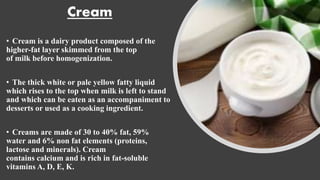
• Cream is a dairy product composed of the
higher-fat layer skimmed from the top
of milk before homogenization.
• The thick white or pale yellow fatty liquid
which rises to the top when milk is left to stand
and which can be eaten as an accompaniment to
desserts or used as a cooking ingredient.
• Creams are made of 30 to 40% fat, 59%
water and 6% non fat elements (proteins,
lactose and minerals). Cream
contains calcium and is rich in fat-soluble
vitamins A, D, E, K.
• Cream skimmed from milk may be called "sweet cream" to distinguish it
from cream skimmed from whey, a by-product of cheese-making. Whey
cream has a lower fat content and tastes more salty, tangy and "cheesy”.
• Cream produced by cattle (particularly Jersey cattle) grazing on
natural pasture often contains some natural carotenoid pigments derived
from the plants they eat; this gives it a slightly yellow tone, hence the name
of the yellowish-white color: cream.
• This is also the origin of butter's yellow color. Cream from goat's milk, or
from cows fed indoors on grain or grain-based pellets, is white.
Processing of
Cream from Milk
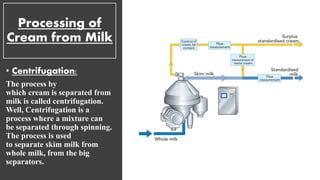
• Centrifugation:
The process by
which cream is separated from
milk is called centrifugation.
Well, Centrifugation is a
process where a mixture can
be separated through spinning.
The process is used
to separate skim milk from
whole milk, from the big
separators.
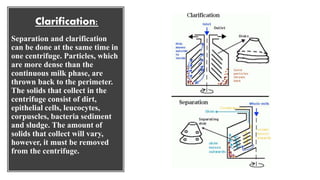
Clarification:
Separation and clarification
can be done at the same time in
one centrifuge. Particles, which
are more dense than the
continuous milk phase, are
thrown back to the perimeter.
The solids that collect in the
centrifuge consist of dirt,
epithelial cells, leucocytes,
corpuscles, bacteria sediment
and sludge. The amount of
solids that collect will vary,
however, it must be removed
from the centrifuge.
Separation:
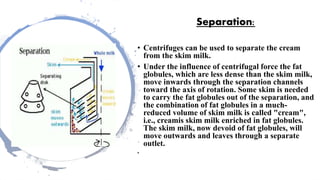
• Centrifuges can be used to separate the cream
from the skim milk.
• Under the influence of centrifugal force the fat
globules, which are less dense than the skim milk,
move inwards through the separation channels
toward the axis of rotation. Some skim is needed
to carry the fat globules out of the separation, and
the combination of fat globules in a much-
reduced volume of skim milk is called "cream",
i.e., creamis skim milk enriched in fat globules.
The skim milk, now devoid of fat globules, will
move outwards and leaves through a separate
outlet.
•
Standardization:
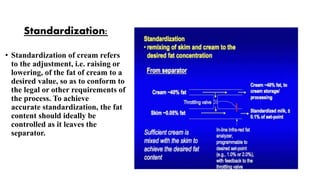
• Standardization of cream refers
to the adjustment, i.e. raising or
lowering, of the fat of cream to a
desired value, so as to conform to
the legal or other requirements of
the process. To achieve
accurate standardization, the fat
content should ideally be
controlled as it leaves the
separator.
• Homogenization: To prevent the creaming phenomenon during storage and to allow
an increase in cream viscosity (for low-fat fluid creams).
• Heat treatment: The objective is to inactivate microbial lipases and as a result destroy
pathogenic germs without damaging the cream organoleptic qualities. Most creams are
pasteurized.
• Seeding and maturation: Pasteurized creams may be matured with acidifying,
aromatic or even thickening mesophilic lactic bacteria. Maturation gives more taste to the
creams and protects it against lactic acid and bacteriocin production.
Types of the Cream
Heat treatment, fat content, viscosity, structure are as many elements that
help distinguish the numerous existing creams.
• Raw cream: Undergoes no heat treatment. This cream is neither pasteurized, nor
sterilized. It comes directly from skimming. The reference “raw” has to be written
on the label.
• Pasteurized cream: Undergoes a heat treatment up to 72°C during 20 seconds.
This kind of product is nevertheless more fragile than sterilized cream.
• Thick cream: Has been matured, meaning that the cream has been sown with
lactic ferments. Cream matures in tanks during several hours in order to acidify,
thicken and intensify its taste.
• Acid cream: obtained from bacterial fermentation that produces lactic acid. This
cream is broadly used in Anglo-Saxon countries, where it is called “sour cream”.
Main industrial uses of cream
Cream is used in many areas of the food industry, such as:
• Chocolate manufacturing: Cream is used in some formulations, such as chocolate stuffing.
• Bakery and Pastry: Cream is used for stuffing in pastries, mostly for its taste and emulsifying capacities
(in particular in whipped cream and mousse).
• Fresh dairy products: Cream is used in most products: cream dessert, dairy dessert, fresh cheese spread,
ice cream… Cream fat gives a soft texture and more flavour.
• Biscuit manufacturing: Cream may be used for stuffing or for the biscuit itself.
• Ready meals, soups and broths: Cream is used for its taste and binding property.
Functional properties of cream and its
advantages according to industrial applications
• Taste sensations: Taste and flavour enhancer.
• Maturation gives more flavour to the cream
• Size of suspended fat globules allows a fast fat melt.
• Texture builder:
Rich and velvety viscosity due to cream homogenisation, that is perfect for soups and sauces.
• Emulsifying property:
Cream proteins ease emulsification, ventilation, foaming and overrun.
• Whitening property:
• Whitening effect,
• Coloring effect due to fat globules and caseins that diffuse light.
• Browning of cooked aliments: Maillard reaction between proteins and lactose in the cream.
Health benefits of Cream
• Good for body growth:
• Calcium helps for maintenance of the bone health. With calcium, the
cream also contains phosphorous. Phosphorous helps in absorption of
calcium in the body. , it also contains folate which helps for brain and
nerves development. Also, the vitamin A and C present in the product
help to boost the immunity system.
• Promotes red blood cells:
• Iron and some other minerals are extremely necessary for the
development of these red blood cells. All these minerals are present in
fresh cream
• Good energy booster:
• If you look at the fat content of this product, it is very high. Fats, up to a
amount, are required by the body to create energy. The calories in it are 455
kcal and thus can help you to replenish your lost energy.
• Brain health:
• Phosphorous, present in the dairy product, is responsible for all the essential
brain functionalities. The phosphorous helps to keep away deadly diseases like
Alzheimer’s.
• Maintains eye health:
• Vitamin A helps to promote eye health. The vitamin helps to adapt to quick
changes in light and keeps the eyes moist. It also maintains your night vision.
Thus, it keeps you safe from night blindness.
• Hair health:
• The product is an excellent source of protein. Protein helps in preventing the
damage of hair and maintains hair health. On the other hand, it promotes hair
growth.
• Helps to avoid Kidney Stones:
• Calcium is known to reduce the risk of kidney stones. Many dairy products are
known to reduce the risk of many kidney related problems.
References:
• http://ecoursesonline.iasri.res.in/mod/page/view.php?id=147507
• https://www.fitsa-group.com/en/connaitre-creme-industrielle/
• https://www.healthbenefitstimes.com/cream/
• https://www.uoguelph.ca/foodscience/book/export/html/1906
• https://www.dairy.com.au/products/cream
• http://www.howstuffcompares.com/doc/c/cream-vs-milk.htm
• http://theepicentre.com/ingredient/cream-types-of-cream-and-their-uses/
• https://www.leaf.tv/articles/how-to-separate-cream-from-milk/
• https://www.wikihow.com/Make-Cream-from-Milk

Cream presentation

  • 1.
    Department of theNutrition and Food Technology University of Sindh, Jamshoro, Sindh, Pakistan CREAM Subject: Dairy Technology Ali Manzar 2k17-NFT-18 Afaque Ahmed 2k17-NFT-05 BS-Nutrition and Food Technology-iii Submitted to: Respected Ma’am Prof. Farha Naz Memon
  • 2.
    Table Of Contents •Introduction to Cream • Processing of the Cream -Centrifugation -Clarification and Separation -Standardization -Homogenization, Heat Treatment, Seeding and maturation • Types of the Cream • Main industrial uses of cream • cream and its advantages according to industrial applications • Health benefits of Cream
  • 3.
    Cream • Cream isa dairy product composed of the higher-fat layer skimmed from the top of milk before homogenization. • The thick white or pale yellow fatty liquid which rises to the top when milk is left to stand and which can be eaten as an accompaniment to desserts or used as a cooking ingredient. • Creams are made of 30 to 40% fat, 59% water and 6% non fat elements (proteins, lactose and minerals). Cream contains calcium and is rich in fat-soluble vitamins A, D, E, K.
  • 4.
    • Cream skimmedfrom milk may be called "sweet cream" to distinguish it from cream skimmed from whey, a by-product of cheese-making. Whey cream has a lower fat content and tastes more salty, tangy and "cheesy”. • Cream produced by cattle (particularly Jersey cattle) grazing on natural pasture often contains some natural carotenoid pigments derived from the plants they eat; this gives it a slightly yellow tone, hence the name of the yellowish-white color: cream. • This is also the origin of butter's yellow color. Cream from goat's milk, or from cows fed indoors on grain or grain-based pellets, is white.
  • 5.
    Processing of Cream fromMilk • Centrifugation: The process by which cream is separated from milk is called centrifugation. Well, Centrifugation is a process where a mixture can be separated through spinning. The process is used to separate skim milk from whole milk, from the big separators.
  • 6.
    Clarification: Separation and clarification canbe done at the same time in one centrifuge. Particles, which are more dense than the continuous milk phase, are thrown back to the perimeter. The solids that collect in the centrifuge consist of dirt, epithelial cells, leucocytes, corpuscles, bacteria sediment and sludge. The amount of solids that collect will vary, however, it must be removed from the centrifuge.
  • 7.
    Separation: • Centrifuges canbe used to separate the cream from the skim milk. • Under the influence of centrifugal force the fat globules, which are less dense than the skim milk, move inwards through the separation channels toward the axis of rotation. Some skim is needed to carry the fat globules out of the separation, and the combination of fat globules in a much- reduced volume of skim milk is called "cream", i.e., creamis skim milk enriched in fat globules. The skim milk, now devoid of fat globules, will move outwards and leaves through a separate outlet. •
  • 8.
    Standardization: • Standardization ofcream refers to the adjustment, i.e. raising or lowering, of the fat of cream to a desired value, so as to conform to the legal or other requirements of the process. To achieve accurate standardization, the fat content should ideally be controlled as it leaves the separator.
  • 9.
    • Homogenization: Toprevent the creaming phenomenon during storage and to allow an increase in cream viscosity (for low-fat fluid creams). • Heat treatment: The objective is to inactivate microbial lipases and as a result destroy pathogenic germs without damaging the cream organoleptic qualities. Most creams are pasteurized. • Seeding and maturation: Pasteurized creams may be matured with acidifying, aromatic or even thickening mesophilic lactic bacteria. Maturation gives more taste to the creams and protects it against lactic acid and bacteriocin production.
  • 10.
    Types of theCream Heat treatment, fat content, viscosity, structure are as many elements that help distinguish the numerous existing creams. • Raw cream: Undergoes no heat treatment. This cream is neither pasteurized, nor sterilized. It comes directly from skimming. The reference “raw” has to be written on the label. • Pasteurized cream: Undergoes a heat treatment up to 72°C during 20 seconds. This kind of product is nevertheless more fragile than sterilized cream. • Thick cream: Has been matured, meaning that the cream has been sown with lactic ferments. Cream matures in tanks during several hours in order to acidify, thicken and intensify its taste. • Acid cream: obtained from bacterial fermentation that produces lactic acid. This cream is broadly used in Anglo-Saxon countries, where it is called “sour cream”.
  • 11.
    Main industrial usesof cream Cream is used in many areas of the food industry, such as: • Chocolate manufacturing: Cream is used in some formulations, such as chocolate stuffing. • Bakery and Pastry: Cream is used for stuffing in pastries, mostly for its taste and emulsifying capacities (in particular in whipped cream and mousse). • Fresh dairy products: Cream is used in most products: cream dessert, dairy dessert, fresh cheese spread, ice cream… Cream fat gives a soft texture and more flavour. • Biscuit manufacturing: Cream may be used for stuffing or for the biscuit itself. • Ready meals, soups and broths: Cream is used for its taste and binding property.
  • 12.
    Functional properties ofcream and its advantages according to industrial applications • Taste sensations: Taste and flavour enhancer. • Maturation gives more flavour to the cream • Size of suspended fat globules allows a fast fat melt. • Texture builder: Rich and velvety viscosity due to cream homogenisation, that is perfect for soups and sauces. • Emulsifying property: Cream proteins ease emulsification, ventilation, foaming and overrun. • Whitening property: • Whitening effect, • Coloring effect due to fat globules and caseins that diffuse light. • Browning of cooked aliments: Maillard reaction between proteins and lactose in the cream.
  • 13.
    Health benefits ofCream • Good for body growth: • Calcium helps for maintenance of the bone health. With calcium, the cream also contains phosphorous. Phosphorous helps in absorption of calcium in the body. , it also contains folate which helps for brain and nerves development. Also, the vitamin A and C present in the product help to boost the immunity system. • Promotes red blood cells: • Iron and some other minerals are extremely necessary for the development of these red blood cells. All these minerals are present in fresh cream
  • 14.
    • Good energybooster: • If you look at the fat content of this product, it is very high. Fats, up to a amount, are required by the body to create energy. The calories in it are 455 kcal and thus can help you to replenish your lost energy. • Brain health: • Phosphorous, present in the dairy product, is responsible for all the essential brain functionalities. The phosphorous helps to keep away deadly diseases like Alzheimer’s.
  • 15.
    • Maintains eyehealth: • Vitamin A helps to promote eye health. The vitamin helps to adapt to quick changes in light and keeps the eyes moist. It also maintains your night vision. Thus, it keeps you safe from night blindness. • Hair health: • The product is an excellent source of protein. Protein helps in preventing the damage of hair and maintains hair health. On the other hand, it promotes hair growth. • Helps to avoid Kidney Stones: • Calcium is known to reduce the risk of kidney stones. Many dairy products are known to reduce the risk of many kidney related problems.
  • 16.
    References: • http://ecoursesonline.iasri.res.in/mod/page/view.php?id=147507 • https://www.fitsa-group.com/en/connaitre-creme-industrielle/ •https://www.healthbenefitstimes.com/cream/ • https://www.uoguelph.ca/foodscience/book/export/html/1906 • https://www.dairy.com.au/products/cream • http://www.howstuffcompares.com/doc/c/cream-vs-milk.htm • http://theepicentre.com/ingredient/cream-types-of-cream-and-their-uses/ • https://www.leaf.tv/articles/how-to-separate-cream-from-milk/ • https://www.wikihow.com/Make-Cream-from-Milk