

FLESH FOOD : AN OVERVIEW OF MEAT
SUBJECT - INTRODUCTION TO FOOD TECHNOLOGY
SUBMITTED BY :
NAME – PARWAN SHARMA
ROLL NO. – A0989216060
COURSE - B.SC. (H) MICROBIOLOGY
SECTION – B
SEMESTER - 06
FLESH FOOD (MEAT)
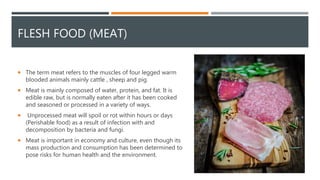
 The term meat refers to the muscles of four legged warm
blooded animals mainly cattle , sheep and pig.
 Meat is mainly composed of water, protein, and fat. It is
edible raw, but is normally eaten after it has been cooked
and seasoned or processed in a variety of ways.
 Unprocessed meat will spoil or rot within hours or days
(Perishable food) as a result of infection with and
decomposition by bacteria and fungi.
 Meat is important in economy and culture, even though its
mass production and consumption has been determined to
pose risks for human health and the environment.
STRUCTURE
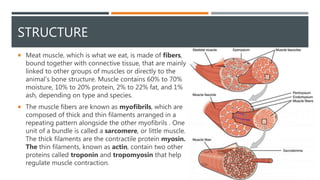
 Meat muscle, which is what we eat, is made of fibers,
bound together with connective tissue, that are mainly
linked to other groups of muscles or directly to the
animal’s bone structure. Muscle contains 60% to 70%
moisture, 10% to 20% protein, 2% to 22% fat, and 1%
ash, depending on type and species.
 The muscle fibers are known as myofibrils, which are
composed of thick and thin filaments arranged in a
repeating pattern alongside the other myofibrils . One
unit of a bundle is called a sarcomere, or little muscle.
The thick filaments are the contractile protein myosin.
The thin filaments, known as actin, contain two other
proteins called troponin and tropomyosin that help
regulate muscle contraction.
COMPOSITION
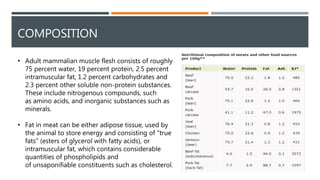
• Adult mammalian muscle flesh consists of roughly
75 percent water, 19 percent protein, 2.5 percent
intramuscular fat, 1.2 percent carbohydrates and
2.3 percent other soluble non-protein substances.
These include nitrogenous compounds, such
as amino acids, and inorganic substances such as
minerals.
• Fat in meat can be either adipose tissue, used by
the animal to store energy and consisting of "true
fats" (esters of glycerol with fatty acids), or
intramuscular fat, which contains considerable
quantities of phospholipids and
of unsaponifiable constituents such as cholesterol.
NUTRITIONAL VALUE
 All muscle tissue is very high in protein,
containing all of the essential amino acids,
and in most cases is a good source
of zinc, vitamin
B12, selenium, phosphorus, niacin, vitamin
B6 ,choline, riboflavin and iron.
 Several forms of meat are also high
in vitamin K. Muscle tissue is very low in
carbohydrates and does not contain dietary
fiber.
 The fat content of meat can vary widely
depending on the species and breed of
animal, the way in which the animal was
raised, including what it was fed,
the anatomical part of the body, and the
methods of butchering and cooking.
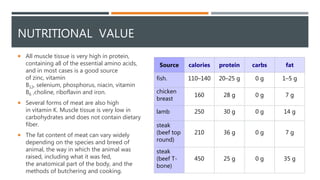
Source calories protein carbs fat
fish. 110–140 20–25 g 0 g 1–5 g
chicken
breast
160 28 g 0 g 7 g
lamb 250 30 g 0 g 14 g
steak
(beef top
round)
210 36 g 0 g 7 g
steak
(beef T-
bone)
450 25 g 0 g 35 g
POST-MORTEM CHANGES
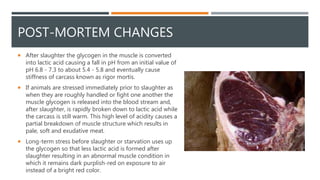
 After slaughter the glycogen in the muscle is converted
into lactic acid causing a fall in pH from an initial value of
pH 6.8 - 7.3 to about 5.4 - 5.8 and eventually cause
stiffness of carcass known as rigor mortis.
 If animals are stressed immediately prior to slaughter as
when they are roughly handled or fight one another the
muscle glycogen is released into the blood stream and,
after slaughter, is rapidly broken down to lactic acid while
the carcass is still warm. This high level of acidity causes a
partial breakdown of muscle structure which results in
pale, soft and exudative meat.
 Long-term stress before slaughter or starvation uses up
the glycogen so that less lactic acid is formed after
slaughter resulting in an abnormal muscle condition in
which it remains dark purplish-red on exposure to air
instead of a bright red color.
AGING OF MEAT CARCASSES
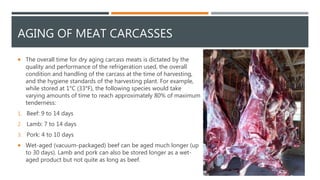
 The overall time for dry aging carcass meats is dictated by the
quality and performance of the refrigeration used, the overall
condition and handling of the carcass at the time of harvesting,
and the hygiene standards of the harvesting plant. For example,
while stored at 1°C (33°F), the following species would take
varying amounts of time to reach approximately 80% of maximum
tenderness:
1. Beef: 9 to 14 days
2. Lamb: 7 to 14 days
3. Pork: 4 to 10 days
 Wet-aged (vacuum-packaged) beef can be aged much longer (up
to 30 days). Lamb and pork can also be stored longer as a wet-
aged product but not quite as long as beef.
CURING OF MEAT
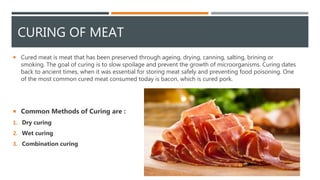
 Cured meat is meat that has been preserved through ageing, drying, canning, salting, brining or
smoking. The goal of curing is to slow spoilage and prevent the growth of microorganisms. Curing dates
back to ancient times, when it was essential for storing meat safely and preventing food poisoning. One
of the most common cured meat consumed today is bacon, which is cured pork.
 Common Methods of Curing are :
1. Dry curing
2. Wet curing
3. Combination curing
Essential curing ingredients include:
• Meat – you can use beef, pork, veal, lamb, poultry and fish.
• Salt – salt is the most important ingredient for curing, as it
draws the water out of the meat and kills microorganisms.
The less moisture in the meat, the longer it can be saved
before being eaten.
• Sugar – although not required for curing, sugar is often
added to counteract the harsh flavor of the salt.
• Nitrates and nitrites – They kill bacteria in the meat and
also give the meat an appealing pink color (without them,
cured meat would be grey). Nitrates and nitrites can be
harmful in large quantities, so it is essential that they are used
carefully and sparingly. Curing methods/recipes should
always be followed exactly.
CONSUMPTION
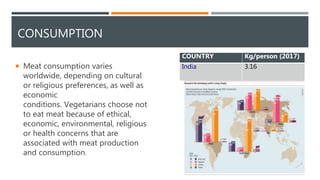
COUNTRY Kg/person (2017)
India 3.16 Meat consumption varies
worldwide, depending on cultural
or religious preferences, as well as
economic
conditions. Vegetarians choose not
to eat meat because of ethical,
economic, environmental, religious
or health concerns that are
associated with meat production
and consumption.
Flesh food

Flesh food

  • 1.
    FLESH FOOD :AN OVERVIEW OF MEAT SUBJECT - INTRODUCTION TO FOOD TECHNOLOGY SUBMITTED BY : NAME – PARWAN SHARMA ROLL NO. – A0989216060 COURSE - B.SC. (H) MICROBIOLOGY SECTION – B SEMESTER - 06
  • 2.
    FLESH FOOD (MEAT) The term meat refers to the muscles of four legged warm blooded animals mainly cattle , sheep and pig.  Meat is mainly composed of water, protein, and fat. It is edible raw, but is normally eaten after it has been cooked and seasoned or processed in a variety of ways.  Unprocessed meat will spoil or rot within hours or days (Perishable food) as a result of infection with and decomposition by bacteria and fungi.  Meat is important in economy and culture, even though its mass production and consumption has been determined to pose risks for human health and the environment.
  • 3.
    STRUCTURE  Meat muscle,which is what we eat, is made of fibers, bound together with connective tissue, that are mainly linked to other groups of muscles or directly to the animal’s bone structure. Muscle contains 60% to 70% moisture, 10% to 20% protein, 2% to 22% fat, and 1% ash, depending on type and species.  The muscle fibers are known as myofibrils, which are composed of thick and thin filaments arranged in a repeating pattern alongside the other myofibrils . One unit of a bundle is called a sarcomere, or little muscle. The thick filaments are the contractile protein myosin. The thin filaments, known as actin, contain two other proteins called troponin and tropomyosin that help regulate muscle contraction.
  • 4.
    COMPOSITION • Adult mammalianmuscle flesh consists of roughly 75 percent water, 19 percent protein, 2.5 percent intramuscular fat, 1.2 percent carbohydrates and 2.3 percent other soluble non-protein substances. These include nitrogenous compounds, such as amino acids, and inorganic substances such as minerals. • Fat in meat can be either adipose tissue, used by the animal to store energy and consisting of "true fats" (esters of glycerol with fatty acids), or intramuscular fat, which contains considerable quantities of phospholipids and of unsaponifiable constituents such as cholesterol.
  • 5.
    NUTRITIONAL VALUE  Allmuscle tissue is very high in protein, containing all of the essential amino acids, and in most cases is a good source of zinc, vitamin B12, selenium, phosphorus, niacin, vitamin B6 ,choline, riboflavin and iron.  Several forms of meat are also high in vitamin K. Muscle tissue is very low in carbohydrates and does not contain dietary fiber.  The fat content of meat can vary widely depending on the species and breed of animal, the way in which the animal was raised, including what it was fed, the anatomical part of the body, and the methods of butchering and cooking. Source calories protein carbs fat fish. 110–140 20–25 g 0 g 1–5 g chicken breast 160 28 g 0 g 7 g lamb 250 30 g 0 g 14 g steak (beef top round) 210 36 g 0 g 7 g steak (beef T- bone) 450 25 g 0 g 35 g
  • 6.
    POST-MORTEM CHANGES  Afterslaughter the glycogen in the muscle is converted into lactic acid causing a fall in pH from an initial value of pH 6.8 - 7.3 to about 5.4 - 5.8 and eventually cause stiffness of carcass known as rigor mortis.  If animals are stressed immediately prior to slaughter as when they are roughly handled or fight one another the muscle glycogen is released into the blood stream and, after slaughter, is rapidly broken down to lactic acid while the carcass is still warm. This high level of acidity causes a partial breakdown of muscle structure which results in pale, soft and exudative meat.  Long-term stress before slaughter or starvation uses up the glycogen so that less lactic acid is formed after slaughter resulting in an abnormal muscle condition in which it remains dark purplish-red on exposure to air instead of a bright red color.
  • 7.
    AGING OF MEATCARCASSES  The overall time for dry aging carcass meats is dictated by the quality and performance of the refrigeration used, the overall condition and handling of the carcass at the time of harvesting, and the hygiene standards of the harvesting plant. For example, while stored at 1°C (33°F), the following species would take varying amounts of time to reach approximately 80% of maximum tenderness: 1. Beef: 9 to 14 days 2. Lamb: 7 to 14 days 3. Pork: 4 to 10 days  Wet-aged (vacuum-packaged) beef can be aged much longer (up to 30 days). Lamb and pork can also be stored longer as a wet- aged product but not quite as long as beef.
  • 8.
    CURING OF MEAT Cured meat is meat that has been preserved through ageing, drying, canning, salting, brining or smoking. The goal of curing is to slow spoilage and prevent the growth of microorganisms. Curing dates back to ancient times, when it was essential for storing meat safely and preventing food poisoning. One of the most common cured meat consumed today is bacon, which is cured pork.  Common Methods of Curing are : 1. Dry curing 2. Wet curing 3. Combination curing
  • 9.
    Essential curing ingredientsinclude: • Meat – you can use beef, pork, veal, lamb, poultry and fish. • Salt – salt is the most important ingredient for curing, as it draws the water out of the meat and kills microorganisms. The less moisture in the meat, the longer it can be saved before being eaten. • Sugar – although not required for curing, sugar is often added to counteract the harsh flavor of the salt. • Nitrates and nitrites – They kill bacteria in the meat and also give the meat an appealing pink color (without them, cured meat would be grey). Nitrates and nitrites can be harmful in large quantities, so it is essential that they are used carefully and sparingly. Curing methods/recipes should always be followed exactly.
  • 10.
    CONSUMPTION COUNTRY Kg/person (2017) India3.16 Meat consumption varies worldwide, depending on cultural or religious preferences, as well as economic conditions. Vegetarians choose not to eat meat because of ethical, economic, environmental, religious or health concerns that are associated with meat production and consumption.