Butter, Cream, Yoghurt & Cheese
© PDST Home Economics
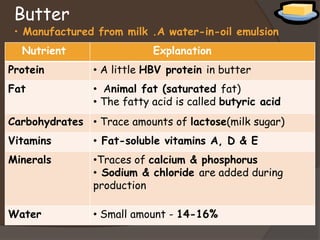
• Manufactured from milk .A water-in-oil emulsion
Butter
Nutrient Explanation
Protein • A little HBV protein in butter
Fat • Animal fat (saturated fat)
• The fatty acid is called butyric acid
Carbohydrates • Trace amounts of lactose(milk sugar)
Vitamins • Fat-soluble vitamins A, D & E
Minerals •Traces of calcium & phosphorus
• Sodium & chloride are added during
production
Water • Small amount - 14-16%
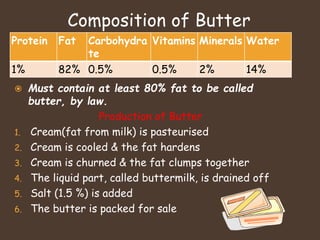
Composition of Butter
Protein Fat Carbohydra
te
Vitamins Minerals Water
1% 82% 0.5% 0.5% 2% 14%
 Must contain at least 80% fat to be called
butter, by law.
Production of Butter
1. Cream(fat from milk) is pasteurised
2. Cream is cooled & the fat hardens
3. Cream is churned & the fat clumps together
4. The liquid part, called buttermilk, is drained off
5. Salt (1.5 %) is added
6. The butter is packed for sale
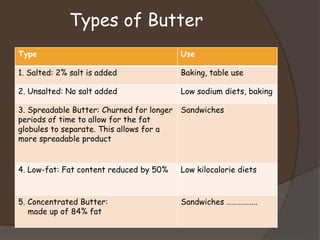
Types of Butter
Type Use
1. Salted: 2% salt is added Baking, table use
2. Unsalted: No salt added Low sodium diets, baking
3. Spreadable Butter: Churned for longer
periods of time to allow for the fat
globules to separate. This allows for a
more spreadable product
Sandwiches
4. Low-fat: Fat content reduced by 50% Low kilocalorie diets
5. Concentrated Butter:
made up of 84% fat
Sandwiches ……………..
Cream
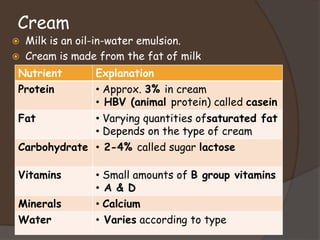
 Milk is an oil-in-water emulsion.
 Cream is made from the fat of milk
Nutrient Explanation
Protein • Approx. 3% in cream
• HBV (animal protein) called casein
Fat • Varying quantities ofsaturated fat
• Depends on the type of cream
Carbohydrate • 2-4% called sugar lactose
Vitamins • Small amounts of B group vitamins
• A & D
Minerals • Calcium
Water • Varies according to type
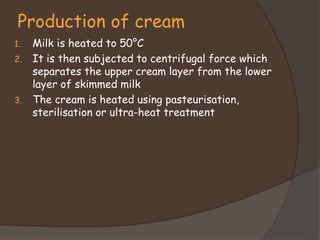
Production of cream
1. Milk is heated to 50°C
2. It is then subjected to centrifugal force which
separates the upper cream layer from the lower
layer of skimmed milk
3. The cream is heated using pasteurisation,
sterilisation or ultra-heat treatment
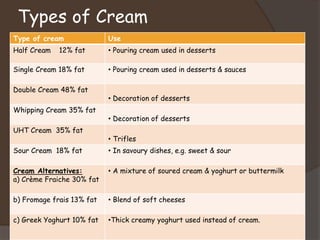
Types of Cream
Type of cream Use
Half Cream 12% fat • Pouring cream used in desserts
Single Cream 18% fat • Pouring cream used in desserts & sauces
Double Cream 48% fat
• Decoration of desserts
Whipping Cream 35% fat
• Decoration of desserts
UHT Cream 35% fat
• Trifles
Sour Cream 18% fat • In savoury dishes, e.g. sweet & sour
Cream Alternatives:
a) Crème Fraiche 30% fat
• A mixture of soured cream & yoghurt or buttermilk
b) Fromage frais 13% fat • Blend of soft cheeses
c) Greek Yoghurt 10% fat •Thick creamy yoghurt used instead of cream.
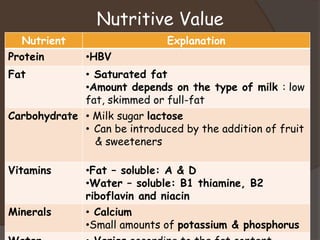
Nutritive Value
Nutrient Explanation
Protein •HBV
Fat • Saturated fat
•Amount depends on the type of milk : low
fat, skimmed or full-fat
Carbohydrate • Milk sugar lactose
• Can be introduced by the addition of fruit
& sweeteners
Vitamins •Fat – soluble: A & D
•Water – soluble: B1 thiamine, B2
riboflavin and niacin
Minerals • Calcium
•Small amounts of potassium & phosphorus
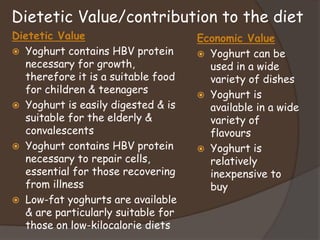
Dietetic Value/contribution to the diet
Dietetic Value
 Yoghurt contains HBV protein
necessary for growth,
therefore it is a suitable food
for children & teenagers
 Yoghurt is easily digested & is
suitable for the elderly &
convalescents
 Yoghurt contains HBV protein
necessary to repair cells,
essential for those recovering
from illness
 Low-fat yoghurts are available
& are particularly suitable for
those on low-kilocalorie diets
Economic Value
 Yoghurt can be
used in a wide
variety of dishes
 Yoghurt is
available in a wide
variety of
flavours
 Yoghurt is
relatively
inexpensive to
buy
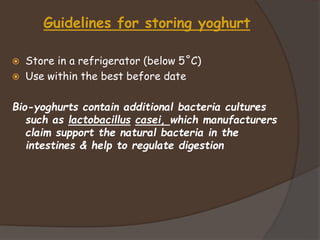
Guidelines for storing yoghurt
 Store in a refrigerator (below 5˚C)
 Use within the best before date
Bio-yoghurts contain additional bacteria cultures
such as lactobacillus casei, which manufacturers
claim support the natural bacteria in the
intestines & help to regulate digestion
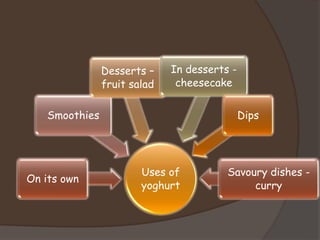
Uses of
yoghurt
On its own
Smoothies
Desserts –
fruit salad
In desserts -
cheesecake
Dips
Savoury dishes -
curry
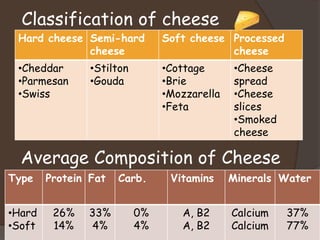
Classification of cheese
Hard cheese Semi-hard
cheese
Soft cheese Processed
cheese
•Cheddar
•Parmesan
•Swiss
•Stilton
•Gouda
•Cottage
•Brie
•Mozzarella
•Feta
•Cheese
spread
•Cheese
slices
•Smoked
cheese
Type Protein Fat Carb. Vitamins Minerals Water
•Hard
•Soft
26%
14%
33%
4%
0%
4%
A, B2
A, B2
Calcium
Calcium
37%
77%
Average Composition of Cheese
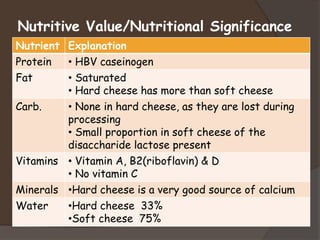
Nutritive Value/Nutritional Significance
Nutrient Explanation
Protein • HBV caseinogen
Fat • Saturated
• Hard cheese has more than soft cheese
Carb. • None in hard cheese, as they are lost during
processing
• Small proportion in soft cheese of the
disaccharide lactose present
Vitamins • Vitamin A, B2(riboflavin) & D
• No vitamin C
Minerals •Hard cheese is a very good source of calcium
Water •Hard cheese 33%
•Soft cheese 75%
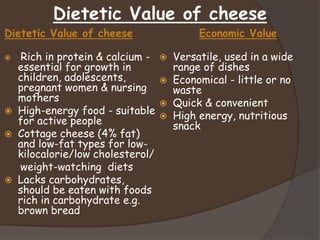
Dietetic Value of cheese
 Rich in protein & calcium -
essential for growth in
children, adolescents,
pregnant women & nursing
mothers
 High-energy food - suitable
for active people
 Cottage cheese (4% fat)
and low-fat types for low-
kilocalorie/low cholesterol/
weight-watching diets
 Lacks carbohydrates,
should be eaten with foods
rich in carbohydrate e.g.
brown bread
Economic Value
 Versatile, used in a wide
range of dishes
 Economical - little or no
waste
 Quick & convenient
 High energy, nutritious
snack
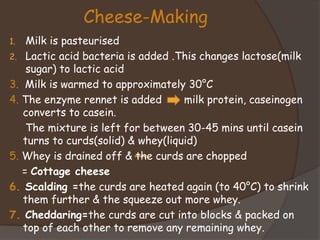
Cheese-Making
1. Milk is pasteurised
2. Lactic acid bacteria is added .This changes lactose(milk
sugar) to lactic acid
3. Milk is warmed to approximately 30°C
4. The enzyme rennet is added milk protein, caseinogen
converts to casein.
The mixture is left for between 30-45 mins until casein
turns to curds(solid) & whey(liquid)
5. Whey is drained off & the curds are chopped
= Cottage cheese
6. Scalding =the curds are heated again (to 40°C) to shrink
them further & the squeeze out more whey.
7. Cheddaring=the curds are cut into blocks & packed on
top of each other to remove any remaining whey.
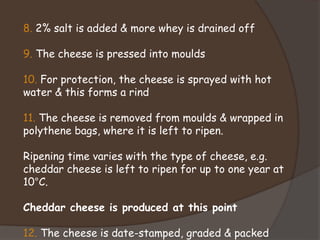
8. 2% salt is added & more whey is drained off
9. The cheese is pressed into moulds
10. For protection, the cheese is sprayed with hot
water & this forms a rind
11. The cheese is removed from moulds & wrapped in
polythene bags, where it is left to ripen.
Ripening time varies with the type of cheese, e.g.
cheddar cheese is left to ripen for up to one year at
10°C.
Cheddar cheese is produced at this point
12. The cheese is date-stamped, graded & packed
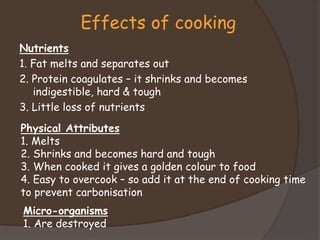
Nutrients
1. Fat melts and separates out
2. Protein coagulates – it shrinks and becomes
indigestible, hard & tough
3. Little loss of nutrients
Effects of cooking
Physical Attributes
1. Melts
2. Shrinks and becomes hard and tough
3. When cooked it gives a golden colour to food
4. Easy to overcook – so add it at the end of cooking time
to prevent carbonisation
Micro-organisms
1. Are destroyed
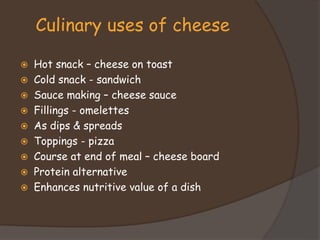
 Hot snack – cheese on toast
 Cold snack - sandwich
 Sauce making – cheese sauce
 Fillings - omelettes
 As dips & spreads
 Toppings - pizza
 Course at end of meal – cheese board
 Protein alternative
 Enhances nutritive value of a dish
Culinary uses of cheese
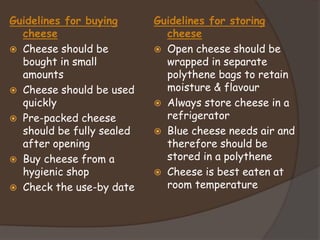
Guidelines for buying
cheese
 Cheese should be
bought in small
amounts
 Cheese should be used
quickly
 Pre-packed cheese
should be fully sealed
after opening
 Buy cheese from a
hygienic shop
 Check the use-by date
Guidelines for storing
cheese
 Open cheese should be
wrapped in separate
polythene bags to retain
moisture & flavour
 Always store cheese in a
refrigerator
 Blue cheese needs air and
therefore should be
stored in a polythene
 Cheese is best eaten at
room temperature

Dairy Products.ppt

  • 1.
    Butter, Cream, Yoghurt& Cheese © PDST Home Economics
  • 2.
    • Manufactured frommilk .A water-in-oil emulsion Butter Nutrient Explanation Protein • A little HBV protein in butter Fat • Animal fat (saturated fat) • The fatty acid is called butyric acid Carbohydrates • Trace amounts of lactose(milk sugar) Vitamins • Fat-soluble vitamins A, D & E Minerals •Traces of calcium & phosphorus • Sodium & chloride are added during production Water • Small amount - 14-16%
  • 3.
    Composition of Butter ProteinFat Carbohydra te Vitamins Minerals Water 1% 82% 0.5% 0.5% 2% 14%  Must contain at least 80% fat to be called butter, by law. Production of Butter 1. Cream(fat from milk) is pasteurised 2. Cream is cooled & the fat hardens 3. Cream is churned & the fat clumps together 4. The liquid part, called buttermilk, is drained off 5. Salt (1.5 %) is added 6. The butter is packed for sale
  • 4.
    Types of Butter TypeUse 1. Salted: 2% salt is added Baking, table use 2. Unsalted: No salt added Low sodium diets, baking 3. Spreadable Butter: Churned for longer periods of time to allow for the fat globules to separate. This allows for a more spreadable product Sandwiches 4. Low-fat: Fat content reduced by 50% Low kilocalorie diets 5. Concentrated Butter: made up of 84% fat Sandwiches ……………..
  • 5.
    Cream  Milk isan oil-in-water emulsion.  Cream is made from the fat of milk Nutrient Explanation Protein • Approx. 3% in cream • HBV (animal protein) called casein Fat • Varying quantities ofsaturated fat • Depends on the type of cream Carbohydrate • 2-4% called sugar lactose Vitamins • Small amounts of B group vitamins • A & D Minerals • Calcium Water • Varies according to type
  • 6.
    Production of cream 1.Milk is heated to 50°C 2. It is then subjected to centrifugal force which separates the upper cream layer from the lower layer of skimmed milk 3. The cream is heated using pasteurisation, sterilisation or ultra-heat treatment
  • 7.
    Types of Cream Typeof cream Use Half Cream 12% fat • Pouring cream used in desserts Single Cream 18% fat • Pouring cream used in desserts & sauces Double Cream 48% fat • Decoration of desserts Whipping Cream 35% fat • Decoration of desserts UHT Cream 35% fat • Trifles Sour Cream 18% fat • In savoury dishes, e.g. sweet & sour Cream Alternatives: a) Crème Fraiche 30% fat • A mixture of soured cream & yoghurt or buttermilk b) Fromage frais 13% fat • Blend of soft cheeses c) Greek Yoghurt 10% fat •Thick creamy yoghurt used instead of cream.
  • 8.
    Nutritive Value Nutrient Explanation Protein•HBV Fat • Saturated fat •Amount depends on the type of milk : low fat, skimmed or full-fat Carbohydrate • Milk sugar lactose • Can be introduced by the addition of fruit & sweeteners Vitamins •Fat – soluble: A & D •Water – soluble: B1 thiamine, B2 riboflavin and niacin Minerals • Calcium •Small amounts of potassium & phosphorus
  • 9.
    Dietetic Value/contribution tothe diet Dietetic Value  Yoghurt contains HBV protein necessary for growth, therefore it is a suitable food for children & teenagers  Yoghurt is easily digested & is suitable for the elderly & convalescents  Yoghurt contains HBV protein necessary to repair cells, essential for those recovering from illness  Low-fat yoghurts are available & are particularly suitable for those on low-kilocalorie diets Economic Value  Yoghurt can be used in a wide variety of dishes  Yoghurt is available in a wide variety of flavours  Yoghurt is relatively inexpensive to buy
  • 10.
    Guidelines for storingyoghurt  Store in a refrigerator (below 5˚C)  Use within the best before date Bio-yoghurts contain additional bacteria cultures such as lactobacillus casei, which manufacturers claim support the natural bacteria in the intestines & help to regulate digestion
  • 11.
    Uses of yoghurt On itsown Smoothies Desserts – fruit salad In desserts - cheesecake Dips Savoury dishes - curry
  • 12.
    Classification of cheese Hardcheese Semi-hard cheese Soft cheese Processed cheese •Cheddar •Parmesan •Swiss •Stilton •Gouda •Cottage •Brie •Mozzarella •Feta •Cheese spread •Cheese slices •Smoked cheese Type Protein Fat Carb. Vitamins Minerals Water •Hard •Soft 26% 14% 33% 4% 0% 4% A, B2 A, B2 Calcium Calcium 37% 77% Average Composition of Cheese
  • 13.
    Nutritive Value/Nutritional Significance NutrientExplanation Protein • HBV caseinogen Fat • Saturated • Hard cheese has more than soft cheese Carb. • None in hard cheese, as they are lost during processing • Small proportion in soft cheese of the disaccharide lactose present Vitamins • Vitamin A, B2(riboflavin) & D • No vitamin C Minerals •Hard cheese is a very good source of calcium Water •Hard cheese 33% •Soft cheese 75%
  • 14.
    Dietetic Value ofcheese Dietetic Value of cheese  Rich in protein & calcium - essential for growth in children, adolescents, pregnant women & nursing mothers  High-energy food - suitable for active people  Cottage cheese (4% fat) and low-fat types for low- kilocalorie/low cholesterol/ weight-watching diets  Lacks carbohydrates, should be eaten with foods rich in carbohydrate e.g. brown bread Economic Value  Versatile, used in a wide range of dishes  Economical - little or no waste  Quick & convenient  High energy, nutritious snack
  • 15.
    Cheese-Making 1. Milk ispasteurised 2. Lactic acid bacteria is added .This changes lactose(milk sugar) to lactic acid 3. Milk is warmed to approximately 30°C 4. The enzyme rennet is added milk protein, caseinogen converts to casein. The mixture is left for between 30-45 mins until casein turns to curds(solid) & whey(liquid) 5. Whey is drained off & the curds are chopped = Cottage cheese 6. Scalding =the curds are heated again (to 40°C) to shrink them further & the squeeze out more whey. 7. Cheddaring=the curds are cut into blocks & packed on top of each other to remove any remaining whey.
  • 16.
    8. 2% saltis added & more whey is drained off 9. The cheese is pressed into moulds 10. For protection, the cheese is sprayed with hot water & this forms a rind 11. The cheese is removed from moulds & wrapped in polythene bags, where it is left to ripen. Ripening time varies with the type of cheese, e.g. cheddar cheese is left to ripen for up to one year at 10°C. Cheddar cheese is produced at this point 12. The cheese is date-stamped, graded & packed
  • 17.
    Nutrients 1. Fat meltsand separates out 2. Protein coagulates – it shrinks and becomes indigestible, hard & tough 3. Little loss of nutrients Effects of cooking Physical Attributes 1. Melts 2. Shrinks and becomes hard and tough 3. When cooked it gives a golden colour to food 4. Easy to overcook – so add it at the end of cooking time to prevent carbonisation Micro-organisms 1. Are destroyed
  • 18.
     Hot snack– cheese on toast  Cold snack - sandwich  Sauce making – cheese sauce  Fillings - omelettes  As dips & spreads  Toppings - pizza  Course at end of meal – cheese board  Protein alternative  Enhances nutritive value of a dish Culinary uses of cheese
  • 19.
    Guidelines for buying cheese Cheese should be bought in small amounts  Cheese should be used quickly  Pre-packed cheese should be fully sealed after opening  Buy cheese from a hygienic shop  Check the use-by date Guidelines for storing cheese  Open cheese should be wrapped in separate polythene bags to retain moisture & flavour  Always store cheese in a refrigerator  Blue cheese needs air and therefore should be stored in a polythene  Cheese is best eaten at room temperature