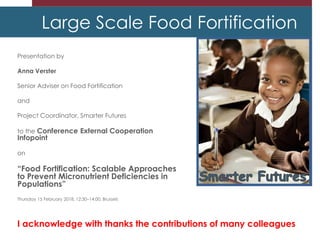
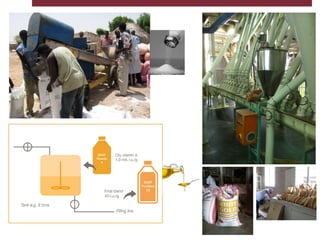
Large Scale Food Fortification
Presentation by
Anna Verster
Senior Adviser on Food Fortification
and
Project Coordinator, Smarter Futures
to the Conference External Cooperation
Infopoint
on
“Food Fortification: Scalable Approaches
to Prevent Micronutrient Deficiencies in
Populations”
Thursday 15 February 2018, 12:30–14:00, Brussels
I acknowledge with thanks the contributions of many colleagues
Large Scale Food Fortification
 What is it?
 Why fortify?
 Who benefits?
 History and current progress
 Evidence of impact
 Cost and benefit
 Programme implementation
What is food fortification?
 Food fortification has been defined as the
addition of one or more essential nutrients to a
food, whether or not it is normally contained in
the food, for the purpose of preventing or
correcting a demonstrated deficiency of one or
more nutrients in the population or specific
population groups (FAO/WHO 1994).
 Enrichment is defined as "synonymous with
fortification and refers to the addition of
micronutrients to a food which are lost during
processing"
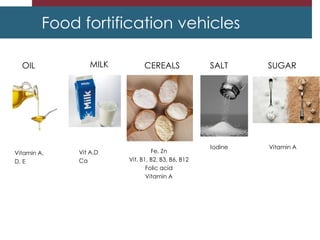
Food fortification vehicles
OIL
Vitamin A,
D, E
CEREALS
Fe, Zn
Vit. B1, B2, B3, B6, B12
Folic acid
Vitamin A
Vitamin A
SALT SUGAR
Iodine
MILK
Vit A,D
Ca
Large Scale Food Fortification
 What is it?
 Why Fortify?
 Who benefits?
 History and current progress
 Evidence of impact
 Cost and benefit
 Programme implementation
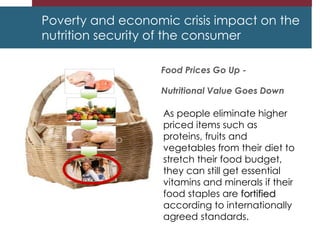
Poverty and economic crisis impact on the
nutrition security of the consumer
Food Prices Go Up -
Nutritional Value Goes Down
As people eliminate higher
priced items such as
proteins, fruits and
vegetables from their diet to
stretch their food budget,
they can still get essential
vitamins and minerals if their
food staples are fortified
according to internationally
agreed standards.
The Big Five……..
 Iodine deficiency is the single most preventable
cause of mental retardation and brain
damage.
 Vitamin A deficiency is the leading cause of
acquired blindness in children and impairs
immune function.
 Severe zinc deficiency causes short stature,
impairs immune function and other disorders
 Iron deficiency is one of the most prevalent
nutrient deficiencies in the world; it affects an
estimated two billion people, and causes
almost a million deaths a year.
 Folic acid prevents birth defects of the brain
and spine, such as spina bifida.
Large Scale Food Fortification
 What is it
 Why fortify?
 Who benefits?
 History and current progress
 Evidence of impact
 Cost and benefit
 Programme implementation
Who will benefit from fortified foods?
 Food fortification is an industrial process. The industry
ensures provision of essential vitamins and minerals
according to government standards and regulations.
 Fortified foods reach all those who have access to the
market and purchase their staple food/ oil/ salt.
 This includes the urban poor, a fast growing group in many
developing countries in Africa and Asia.
 Those who do not have access to fortified, packaged
commercially processed foods need to receive essential
vitamins and minerals through alternative mechanisms.
This may include provision of multiple micronutrient
powder sachets (“sprinkles”) or supplements, as well as
social safety net approaches, which use fortified foods.
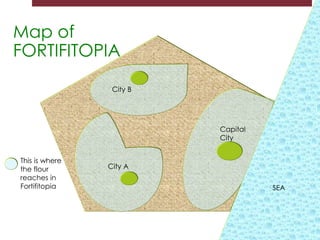
City A
City B
Capital
City
Map of
FORTIFITOPIA
SEA
This is where
the flour
reaches in
Fortifitopia
Large Scale Food Fortification
 What is it?
 Why fortify?
 Who benefits?
 History and current progress
 Evidence of impact
 Cost and benefit
 Programme implementation
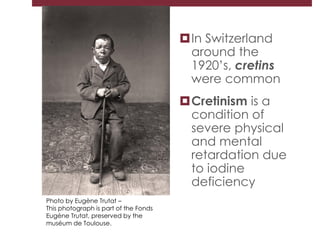
Photo by Eugène Trutat –
This photograph is part of the Fonds
Eugène Trutat, preserved by the
muséum de Toulouse.
In Switzerland
around the
1920’s, cretins
were common
Cretinism is a
condition of
severe physical
and mental
retardation due
to iodine
deficiency
Iodine deficiency disorders
Iodine deficiency is the world’s most
prevalent, yet easily preventable, cause of
brain damage.
In certain regions of Switzerland, 0.5% of the
inhabitants were cretins, almost 100% of
schoolchildren had large goiters, and up to
30% of young men were unfit for military
service owing to a large goiter
Iodization of salt was introduced in
Switzerland in 1922. The USA quickly followed.
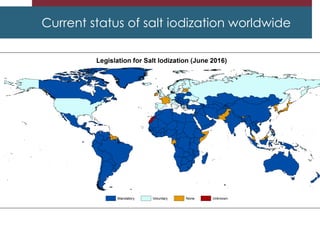
Current status of salt iodization worldwide
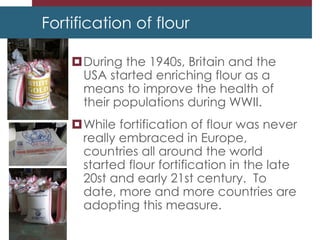
Fortification of flour
During the 1940s, Britain and the
USA started enriching flour as a
means to improve the health of
their populations during WWII.
While fortification of flour was never
really embraced in Europe,
countries all around the world
started flour fortification in the late
20st and early 21st century. To
date, more and more countries are
adopting this measure.
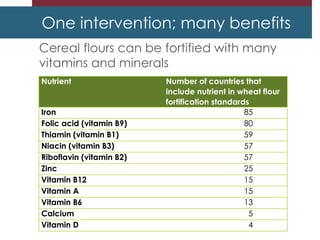
One intervention; many benefits
Cereal flours can be fortified with many
vitamins and minerals
Nutrient Number of countries that
include nutrient in wheat flour
fortification standards
Iron 85
Folic acid (vitamin B9) 80
Thiamin (vitamin B1) 59
Niacin (vitamin B3) 57
Riboflavin (vitamin B2) 57
Zinc 25
Vitamin B12 15
Vitamin A 15
Vitamin B6 13
Calcium 5
Vitamin D 4
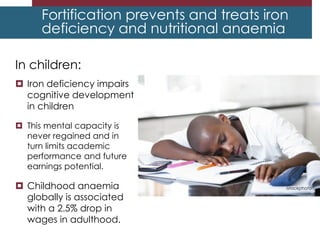
Fortification prevents and treats
nutritional anemia
In children:
 Iron deficiency impairs
cognitive development
in children
 This mental capacity is
never regained and in
turn limits academic
performance and future
earnings potential.
 Childhood anaemia
globally is associated
with a 2.5% drop in
wages in adulthood.
Fortification prevents and treats iron
deficiency and nutritional anaemia
istockphoto
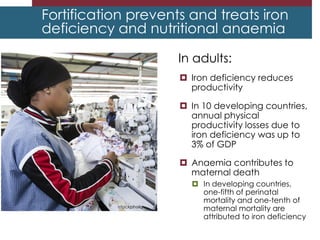
Fortification prevents and treats
nutritional anemia
In adults:
 Iron deficiency reduces
productivity
 In 10 developing countries,
annual physical
productivity losses due to
iron deficiency was up to
3% of GDP
 Anaemia contributes to
maternal death
 In developing countries,
one-fifth of perinatal
mortality and one-tenth of
maternal mortality are
attributed to iron deficiency
Fortification prevents and treats iron
deficiency and nutritional anaemia
istockphoto
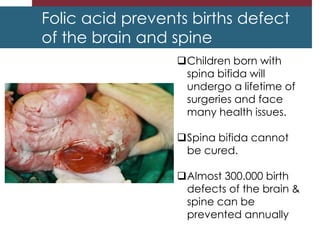
Folic acid prevents births defect
of the brain and spine
Children born with
spina bifida will
undergo a lifetime of
surgeries and face
many health issues.
Spina bifida cannot
be cured.
Almost 300.000 birth
defects of the brain &
spine can be
prevented annually
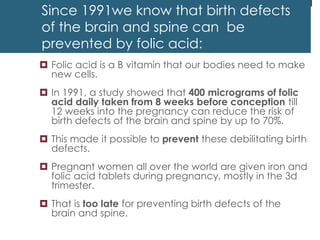
Since 1991we know that birth defects
of the brain and spine can be
prevented by folic acid:
 Folic acid is a B vitamin that our bodies need to make
new cells.
 In 1991, a study showed that 400 micrograms of folic
acid daily taken from 8 weeks before conception till
12 weeks into the pregnancy can reduce the risk of
birth defects of the brain and spine by up to 70%.
 This made it possible to prevent these debilitating birth
defects.
 Pregnant women all over the world are given iron and
folic acid tablets during pregnancy, mostly in the 3d
trimester.
 That is too late for preventing birth defects of the
brain and spine.
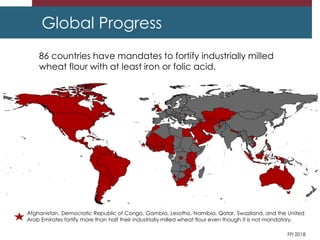
Global Progress
86 countries have mandates to fortify industrially milled
wheat flour with at least iron or folic acid.
FFI 2018
Afghanistan, Democratic Republic of Congo, Gambia, Lesotho, Namibia, Qatar, Swaziland, and the United
Arab Emirates fortify more than half their industrially milled wheat flour even though it is not mandatory.
Large Scale Food Fortification
 What is it?
 Why fortify?
 Who benefits?
 History and current progress
 Evidence of impact
 Cost and benefit
 Programme implementation
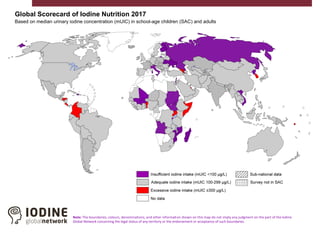
Global Scorecard of Iodine Nutrition 2017
Based on median urinary iodine concentration (mUIC) in school-age children (SAC) and adults
Note: The boundaries, colours, denominations, and other information shown on this map do not imply any judgment on the part of the Iodine
Global Network concerning the legal status of any territory or the endorsement or acceptance of such boundaries.
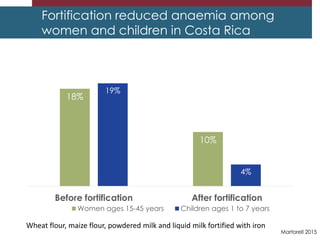
Fortification reduced anaemia among
women and children in Costa Rica
18%
10%
19%
4%
Before fortification After fortification
Women ages 15-45 years Children ages 1 to 7 years
Martorell 2015
Wheat flour, maize flour, powdered milk and liquid milk fortified with iron
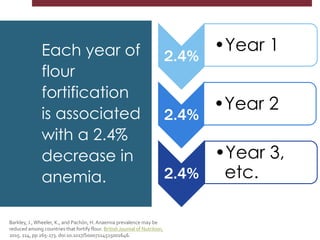
Each year of
flour
fortification
is associated
with a 2.4%
decrease in
anemia.
Barkley, J.,Wheeler, K., and Pachón, H.Anaemia prevalence may be
reduced among countries that fortify flour. British Journal of Nutrition,
2015. 114, pp 265-273. doi:10.1017/S0007114515001646.
2.4%
•Year 1
2.4%
•Year 2
2.4%
•Year 3,
etc.
0
0.5
1
1.5
2
2.5
3
3.5
4
4.5
1991
1992
1993
1994
1995
1996
1997
1998
1999
2000
2001
2002
2003
2004
2005
2006
Year
Per1000births
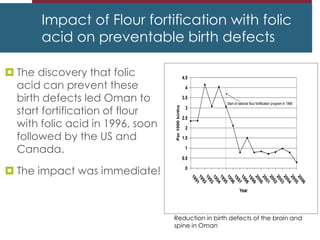
Start of national flour fortification program in 1996
Impact of Flour fortification with folic
acid on preventable birth defects
 The discovery that folic
acid can prevent these
birth defects led Oman to
start fortification of flour
with folic acid in 1996, soon
followed by the US and
Canada.
 The impact was immediate!
Reduction in birth defects of the brain and
spine in Oman
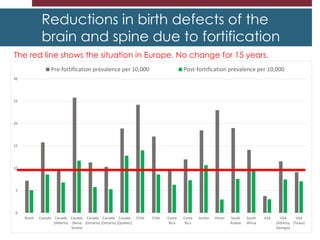
Reductions in birth defects of the
brain and spine due to fortification
0
5
10
15
20
25
30
Brazil Canada Canada
(Alberta)
Canada
(Nova
Scotia)
Canada
(Ontario)
Canada
(Ontario)
Canada
(Quebec)
Chile Chile Costa
Rica
Costa
Rica
Jordan Oman Saudi
Arabia
South
Africa
USA USA
(Atlanta,
Georgia)
USA
(Texas)
Pre-fortification prevalence per 10,000 Post-fortification prevalence per 10,000
The red line shows the situation in Europe. No change for 15 years.
Large Scale Food Fortification
 What is it?
 Why fortify?
 Benefits?
 History and current progress
 Evidence of impact
 Cost and benefit
 Programme implementation
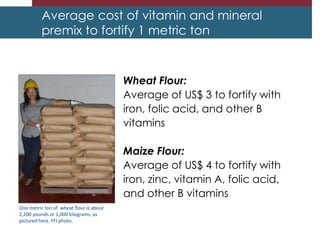
Average cost of vitamin and mineral
premix to fortify 1 metric ton
Wheat Flour:
Average of US$ 3 to fortify with
iron, folic acid, and other B
vitamins
Maize Flour:
Average of US$ 4 to fortify with
iron, zinc, vitamin A, folic acid,
and other B vitamins
One metric ton of wheat flour is about
2,200 pounds or 1,000 kilograms, as
pictured here. FFI photo.
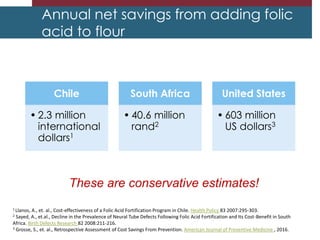
Annual net savings from adding folic
acid to flour
Chile
• 2.3 million
international
dollars1
South Africa
• 40.6 million
rand2
United States
• 603 million
US dollars3
1 Llanos, A., et. al., Cost-effectiveness of a Folic Acid Fortification Program in Chile. Health Policy 83 2007:295-303.
2 Sayed, A., et.al., Decline in the Prevalence of Neural Tube Defects Following Folic Acid Fortification and Its Cost-Benefit in South
Africa. Birth Defects Research 82 2008:211-216.
3 Grosse, S., et. al., Retrospective Assessment of Cost Savings From Prevention. American Journal of Preventive Medicine , 2016.
These are conservative estimates!
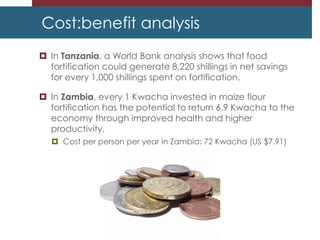
Cost:benefit analysis
 In Tanzania, a World Bank analysis shows that food
fortification could generate 8,220 shillings in net savings
for every 1,000 shillings spent on fortification.
 In Zambia, every 1 Kwacha invested in maize flour
fortification has the potential to return 6.9 Kwacha to the
economy through improved health and higher
productivity.
 Cost per person per year in Zambia: 72 Kwacha (US $7.91)
Large Scale Food Fortification
 What is it?
 Why fortify?
 Benefits?
 History and current progress
 Evidence of impact
 Cost and benefit
 Programme implementation
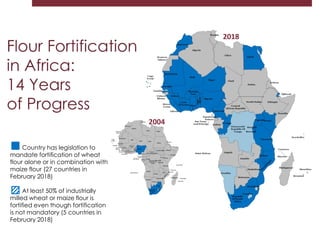
2004
2018
Country has legislation to
mandate fortification of wheat
flour alone or in combination with
maize flour (27 countries in
February 2018)
At least 50% of industrially
milled wheat or maize flour is
fortified even though fortification
is not mandatory (5 countries in
February 2018)
.
Fortification programmes
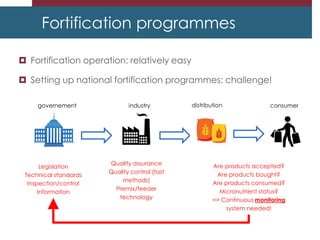
 Fortification operation: relatively easy
 Setting up national fortification programmes: challenge!
governement industry distribution consumer
Legislation
Technical standards
Inspection/control
Information
Quality assurance
Quality control (fast
methods)
Premix/feeder
technology
Are products accepted?
Are products bought?
Are products consumed?
Micronutrient status?
=> Continuous monitoring
system needed!
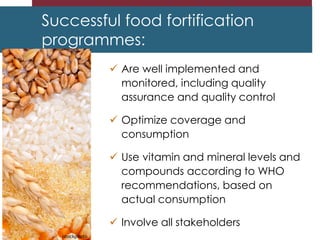
Successful food fortification
programmes:
 Are well implemented and
monitored, including quality
assurance and quality control
 Optimize coverage and
consumption
 Use vitamin and mineral levels and
compounds according to WHO
recommendations, based on
actual consumption
 Involve all stakeholders
istockphoto
THANK YOU!
Some useful websites:
 www.Smarterfutures.net
 www.FFInetwork.org
 www.ifglobal.org
 www.hki.org
 www.gainhealth.org
 www.fortificationdata.org

Large Scale Food Fortification

  • 1.
    Large Scale FoodFortification Presentation by Anna Verster Senior Adviser on Food Fortification and Project Coordinator, Smarter Futures to the Conference External Cooperation Infopoint on “Food Fortification: Scalable Approaches to Prevent Micronutrient Deficiencies in Populations” Thursday 15 February 2018, 12:30–14:00, Brussels I acknowledge with thanks the contributions of many colleagues
  • 2.
    Large Scale FoodFortification  What is it?  Why fortify?  Who benefits?  History and current progress  Evidence of impact  Cost and benefit  Programme implementation
  • 3.
    What is foodfortification?  Food fortification has been defined as the addition of one or more essential nutrients to a food, whether or not it is normally contained in the food, for the purpose of preventing or correcting a demonstrated deficiency of one or more nutrients in the population or specific population groups (FAO/WHO 1994).  Enrichment is defined as "synonymous with fortification and refers to the addition of micronutrients to a food which are lost during processing"
  • 4.
    Food fortification vehicles OIL VitaminA, D, E CEREALS Fe, Zn Vit. B1, B2, B3, B6, B12 Folic acid Vitamin A Vitamin A SALT SUGAR Iodine MILK Vit A,D Ca
  • 6.
    Large Scale FoodFortification  What is it?  Why Fortify?  Who benefits?  History and current progress  Evidence of impact  Cost and benefit  Programme implementation
  • 7.
    Poverty and economiccrisis impact on the nutrition security of the consumer Food Prices Go Up - Nutritional Value Goes Down As people eliminate higher priced items such as proteins, fruits and vegetables from their diet to stretch their food budget, they can still get essential vitamins and minerals if their food staples are fortified according to internationally agreed standards.
  • 8.
    The Big Five…….. Iodine deficiency is the single most preventable cause of mental retardation and brain damage.  Vitamin A deficiency is the leading cause of acquired blindness in children and impairs immune function.  Severe zinc deficiency causes short stature, impairs immune function and other disorders  Iron deficiency is one of the most prevalent nutrient deficiencies in the world; it affects an estimated two billion people, and causes almost a million deaths a year.  Folic acid prevents birth defects of the brain and spine, such as spina bifida.
  • 9.
    Large Scale FoodFortification  What is it  Why fortify?  Who benefits?  History and current progress  Evidence of impact  Cost and benefit  Programme implementation
  • 10.
    Who will benefitfrom fortified foods?  Food fortification is an industrial process. The industry ensures provision of essential vitamins and minerals according to government standards and regulations.  Fortified foods reach all those who have access to the market and purchase their staple food/ oil/ salt.  This includes the urban poor, a fast growing group in many developing countries in Africa and Asia.  Those who do not have access to fortified, packaged commercially processed foods need to receive essential vitamins and minerals through alternative mechanisms. This may include provision of multiple micronutrient powder sachets (“sprinkles”) or supplements, as well as social safety net approaches, which use fortified foods.
  • 11.
    City A City B Capital City Mapof FORTIFITOPIA SEA This is where the flour reaches in Fortifitopia
  • 12.
    Large Scale FoodFortification  What is it?  Why fortify?  Who benefits?  History and current progress  Evidence of impact  Cost and benefit  Programme implementation
  • 13.
    Photo by EugèneTrutat – This photograph is part of the Fonds Eugène Trutat, preserved by the muséum de Toulouse. In Switzerland around the 1920’s, cretins were common Cretinism is a condition of severe physical and mental retardation due to iodine deficiency
  • 14.
    Iodine deficiency disorders Iodinedeficiency is the world’s most prevalent, yet easily preventable, cause of brain damage. In certain regions of Switzerland, 0.5% of the inhabitants were cretins, almost 100% of schoolchildren had large goiters, and up to 30% of young men were unfit for military service owing to a large goiter Iodization of salt was introduced in Switzerland in 1922. The USA quickly followed.
  • 15.
    Current status ofsalt iodization worldwide
  • 16.
    Fortification of flour Duringthe 1940s, Britain and the USA started enriching flour as a means to improve the health of their populations during WWII. While fortification of flour was never really embraced in Europe, countries all around the world started flour fortification in the late 20st and early 21st century. To date, more and more countries are adopting this measure.
  • 17.
    One intervention; manybenefits Cereal flours can be fortified with many vitamins and minerals Nutrient Number of countries that include nutrient in wheat flour fortification standards Iron 85 Folic acid (vitamin B9) 80 Thiamin (vitamin B1) 59 Niacin (vitamin B3) 57 Riboflavin (vitamin B2) 57 Zinc 25 Vitamin B12 15 Vitamin A 15 Vitamin B6 13 Calcium 5 Vitamin D 4
  • 18.
    Fortification prevents andtreats nutritional anemia In children:  Iron deficiency impairs cognitive development in children  This mental capacity is never regained and in turn limits academic performance and future earnings potential.  Childhood anaemia globally is associated with a 2.5% drop in wages in adulthood. Fortification prevents and treats iron deficiency and nutritional anaemia istockphoto
  • 19.
    Fortification prevents andtreats nutritional anemia In adults:  Iron deficiency reduces productivity  In 10 developing countries, annual physical productivity losses due to iron deficiency was up to 3% of GDP  Anaemia contributes to maternal death  In developing countries, one-fifth of perinatal mortality and one-tenth of maternal mortality are attributed to iron deficiency Fortification prevents and treats iron deficiency and nutritional anaemia istockphoto
  • 20.
    Folic acid preventsbirths defect of the brain and spine Children born with spina bifida will undergo a lifetime of surgeries and face many health issues. Spina bifida cannot be cured. Almost 300.000 birth defects of the brain & spine can be prevented annually
  • 21.
    Since 1991we knowthat birth defects of the brain and spine can be prevented by folic acid:  Folic acid is a B vitamin that our bodies need to make new cells.  In 1991, a study showed that 400 micrograms of folic acid daily taken from 8 weeks before conception till 12 weeks into the pregnancy can reduce the risk of birth defects of the brain and spine by up to 70%.  This made it possible to prevent these debilitating birth defects.  Pregnant women all over the world are given iron and folic acid tablets during pregnancy, mostly in the 3d trimester.  That is too late for preventing birth defects of the brain and spine.
  • 22.
    Global Progress 86 countrieshave mandates to fortify industrially milled wheat flour with at least iron or folic acid. FFI 2018 Afghanistan, Democratic Republic of Congo, Gambia, Lesotho, Namibia, Qatar, Swaziland, and the United Arab Emirates fortify more than half their industrially milled wheat flour even though it is not mandatory.
  • 23.
    Large Scale FoodFortification  What is it?  Why fortify?  Who benefits?  History and current progress  Evidence of impact  Cost and benefit  Programme implementation
  • 24.
    Global Scorecard ofIodine Nutrition 2017 Based on median urinary iodine concentration (mUIC) in school-age children (SAC) and adults Note: The boundaries, colours, denominations, and other information shown on this map do not imply any judgment on the part of the Iodine Global Network concerning the legal status of any territory or the endorsement or acceptance of such boundaries.
  • 25.
    Fortification reduced anaemiaamong women and children in Costa Rica 18% 10% 19% 4% Before fortification After fortification Women ages 15-45 years Children ages 1 to 7 years Martorell 2015 Wheat flour, maize flour, powdered milk and liquid milk fortified with iron
  • 26.
    Each year of flour fortification isassociated with a 2.4% decrease in anemia. Barkley, J.,Wheeler, K., and Pachón, H.Anaemia prevalence may be reduced among countries that fortify flour. British Journal of Nutrition, 2015. 114, pp 265-273. doi:10.1017/S0007114515001646. 2.4% •Year 1 2.4% •Year 2 2.4% •Year 3, etc.
  • 27.
    0 0.5 1 1.5 2 2.5 3 3.5 4 4.5 1991 1992 1993 1994 1995 1996 1997 1998 1999 2000 2001 2002 2003 2004 2005 2006 Year Per1000births Start of nationalflour fortification program in 1996 Impact of Flour fortification with folic acid on preventable birth defects  The discovery that folic acid can prevent these birth defects led Oman to start fortification of flour with folic acid in 1996, soon followed by the US and Canada.  The impact was immediate! Reduction in birth defects of the brain and spine in Oman
  • 28.
    Reductions in birthdefects of the brain and spine due to fortification 0 5 10 15 20 25 30 Brazil Canada Canada (Alberta) Canada (Nova Scotia) Canada (Ontario) Canada (Ontario) Canada (Quebec) Chile Chile Costa Rica Costa Rica Jordan Oman Saudi Arabia South Africa USA USA (Atlanta, Georgia) USA (Texas) Pre-fortification prevalence per 10,000 Post-fortification prevalence per 10,000 The red line shows the situation in Europe. No change for 15 years.
  • 29.
    Large Scale FoodFortification  What is it?  Why fortify?  Benefits?  History and current progress  Evidence of impact  Cost and benefit  Programme implementation
  • 30.
    Average cost ofvitamin and mineral premix to fortify 1 metric ton Wheat Flour: Average of US$ 3 to fortify with iron, folic acid, and other B vitamins Maize Flour: Average of US$ 4 to fortify with iron, zinc, vitamin A, folic acid, and other B vitamins One metric ton of wheat flour is about 2,200 pounds or 1,000 kilograms, as pictured here. FFI photo.
  • 31.
    Annual net savingsfrom adding folic acid to flour Chile • 2.3 million international dollars1 South Africa • 40.6 million rand2 United States • 603 million US dollars3 1 Llanos, A., et. al., Cost-effectiveness of a Folic Acid Fortification Program in Chile. Health Policy 83 2007:295-303. 2 Sayed, A., et.al., Decline in the Prevalence of Neural Tube Defects Following Folic Acid Fortification and Its Cost-Benefit in South Africa. Birth Defects Research 82 2008:211-216. 3 Grosse, S., et. al., Retrospective Assessment of Cost Savings From Prevention. American Journal of Preventive Medicine , 2016. These are conservative estimates!
  • 32.
    Cost:benefit analysis  InTanzania, a World Bank analysis shows that food fortification could generate 8,220 shillings in net savings for every 1,000 shillings spent on fortification.  In Zambia, every 1 Kwacha invested in maize flour fortification has the potential to return 6.9 Kwacha to the economy through improved health and higher productivity.  Cost per person per year in Zambia: 72 Kwacha (US $7.91)
  • 33.
    Large Scale FoodFortification  What is it?  Why fortify?  Benefits?  History and current progress  Evidence of impact  Cost and benefit  Programme implementation
  • 34.
    2004 2018 Country has legislationto mandate fortification of wheat flour alone or in combination with maize flour (27 countries in February 2018) At least 50% of industrially milled wheat or maize flour is fortified even though fortification is not mandatory (5 countries in February 2018) .
  • 35.
    Fortification programmes  Fortificationoperation: relatively easy  Setting up national fortification programmes: challenge! governement industry distribution consumer Legislation Technical standards Inspection/control Information Quality assurance Quality control (fast methods) Premix/feeder technology Are products accepted? Are products bought? Are products consumed? Micronutrient status? => Continuous monitoring system needed!
  • 36.
    Successful food fortification programmes: Are well implemented and monitored, including quality assurance and quality control  Optimize coverage and consumption  Use vitamin and mineral levels and compounds according to WHO recommendations, based on actual consumption  Involve all stakeholders istockphoto
  • 38.
    THANK YOU! Some usefulwebsites:  www.Smarterfutures.net  www.FFInetwork.org  www.ifglobal.org  www.hki.org  www.gainhealth.org  www.fortificationdata.org