Chemical
additives as non-
preservatives
• Improve flavor
• Improve taste
• Improve nutrition
• Improve functional
properties of food
Improve flavor
Natural flavoring substances include spices,
herbs, essential oils and plant extracts.
Currently there are 12000 different flavoring
materials used in foods.
Number of flavoring compounds are extracted
from natural raw materials while large numbers
are synthesized.
Extracted flavors from plant materials in the
form of essential oils and oleoresins used as
flavoring agents.
 Flavors derived from orange and lime peels are
common ingredients in orange and lime-based
products.
 Synthetic flavors:
 Commonly added to food material
 Available in powder or liquid forms or as
encapsulated dry flavors
Compounds Flavors
Ethyl butyrate Pineapple flavor
Methyl anthranilate Grape flavor
Amyl acetate Banana flavor
Benzaldehyde Almond flavor
Flavor enhancers
 Additionally some substances called flavor enhancers
are added to accentuate the original flavor of the
foodstuff.
 These may not have a flavor of their own but are
efficient in bringing out the natural flavors of food to
which they are added.
 Monosodium glutamate is a common flavor
improver used in meats, gravies, sauce and food rich
in proteins.
 Its excessive use can results in toxicity- a burning
sensation in the back of neck.
Improve taste
 The basic quality of foodstuff meant for human
consumption is that in addition to its appearance, it
should have a good taste.
 All foods have natural taste of their own.
 Several additives are used to improve the taste of
foods i.e.
 Sugar
 Salt
 Spices
 Synthetic low caloric sweeteners
 Accidulants
Improve nutrition
 Generally natural foods lack a few nutrients or may
lose some during processing.
 Foodstuff is fortify with suitable nutrients.
 Addition of vitamin A and D and iron to infant milk
recipes.
 B vitamins, iron and calcium to cereal products.
 Iodine to common salt
 Vitamin C to fruit products
 Vitamin A to butter and margarine
Improve functional properties
of foods
 Fresh and processed foods have characteristics
textural properties.
 It may be necessary to add substances that will favor
the attainment of desired characteristics.
 Texture of potatoes, peas and tomatoes soften on
canning so addition of calcium chloride or calcium
phosphate provides firmness to the product.
 Similarly in salad dressings and mayonnaise
production, emulsifiers are added to form
homogenous mixture of oil and water.
 Emulsifiers such as monoglycerides, diglycerides
and phospholipids help in the formation of the
oil/water emulsion, which is stable.
 Emulsifiers are also important in the baking
industry where they are used to improve the
volume, uniformity and firmness of grain in bread.
 They also favor the distribution of fat in the batter
and give stability to structure in baked goods.
 Stabilizers and thickeners are also important in
several manufactured products such as cake
toppings, chocolate milk drinks, jellies, puddings,
salad dressings, gravies and others.
 Prevent separation of ingredients.
 Calcium gluconate and calcium chloride are
permitted stabilizers in jams, jellies, pickled
cucumbers as well as canned peas, tomatoes.
 In evaporated milks, sweetened condensed milks,
milk powders and cream, mono-calcium
phosphate and tri-potassium citrate are used.
 In ice creams stabilizers increases viscosity and
prevent formation of large ice crystals.
 Vegetable gums ( gum Arabic, pectin & gelatin)
and cellulose compounds ( methyl cellulose &
carboxymethyl cellulose) are also used as
stabilizers and thickeners in numerous products.
 Leavening agents are useful in production of bread,
cakes, biscuits, wafers, muffins and many other
baked goods.
 Give desired textural characteristics to the product
 i.e. sodium bicarbonate and baking powders,
which contain sodium bicarbonate, an acid, salt and
starch.
 Moisturizing agents, commonly known as
humectants are employed to retain moisture in
products like shredded coconut.
 Anticaking agents are added to sugar, salt, garlic
and onion powders, powdered sugar and milk
powders to prevent caking.
 Clarifying agents help to improve the filterability,
appearance as well as the quality of product to which
they are added.
 Chemical additives are used as glazing agents
(prevent water loss, curing agents (to remove
moisture from foods) and foaming agents.
 State food laws regulate the limit as to the use of
these substances.
Chemical Additives as
preservatives
 In addition to use of chemicals for various non-
preservative purposes, some are employed to
increase the shelf life of the food.
 Among these are:
 Anti-ripening agents
 Sprout inhibitors
 Anti-microbial agents
 Anti-oxidants
Chemical
Additives as
preservatives
• Anti-ripening
agents
• Sprout inhibitors
• Anti-microbial
agents
• Anti-oxidants
Anti-ripening agents
 Fruits continue their normal physiology even after
they are detached from the tree and ripen after
harvesting.
 Sometimes during cold storage of such
commodities, it is essential to control the ripening
process.
 Purafil & 2,4,5- trichlorophenoxy acetic acid
help to retard the ripening process in fruits.
Sprout Inhibitors
 Onions, carrots, potatoes that grow beneath the
soil surfaces sprout during storage.
 Sprouting is a process by which plants produces
new leaves or buds or other newly developed parts
experience further growth.
 Potatoes especially vulnerable when the storage
temperature is moderate 25 or 30 º C and relative
humidity is 50-80%.
 Methyl esters of naphthalene acetic acid ,
maleic hydride are employed.
Antioxidants
 Antioxidants are substances that prevent the
reaction of various food constituents with oxygen
thereby avoiding deterioration caused by simple
oxidative chemical reactions.
 Oxidative changes occur in unsaturated food
components that include fats and oils, carotenoids
and porphyrin-like compounds (e.g. chlorophyll,
haemoglobin).
 Fats and oils are particularly vulnerable to oxidation
resulting in off-odor development and deterioration
in commodity.
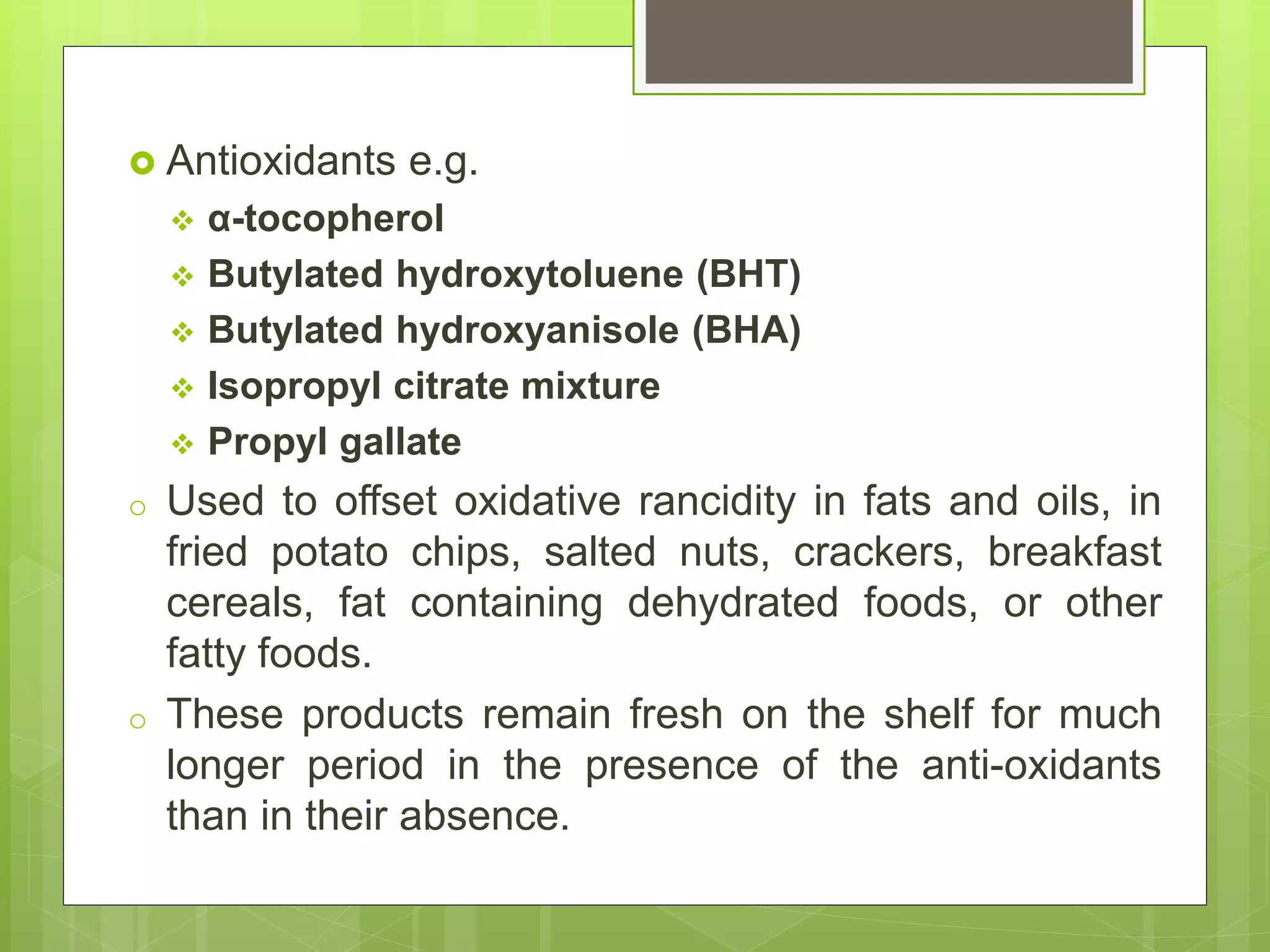
 Antioxidants e.g.
 α-tocopherol
 Butylated hydroxytoluene (BHT)
 Butylated hydroxyanisole (BHA)
 Isopropyl citrate mixture
 Propyl gallate
o Used to offset oxidative rancidity in fats and oils, in
fried potato chips, salted nuts, crackers, breakfast
cereals, fat containing dehydrated foods, or other
fatty foods.
o These products remain fresh on the shelf for much
longer period in the presence of the anti-oxidants
than in their absence.
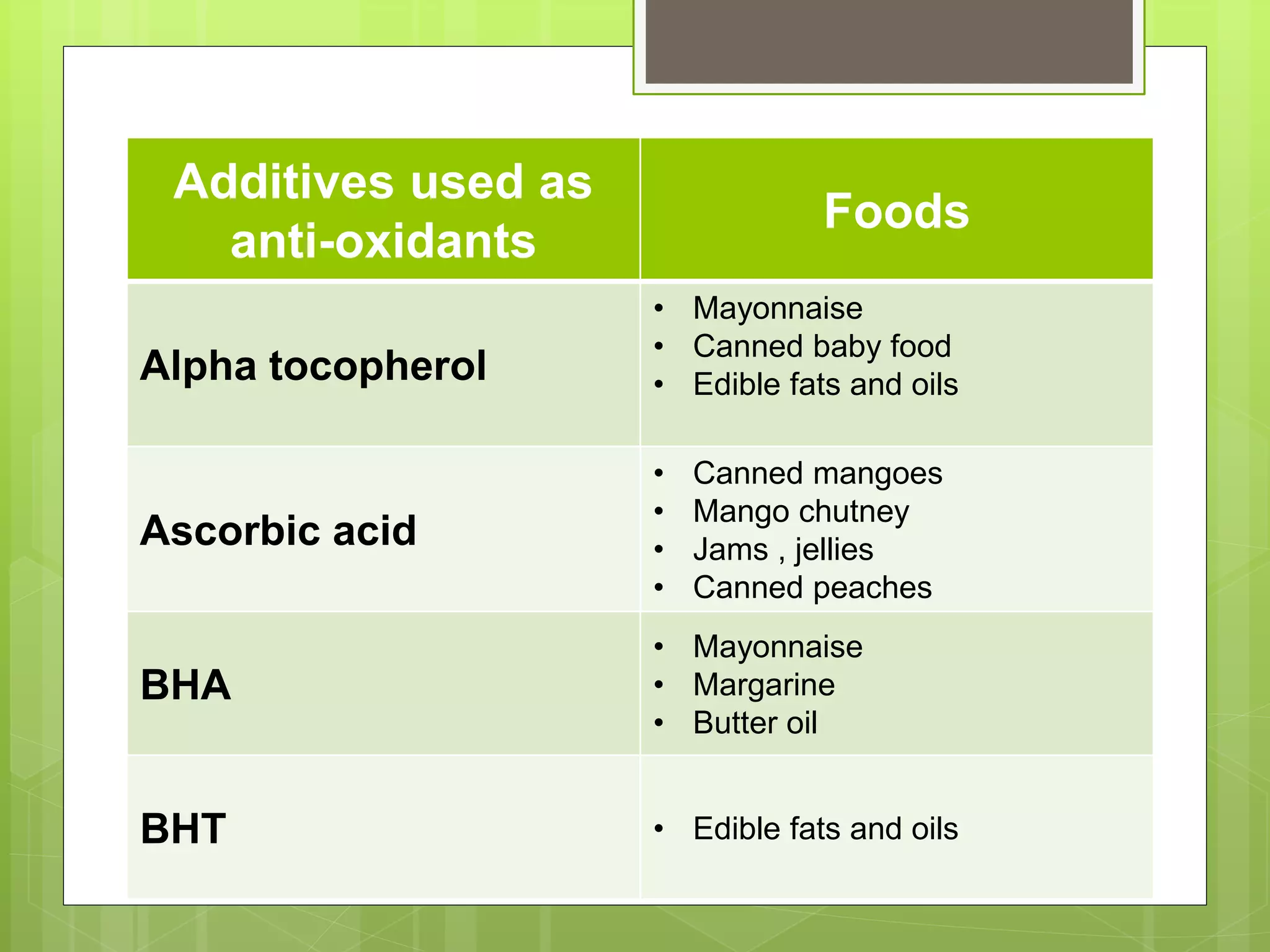
Additives used as
anti-oxidants
Foods
Alpha tocopherol
• Mayonnaise
• Canned baby food
• Edible fats and oils
Ascorbic acid
• Canned mangoes
• Mango chutney
• Jams , jellies
• Canned peaches
BHA
• Mayonnaise
• Margarine
• Butter oil
BHT • Edible fats and oils
 The process of rancidity in fats and oils is
stimulated by the presence of metallic ions such as
copper and iron.
 These come in contact with lipids during
processing or storage in iron or copper
containers or may be part of the food system.
 Importance to prevent contact of these metal
catalyst with the unsaturated fats and thus
hinder their catalytic action.
 chemical compounds generally referred to as
sequestering or chelating agents are employed
to inactivate metals.
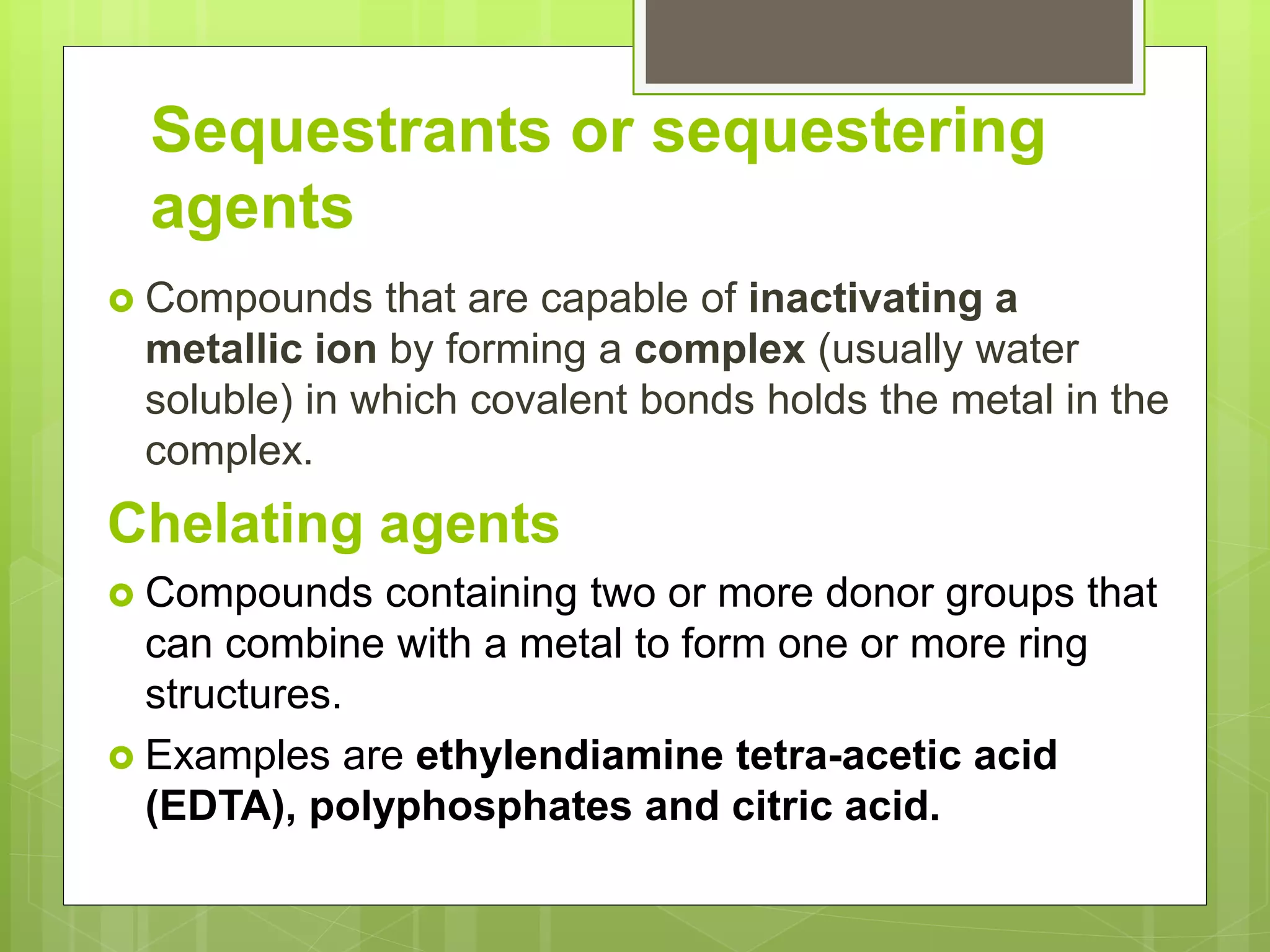
Sequestrants or sequestering
agents
 Compounds that are capable of inactivating a
metallic ion by forming a complex (usually water
soluble) in which covalent bonds holds the metal in the
complex.
Chelating agents
 Compounds containing two or more donor groups that
can combine with a metal to form one or more ring
structures.
 Examples are ethylendiamine tetra-acetic acid
(EDTA), polyphosphates and citric acid.
Anti-microbial agents
 Micro-organisms are present on the surface of fresh
food commodities; these also find their way into
processed foods.
 If these are not inhibited, they will grow and cause
spoilage.
 Fruits are treated with fungicidal solutions to
prevent fungal growth on their surface.
 Citrus fruits are dipped into sodium salt solutions.
Anti-microbial agents in food
preservation
 Salt
 Sugar
 Smoke
 Vinegar
 Organic acids
 Parabens
 Nitrates
 Fatty acids
 Hydrogen peroxides
 Phosphates
 Some naturally occurring compounds produced by
lactic acid bacteria or those present in spices and
herbs are effective against microbes.
 Fumigants also help to control microbial growth on
spices, nuts and dried fruits.
 Production of pan bread and cakes, sodium and
calcium salts are employed as mould inhibitors.
 Fruits and vegetables may be washed in water
containing germicidal substances like chlorine.
 Potassium and sodium metabisulphite are used in
the preservation of syrups, juices and squashes.
Choice of anti-microbial agents
Depends upon several factors:
 Properties
 Safety
 Cost of compound
 Properties of food
 Possible effect of chemical on food quality
 Type and level of micro-organism present
 Post-processing and storage conditions
 Food laws of the country

Chemical additives as non preservatives

  • 1.
    Chemical additives as non- preservatives •Improve flavor • Improve taste • Improve nutrition • Improve functional properties of food
  • 2.
    Improve flavor Natural flavoringsubstances include spices, herbs, essential oils and plant extracts. Currently there are 12000 different flavoring materials used in foods. Number of flavoring compounds are extracted from natural raw materials while large numbers are synthesized. Extracted flavors from plant materials in the form of essential oils and oleoresins used as flavoring agents.
  • 3.
     Flavors derivedfrom orange and lime peels are common ingredients in orange and lime-based products.  Synthetic flavors:  Commonly added to food material  Available in powder or liquid forms or as encapsulated dry flavors Compounds Flavors Ethyl butyrate Pineapple flavor Methyl anthranilate Grape flavor Amyl acetate Banana flavor Benzaldehyde Almond flavor
  • 4.
    Flavor enhancers  Additionallysome substances called flavor enhancers are added to accentuate the original flavor of the foodstuff.  These may not have a flavor of their own but are efficient in bringing out the natural flavors of food to which they are added.  Monosodium glutamate is a common flavor improver used in meats, gravies, sauce and food rich in proteins.  Its excessive use can results in toxicity- a burning sensation in the back of neck.
  • 5.
    Improve taste  Thebasic quality of foodstuff meant for human consumption is that in addition to its appearance, it should have a good taste.  All foods have natural taste of their own.  Several additives are used to improve the taste of foods i.e.  Sugar  Salt  Spices  Synthetic low caloric sweeteners  Accidulants
  • 6.
    Improve nutrition  Generallynatural foods lack a few nutrients or may lose some during processing.  Foodstuff is fortify with suitable nutrients.  Addition of vitamin A and D and iron to infant milk recipes.  B vitamins, iron and calcium to cereal products.  Iodine to common salt  Vitamin C to fruit products  Vitamin A to butter and margarine
  • 7.
    Improve functional properties offoods  Fresh and processed foods have characteristics textural properties.  It may be necessary to add substances that will favor the attainment of desired characteristics.  Texture of potatoes, peas and tomatoes soften on canning so addition of calcium chloride or calcium phosphate provides firmness to the product.  Similarly in salad dressings and mayonnaise production, emulsifiers are added to form homogenous mixture of oil and water.
  • 8.
     Emulsifiers suchas monoglycerides, diglycerides and phospholipids help in the formation of the oil/water emulsion, which is stable.  Emulsifiers are also important in the baking industry where they are used to improve the volume, uniformity and firmness of grain in bread.  They also favor the distribution of fat in the batter and give stability to structure in baked goods.
  • 9.
     Stabilizers andthickeners are also important in several manufactured products such as cake toppings, chocolate milk drinks, jellies, puddings, salad dressings, gravies and others.  Prevent separation of ingredients.  Calcium gluconate and calcium chloride are permitted stabilizers in jams, jellies, pickled cucumbers as well as canned peas, tomatoes.  In evaporated milks, sweetened condensed milks, milk powders and cream, mono-calcium phosphate and tri-potassium citrate are used.
  • 10.
     In icecreams stabilizers increases viscosity and prevent formation of large ice crystals.  Vegetable gums ( gum Arabic, pectin & gelatin) and cellulose compounds ( methyl cellulose & carboxymethyl cellulose) are also used as stabilizers and thickeners in numerous products.  Leavening agents are useful in production of bread, cakes, biscuits, wafers, muffins and many other baked goods.  Give desired textural characteristics to the product  i.e. sodium bicarbonate and baking powders, which contain sodium bicarbonate, an acid, salt and starch.
  • 11.
     Moisturizing agents,commonly known as humectants are employed to retain moisture in products like shredded coconut.  Anticaking agents are added to sugar, salt, garlic and onion powders, powdered sugar and milk powders to prevent caking.  Clarifying agents help to improve the filterability, appearance as well as the quality of product to which they are added.  Chemical additives are used as glazing agents (prevent water loss, curing agents (to remove moisture from foods) and foaming agents.  State food laws regulate the limit as to the use of these substances.
  • 12.
    Chemical Additives as preservatives In addition to use of chemicals for various non- preservative purposes, some are employed to increase the shelf life of the food.  Among these are:  Anti-ripening agents  Sprout inhibitors  Anti-microbial agents  Anti-oxidants
  • 13.
    Chemical Additives as preservatives • Anti-ripening agents •Sprout inhibitors • Anti-microbial agents • Anti-oxidants
  • 14.
    Anti-ripening agents  Fruitscontinue their normal physiology even after they are detached from the tree and ripen after harvesting.  Sometimes during cold storage of such commodities, it is essential to control the ripening process.  Purafil & 2,4,5- trichlorophenoxy acetic acid help to retard the ripening process in fruits.
  • 15.
    Sprout Inhibitors  Onions,carrots, potatoes that grow beneath the soil surfaces sprout during storage.  Sprouting is a process by which plants produces new leaves or buds or other newly developed parts experience further growth.  Potatoes especially vulnerable when the storage temperature is moderate 25 or 30 º C and relative humidity is 50-80%.  Methyl esters of naphthalene acetic acid , maleic hydride are employed.
  • 16.
    Antioxidants  Antioxidants aresubstances that prevent the reaction of various food constituents with oxygen thereby avoiding deterioration caused by simple oxidative chemical reactions.  Oxidative changes occur in unsaturated food components that include fats and oils, carotenoids and porphyrin-like compounds (e.g. chlorophyll, haemoglobin).  Fats and oils are particularly vulnerable to oxidation resulting in off-odor development and deterioration in commodity.
  • 17.
     Antioxidants e.g. α-tocopherol  Butylated hydroxytoluene (BHT)  Butylated hydroxyanisole (BHA)  Isopropyl citrate mixture  Propyl gallate o Used to offset oxidative rancidity in fats and oils, in fried potato chips, salted nuts, crackers, breakfast cereals, fat containing dehydrated foods, or other fatty foods. o These products remain fresh on the shelf for much longer period in the presence of the anti-oxidants than in their absence.
  • 18.
    Additives used as anti-oxidants Foods Alphatocopherol • Mayonnaise • Canned baby food • Edible fats and oils Ascorbic acid • Canned mangoes • Mango chutney • Jams , jellies • Canned peaches BHA • Mayonnaise • Margarine • Butter oil BHT • Edible fats and oils
  • 19.
     The processof rancidity in fats and oils is stimulated by the presence of metallic ions such as copper and iron.  These come in contact with lipids during processing or storage in iron or copper containers or may be part of the food system.  Importance to prevent contact of these metal catalyst with the unsaturated fats and thus hinder their catalytic action.  chemical compounds generally referred to as sequestering or chelating agents are employed to inactivate metals.
  • 20.
    Sequestrants or sequestering agents Compounds that are capable of inactivating a metallic ion by forming a complex (usually water soluble) in which covalent bonds holds the metal in the complex. Chelating agents  Compounds containing two or more donor groups that can combine with a metal to form one or more ring structures.  Examples are ethylendiamine tetra-acetic acid (EDTA), polyphosphates and citric acid.
  • 21.
    Anti-microbial agents  Micro-organismsare present on the surface of fresh food commodities; these also find their way into processed foods.  If these are not inhibited, they will grow and cause spoilage.  Fruits are treated with fungicidal solutions to prevent fungal growth on their surface.  Citrus fruits are dipped into sodium salt solutions.
  • 22.
    Anti-microbial agents infood preservation  Salt  Sugar  Smoke  Vinegar  Organic acids  Parabens  Nitrates  Fatty acids  Hydrogen peroxides  Phosphates
  • 23.
     Some naturallyoccurring compounds produced by lactic acid bacteria or those present in spices and herbs are effective against microbes.  Fumigants also help to control microbial growth on spices, nuts and dried fruits.  Production of pan bread and cakes, sodium and calcium salts are employed as mould inhibitors.  Fruits and vegetables may be washed in water containing germicidal substances like chlorine.  Potassium and sodium metabisulphite are used in the preservation of syrups, juices and squashes.
  • 24.
    Choice of anti-microbialagents Depends upon several factors:  Properties  Safety  Cost of compound  Properties of food  Possible effect of chemical on food quality  Type and level of micro-organism present  Post-processing and storage conditions  Food laws of the country