Lecture – 3
Dr. Ahmed Abouelmagd
Electromagnetic Fields
COMM 320
ELECTROMAGNETIC WAVE PROPAGATION
Plane Waves
Elgazeera High Institute for
Engineering and Technology
Waves are means of transporting energy or information
A wave is a function of both space and time.
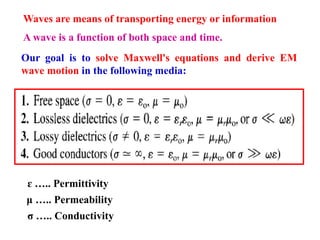
Our goal is to solve Maxwell's equations and derive EM
wave motion in the following media:
ɛ ….. Permittivity
μ ….. Permeability
σ ….. Conductivity
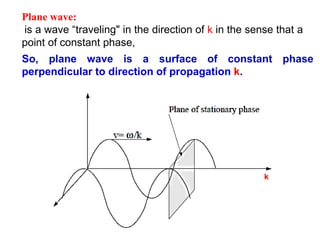
So, plane wave is a surface of constant phase
perpendicular to direction of propagation k.
Plane wave:
is a wave “traveling" in the direction of k in the sense that a
point of constant phase,
k
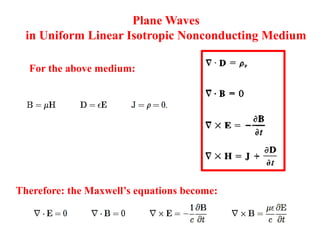
Plane Waves
in Uniform Linear Isotropic Nonconducting Medium
Therefore: the Maxwell’s equations become:
For the above medium:
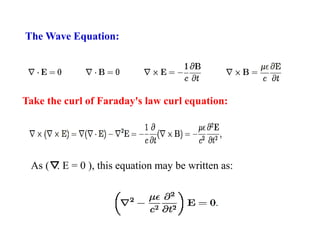
The Wave Equation:
Take the curl of Faraday's law curl equation:
As ( . E = 0 ), this equation may be written as:
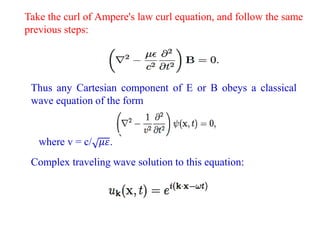
Take the curl of Ampere's law curl equation, and follow the same
previous steps:
Thus any Cartesian component of E or B obeys a classical
wave equation of the form
where v = c/ 𝜇𝜀.
Complex traveling wave solution to this equation:
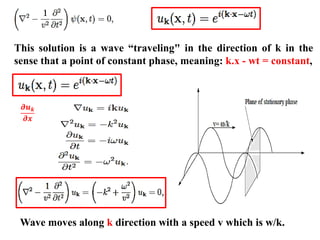
Wave moves along k direction with a speed v which is w/k.
This solution is a wave “traveling" in the direction of k in the
sense that a point of constant phase, meaning: k.x - wt = constant,
𝝏𝒖𝒌
𝝏𝒙
V …. Electric scalar potential
A…. magnetic vector potential
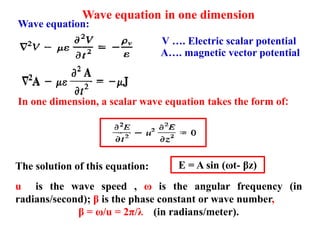
Wave equation:
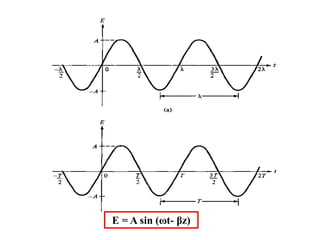
In one dimension, a scalar wave equation takes the form of:
E = A sin (ωt- βz)
The solution of this equation:
u is the wave speed , ω is the angular frequency (in
radians/second); β is the phase constant or wave number,
β = ω/u = 2π/λ (in radians/meter).
Wave equation in one dimension
E = A sin (ωt- βz)
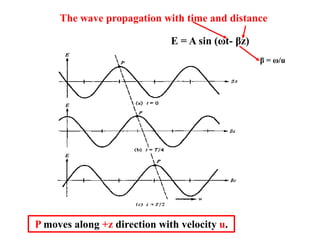
P moves along +z direction with velocity u.
β = ω/u
E = A sin (ωt- βz)
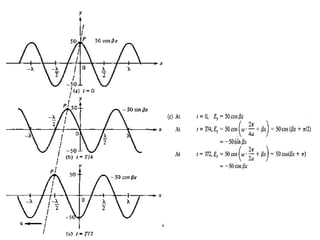
The wave propagation with time and distance
Solution 1
Example 1
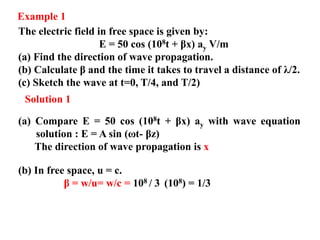
The electric field in free space is given by:
E = 50 cos (108t + βx) ay V/m
(a) Find the direction of wave propagation.
(b) Calculate β and the time it takes to travel a distance of λ/2.
(c) Sketch the wave at t=0, T/4, and T/2)
(a) Compare E = 50 cos (108t + βx) ay with wave equation
solution : E = A sin (ωt- βz)
The direction of wave propagation is x
(b) In free space, u = c.
β = w/u= w/c = 108 / 3 (108) = 1/3
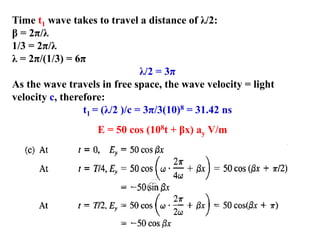
Time t1 wave takes to travel a distance of λ/2:
β = 2π/λ
1/3 = 2π/λ
λ = 2π/(1/3) = 6π
λ/2 = 3π
As the wave travels in free space, the wave velocity = light
velocity c, therefore:
t1 = (λ/2 )/c = 3π/3(10)8 = 31.42 ns
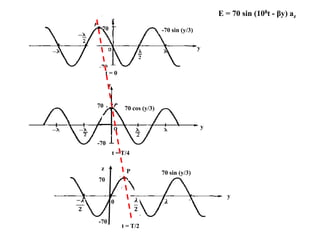
E = 50 cos (108t + βx) ay V/m
z
y
-70 sin (y/3)
70
-70
t = 0
t = T/4
70 cos (y/3)
-70
z
y
70
0 𝝀
𝟐
−𝝀
𝟐
𝝀
y
z P
70
-70
70 sin (y/3)
t = T/2
E = 70 sin (108t - βy) az

Lec.3 -COMM 320 Electromagnetic fields.pdf

  • 1.
    Lecture – 3 Dr.Ahmed Abouelmagd Electromagnetic Fields COMM 320 ELECTROMAGNETIC WAVE PROPAGATION Plane Waves Elgazeera High Institute for Engineering and Technology
  • 2.
    Waves are meansof transporting energy or information A wave is a function of both space and time. Our goal is to solve Maxwell's equations and derive EM wave motion in the following media: ɛ ….. Permittivity μ ….. Permeability σ ….. Conductivity
  • 3.
    So, plane waveis a surface of constant phase perpendicular to direction of propagation k. Plane wave: is a wave “traveling" in the direction of k in the sense that a point of constant phase, k
  • 4.
    Plane Waves in UniformLinear Isotropic Nonconducting Medium Therefore: the Maxwell’s equations become: For the above medium:
  • 5.
    The Wave Equation: Takethe curl of Faraday's law curl equation: As ( . E = 0 ), this equation may be written as:
  • 6.
    Take the curlof Ampere's law curl equation, and follow the same previous steps: Thus any Cartesian component of E or B obeys a classical wave equation of the form where v = c/ 𝜇𝜀. Complex traveling wave solution to this equation:
  • 7.
    Wave moves alongk direction with a speed v which is w/k. This solution is a wave “traveling" in the direction of k in the sense that a point of constant phase, meaning: k.x - wt = constant, 𝝏𝒖𝒌 𝝏𝒙
  • 8.
    V …. Electricscalar potential A…. magnetic vector potential Wave equation: In one dimension, a scalar wave equation takes the form of: E = A sin (ωt- βz) The solution of this equation: u is the wave speed , ω is the angular frequency (in radians/second); β is the phase constant or wave number, β = ω/u = 2π/λ (in radians/meter). Wave equation in one dimension
  • 9.
    E = Asin (ωt- βz)
  • 10.
    P moves along+z direction with velocity u. β = ω/u E = A sin (ωt- βz) The wave propagation with time and distance
  • 11.
    Solution 1 Example 1 Theelectric field in free space is given by: E = 50 cos (108t + βx) ay V/m (a) Find the direction of wave propagation. (b) Calculate β and the time it takes to travel a distance of λ/2. (c) Sketch the wave at t=0, T/4, and T/2) (a) Compare E = 50 cos (108t + βx) ay with wave equation solution : E = A sin (ωt- βz) The direction of wave propagation is x (b) In free space, u = c. β = w/u= w/c = 108 / 3 (108) = 1/3
  • 12.
    Time t1 wavetakes to travel a distance of λ/2: β = 2π/λ 1/3 = 2π/λ λ = 2π/(1/3) = 6π λ/2 = 3π As the wave travels in free space, the wave velocity = light velocity c, therefore: t1 = (λ/2 )/c = 3π/3(10)8 = 31.42 ns E = 50 cos (108t + βx) ay V/m
  • 14.
    z y -70 sin (y/3) 70 -70 t= 0 t = T/4 70 cos (y/3) -70 z y 70 0 𝝀 𝟐 −𝝀 𝟐 𝝀 y z P 70 -70 70 sin (y/3) t = T/2 E = 70 sin (108t - βy) az