Basic Electronics 
Prepareed By: 
● Patel Yash K. - 130420109537 
● Pawar Kumar S. - 130420109538 
● Rathod Kishan . -130420109539
Topics 
● Transmission Lines 
● Waveguides 
● Antenna Fundamentals
Characteristics of and 
applications of 
Transmission lines 
● Advantages: 
– Less distortion, radiation (EMI), cross-talk 
● Disadvantage 
– More power required. 
● Applications, transmission lines can 
handle 
– Signals traveling in long distance in 
Printed-circuit-board PCB 
– Signals in a cables, connectors (USB, 
PCI).
Advantage of using 
transmission lines: 
Reduce Electromagnetic 
Interference (EMI) in 
point-to-point wiring 
● Wire-wrap connections create EMI. 
● Transmission lines reduce EMI 
because, 
– Current loop area is small, also it 
constraints the return current (in ground 
plane) closer to the outgoing signal path, 
magnetic current cancel each other.
Different 
transmission lines 
1. Coaxial (unbalanced) line and 
2. Parallel-wire (balanced) line
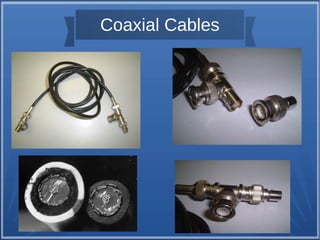
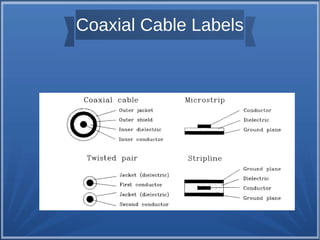
Coaxial Cables
Coaxial Cable Labels
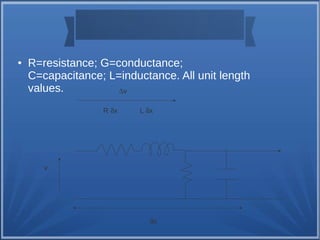
● R=resistance; G=conductance; 
C=capacitance; L=inductance. All unit length 
values. 
Dv 
R dx L dx 
v 
dx
Important result for a 
good copper 
transmission line and w 
=constant 
● Z0= [(R+j w L)/(G+j w C)]=characteristic 
impedance 
● If you have a good copper 
transmission line R,G are small, and 
● if the signal has a Constant frequency w 
● therefore 
● Z0=(L/C)1/2= a constant
Waveguides 
Introduction 
At frequencies higher than 3 GHz, transmission 
of electromagnetic energy along the 
transmission lines and cables becomes difficult. 
This is due to the losses that occur both in the 
solid dielectric needed to support the conductor 
and in the conductors themselves. 
A metallic tube can be used to transmit 
electromagnetic wave at the above frequencies
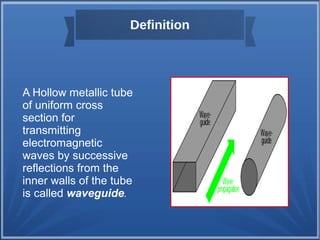
Definition 
A Hollow metallic tube 
of uniform cross 
section for 
transmitting 
electromagnetic 
waves by successive 
reflections from the 
inner walls of the tube 
is called waveguide.
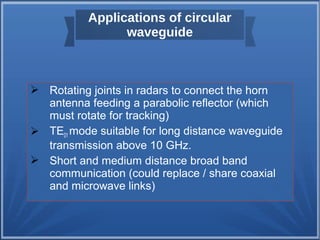
Applications of circular 
waveguide 
 Rotating joints in radars to connect the horn 
antenna feeding a parabolic reflector (which 
must rotate for tracking) 
 TE01 mode suitable for long distance waveguide 
transmission above 10 GHz. 
 Short and medium distance broad band 
communication (could replace / share coaxial 
and microwave links)
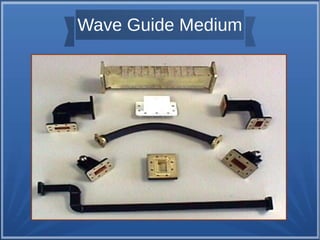
Wave Guide Medium
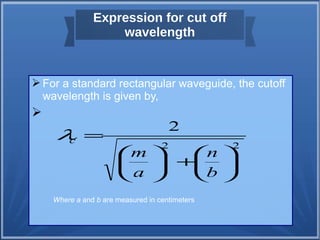
Expression for cut off 
wavelength 
For a standard rectangular waveguide, the cutoff 
wavelength is given by, 
 
2 
2 2 
n 
ö çè 
÷ø 
m 
ö çè 
æ + ÷ø 
æ 
= 
b 
a 
c l 
Where a and b are measured in centimeters
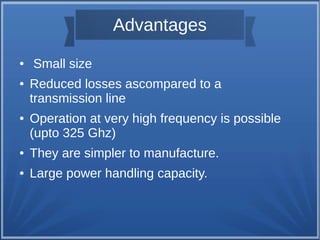
Advantages 
● Small size 
● Reduced losses ascompared to a 
transmission line 
● Operation at very high frequency is possible 
(upto 325 Ghz) 
● They are simpler to manufacture. 
● Large power handling capacity.
Disadvantages 
● Low Frequency operation is not possible as 
they become bulky at low frequency. 
● Absolute efficiency is low.
Antennas 
● Function of antennas 
● Radiation Pattern of antenna 
● Isotropic Radiator 
● Efficiency 
● Gain
Antennas 
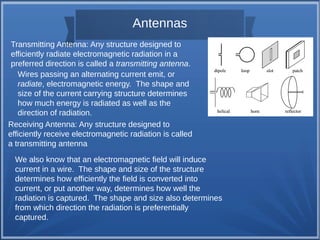
Transmitting Antenna: Any structure designed to 
efficiently radiate electromagnetic radiation in a 
preferred direction is called a transmitting antenna. 
Wires passing an alternating current emit, or 
radiate, electromagnetic energy. The shape and 
size of the current carrying structure determines 
how much energy is radiated as well as the 
direction of radiation. 
Receiving Antenna: Any structure designed to 
efficiently receive electromagnetic radiation is called 
a transmitting antenna 
We also know that an electromagnetic field will induce 
current in a wire. The shape and size of the structure 
determines how efficiently the field is converted into 
current, or put another way, determines how well the 
radiation is captured. The shape and size also determines 
from which direction the radiation is preferentially 
captured.
Antennas – Radiation Patterns 
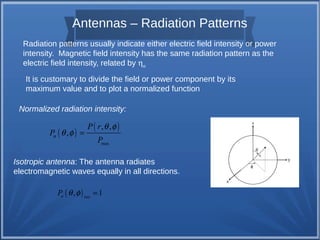
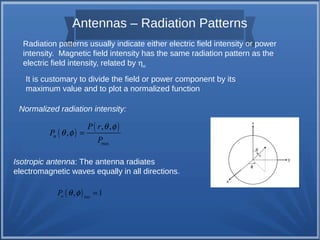
Radiation patterns usually indicate either electric field intensity or power 
intensity. Magnetic field intensity has the same radiation pattern as the 
electric field intensity, related by ho 
It is customary to divide the field or power component by its 
maximum value and to plot a normalized function 
Normalized radiation intensity: 
( ) ( , , 
) 
max 
n , 
P r 
P 
P 
q f 
q f = 
Isotropic antenna: The antenna radiates 
electromagnetic waves equally in all directions. 
( , ) 1 n iso P q f =
Antennas – Radiation Patterns 
Radiation patterns usually indicate either electric field intensity or power 
intensity. Magnetic field intensity has the same radiation pattern as the 
electric field intensity, related by ho 
It is customary to divide the field or power component by its 
maximum value and to plot a normalized function 
Normalized radiation intensity: 
( ) ( , , 
) 
max 
n , 
P r 
P 
P 
q f 
q f = 
Isotropic antenna: The antenna radiates 
electromagnetic waves equally in all directions. 
( , ) 1 n iso P q f =
Antennas – Radiation Patterns 
Radiation Pattern: 
A directional antenna radiates and receives 
preferentially in some direction. 
A polar plot 
A rectangular plot 
It is customary, then, to take slices of the 
pattern and generate two-dimensional 
plots. 
The polar plot can also be in terms of decibels. 
( ) ( , , 
) 
max 
, n 
E r 
E 
E 
q f 
q f = 
( , ) ( ) 20log[ ( , ) ] n n E q f dB = E q f 
It is interesting to note that a normalized 
electric field pattern in dB will be identical to the 
power pattern in dB. 
( , ) ( ) 10log[ ( , ) ] n n P q f dB = P q f
Antennas – Radiation Patterns 
A polar plot 
A rectangular plot 
Radiation Pattern: 
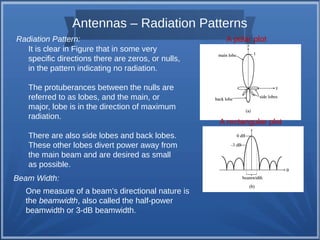
It is clear in Figure that in some very 
specific directions there are zeros, or nulls, 
in the pattern indicating no radiation. 
The protuberances between the nulls are 
referred to as lobes, and the main, or 
major, lobe is in the direction of maximum 
radiation. 
There are also side lobes and back lobes. 
These other lobes divert power away from 
the main beam and are desired as small 
as possible. 
Beam Width: 
One measure of a beam’s directional nature is 
the beamwidth, also called the half-power 
beamwidth or 3-dB beamwidth.
Antennas – Efficiency 
Efficiency 
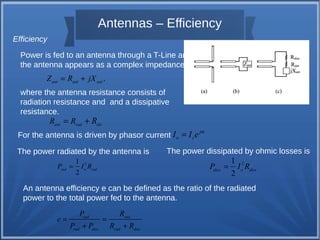
Power is fed to an antenna through a T-Line and 
the antenna appears as a complex impedance 
Zant = Rant + jXant . 
where the antenna resistance consists of 
radiation resistance and and a dissipative 
resistance. 
ant rad dis R = R + R 
For the antenna is driven by phasor current j 
The power radiated by the antenna is The power dissipated by ohmic losses is 
2 1 
2 rad o rad P = I R 2 1 
2 diss o diss P = I R 
An antenna efficiency e can be defined as the ratio of the radiated 
power to the total power fed to the antenna. 
P R 
= = 
rad rad 
rad diss rad diss 
e 
P + P R + 
R 
o s I = I e a
Antennas – Gain 
Gain 
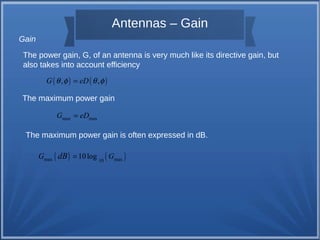
The power gain, G, of an antenna is very much like its directive gain, but 
also takes into account efficiency 
G(q ,f ) = eD(q ,f ) 
The maximum power gain 
Gmax = eDmax 
The maximum power gain is often expressed in dB. 
( ) ( ) max 10 max G dB = 10 log G
Types of Antennas 
1. Dipole antennas 
2. Horn antennas 
3. Parabolic antennas 
4. Yagi antennas

Transmission lines, Waveguide, Antennas

  • 1.
    Basic Electronics PrepareedBy: ● Patel Yash K. - 130420109537 ● Pawar Kumar S. - 130420109538 ● Rathod Kishan . -130420109539
  • 2.
    Topics ● TransmissionLines ● Waveguides ● Antenna Fundamentals
  • 3.
    Characteristics of and applications of Transmission lines ● Advantages: – Less distortion, radiation (EMI), cross-talk ● Disadvantage – More power required. ● Applications, transmission lines can handle – Signals traveling in long distance in Printed-circuit-board PCB – Signals in a cables, connectors (USB, PCI).
  • 4.
    Advantage of using transmission lines: Reduce Electromagnetic Interference (EMI) in point-to-point wiring ● Wire-wrap connections create EMI. ● Transmission lines reduce EMI because, – Current loop area is small, also it constraints the return current (in ground plane) closer to the outgoing signal path, magnetic current cancel each other.
  • 5.
    Different transmission lines 1. Coaxial (unbalanced) line and 2. Parallel-wire (balanced) line
  • 6.
  • 7.
  • 8.
    ● R=resistance; G=conductance; C=capacitance; L=inductance. All unit length values. Dv R dx L dx v dx
  • 9.
    Important result fora good copper transmission line and w =constant ● Z0= [(R+j w L)/(G+j w C)]=characteristic impedance ● If you have a good copper transmission line R,G are small, and ● if the signal has a Constant frequency w ● therefore ● Z0=(L/C)1/2= a constant
  • 10.
    Waveguides Introduction Atfrequencies higher than 3 GHz, transmission of electromagnetic energy along the transmission lines and cables becomes difficult. This is due to the losses that occur both in the solid dielectric needed to support the conductor and in the conductors themselves. A metallic tube can be used to transmit electromagnetic wave at the above frequencies
  • 11.
    Definition A Hollowmetallic tube of uniform cross section for transmitting electromagnetic waves by successive reflections from the inner walls of the tube is called waveguide.
  • 12.
    Applications of circular waveguide  Rotating joints in radars to connect the horn antenna feeding a parabolic reflector (which must rotate for tracking)  TE01 mode suitable for long distance waveguide transmission above 10 GHz.  Short and medium distance broad band communication (could replace / share coaxial and microwave links)
  • 13.
  • 14.
    Expression for cutoff wavelength For a standard rectangular waveguide, the cutoff wavelength is given by,  2 2 2 n ö çè ÷ø m ö çè æ + ÷ø æ = b a c l Where a and b are measured in centimeters
  • 15.
    Advantages ● Smallsize ● Reduced losses ascompared to a transmission line ● Operation at very high frequency is possible (upto 325 Ghz) ● They are simpler to manufacture. ● Large power handling capacity.
  • 16.
    Disadvantages ● LowFrequency operation is not possible as they become bulky at low frequency. ● Absolute efficiency is low.
  • 17.
    Antennas ● Functionof antennas ● Radiation Pattern of antenna ● Isotropic Radiator ● Efficiency ● Gain
  • 18.
    Antennas Transmitting Antenna:Any structure designed to efficiently radiate electromagnetic radiation in a preferred direction is called a transmitting antenna. Wires passing an alternating current emit, or radiate, electromagnetic energy. The shape and size of the current carrying structure determines how much energy is radiated as well as the direction of radiation. Receiving Antenna: Any structure designed to efficiently receive electromagnetic radiation is called a transmitting antenna We also know that an electromagnetic field will induce current in a wire. The shape and size of the structure determines how efficiently the field is converted into current, or put another way, determines how well the radiation is captured. The shape and size also determines from which direction the radiation is preferentially captured.
  • 19.
    Antennas – RadiationPatterns Radiation patterns usually indicate either electric field intensity or power intensity. Magnetic field intensity has the same radiation pattern as the electric field intensity, related by ho It is customary to divide the field or power component by its maximum value and to plot a normalized function Normalized radiation intensity: ( ) ( , , ) max n , P r P P q f q f = Isotropic antenna: The antenna radiates electromagnetic waves equally in all directions. ( , ) 1 n iso P q f =
  • 20.
    Antennas – RadiationPatterns Radiation patterns usually indicate either electric field intensity or power intensity. Magnetic field intensity has the same radiation pattern as the electric field intensity, related by ho It is customary to divide the field or power component by its maximum value and to plot a normalized function Normalized radiation intensity: ( ) ( , , ) max n , P r P P q f q f = Isotropic antenna: The antenna radiates electromagnetic waves equally in all directions. ( , ) 1 n iso P q f =
  • 21.
    Antennas – RadiationPatterns Radiation Pattern: A directional antenna radiates and receives preferentially in some direction. A polar plot A rectangular plot It is customary, then, to take slices of the pattern and generate two-dimensional plots. The polar plot can also be in terms of decibels. ( ) ( , , ) max , n E r E E q f q f = ( , ) ( ) 20log[ ( , ) ] n n E q f dB = E q f It is interesting to note that a normalized electric field pattern in dB will be identical to the power pattern in dB. ( , ) ( ) 10log[ ( , ) ] n n P q f dB = P q f
  • 22.
    Antennas – RadiationPatterns A polar plot A rectangular plot Radiation Pattern: It is clear in Figure that in some very specific directions there are zeros, or nulls, in the pattern indicating no radiation. The protuberances between the nulls are referred to as lobes, and the main, or major, lobe is in the direction of maximum radiation. There are also side lobes and back lobes. These other lobes divert power away from the main beam and are desired as small as possible. Beam Width: One measure of a beam’s directional nature is the beamwidth, also called the half-power beamwidth or 3-dB beamwidth.
  • 23.
    Antennas – Efficiency Efficiency Power is fed to an antenna through a T-Line and the antenna appears as a complex impedance Zant = Rant + jXant . where the antenna resistance consists of radiation resistance and and a dissipative resistance. ant rad dis R = R + R For the antenna is driven by phasor current j The power radiated by the antenna is The power dissipated by ohmic losses is 2 1 2 rad o rad P = I R 2 1 2 diss o diss P = I R An antenna efficiency e can be defined as the ratio of the radiated power to the total power fed to the antenna. P R = = rad rad rad diss rad diss e P + P R + R o s I = I e a
  • 24.
    Antennas – Gain Gain The power gain, G, of an antenna is very much like its directive gain, but also takes into account efficiency G(q ,f ) = eD(q ,f ) The maximum power gain Gmax = eDmax The maximum power gain is often expressed in dB. ( ) ( ) max 10 max G dB = 10 log G
  • 25.
    Types of Antennas 1. Dipole antennas 2. Horn antennas 3. Parabolic antennas 4. Yagi antennas