Chemistry
MICROWAVE
ASSISTED
EXTRACTION
Bisma Shafiq
Introductio
n
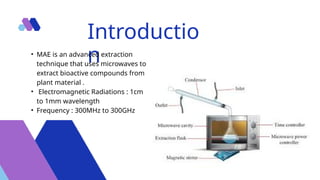
• MAE is an advanced extraction
technique that uses microwaves to
extract bioactive compounds from
plant material .
• Electromagnetic Radiations : 1cm
to 1mm wavelength
• Frequency : 300MHz to 300GHz
MAE
Microwaves directly act on the material which is able to absorb a part
of its electromagnetic energy and can transform it into heat. This
conversion of electromagnetic energy into heat energy occurs by two
mechanism :
1) Ionic Conduction
In ionic compounds , such as acid salts ,
microwave radiations causes the ions to
move back and forth , which generates
heat due to resistance of ionic solution
to the movement of the ions .
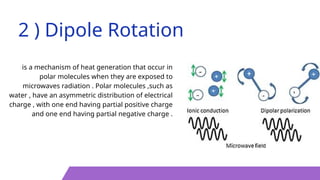
2 ) Dipole Rotation
is a mechanism of heat generation that occur in
polar molecules when they are exposed to
microwaves radiation . Polar molecules ,such as
water , have an asymmetric distribution of electrical
charge , with one end having partial positive charge
and one end having partial negative charge .
Working Principle
Irrespective of any drying method used, plants still do
contain some moisture (microscopic traces of moisture
that serve as a target for microwave heating). When this
moisture inside the plant material gets heated under the
influence of microwaves get evaporated and creates
great pressure on the cell wall from inside because of
swelling of plant cells. This causes the rupturing of cell
wall (electroporation effect) thus facilitates the leaching
of phytoconstituents (leakage and release of
intracellular components) from the cells into the
surrounding solvent. Higher temperature attained in
MAE increases dehydration of cellulose and reduces its
mechanical strength and this in turn helps solvent to
access easily to compounds inside the cell.
Types:
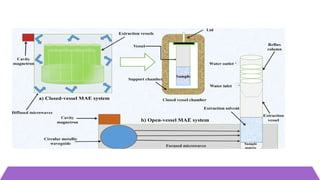
There are 2 primary types of MAE system
Closed Vessel
System
This system is commonly used for
extraction undercontrolled
temprature and pressure conditions .
It is especially useful when precise
extraction conditions are required .
Closed Vessel
System
In this system extraction is conducted
under atmospheric pressure. It is
often employed when controlled
pressure is not necessary .
Solvent properties
Extraction time
Matrix characteristics
Microwave power
Factors
affecting
the
efficiency
of MAE Temperature
Advantages of
Microwave assisted
Extraction (MAE) :
• Rapid exhaustive extraction:The process is
time saving as the extraction process can
be completed from few seconds to few
minutes (5-20 min).
• MAE consumes less solvents (easy
recycled). Uses only few milliliters of
solvent
• Improved extraction yield and enhanced
efficiency.
• Avoid the thermal degradation and
oxidation.
• Favorable for thermo labile
phytocontituents
• Better process accuracy and precision as provided by the
automation of the instrument.
• MAE is one of the simplest methods and most effective among
the several existing techniques.
• Further, the energy loss to the surrounding environment in MAE
is very less as the heating occurs in a selective and targeted
manner.
• Heavy metals and pesticide residue which are present in minute
traces can be extracted from a few milligram of plant sample.
Thanks for
Watching

Microwave Assisted extraction techniques.pptx

  • 1.
  • 2.
    Introductio n • MAE isan advanced extraction technique that uses microwaves to extract bioactive compounds from plant material . • Electromagnetic Radiations : 1cm to 1mm wavelength • Frequency : 300MHz to 300GHz
  • 3.
    MAE Microwaves directly acton the material which is able to absorb a part of its electromagnetic energy and can transform it into heat. This conversion of electromagnetic energy into heat energy occurs by two mechanism : 1) Ionic Conduction In ionic compounds , such as acid salts , microwave radiations causes the ions to move back and forth , which generates heat due to resistance of ionic solution to the movement of the ions .
  • 4.
    2 ) DipoleRotation is a mechanism of heat generation that occur in polar molecules when they are exposed to microwaves radiation . Polar molecules ,such as water , have an asymmetric distribution of electrical charge , with one end having partial positive charge and one end having partial negative charge .
  • 5.
    Working Principle Irrespective ofany drying method used, plants still do contain some moisture (microscopic traces of moisture that serve as a target for microwave heating). When this moisture inside the plant material gets heated under the influence of microwaves get evaporated and creates great pressure on the cell wall from inside because of swelling of plant cells. This causes the rupturing of cell wall (electroporation effect) thus facilitates the leaching of phytoconstituents (leakage and release of intracellular components) from the cells into the surrounding solvent. Higher temperature attained in MAE increases dehydration of cellulose and reduces its mechanical strength and this in turn helps solvent to access easily to compounds inside the cell.
  • 6.
    Types: There are 2primary types of MAE system Closed Vessel System This system is commonly used for extraction undercontrolled temprature and pressure conditions . It is especially useful when precise extraction conditions are required . Closed Vessel System In this system extraction is conducted under atmospheric pressure. It is often employed when controlled pressure is not necessary .
  • 8.
    Solvent properties Extraction time Matrixcharacteristics Microwave power Factors affecting the efficiency of MAE Temperature
  • 9.
    Advantages of Microwave assisted Extraction(MAE) : • Rapid exhaustive extraction:The process is time saving as the extraction process can be completed from few seconds to few minutes (5-20 min). • MAE consumes less solvents (easy recycled). Uses only few milliliters of solvent • Improved extraction yield and enhanced efficiency. • Avoid the thermal degradation and oxidation. • Favorable for thermo labile phytocontituents
  • 10.
    • Better processaccuracy and precision as provided by the automation of the instrument. • MAE is one of the simplest methods and most effective among the several existing techniques. • Further, the energy loss to the surrounding environment in MAE is very less as the heating occurs in a selective and targeted manner. • Heavy metals and pesticide residue which are present in minute traces can be extracted from a few milligram of plant sample.
  • 11.