Final Year Project Presentation FYP 08 Arsalan Tariq Mir Saad Najeeb Syed Ammar Faheem
The recent convergence of the Internet and mobile radio has also accelerated the demand for “Internet in the pocket”. This trend to higher data rates over wireless networks will culminate in the introduction of Third Generation (3G). An extremely flexible expansion and migration strategy along the road to the 3G would be “soft” network evolution that does not render existing installations superfluous. Introduction
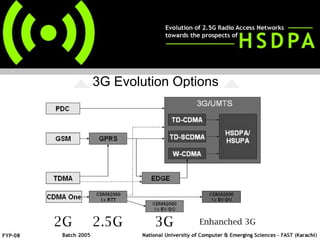
3G Evolution Options
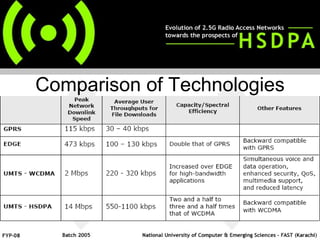
Comparison of Technologies
 
 
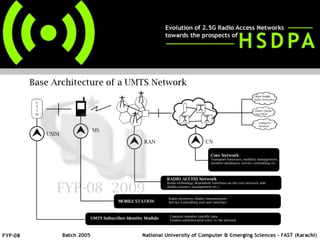
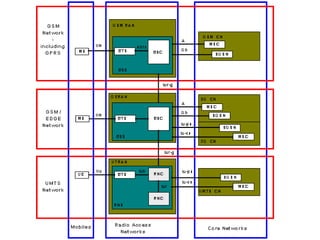
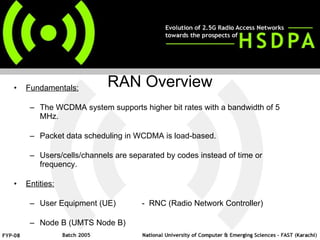
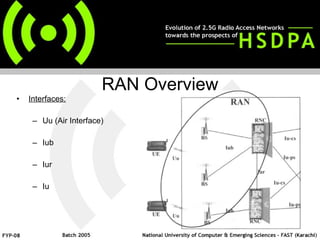
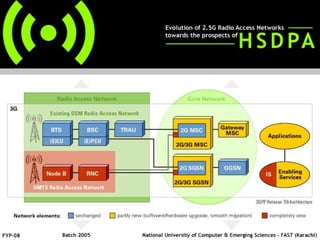
RAN Overview Fundamentals: The WCDMA system supports higher bit rates with a bandwidth of 5 MHz. Packet data scheduling in WCDMA is load-based. Users/cells/channels are separated by codes instead of time or frequency.  Entities: User Equipment (UE) -  RNC (Radio Network Controller) Node B (UMTS Node B)
Interfaces: Uu (Air Interface) Iub Iur Iu RAN Overview
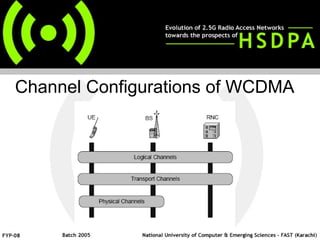
Channel Configurations of WCDMA
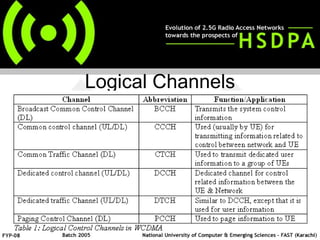
Logical Channels
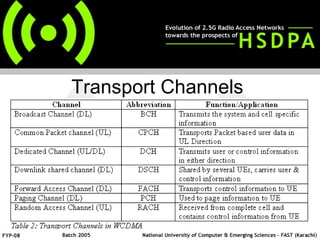
Transport Channels
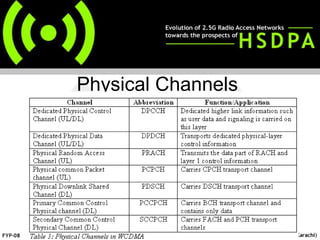
Physical Channels
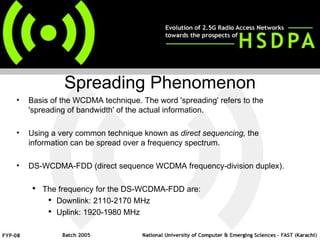
Basis of the WCDMA technique. The word 'spreading' refers to the 'spreading of bandwidth' of the actual information. Using a very common technique known as  direct sequencing,  the information can be spread over a frequency spectrum.  DS-WCDMA-FDD (direct sequence WCDMA frequency-division duplex).  The frequency for the DS-WCDMA-FDD are: Downlink: 2110-2170 MHz Uplink: 1920-1980 MHz Spreading Phenomenon
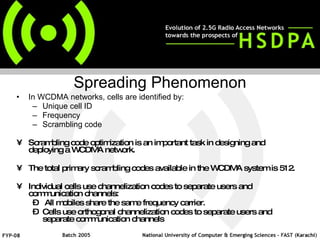
In WCDMA networks, cells are identified by: Unique cell ID  Frequency  Scrambling code Scrambling code optimization is an important task in designing and deploying a WCDMA network.   The total primary scrambling codes available in the WCDMA system is 512.   Individual cells use channelization codes to separate users and communication channels: All mobiles share the same frequency carrier. Cells use orthogonal channelization codes to separate users and separate communication channels   Spreading Phenomenon
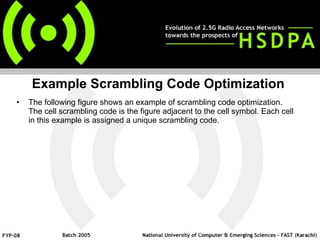
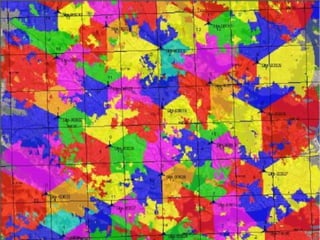
Example Scrambling Code Optimization  The following figure shows an example of scrambling code optimization. The cell scrambling code is the figure adjacent to the cell symbol. Each cell in this example is assigned a unique scrambling code.
 
Power Control As the frequency re-use factor is 1, so fast and accurate power control   becomes even more essential. Something else that is used in these networks is 'slow power control', also known as 'outer-loop power control'. The process is based on the needs of individual single links and is responsible for maintaining quality targets in the base station and the network.
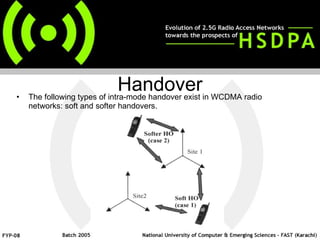
Handover The following types of intra-mode handover exist in WCDMA radio networks: soft and softer handovers.
Migration Process It is a two step process, the first step involves the introduction of UMTS networks which involves a hardware change to the RAN network as new WCDMA air-interface is introduced.  the second step is a software upgrade to the RNC of WCDMA RAN if it supports the power needed for HSDPA else it would also involve the addition of power amplifier at the Node B.
 
Traffic Intensity (Erlang) [Number of calls (per hour) × average call duration (in seconds)] / 3,600 Traffic Density (Erlang/km 2 )  Number of calls per square kilometer Spectral Efficiency Traffic that can be handled within a certain bandwidth and area. Traffic intensity (Erlang)/(Bandwidth × Area) = bps/(MHz × km 2 ) Cell Loading It indicates the relative occupancy of the cell Loading Factor It defines the amount of interference loaded into the cell by surrounding cells.  Some Terminologies
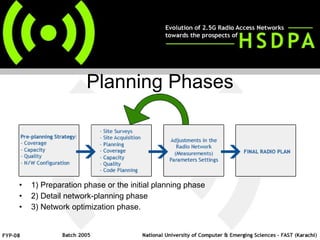
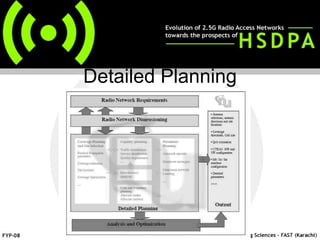
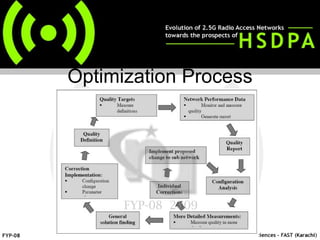
Planning Phases 1) Preparation phase or the initial planning phase 2) Detail network-planning phase 3) Network optimization phase.
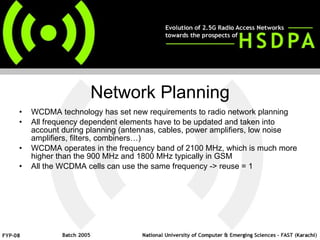
Network Planning WCDMA technology has set new requirements to radio network planning All frequency dependent elements have to be updated and taken into account during planning (antennas, cables, power amplifiers, low noise amplifiers, filters, combiners…) WCDMA operates in the frequency band of 2100 MHz, which is much more higher than the 900 MHz and 1800 MHz typically in GSM All the WCDMA cells can use the same frequency -> reuse = 1
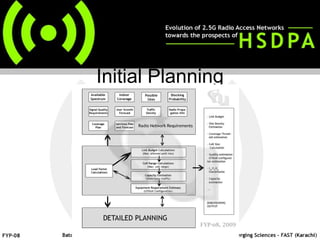
Initial Planning
Detailed Planning
Optimization Process
High Speed Downlink Packet Access (HSDPA) supports the introduction of high bit rate data services and will increase network capacity. It provides a smooth evolutionary path for Universal Mobile Telecommunications System (UMTS) networks to higher data rates and higher capacities, in the same way as Enhanced Data rates for GSM Evolution (EDGE) does in the Global System for Mobile communication (GSM) world.  HSDPA Upgrade
HSDPA achieves its performance gains from the following radio features: High speed channels shared both in the code and time domains Adaptive modulation and coding schemes: Quadrature Phase Shift Keying (QPSK) and 16QAM (Quadrature Amplitude Modulation).  Hybrid Automatic Repeat reQuest (HARQ) retransmission protocol.  Short transmission time interval (TTI) Fast scheduling and User Diversity HSDPA Upgrade
HSDPA is primarily implemented in the Node B and the RNC.  Introduces an additional transport channel called the high-speed downlink shared channel (HS-DSCH).  Employs a technique called adaptive modulation and coding (AMC)  Provides re-transmission mechanisms for faster error correction  HSDPA Implementation
Requires investments to R99/R4 UMTS (WCDMA) network –  Affects radio network HW (if power not supported) and SW –  Can be deployed using small upgrades, not required for all BSs, RNCs –  Does not require a completely new network structure Protecting the current investments made to the network HSDPA Implementation
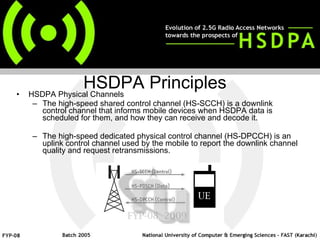
HSDPA Physical Channels The high-speed shared control channel (HS-SCCH) is a downlink control channel that informs mobile devices when HSDPA data is scheduled for them, and how they can receive and decode it.  The high-speed dedicated physical control channel (HS-DPCCH) is an uplink control channel used by the mobile to report the downlink channel quality and request retransmissions.  HSDPA Principles
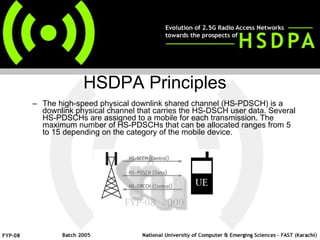
The high-speed physical downlink shared channel (HS-PDSCH) is a downlink physical channel that carries the HS-DSCH user data. Several HS-PDSCHs are assigned to a mobile for each transmission. The maximum number of HS-PDSCHs that can be allocated ranges from 5 to 15 depending on the category of the mobile device.  HSDPA Principles
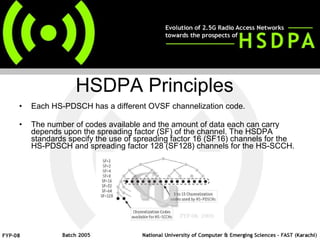
Each HS-PDSCH has a different OVSF channelization code.  The number of codes available and the amount of data each can carry depends upon the spreading factor (SF) of the channel. The HSDPA standards specify the use of spreading factor 16 (SF16) channels for the HS-PDSCH and spreading factor 128 (SF128) channels for the HS-SCCH.  HSDPA Principles
Increased Data Rata HSDPA allows the use of 16-QAM modulation on HS-PDSCH channels to double the data rate of transmissions in favorable channel conditions.  16QAM signals are more susceptible to channel impairments and so the full gains can only be realized in high channel quality conditions.  The decision to transmit QPSK or 16QAM is made in the network using channel quality information provided by the mobile terminal via the uplink control channel. HSDPA Principles
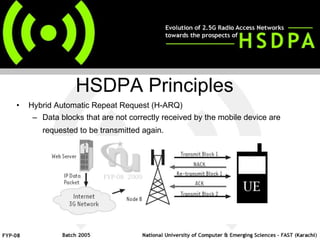
Hybrid Automatic Repeat Request (H-ARQ) Data blocks that are not correctly received by the mobile device are requested to be transmitted again.   HSDPA Principles
During the course of this study, one of the biggest hurdles was to get a planning tool. What we found needs a professional license for operation. We had no choice but to develop one of our own. Our focus was not just to plan but also to understand the mathematics that runs behind the catchy GUI’s of expensive planning software.  ‘ LinkIT’ , is our application that does all the basic planning for the deployment of a 3G network.  LinkIT
LinkIT is a browser based application that relies on PHP 5 and JavaScript. It has the following: Traffic Calculator Frequency Planner Link Budget Calculation (Uplink and Downlink) Coverage Range Calculator RNC Dimensioning LinkIT
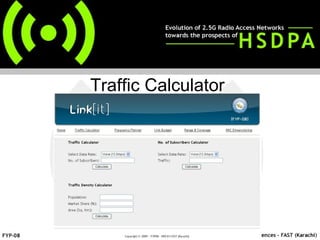
Traffic Calculator Calculatar that takes in the number of subscriber as input and based on the data rate outputs the traffic. It assumes an average traffic of : 45mErl for voice at 12.2kpbs  -  6.5mErl for data at 64kbps 2.2mErl for data at 144kbps  -  2.2mErl for data at 384kbps Subscriber Calculator Performs the vice-versa function of calculating number of subscriber based on traffic. Traffic Density Calculator Computes the traffic density based on Population, Market Share and Coverage Area. Traffic Calculator
Traffic Calculator
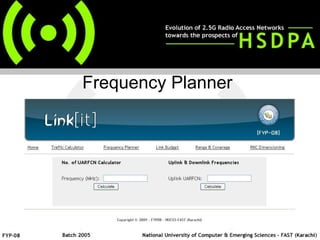
URAFCN Calculator  Calculates the UMTS Absolute Frequency Channel Number based on the following formula. URAFCN = 5 x Channel Frequency Uplink and Downlink Frequency Computes the Uplink and Downlink frequencies based on the Uplink URAFCN. Uplink Frequency: URAFCN / 5 Downlink Frequency: Uplink Frequency + 190 Frequency Planner
Frequency Planner
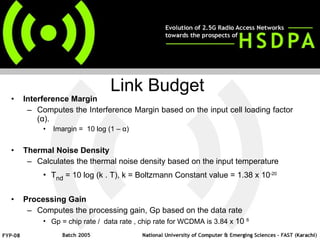
Interference Margin  Computes the Interference Margin based on the input cell loading factor (α). Imargin =  10 log (1 – α) Thermal Noise Density Calculates the thermal noise density based on the input temperature T nd  = 10 log (k . T), k = Boltzmann Constant value = 1.38 x 10 -20 Processing Gain Computes the processing gain, Gp based on the data rate Gp = chip rate /  data rate , chip rate for WCDMA is 3.84 x  10  6 Link Budget
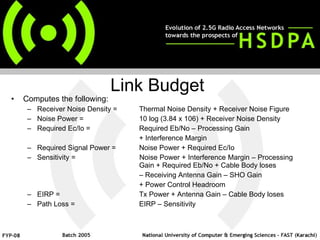
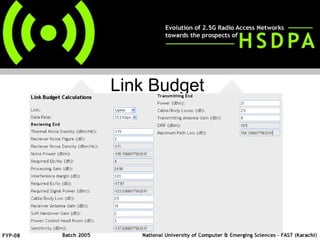
Computes the following: Receiver Noise Density = Thermal Noise Density + Receiver Noise Figure Noise Power = 10 log (3.84 x 10⁶) + Receiver Noise Density Required Ec/Io = Required Eb/No – Processing Gain  + Interference Margin Required Signal Power = Noise Power + Required Ec/Io Sensitivity =  Noise Power + Interference Margin – Processing  Gain + Required Eb/No + Cable Body loses –  Receiving Antenna Gain – SHO Gain + Power Control Headroom EIRP = Tx Power + Antenna Gain – Cable Body loses Path Loss =  EIRP – Sensitivity    Link Budget
Link Budget
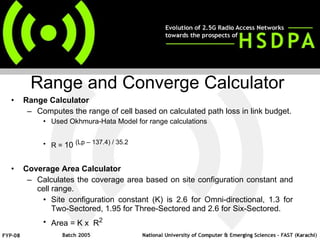
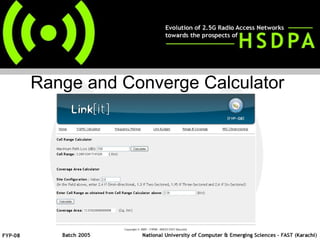
Range Calculator  Computes the range of cell based on calculated path loss in link budget. Used Okhmura-Hata Model for range calculations R =  10  (Lp – 137.4) / 35.2 Coverage Area Calculator Calculates the coverage area based on site configuration constant and cell range. Site configuration constant (K) is 2.6 for Omni-directional, 1.3 for Two-Sectored, 1.95 for Three-Sectored and 2.6 for Six-Sectored. Area = K x  R 2 Range and Converge Calculator
Range and Converge Calculator
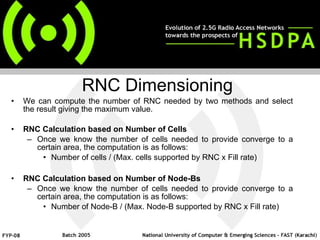
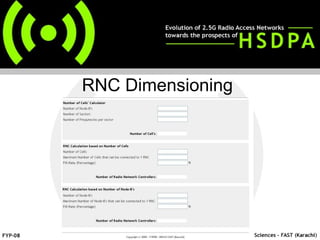
We can compute the number of RNC needed by two methods and select the result giving the maximum value. RNC Calculation based on Number of Cells Once we know the number of cells needed to provide converge to a certain area, the computation is as follows: Number of cells / (Max. cells supported by RNC x Fill rate) RNC Calculation based on Number of Node-Bs Once we know the number of cells needed to provide converge to a certain area, the computation is as follows: Number of Node-B / (Max. Node-B supported by RNC x Fill rate) RNC Dimensioning
RNC Dimensioning
UMTS Radio Access Network (UTRAN) designing like GSM requires a thorough analysis of resources, geographical area and required standards.  This project provided us with an opportunity to grasp the concepts of RAN, understanding the procedure of its designing, and upgrading it to support HSDPA. The license of 3G frequency bands have not been issued by PTA. The foremost and the major recommendation is to make the 3G network technology available in Pakistan. The second recommendation comes with data traffic increasing exponentially, operators must keep themselves ready to quickly evolve.  Conclusion and Future Work
One solution that has been developed by Nokia Siemens Networks (NSN) is a single hardware platform for multiple technologies that does all and more. GSM/EDGE, WCDMA/HSPA and LTE, all technologies in one  Flexi Multi-radio. If the PTA is unable to auction 3G licenses within the next four to five months, we would suggest they should then focus themselves on LTE technologies and start planning for LTE to keep up with the latest trends in the telecommunication industry worldwide.  The tool, LinkIT proves to be useful tool for providing estimations in the initial planning and detailed planning phase. It may be extended to provide visual plots and simulation of coverage and capacity. Conclusion and Future Work
Thank You!

Fyp Presentation

  • 1.
    Final Year ProjectPresentation FYP 08 Arsalan Tariq Mir Saad Najeeb Syed Ammar Faheem
  • 2.
    The recent convergenceof the Internet and mobile radio has also accelerated the demand for “Internet in the pocket”. This trend to higher data rates over wireless networks will culminate in the introduction of Third Generation (3G). An extremely flexible expansion and migration strategy along the road to the 3G would be “soft” network evolution that does not render existing installations superfluous. Introduction
  • 3.
  • 4.
  • 5.
  • 6.
  • 7.
    RAN Overview Fundamentals:The WCDMA system supports higher bit rates with a bandwidth of 5 MHz. Packet data scheduling in WCDMA is load-based. Users/cells/channels are separated by codes instead of time or frequency. Entities: User Equipment (UE) - RNC (Radio Network Controller) Node B (UMTS Node B)
  • 8.
    Interfaces: Uu (AirInterface) Iub Iur Iu RAN Overview
  • 9.
  • 10.
  • 11.
  • 12.
  • 13.
    Basis of theWCDMA technique. The word 'spreading' refers to the 'spreading of bandwidth' of the actual information. Using a very common technique known as direct sequencing, the information can be spread over a frequency spectrum. DS-WCDMA-FDD (direct sequence WCDMA frequency-division duplex). The frequency for the DS-WCDMA-FDD are: Downlink: 2110-2170 MHz Uplink: 1920-1980 MHz Spreading Phenomenon
  • 14.
    In WCDMA networks,cells are identified by: Unique cell ID Frequency Scrambling code Scrambling code optimization is an important task in designing and deploying a WCDMA network. The total primary scrambling codes available in the WCDMA system is 512. Individual cells use channelization codes to separate users and communication channels: All mobiles share the same frequency carrier. Cells use orthogonal channelization codes to separate users and separate communication channels Spreading Phenomenon
  • 15.
    Example Scrambling CodeOptimization The following figure shows an example of scrambling code optimization. The cell scrambling code is the figure adjacent to the cell symbol. Each cell in this example is assigned a unique scrambling code.
  • 16.
  • 17.
    Power Control Asthe frequency re-use factor is 1, so fast and accurate power control becomes even more essential. Something else that is used in these networks is 'slow power control', also known as 'outer-loop power control'. The process is based on the needs of individual single links and is responsible for maintaining quality targets in the base station and the network.
  • 18.
    Handover The followingtypes of intra-mode handover exist in WCDMA radio networks: soft and softer handovers.
  • 19.
    Migration Process Itis a two step process, the first step involves the introduction of UMTS networks which involves a hardware change to the RAN network as new WCDMA air-interface is introduced. the second step is a software upgrade to the RNC of WCDMA RAN if it supports the power needed for HSDPA else it would also involve the addition of power amplifier at the Node B.
  • 20.
  • 21.
    Traffic Intensity (Erlang)[Number of calls (per hour) × average call duration (in seconds)] / 3,600 Traffic Density (Erlang/km 2 ) Number of calls per square kilometer Spectral Efficiency Traffic that can be handled within a certain bandwidth and area. Traffic intensity (Erlang)/(Bandwidth × Area) = bps/(MHz × km 2 ) Cell Loading It indicates the relative occupancy of the cell Loading Factor It defines the amount of interference loaded into the cell by surrounding cells. Some Terminologies
  • 22.
    Planning Phases 1)Preparation phase or the initial planning phase 2) Detail network-planning phase 3) Network optimization phase.
  • 23.
    Network Planning WCDMAtechnology has set new requirements to radio network planning All frequency dependent elements have to be updated and taken into account during planning (antennas, cables, power amplifiers, low noise amplifiers, filters, combiners…) WCDMA operates in the frequency band of 2100 MHz, which is much more higher than the 900 MHz and 1800 MHz typically in GSM All the WCDMA cells can use the same frequency -> reuse = 1
  • 24.
  • 25.
  • 26.
  • 27.
    High Speed DownlinkPacket Access (HSDPA) supports the introduction of high bit rate data services and will increase network capacity. It provides a smooth evolutionary path for Universal Mobile Telecommunications System (UMTS) networks to higher data rates and higher capacities, in the same way as Enhanced Data rates for GSM Evolution (EDGE) does in the Global System for Mobile communication (GSM) world. HSDPA Upgrade
  • 28.
    HSDPA achieves itsperformance gains from the following radio features: High speed channels shared both in the code and time domains Adaptive modulation and coding schemes: Quadrature Phase Shift Keying (QPSK) and 16QAM (Quadrature Amplitude Modulation). Hybrid Automatic Repeat reQuest (HARQ) retransmission protocol. Short transmission time interval (TTI) Fast scheduling and User Diversity HSDPA Upgrade
  • 29.
    HSDPA is primarilyimplemented in the Node B and the RNC. Introduces an additional transport channel called the high-speed downlink shared channel (HS-DSCH). Employs a technique called adaptive modulation and coding (AMC) Provides re-transmission mechanisms for faster error correction HSDPA Implementation
  • 30.
    Requires investments toR99/R4 UMTS (WCDMA) network – Affects radio network HW (if power not supported) and SW – Can be deployed using small upgrades, not required for all BSs, RNCs – Does not require a completely new network structure Protecting the current investments made to the network HSDPA Implementation
  • 31.
    HSDPA Physical ChannelsThe high-speed shared control channel (HS-SCCH) is a downlink control channel that informs mobile devices when HSDPA data is scheduled for them, and how they can receive and decode it. The high-speed dedicated physical control channel (HS-DPCCH) is an uplink control channel used by the mobile to report the downlink channel quality and request retransmissions. HSDPA Principles
  • 32.
    The high-speed physicaldownlink shared channel (HS-PDSCH) is a downlink physical channel that carries the HS-DSCH user data. Several HS-PDSCHs are assigned to a mobile for each transmission. The maximum number of HS-PDSCHs that can be allocated ranges from 5 to 15 depending on the category of the mobile device. HSDPA Principles
  • 33.
    Each HS-PDSCH hasa different OVSF channelization code. The number of codes available and the amount of data each can carry depends upon the spreading factor (SF) of the channel. The HSDPA standards specify the use of spreading factor 16 (SF16) channels for the HS-PDSCH and spreading factor 128 (SF128) channels for the HS-SCCH. HSDPA Principles
  • 34.
    Increased Data RataHSDPA allows the use of 16-QAM modulation on HS-PDSCH channels to double the data rate of transmissions in favorable channel conditions. 16QAM signals are more susceptible to channel impairments and so the full gains can only be realized in high channel quality conditions. The decision to transmit QPSK or 16QAM is made in the network using channel quality information provided by the mobile terminal via the uplink control channel. HSDPA Principles
  • 35.
    Hybrid Automatic RepeatRequest (H-ARQ) Data blocks that are not correctly received by the mobile device are requested to be transmitted again. HSDPA Principles
  • 36.
    During the courseof this study, one of the biggest hurdles was to get a planning tool. What we found needs a professional license for operation. We had no choice but to develop one of our own. Our focus was not just to plan but also to understand the mathematics that runs behind the catchy GUI’s of expensive planning software. ‘ LinkIT’ , is our application that does all the basic planning for the deployment of a 3G network. LinkIT
  • 37.
    LinkIT is abrowser based application that relies on PHP 5 and JavaScript. It has the following: Traffic Calculator Frequency Planner Link Budget Calculation (Uplink and Downlink) Coverage Range Calculator RNC Dimensioning LinkIT
  • 38.
    Traffic Calculator Calculatarthat takes in the number of subscriber as input and based on the data rate outputs the traffic. It assumes an average traffic of : 45mErl for voice at 12.2kpbs - 6.5mErl for data at 64kbps 2.2mErl for data at 144kbps - 2.2mErl for data at 384kbps Subscriber Calculator Performs the vice-versa function of calculating number of subscriber based on traffic. Traffic Density Calculator Computes the traffic density based on Population, Market Share and Coverage Area. Traffic Calculator
  • 39.
  • 40.
    URAFCN Calculator Calculates the UMTS Absolute Frequency Channel Number based on the following formula. URAFCN = 5 x Channel Frequency Uplink and Downlink Frequency Computes the Uplink and Downlink frequencies based on the Uplink URAFCN. Uplink Frequency: URAFCN / 5 Downlink Frequency: Uplink Frequency + 190 Frequency Planner
  • 41.
  • 42.
    Interference Margin Computes the Interference Margin based on the input cell loading factor (α). Imargin = 10 log (1 – α) Thermal Noise Density Calculates the thermal noise density based on the input temperature T nd = 10 log (k . T), k = Boltzmann Constant value = 1.38 x 10 -20 Processing Gain Computes the processing gain, Gp based on the data rate Gp = chip rate / data rate , chip rate for WCDMA is 3.84 x 10 6 Link Budget
  • 43.
    Computes the following:Receiver Noise Density = Thermal Noise Density + Receiver Noise Figure Noise Power = 10 log (3.84 x 10⁶) + Receiver Noise Density Required Ec/Io = Required Eb/No – Processing Gain + Interference Margin Required Signal Power = Noise Power + Required Ec/Io Sensitivity = Noise Power + Interference Margin – Processing Gain + Required Eb/No + Cable Body loses – Receiving Antenna Gain – SHO Gain + Power Control Headroom EIRP = Tx Power + Antenna Gain – Cable Body loses Path Loss = EIRP – Sensitivity Link Budget
  • 44.
  • 45.
    Range Calculator Computes the range of cell based on calculated path loss in link budget. Used Okhmura-Hata Model for range calculations R = 10 (Lp – 137.4) / 35.2 Coverage Area Calculator Calculates the coverage area based on site configuration constant and cell range. Site configuration constant (K) is 2.6 for Omni-directional, 1.3 for Two-Sectored, 1.95 for Three-Sectored and 2.6 for Six-Sectored. Area = K x R 2 Range and Converge Calculator
  • 46.
  • 47.
    We can computethe number of RNC needed by two methods and select the result giving the maximum value. RNC Calculation based on Number of Cells Once we know the number of cells needed to provide converge to a certain area, the computation is as follows: Number of cells / (Max. cells supported by RNC x Fill rate) RNC Calculation based on Number of Node-Bs Once we know the number of cells needed to provide converge to a certain area, the computation is as follows: Number of Node-B / (Max. Node-B supported by RNC x Fill rate) RNC Dimensioning
  • 48.
  • 49.
    UMTS Radio AccessNetwork (UTRAN) designing like GSM requires a thorough analysis of resources, geographical area and required standards. This project provided us with an opportunity to grasp the concepts of RAN, understanding the procedure of its designing, and upgrading it to support HSDPA. The license of 3G frequency bands have not been issued by PTA. The foremost and the major recommendation is to make the 3G network technology available in Pakistan. The second recommendation comes with data traffic increasing exponentially, operators must keep themselves ready to quickly evolve. Conclusion and Future Work
  • 50.
    One solution thathas been developed by Nokia Siemens Networks (NSN) is a single hardware platform for multiple technologies that does all and more. GSM/EDGE, WCDMA/HSPA and LTE, all technologies in one Flexi Multi-radio. If the PTA is unable to auction 3G licenses within the next four to five months, we would suggest they should then focus themselves on LTE technologies and start planning for LTE to keep up with the latest trends in the telecommunication industry worldwide. The tool, LinkIT proves to be useful tool for providing estimations in the initial planning and detailed planning phase. It may be extended to provide visual plots and simulation of coverage and capacity. Conclusion and Future Work
  • 51.

Editor's Notes

  • #14 As seen from these frequencies, the bandwidth is 60 MHz in either direction, while the separation between the uplink and downlink is 190 MHz.