CAROTENOIDS
Dr.U.Srinivasa, , Professor and Head
Department of Pharmacognosy
Srinivas college of Pharmacy,
Mangalore 574143
Email.ID drsrinivaspharmacy@rediffmail.com
Carotenoids
Carotenoid, are the group of non-nitrogenous ,
yellow, orange, or red pigments (biochromes)
that are almost universally distributed in living
things.
Carotenoids also called tetraterpenoids, are
organic pigments that are produced by plants
and algae, as well as several bacteria and fungi.
Carotenoids
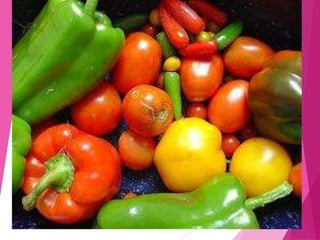
Are the various yellow, orange, red and green
pigments that are found in many fruits and
vegetables.
There are over 600 known carotenoids;
They are split into two classes, xanthophylls
(which contain oxygen) and carotenes (which
are purely hydrocarbons, and contain no
oxygen).
All are derivatives of tetraterpenes, meaning
that they are produced from 8 isoprene
molecules and contain 40 carbon atoms.
Physical properties
• All carotenoids are lipophilic compounds and
thus are soluble in oils and organic solvents
• They can be isomerized by heat, acid, light
• Many carotenoids exhibit spectral shifts with
various reagents and these spectral changes
are used for identification
Chemical properties
• Carotenoids are easily oxidized because of
large number of conjugated double bonds
Such reactions cause color loss of carotenoids in
foods
• Destability of a particular pigment to oxidation
is
highly dependent on its environment
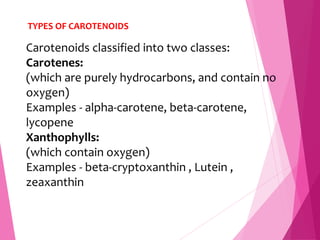
Carotenoids classified into two classes:
Carotenes:
(which are purely hydrocarbons, and contain no
oxygen)
Examples - alpha-carotene, beta-carotene,
lycopene
Xanthophylls:
(which contain oxygen)
Examples - beta-cryptoxanthin , Lutein ,
zeaxanthin
TYPES OF CAROTENOIDS
All are derivatives of tetraterpenes, meaning
that they are produced from 8 isoprene
molecules and contain 40 carbon atoms.
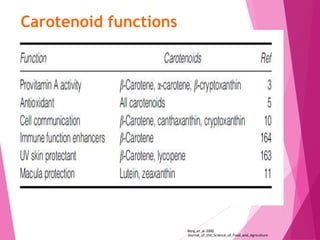
Carotenoid functions
Berg_et_al-2000.
Journal_of_the_Science_of_Food_and_Agriculture
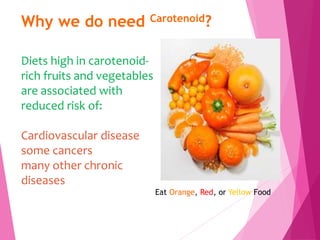
Diets high in carotenoid-
rich fruits and vegetables
are associated with
reduced risk of:
Cardiovascular disease
some cancers
many other chronic
diseases
Why we do need Carotenoid?
Eat Orange, Red, or Yellow Food
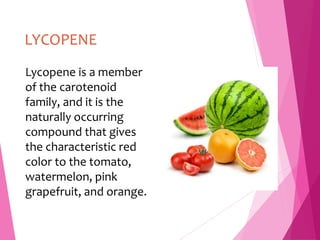
LYCOPENE
Lycopene is a member
of the carotenoid
family, and it is the
naturally occurring
compound that gives
the characteristic red
color to the tomato,
watermelon, pink
grapefruit, and orange.
Xanthophylls
The other type of carotenoid, are oxygen-
containing molecules ( Xanthophylls )
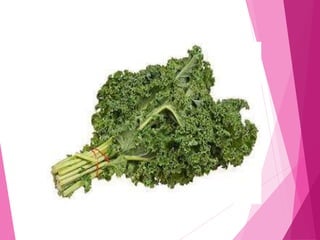
Source : Found in dark leafy greens such as
spinach and kale, as well as broccoli.
Uses : Xanthophylls are also antioxidants, and
two in particular have great importance in the
health of our eyes. (cataracts and macular
degeneration).
beta-carotene.
One of the more familiar carotenes is beta-
carotene.
Beta-carotene is known as a provitamin A
carotene because it can be converted by the
body to a usable form of vitamin A.
Source:
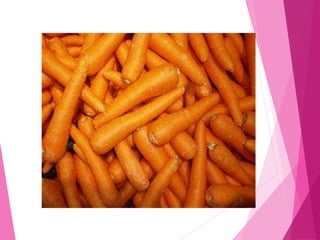
In fact, many of these orange (Carrot) and
yellow foods are the primary source of vitamin
Short answers:
1. Define and write the properties of
Carotenoids.
2. Classify Carotenoids with examples.
3. Write the chemical nature and uses of α and β
Carotenes.
4. Add a note on Lycopene.
5. Note on xanthophylls
6. Write the uses of carotenoids.

Carotenoids - Definition, classification , properties etc

  • 1.
    CAROTENOIDS Dr.U.Srinivasa, , Professorand Head Department of Pharmacognosy Srinivas college of Pharmacy, Mangalore 574143 Email.ID drsrinivaspharmacy@rediffmail.com
  • 3.
    Carotenoids Carotenoid, are thegroup of non-nitrogenous , yellow, orange, or red pigments (biochromes) that are almost universally distributed in living things. Carotenoids also called tetraterpenoids, are organic pigments that are produced by plants and algae, as well as several bacteria and fungi.
  • 4.
    Carotenoids Are the variousyellow, orange, red and green pigments that are found in many fruits and vegetables. There are over 600 known carotenoids;
  • 5.
    They are splitinto two classes, xanthophylls (which contain oxygen) and carotenes (which are purely hydrocarbons, and contain no oxygen). All are derivatives of tetraterpenes, meaning that they are produced from 8 isoprene molecules and contain 40 carbon atoms.
  • 6.
    Physical properties • Allcarotenoids are lipophilic compounds and thus are soluble in oils and organic solvents • They can be isomerized by heat, acid, light • Many carotenoids exhibit spectral shifts with various reagents and these spectral changes are used for identification
  • 7.
    Chemical properties • Carotenoidsare easily oxidized because of large number of conjugated double bonds Such reactions cause color loss of carotenoids in foods • Destability of a particular pigment to oxidation is highly dependent on its environment
  • 8.
    Carotenoids classified intotwo classes: Carotenes: (which are purely hydrocarbons, and contain no oxygen) Examples - alpha-carotene, beta-carotene, lycopene Xanthophylls: (which contain oxygen) Examples - beta-cryptoxanthin , Lutein , zeaxanthin TYPES OF CAROTENOIDS
  • 9.
    All are derivativesof tetraterpenes, meaning that they are produced from 8 isoprene molecules and contain 40 carbon atoms.
  • 10.
  • 11.
    Diets high incarotenoid- rich fruits and vegetables are associated with reduced risk of: Cardiovascular disease some cancers many other chronic diseases Why we do need Carotenoid? Eat Orange, Red, or Yellow Food
  • 12.
    LYCOPENE Lycopene is amember of the carotenoid family, and it is the naturally occurring compound that gives the characteristic red color to the tomato, watermelon, pink grapefruit, and orange.
  • 13.
    Xanthophylls The other typeof carotenoid, are oxygen- containing molecules ( Xanthophylls ) Source : Found in dark leafy greens such as spinach and kale, as well as broccoli. Uses : Xanthophylls are also antioxidants, and two in particular have great importance in the health of our eyes. (cataracts and macular degeneration).
  • 15.
    beta-carotene. One of themore familiar carotenes is beta- carotene. Beta-carotene is known as a provitamin A carotene because it can be converted by the body to a usable form of vitamin A. Source: In fact, many of these orange (Carrot) and yellow foods are the primary source of vitamin
  • 17.
    Short answers: 1. Defineand write the properties of Carotenoids. 2. Classify Carotenoids with examples. 3. Write the chemical nature and uses of α and β Carotenes. 4. Add a note on Lycopene. 5. Note on xanthophylls 6. Write the uses of carotenoids.

Editor's Notes

  • #13 Lycopene as an example