NUTRITIONAL DISEASE
Dr.T.Arivazhagan
Post graduate
Dept.Of.Pathology
PROTEIN ENERGY
MALNUTRITION
• Malnutrition also referred as PEM
• Inadequate intake of proteins & calories
• Deficiencies in the digestion & absorption
• Resulting loss of fat, muscle tissue,
weight loss,lethargy,generalized weakness
Appropriate diet
•Should provide sufficient energy
•Amino acids & fatty acids used for
synthesis of proteins
•Vitamins & minerals function as co
enzyme
•One or all of the
these components
are missing
Primary
•Malabsorption,
•Impaired
utilization
secondary
Etiology
• Poverty
• Infections
• Acute & chronic illness
• Chronic alcoholism – Thiamine deficiency
• Ignorance & failure of diet supplementation
• Self imposed dietary restriction
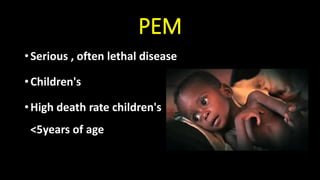
PEM
•Serious , often lethal disease
•Children's
•High death rate children's
<5years of age
Malnutrition determined by
• Body mass index
• Weight in kilograms / Height in meters squared
• Normal 18.5 to 25kg/m²
• BMI < 16kg/m² - malnourished
Other parameters…..
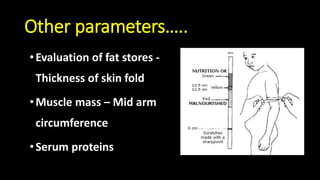
•Evaluation of fat stores -
Thickness of skin fold
•Muscle mass – Mid arm
circumference
•Serum proteins
Types
• Marasmus
• Kwashiorkor
Functional aspect:
• Somatic compartment - Proteins in the skeletal muscle
• Visceral compartment – Proteins in the visceral organs
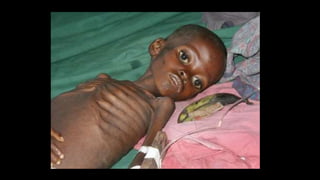
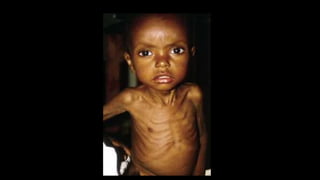
Marasmus
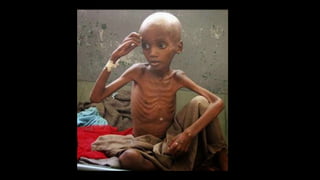
• Weight falls to 60% of normal for sex,height,age
• Growth retardation
• Loss of muscle
• Depletion of somatic compartment
• Visceral compartment normal
• So serum albumin levels normal or slightly reduced
• Extremities are emaciated
• Anemia
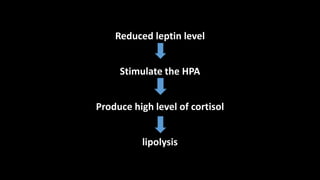
Reduced leptin level
Stimulate the HPA
Produce high level of cortisol
lipolysis
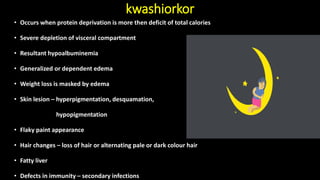
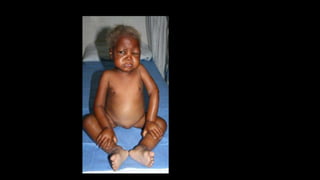
kwashiorkor
• Occurs when protein deprivation is more then deficit of total calories
• Severe depletion of visceral compartment
• Resultant hypoalbuminemia
• Generalized or dependent edema
• Weight loss is masked by edema
• Skin lesion – hyperpigmentation, desquamation,
hypopigmentation
• Flaky paint appearance
• Hair changes – loss of hair or alternating pale or dark colour hair
• Fatty liver
• Defects in immunity – secondary infections
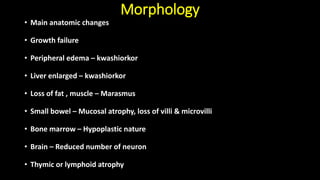
Morphology
• Main anatomic changes
• Growth failure
• Peripheral edema – kwashiorkor
• Liver enlarged – kwashiorkor
• Loss of fat , muscle – Marasmus
• Small bowel – Mucosal atrophy, loss of villi & microvilli
• Bone marrow – Hypoplastic nature
• Brain – Reduced number of neuron
• Thymic or lymphoid atrophy
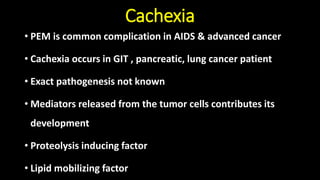
Cachexia
• PEM is common complication in AIDS & advanced cancer
• Cachexia occurs in GIT , pancreatic, lung cancer patient
• Exact pathogenesis not known
• Mediators released from the tumor cells contributes its
development
• Proteolysis inducing factor
• Lipid mobilizing factor
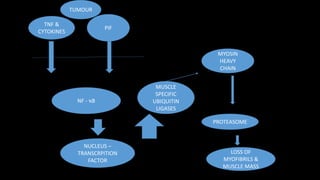
TNF &
CYTOKINES
PIF
TUMOUR
NF - ҡB
NUCLEUS –
TRANSCRPITION
FACTOR
MUSCLE
SPECIFIC
UBIQUITIN
LIGASES
MYOSIN
HEAVY
CHAIN
PROTEASOME
LOSS OF
MYOFIBRILS &
MUSCLE MASS
Pem

Pem

  • 1.
  • 2.
  • 3.
    • Malnutrition alsoreferred as PEM • Inadequate intake of proteins & calories • Deficiencies in the digestion & absorption • Resulting loss of fat, muscle tissue, weight loss,lethargy,generalized weakness
  • 4.
    Appropriate diet •Should providesufficient energy •Amino acids & fatty acids used for synthesis of proteins •Vitamins & minerals function as co enzyme
  • 5.
    •One or allof the these components are missing Primary •Malabsorption, •Impaired utilization secondary
  • 6.
    Etiology • Poverty • Infections •Acute & chronic illness • Chronic alcoholism – Thiamine deficiency • Ignorance & failure of diet supplementation • Self imposed dietary restriction
  • 7.
    PEM •Serious , oftenlethal disease •Children's •High death rate children's <5years of age
  • 8.
    Malnutrition determined by •Body mass index • Weight in kilograms / Height in meters squared • Normal 18.5 to 25kg/m² • BMI < 16kg/m² - malnourished
  • 9.
    Other parameters….. •Evaluation offat stores - Thickness of skin fold •Muscle mass – Mid arm circumference •Serum proteins
  • 10.
    Types • Marasmus • Kwashiorkor Functionalaspect: • Somatic compartment - Proteins in the skeletal muscle • Visceral compartment – Proteins in the visceral organs
  • 11.
    Marasmus • Weight fallsto 60% of normal for sex,height,age • Growth retardation • Loss of muscle • Depletion of somatic compartment • Visceral compartment normal • So serum albumin levels normal or slightly reduced • Extremities are emaciated • Anemia
  • 15.
    Reduced leptin level Stimulatethe HPA Produce high level of cortisol lipolysis
  • 16.
    kwashiorkor • Occurs whenprotein deprivation is more then deficit of total calories • Severe depletion of visceral compartment • Resultant hypoalbuminemia • Generalized or dependent edema • Weight loss is masked by edema • Skin lesion – hyperpigmentation, desquamation, hypopigmentation • Flaky paint appearance • Hair changes – loss of hair or alternating pale or dark colour hair • Fatty liver • Defects in immunity – secondary infections
  • 18.
    Morphology • Main anatomicchanges • Growth failure • Peripheral edema – kwashiorkor • Liver enlarged – kwashiorkor • Loss of fat , muscle – Marasmus • Small bowel – Mucosal atrophy, loss of villi & microvilli • Bone marrow – Hypoplastic nature • Brain – Reduced number of neuron • Thymic or lymphoid atrophy
  • 19.
    Cachexia • PEM iscommon complication in AIDS & advanced cancer • Cachexia occurs in GIT , pancreatic, lung cancer patient • Exact pathogenesis not known • Mediators released from the tumor cells contributes its development • Proteolysis inducing factor • Lipid mobilizing factor
  • 20.
    TNF & CYTOKINES PIF TUMOUR NF -ҡB NUCLEUS – TRANSCRPITION FACTOR MUSCLE SPECIFIC UBIQUITIN LIGASES MYOSIN HEAVY CHAIN PROTEASOME LOSS OF MYOFIBRILS & MUSCLE MASS