MICROTOME
Introduction
 At the beginning of light microscopy
sections were manually prepared using
razor blades.
 1st devices invented - George Adams, Jr.
1770
 Developed by Alexander Cummings
 The device was hand operated with the
sample held in a cylinder
 Andrew Prichard - table based model in 1835
 Allowed for reduction in vibration
 Present day microtome :
 Wilhelm His, Sr. (1865)
 Jan Evangelista Purkyně
Microtome
 Machines that cut extremely thin sections
from a sample for applications in histology
or pathology
 Use special metal, glass, or diamond blades,
depending on the type of specimen and the
desired thickness
 All microtomes consist of main parts
 Base (microtome body) -
 Knife attachment (Knife holder)
 Material or tissue holder
 Advancing mechanism, and a
mechanism for adjusting section
thickness.
 Modern microtome are precision
instruments designed to cut uniformly
thin sections
 For electron microscopy, where
magnifications of several hundred
thousands are possible, the thickness of a
section is usually of the order of 10
Nano meters (ultra-thin section)
Types of microtomes
 1. Cambridge rocking microtome
 2. Rotary microtome
 3. Base sledge microtome
 4. Sliding microtome
 5. Freezing microtome (cryostat)
ROCKING MICROTOME( Cambridge)
 Produced in large numbers early in the 20th
century
 Designed only for cutting paraffin sections
 Oldest in degisn, cheap , simple to use.
 Extremely reliable.
 the tissue moves through an arc as it
advances towards the knife (the slightly
biconcave knife is used) causing the
sections to be cut in a curved plane.
 Very thin sections are difficult to obtain
and
 one major disadvantage is a limit to the
size of block which can be cut.
 Because of the lightness of the frame the
microtome has a tendency tomove
during cutting. The rocking microtome
has largely been replaced by the more
precise rotary microtome
Cambridge Rocking Microtome
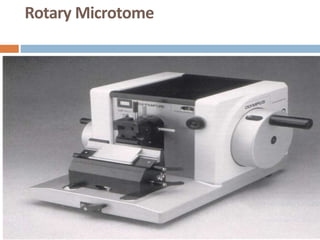
ROTARY MICROTOME
 The microtome operation is based upon
the rotary action of a hand wheel
activating the advancement of a block
towards a rigidly held knife.
 The block moves up and down in a
vertical plane in relation to the knife and
therefore cuts flat sections.
 Available machines range from
lightweight (rotary microtome suitable
for cutting paraffin wax embedded
material in a continuous ribbon),
 to heavy duty, motor driven instruments
used tosection hard material embedded
in synthetic resin. The rotary microtome
can also be found in most cryostats for
cutting frozen sections.
Rotary Microtome
Base sledge microtome
 These are designed for cutting large
blocks of paraffin and resin embedded
material including whole organs, for
light microscopy. a major advantage
when sectioning large, hard blocks.
 can also be used to cut materials from
various industrial applications (wood,
plastics, textile fibers).
 Mechanism of action:
The block holder is mounted on a steel
carriage which slides backwards and
forwards on guides against a fixed
horizontal knife.
 Advantages:
 Heavy ,very stable, not subject to
vibration
 Paraffin wax embedded sections are
more easily cut .
 With practice, sections from routine
paraffin blocks can be cut as quickly as
on any other type of microtome.
Sliding microtome
 The fundamental difference between the
sliding microtome and those models
described earlier is that with this instrument
the block remains stationary while the
microtome knife moves during the process of
the sectioning .
 Designed for cutting celloidin-embedded
tissue blocks.
 The knife or blade is stationary, specimen
slides under it during sectioning.
 Also used for paraffin –wax embedded
sections
FREEZING MICROTOME
 This form of microtome is used for cutting thin
to semi-thin sections of fresh, frozen tissue
 The freezing microtome is equipped with a stage
upon which tissue can be quickly frozen using
either liquid carbon dioxide, from a cylinder
 Some cooling systems also allow the knife to
be cooled at the same time.
 thin sections are very difficult to obtain with
this type of microtome.
ULTRAMICROTOME
 The ultramicrotome is used to prepare
ultrathin sections for light and electron
microscopy.
CRYOSTAT
 A cryostat is primarily used for cutting
sections of frozen tissue
 The cryostat commonly consists of a
microtome contained within a refrigerated
chamber, the temperature of which can be
maintained at a preset level.
 The cryostat usually contains a rotary
microtome although some portable units
utilize a rocking microtome.

Microtomy.pptx

  • 1.
  • 2.
    Introduction  At thebeginning of light microscopy sections were manually prepared using razor blades.  1st devices invented - George Adams, Jr. 1770  Developed by Alexander Cummings
  • 3.
     The devicewas hand operated with the sample held in a cylinder
  • 5.
     Andrew Prichard- table based model in 1835  Allowed for reduction in vibration  Present day microtome :  Wilhelm His, Sr. (1865)  Jan Evangelista Purkyně
  • 6.
    Microtome  Machines thatcut extremely thin sections from a sample for applications in histology or pathology  Use special metal, glass, or diamond blades, depending on the type of specimen and the desired thickness
  • 7.
     All microtomesconsist of main parts  Base (microtome body) -  Knife attachment (Knife holder)
  • 8.
     Material ortissue holder  Advancing mechanism, and a mechanism for adjusting section thickness.
  • 9.
     Modern microtomeare precision instruments designed to cut uniformly thin sections  For electron microscopy, where magnifications of several hundred thousands are possible, the thickness of a section is usually of the order of 10 Nano meters (ultra-thin section)
  • 10.
    Types of microtomes 1. Cambridge rocking microtome  2. Rotary microtome  3. Base sledge microtome  4. Sliding microtome  5. Freezing microtome (cryostat)
  • 11.
    ROCKING MICROTOME( Cambridge) Produced in large numbers early in the 20th century  Designed only for cutting paraffin sections  Oldest in degisn, cheap , simple to use.  Extremely reliable.
  • 12.
     the tissuemoves through an arc as it advances towards the knife (the slightly biconcave knife is used) causing the sections to be cut in a curved plane.
  • 13.
     Very thinsections are difficult to obtain and  one major disadvantage is a limit to the size of block which can be cut.
  • 14.
     Because ofthe lightness of the frame the microtome has a tendency tomove during cutting. The rocking microtome has largely been replaced by the more precise rotary microtome
  • 15.
  • 16.
    ROTARY MICROTOME  Themicrotome operation is based upon the rotary action of a hand wheel activating the advancement of a block towards a rigidly held knife.
  • 17.
     The blockmoves up and down in a vertical plane in relation to the knife and therefore cuts flat sections.
  • 18.
     Available machinesrange from lightweight (rotary microtome suitable for cutting paraffin wax embedded material in a continuous ribbon),
  • 19.
     to heavyduty, motor driven instruments used tosection hard material embedded in synthetic resin. The rotary microtome can also be found in most cryostats for cutting frozen sections.
  • 21.
  • 24.
    Base sledge microtome These are designed for cutting large blocks of paraffin and resin embedded material including whole organs, for light microscopy. a major advantage when sectioning large, hard blocks.
  • 25.
     can alsobe used to cut materials from various industrial applications (wood, plastics, textile fibers).
  • 26.
     Mechanism ofaction: The block holder is mounted on a steel carriage which slides backwards and forwards on guides against a fixed horizontal knife.
  • 27.
     Advantages:  Heavy,very stable, not subject to vibration  Paraffin wax embedded sections are more easily cut .
  • 28.
     With practice,sections from routine paraffin blocks can be cut as quickly as on any other type of microtome.
  • 29.
    Sliding microtome  Thefundamental difference between the sliding microtome and those models described earlier is that with this instrument the block remains stationary while the microtome knife moves during the process of the sectioning .
  • 30.
     Designed forcutting celloidin-embedded tissue blocks.  The knife or blade is stationary, specimen slides under it during sectioning.  Also used for paraffin –wax embedded sections
  • 31.
    FREEZING MICROTOME  Thisform of microtome is used for cutting thin to semi-thin sections of fresh, frozen tissue  The freezing microtome is equipped with a stage upon which tissue can be quickly frozen using either liquid carbon dioxide, from a cylinder
  • 32.
     Some coolingsystems also allow the knife to be cooled at the same time.  thin sections are very difficult to obtain with this type of microtome.
  • 33.
    ULTRAMICROTOME  The ultramicrotomeis used to prepare ultrathin sections for light and electron microscopy.
  • 34.
    CRYOSTAT  A cryostatis primarily used for cutting sections of frozen tissue  The cryostat commonly consists of a microtome contained within a refrigerated chamber, the temperature of which can be maintained at a preset level.
  • 35.
     The cryostatusually contains a rotary microtome although some portable units utilize a rocking microtome.