Λειτουργικά Τρόφιμα και Διατροφή
Εισαγωγή, Μέρος Β
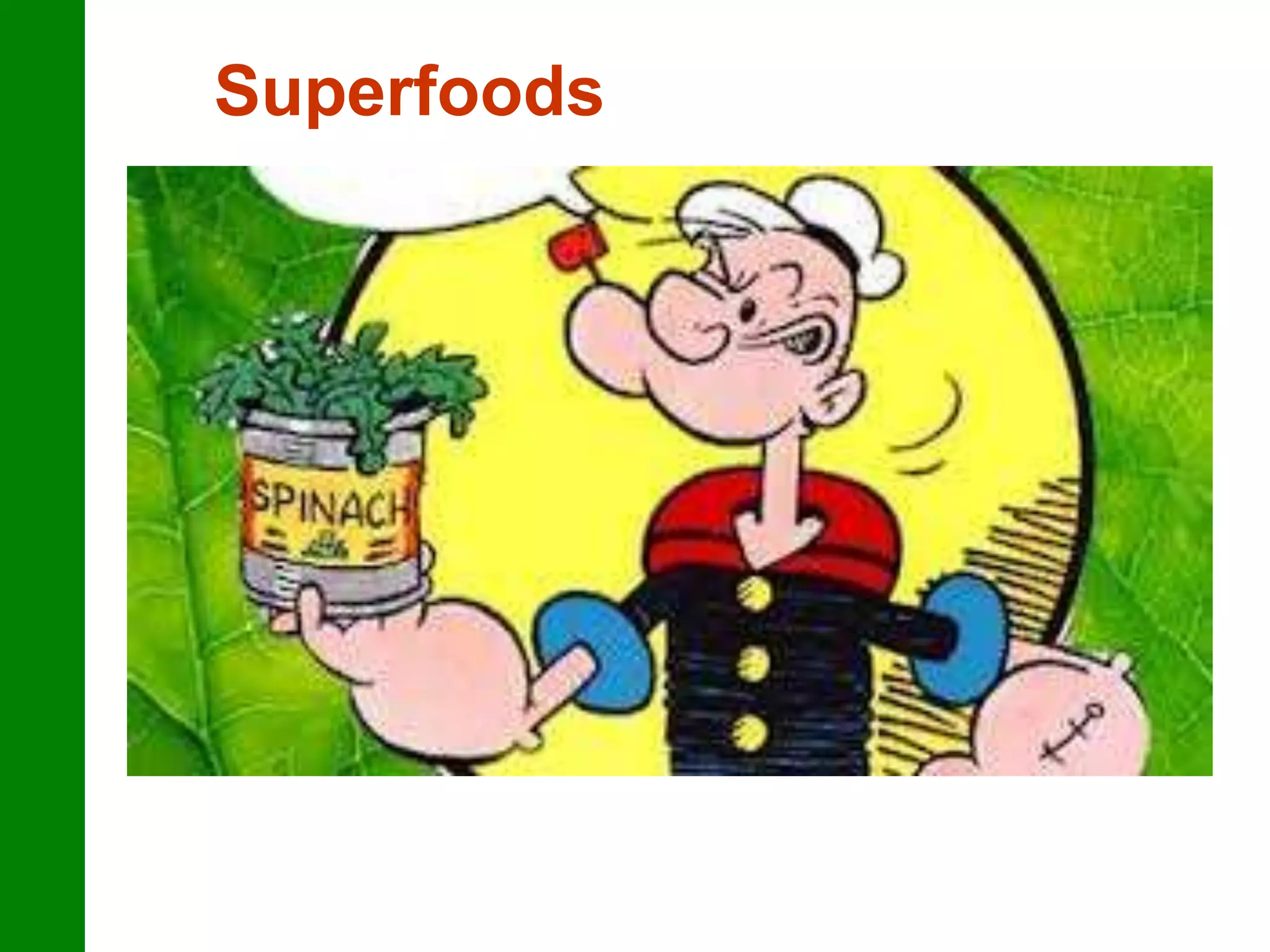
Superfoods
www.ift.org (24/3/2005)
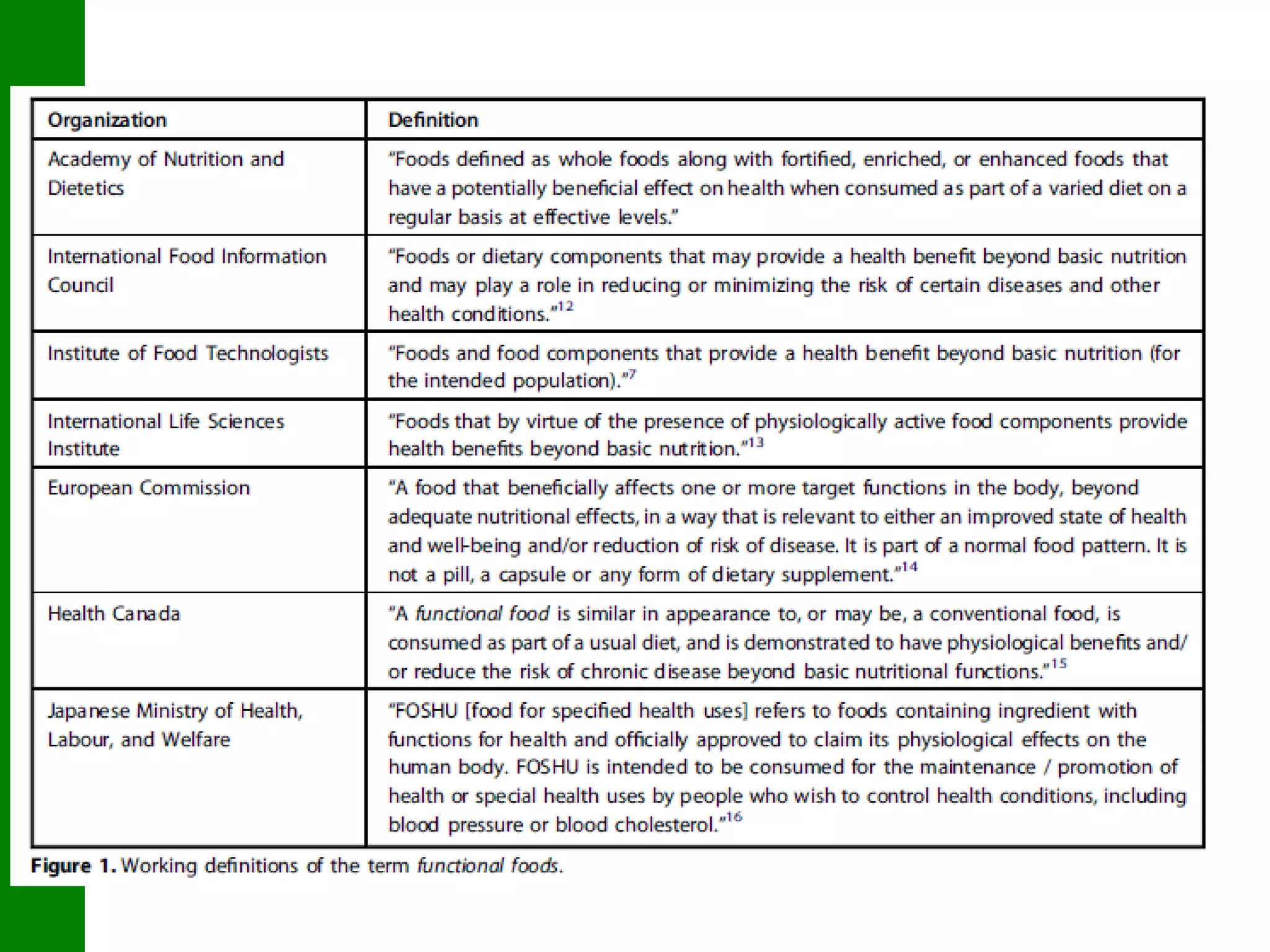
Τι είναι τα λειτουργικά τρόφιμα;
 Είναι τα τρόφιμα που προσφέρονται με τον ισχυρισμό ότι
προάγουν την υγεία ή γενικότερα ότι παρέχουν ωφέλη
στον οργανισμό πέραν των αναμενόμενων.
 Ο ισχυρισμός αυτός μπορεί να βασίζεται σε ενδογενή ή
εξωγενή συστατικά του τροφίμου.
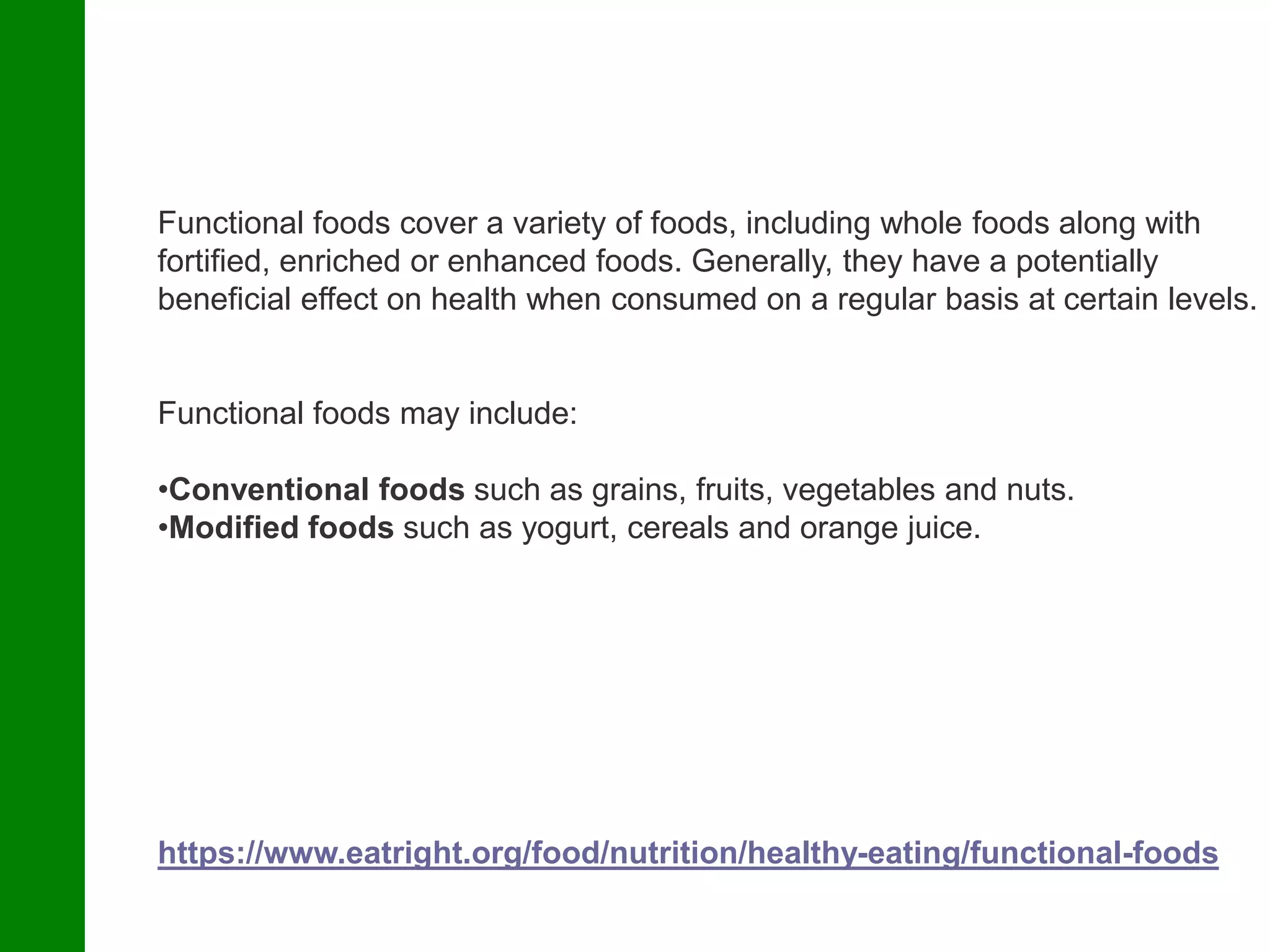
https://www.eatright.org/food/nutrition/healthy-eating/functional-foods
Functional foods cover a variety of foods, including whole foods along with
fortified, enriched or enhanced foods. Generally, they have a potentially
beneficial effect on health when consumed on a regular basis at certain levels.
Functional foods may include:
•Conventional foods such as grains, fruits, vegetables and nuts.
•Modified foods such as yogurt, cereals and orange juice.
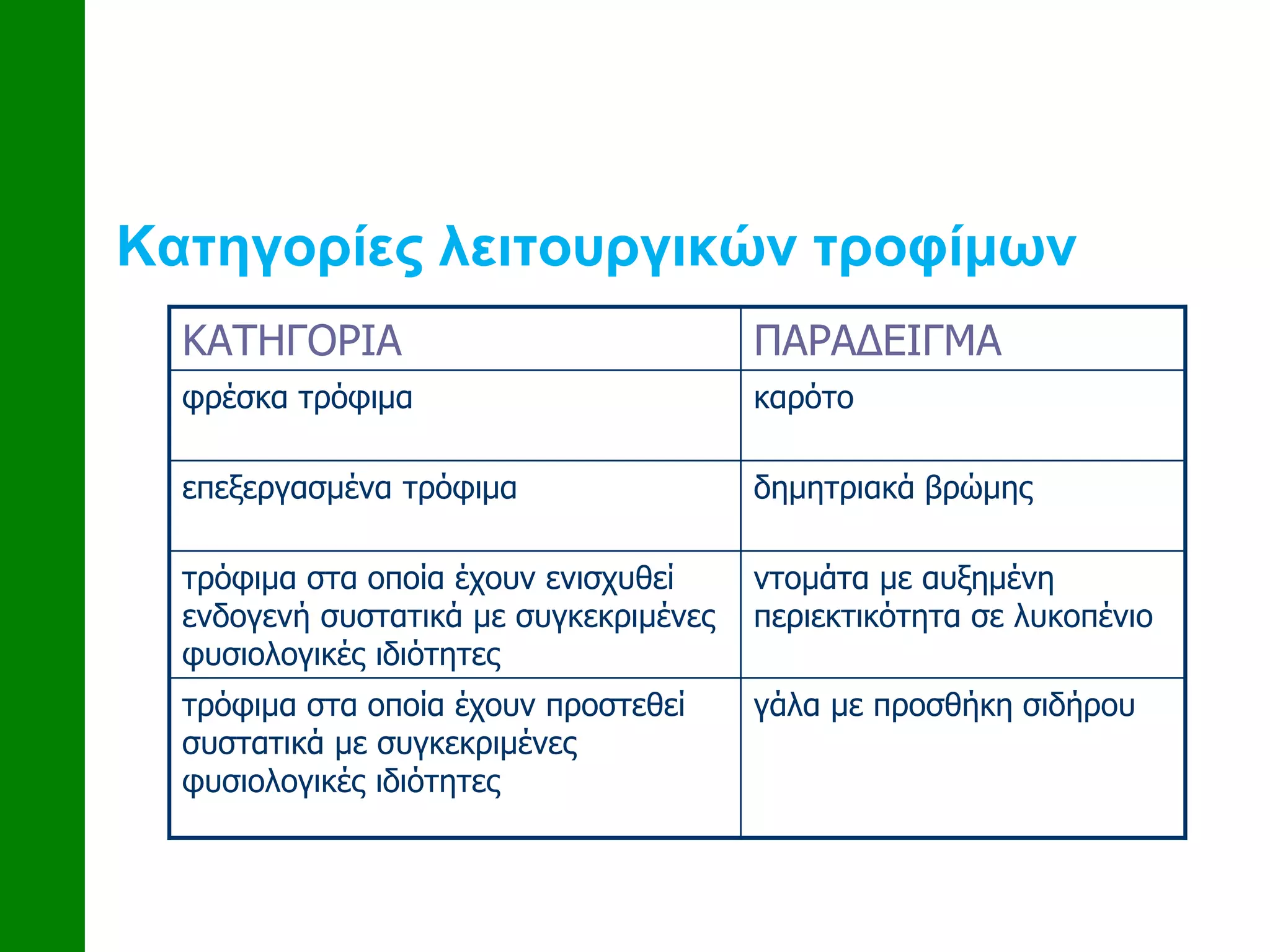
Κατηγορίες λειτουργικών τροφίμων
ΚΑΤΗΓΟΡΙΑ ΠΑΡΑΔΕΙΓΜΑ
φρέσκα τρόφιμα καρότο
επεξεργασμένα τρόφιμα δημητριακά βρώμης
τρόφιμα στα οποία έχουν ενισχυθεί
ενδογενή συστατικά με συγκεκριμένες
φυσιολογικές ιδιότητες
ντομάτα με αυξημένη
περιεκτικότητα σε λυκοπένιο
τρόφιμα στα οποία έχουν προστεθεί
συστατικά με συγκεκριμένες
φυσιολογικές ιδιότητες
γάλα με προσθήκη σιδήρου
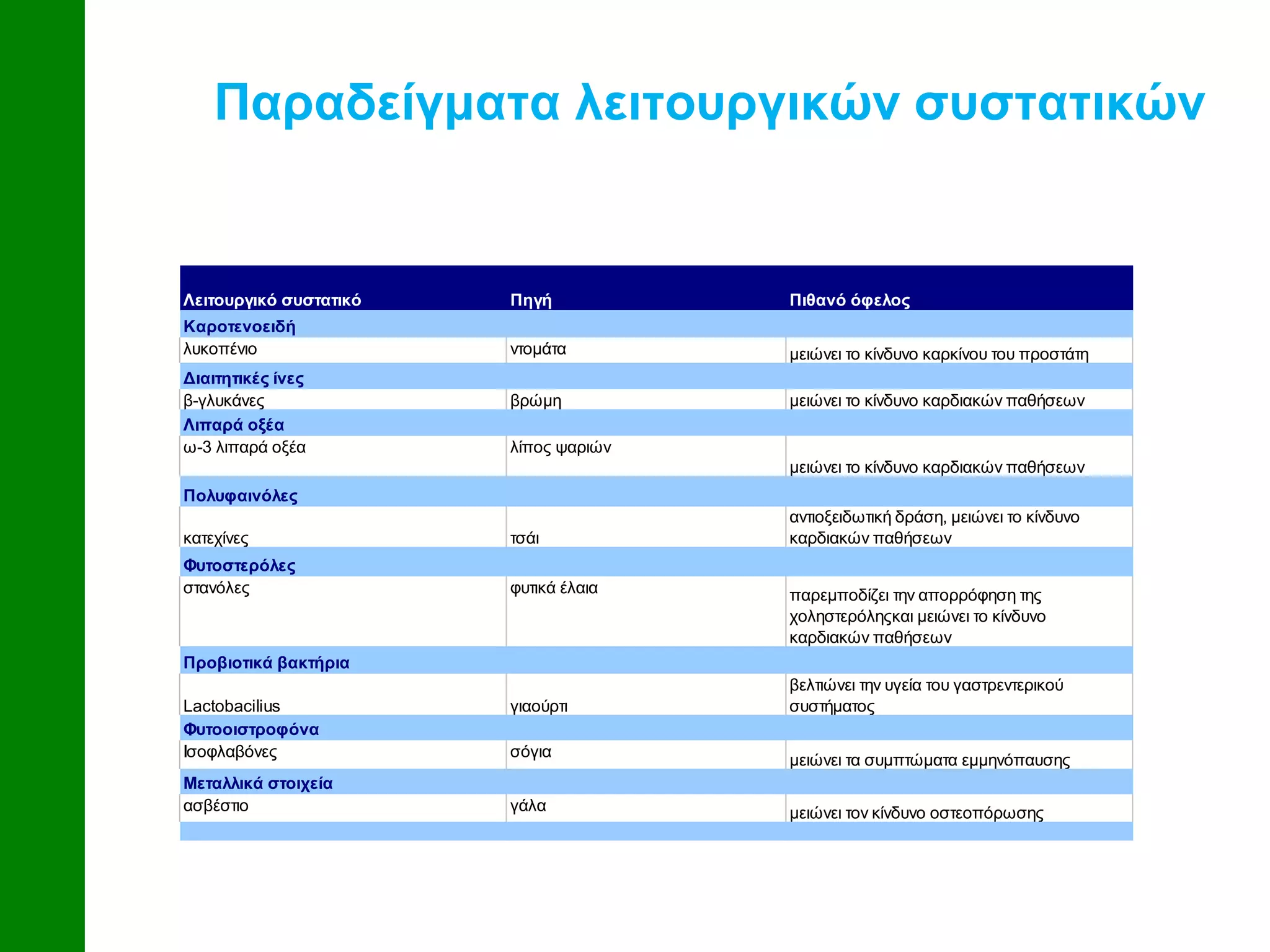
Παραδείγματα λειτουργικών συστατικών
Λειτουργικό συστατικό Πηγή Πιθανό όφελος
λυκοπένιο ντομάτα μειώνει το κίνδυνο καρκίνου του προστάτη
β-γλυκάνες βρώμη μειώνει το κίνδυνο καρδιακών παθήσεων
ω-3 λιπαρά οξέα λίπος ψαριών
μειώνει το κίνδυνο καρδιακών παθήσεων
κατεχίνες τσάι
αντιοξειδωτική δράση, μειώνει το κίνδυνο
καρδιακών παθήσεων
στανόλες φυτικά έλαια παρεμποδίζει την απορρόφηση της
χοληστερόληςκαι μειώνει το κίνδυνο
καρδιακών παθήσεων
Lactobacilius γιαούρτι
βελτιώνει την υγεία του γαστρεντερικού
συστήματος
Ισοφλαβόνες σόγια
μειώνει τα συμπτώματα εμμηνόπαυσης
ασβέστιο γάλα μειώνει τον κίνδυνο οστεοπόρωσης
Λιπαρά οξέα
Καροτενοειδή
Διαιτητικές ίνες
Φυτοοιστροφόνα
Μεταλλικά στοιχεία
Πολυφαινόλες
Φυτοστερόλες
Προβιοτικά βακτήρια
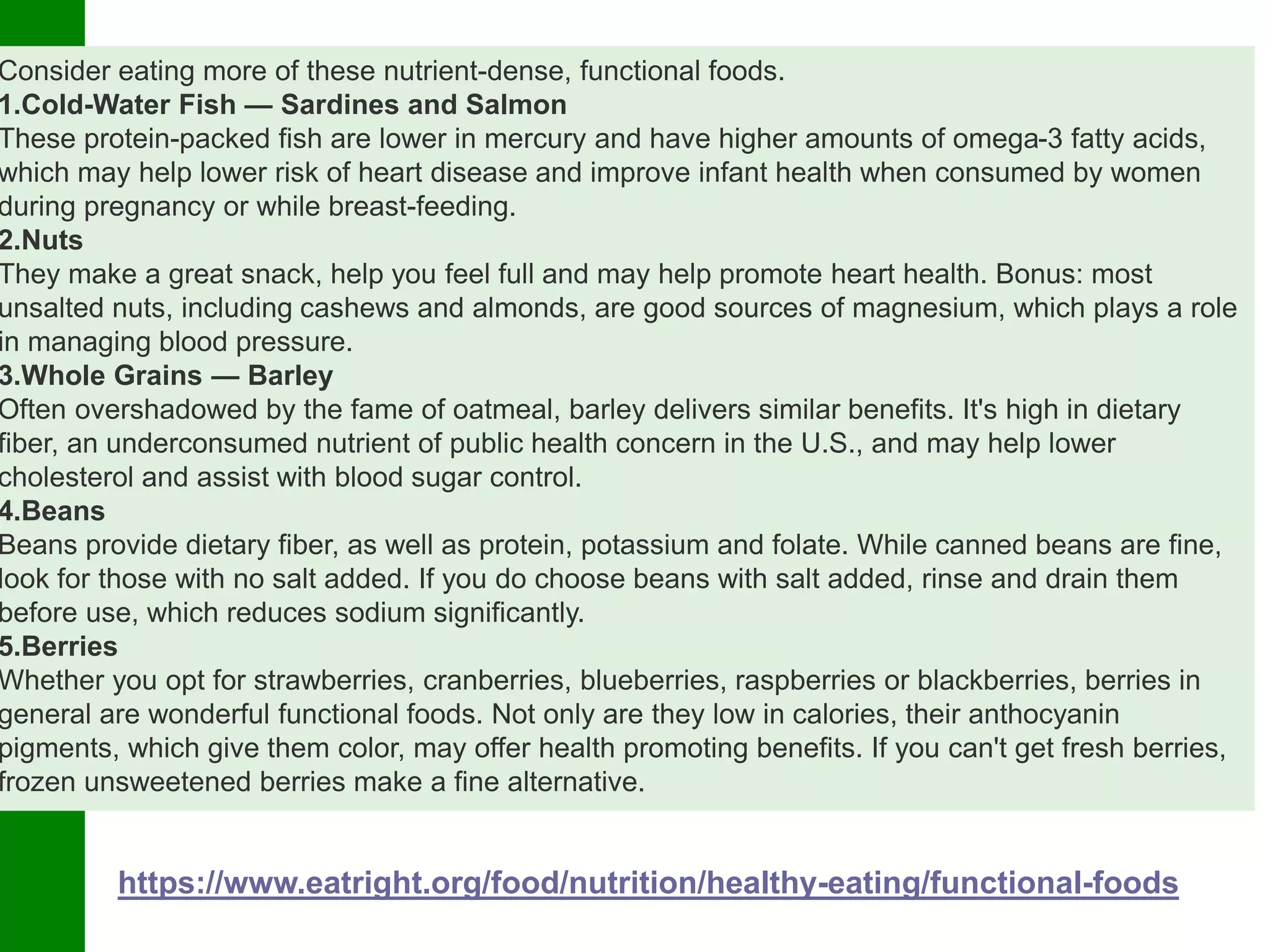
Consider eating more of these nutrient-dense, functional foods.
1.Cold-Water Fish — Sardines and Salmon
These protein-packed fish are lower in mercury and have higher amounts of omega-3 fatty acids,
which may help lower risk of heart disease and improve infant health when consumed by women
during pregnancy or while breast-feeding.
2.Nuts
They make a great snack, help you feel full and may help promote heart health. Bonus: most
unsalted nuts, including cashews and almonds, are good sources of magnesium, which plays a role
in managing blood pressure.
3.Whole Grains — Barley
Often overshadowed by the fame of oatmeal, barley delivers similar benefits. It's high in dietary
fiber, an underconsumed nutrient of public health concern in the U.S., and may help lower
cholesterol and assist with blood sugar control.
4.Beans
Beans provide dietary fiber, as well as protein, potassium and folate. While canned beans are fine,
look for those with no salt added. If you do choose beans with salt added, rinse and drain them
before use, which reduces sodium significantly.
5.Berries
Whether you opt for strawberries, cranberries, blueberries, raspberries or blackberries, berries in
general are wonderful functional foods. Not only are they low in calories, their anthocyanin
pigments, which give them color, may offer health promoting benefits. If you can't get fresh berries,
frozen unsweetened berries make a fine alternative.
https://www.eatright.org/food/nutrition/healthy-eating/functional-foods
Η ανάπτυξη των λειτουργικών
τροφίμων εντάσσεται στην
στρατηγική για την βελτίωση
της διατροφικής πρόσληψης
Είναι αναγκαία η βελτίωση της διατροφικής πρόσληψης;
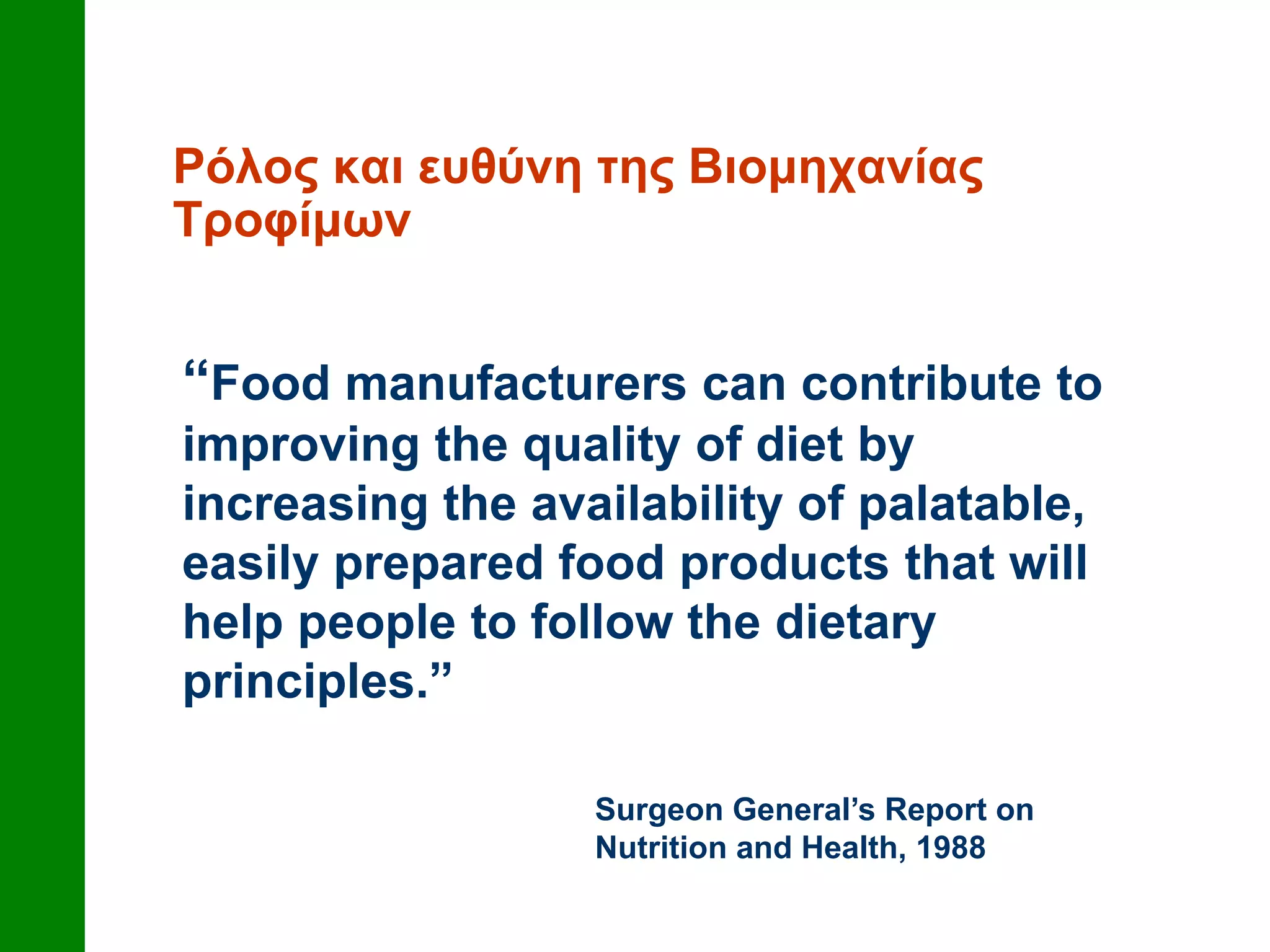
Ρόλος και ευθύνη της Βιομηχανίας
Τροφίμων
“Food manufacturers can contribute to
improving the quality of diet by
increasing the availability of palatable,
easily prepared food products that will
help people to follow the dietary
principles.”
Surgeon General’s Report on
Nutrition and Health, 1988
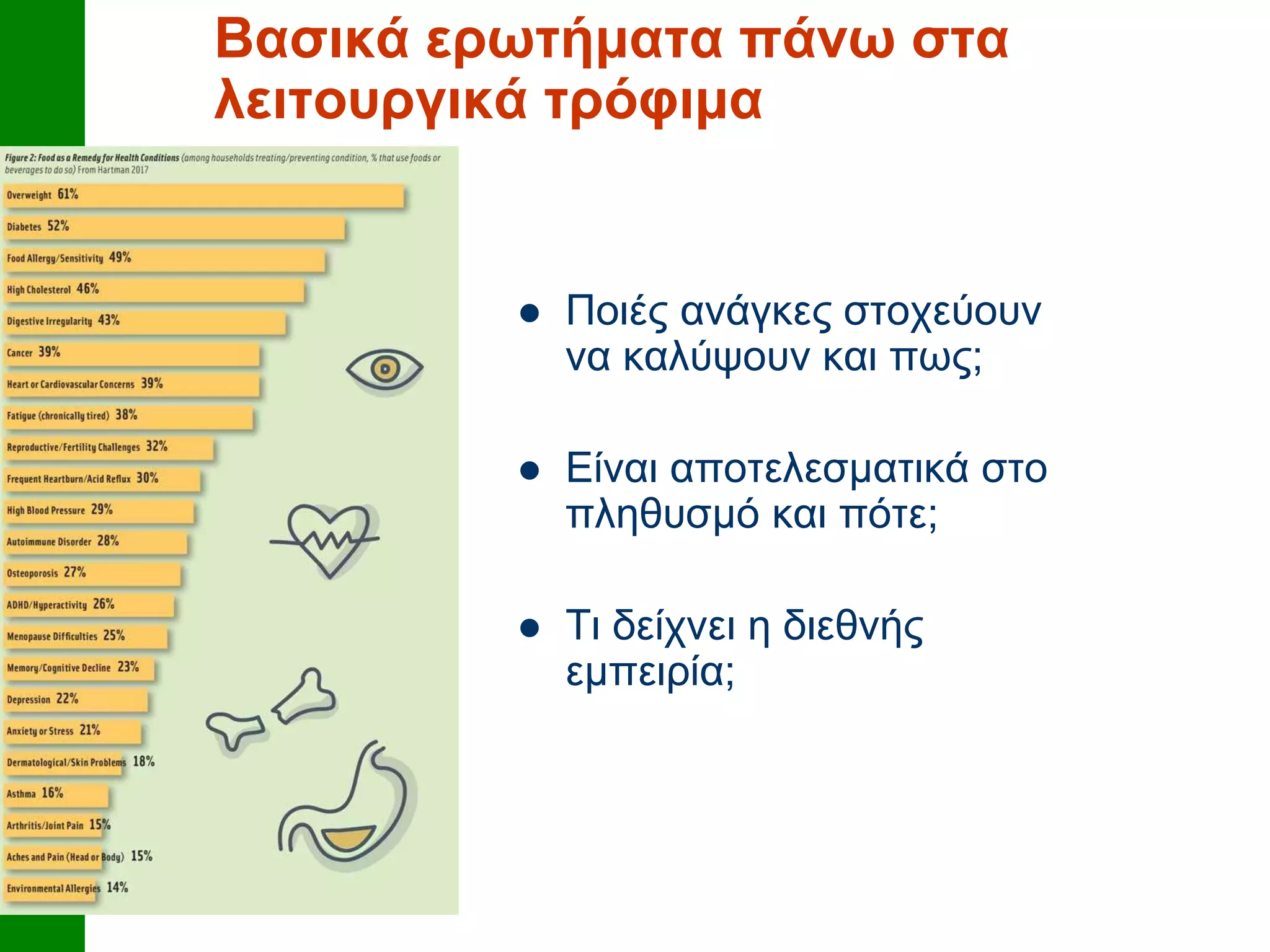
Βασικά ερωτήματα πάνω στα
λειτουργικά τρόφιμα
 Ποιές ανάγκες στοχεύουν
να καλύψουν και πως;
 Είναι αποτελεσματικά στο
πληθυσμό και πότε;
 Τι δείχνει η διεθνής
εμπειρία;
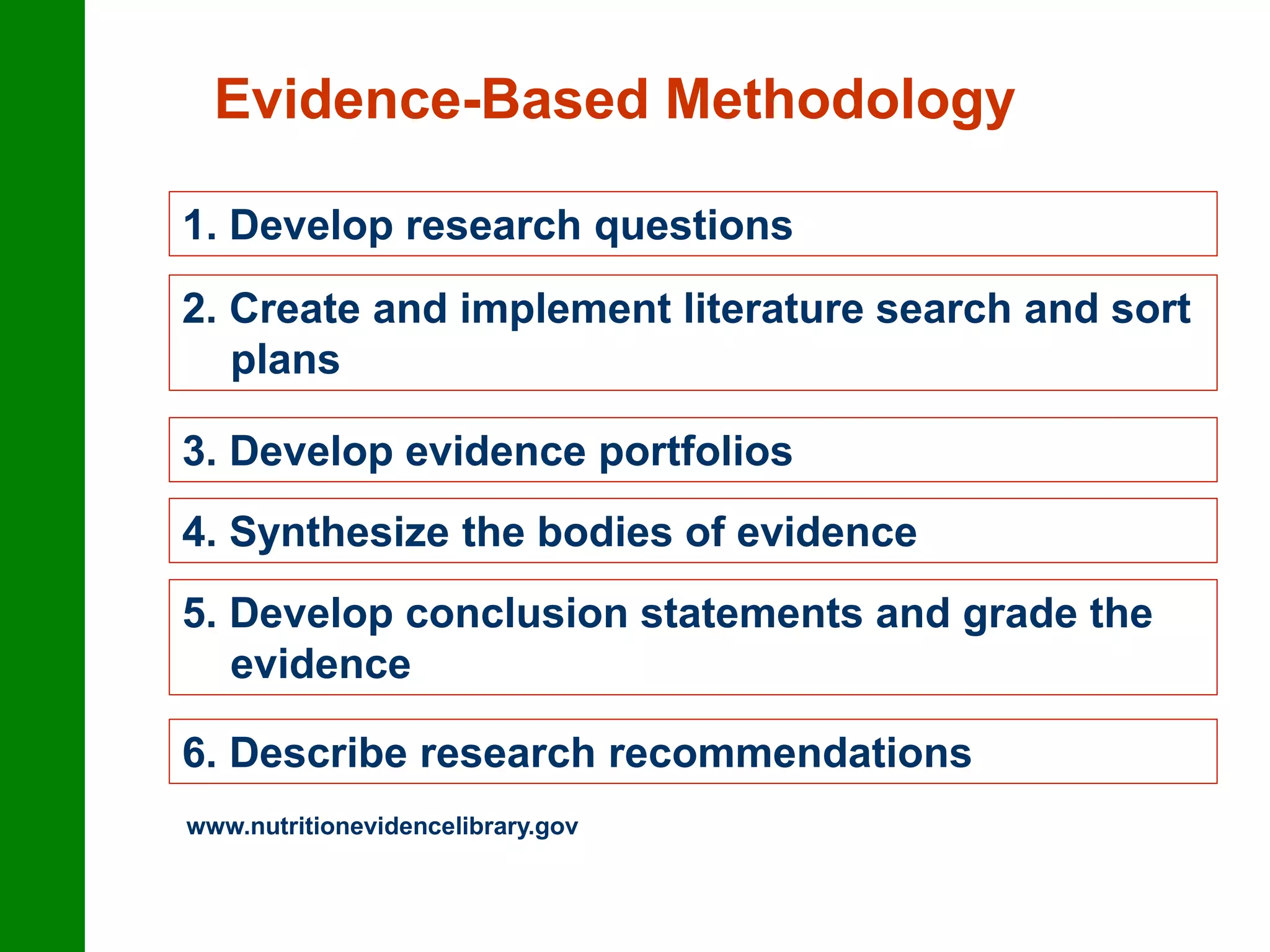
Evidence-Based Methodology
1. Develop research questions
2. Create and implement literature search and sort
plans
www.nutritionevidencelibrary.govSpahn JM, et al. The systematic review methodology
used to support the 2010 Dietary Guidelines Advisory Committee. JADA. (In Press).
3. Develop evidence portfolios
4. Synthesize the bodies of evidence
5. Develop conclusion statements and grade the
evidence
6. Describe research recommendations
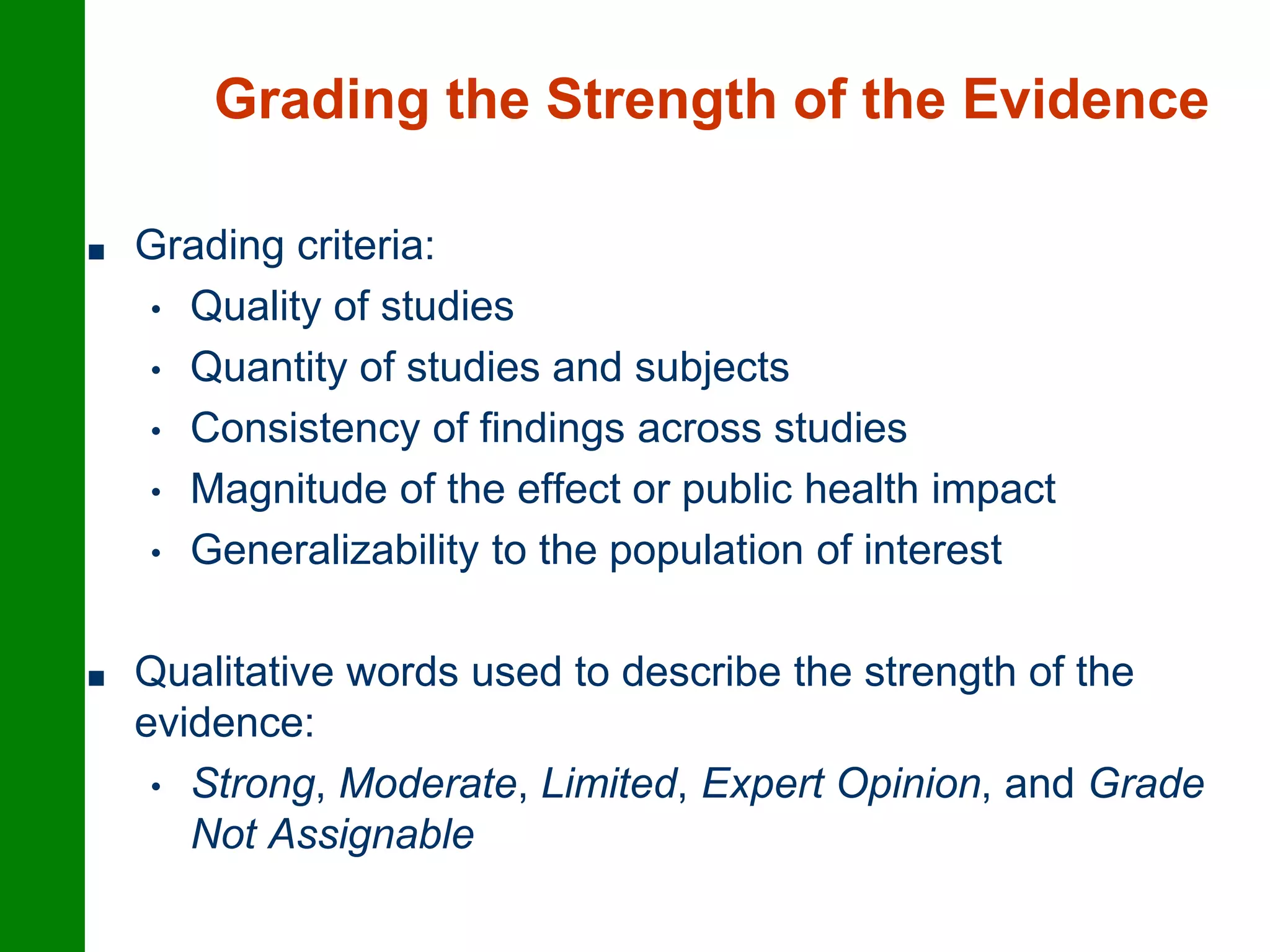
Grading the Strength of the Evidence
■ Grading criteria:
• Quality of studies
• Quantity of studies and subjects
• Consistency of findings across studies
• Magnitude of the effect or public health impact
• Generalizability to the population of interest
■ Qualitative words used to describe the strength of the
evidence:
• Strong, Moderate, Limited, Expert Opinion, and Grade
Not Assignable
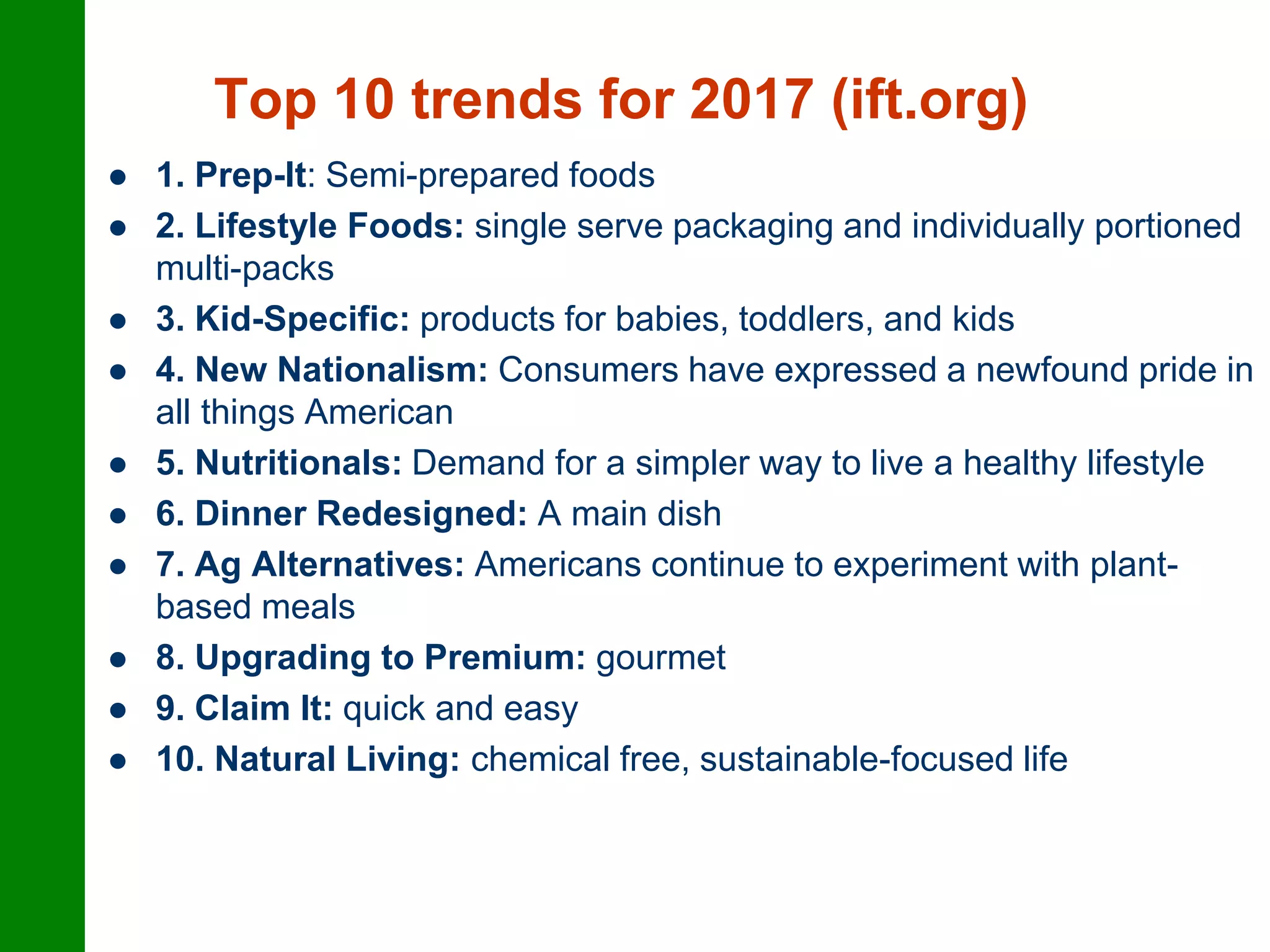
Top 10 trends for 2017 (ift.org)
 1. Prep-It: Semi-prepared foods
 2. Lifestyle Foods: single serve packaging and individually portioned
multi-packs
 3. Kid-Specific: products for babies, toddlers, and kids
 4. New Nationalism: Consumers have expressed a newfound pride in
all things American
 5. Nutritionals: Demand for a simpler way to live a healthy lifestyle
 6. Dinner Redesigned: A main dish
 7. Ag Alternatives: Americans continue to experiment with plant-
based meals
 8. Upgrading to Premium: gourmet
 9. Claim It: quick and easy
 10. Natural Living: chemical free, sustainable-focused life
Top 10 trends for 2018 (ift.org)
1. Floral Flavors
2. Super Powders
3. Functional Mushrooms
4. Feast from the Middle East
5. Transparency 2.0: More is more when it comes to product labeling. Consumers want to know the real story
behind their food, and how that item made its way from the source to the store. GMO transparency is top-of-
mind, but shoppers seek out other details, too, such as Fair-Trade certification, responsible production, and
animal welfare standards.
6. High-Tech Goes Plant-Forward: Plant-based diets and dishes continue to dominate the food world, and now the
tech industry has a seat at the table, too. By using science to advance recipes and manipulate plant-based
ingredients and proteins, these techniques are creating alternatives like “bleeding” vegan burgers or sushi-grade
“not-tuna” made from tomatoes. These new production techniques are also bringing some new varieties of nut
milks and yogurts made from pili nuts, peas, bananas, macadamia nuts, and pecans.
7. Puffed & Popped Snacks:
8. Tacos Come Out of Their Shell:
9. Root-to-Stem: Between nose-to-tail butchery and reducing food waste, a few forces are combining to inspire
root-to-stem cooking, which makes use of the entire fruit or vegetable, including the stems or leaves that are
less commonly eaten. Recipes like pickled watermelon rinds, beet-green pesto or broccoli-stem slaw have
introduced consumers to new flavors and textures from old favorites.
10. Say Cheers to the Other Bubbly: LaCroix may have paved the way, but now there’s an entire booming category
of sparkling beverages vying for consumer attention. Flavored sparkling waters like plant-derived options
from Sap!(made with maple and birch) and sparkling cold brew from Stumptown will are shaking up a fizzy fix.
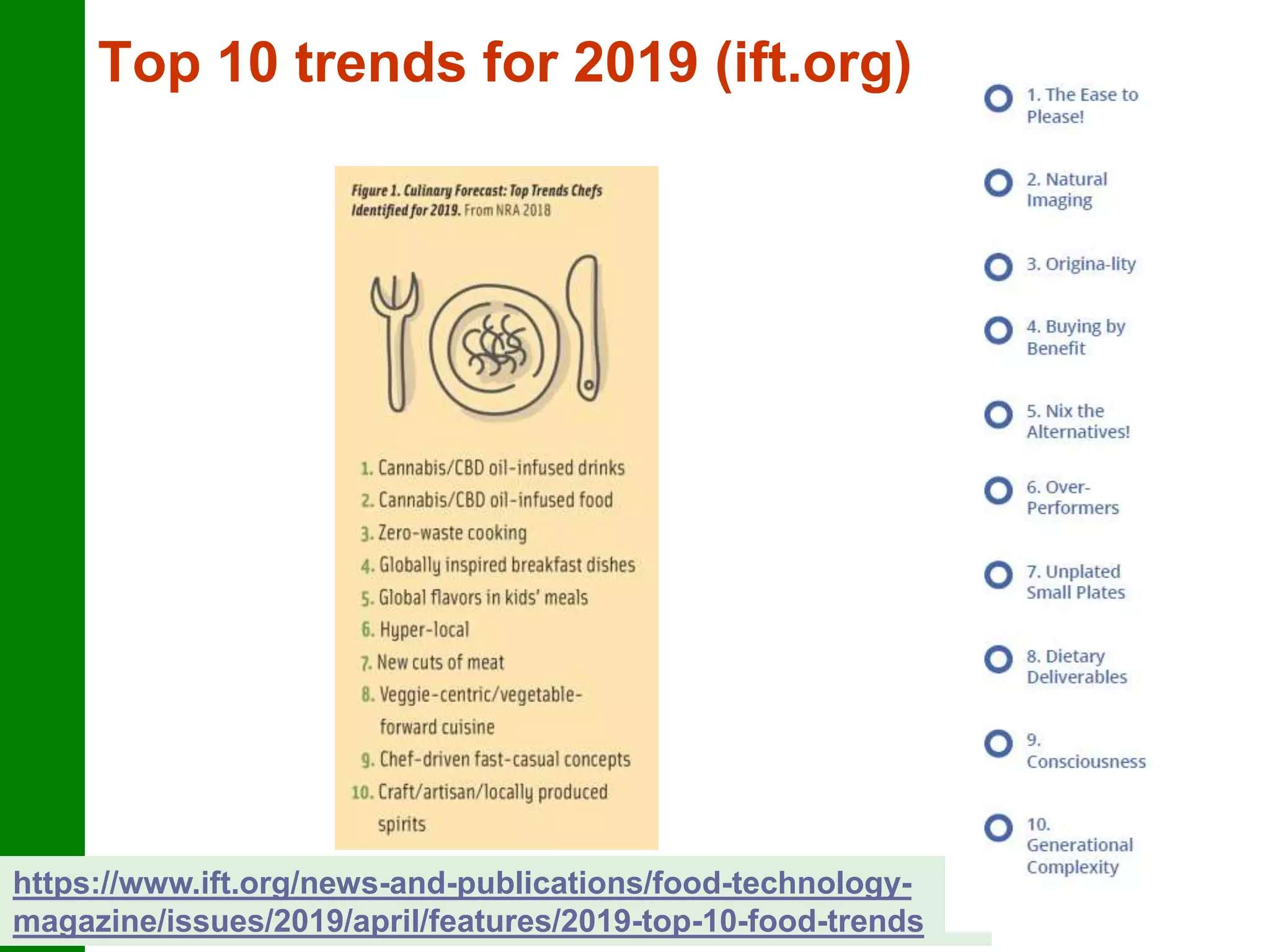
Top 10 trends for 2019 (ift.org)
https://www.ift.org/news-and-publications/food-technology-
magazine/issues/2019/april/features/2019-top-10-food-trends
Μελετώντας την βιοδιαθεσιμότητα, την
βιοπροσβασιμότητα και την
βιοενεργότητα
Η πώς συνδέουμε την Χημεία με την Διατροφική
Πολιτική
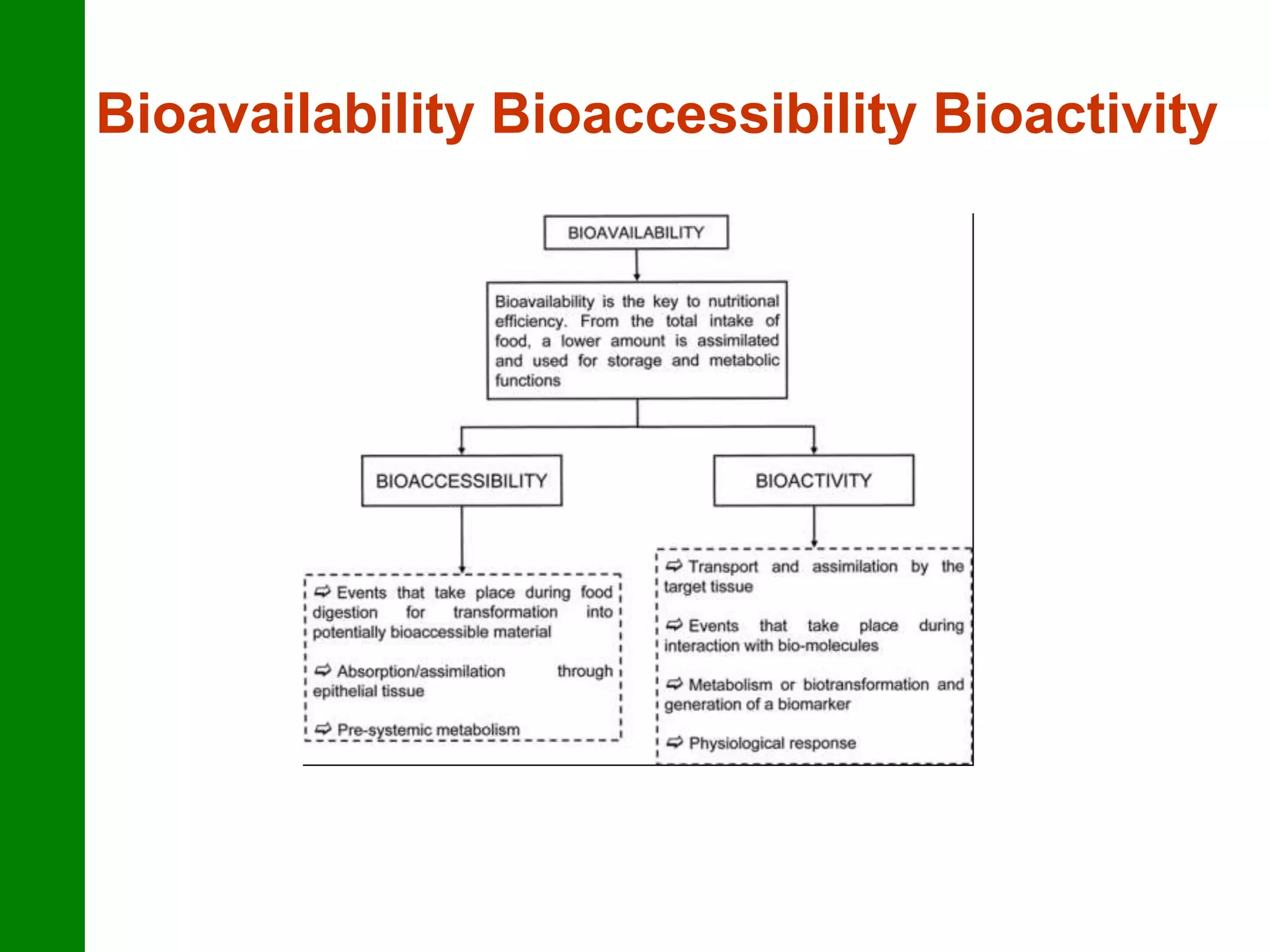
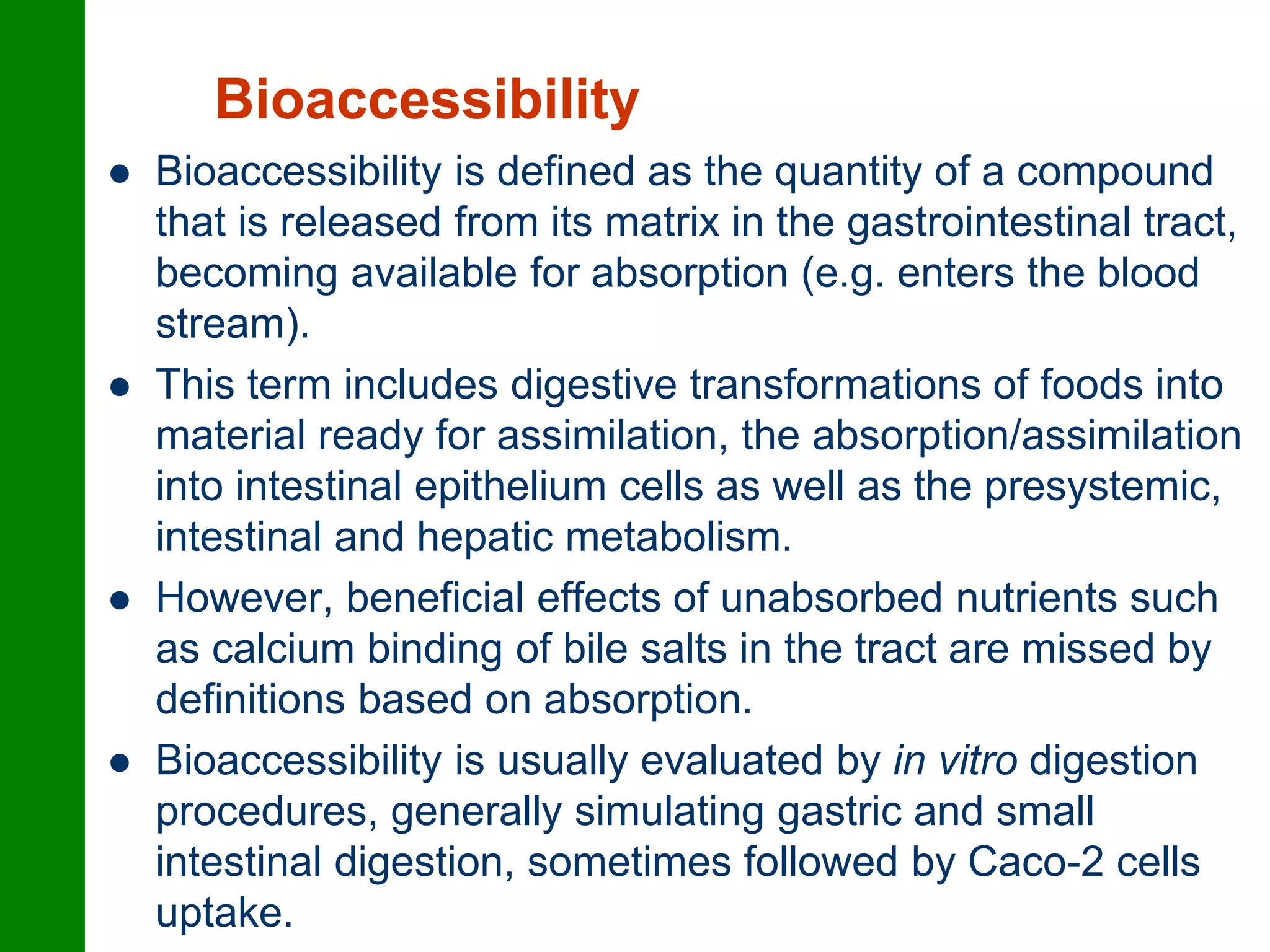
Bioavailability Bioaccessibility Bioactivity
Bioavailability
 Bioavailability includes gastrointestinal (GI) digestion,
absorption, metabolism, tissue distribution, and
bioactivity.
 From the nutritional point of view, bioavailability refers to
the fraction of the nutrient that is stored or being available
in physiological functions.
 It is a key term for nutritional effectiveness, as not all the
amounts of bioactive compounds are used effectively by
the organism.
 Therefore, bioavailability expresses the fraction of
ingested nutrient or bioactive compound that reaches the
systemic circulation and ultimately utilized.
Bioaccessibility
 Bioaccessibility is defined as the quantity of a compound
that is released from its matrix in the gastrointestinal tract,
becoming available for absorption (e.g. enters the blood
stream).
 This term includes digestive transformations of foods into
material ready for assimilation, the absorption/assimilation
into intestinal epithelium cells as well as the presystemic,
intestinal and hepatic metabolism.
 However, beneficial effects of unabsorbed nutrients such
as calcium binding of bile salts in the tract are missed by
definitions based on absorption.
 Bioaccessibility is usually evaluated by in vitro digestion
procedures, generally simulating gastric and small
intestinal digestion, sometimes followed by Caco-2 cells
uptake.
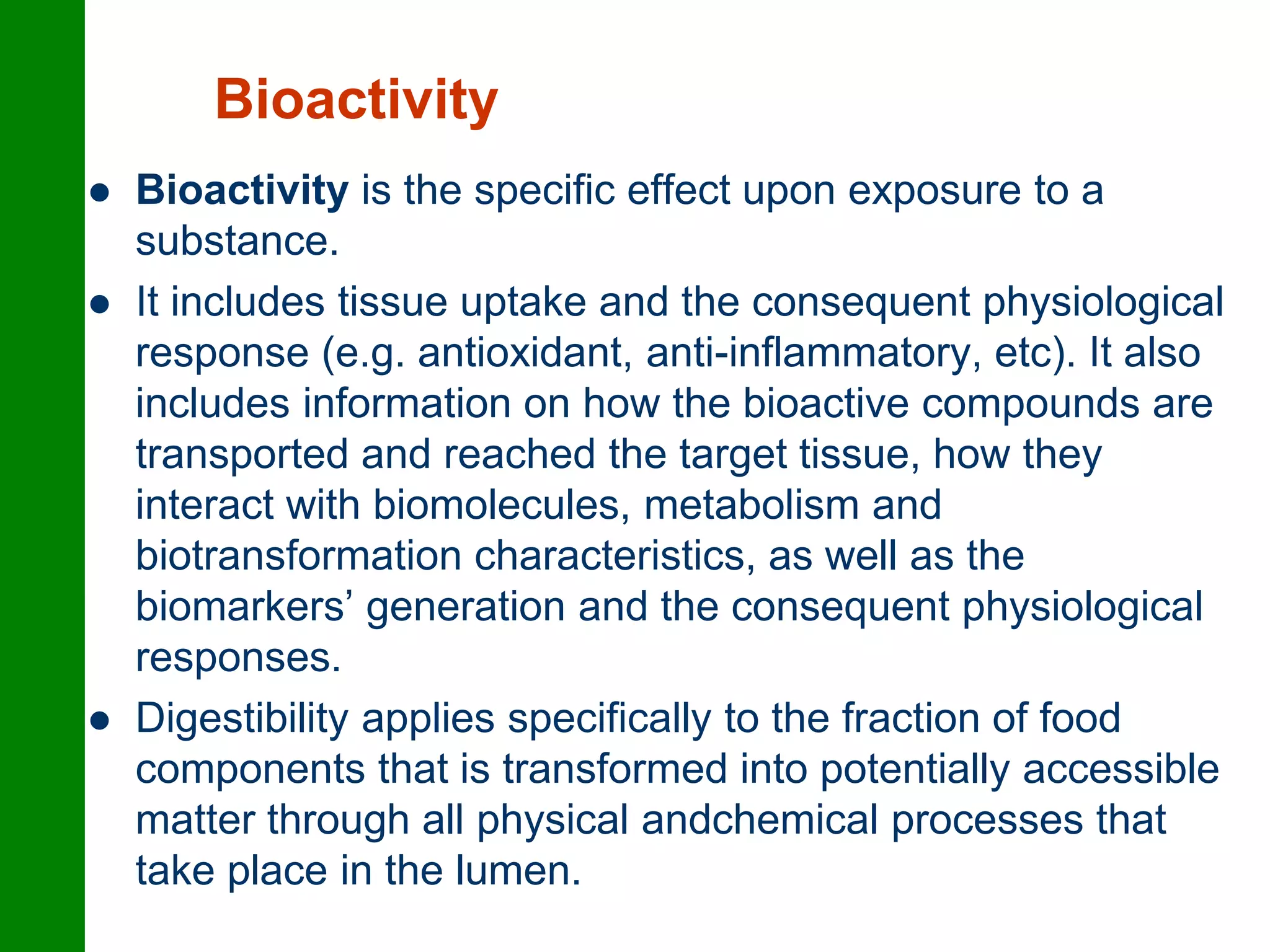
Bioactivity
 Bioactivity is the specific effect upon exposure to a
substance.
 It includes tissue uptake and the consequent physiological
response (e.g. antioxidant, anti-inflammatory, etc). It also
includes information on how the bioactive compounds are
transported and reached the target tissue, how they
interact with biomolecules, metabolism and
biotransformation characteristics, as well as the
biomarkers’ generation and the consequent physiological
responses.
 Digestibility applies specifically to the fraction of food
components that is transformed into potentially accessible
matter through all physical andchemical processes that
take place in the lumen.
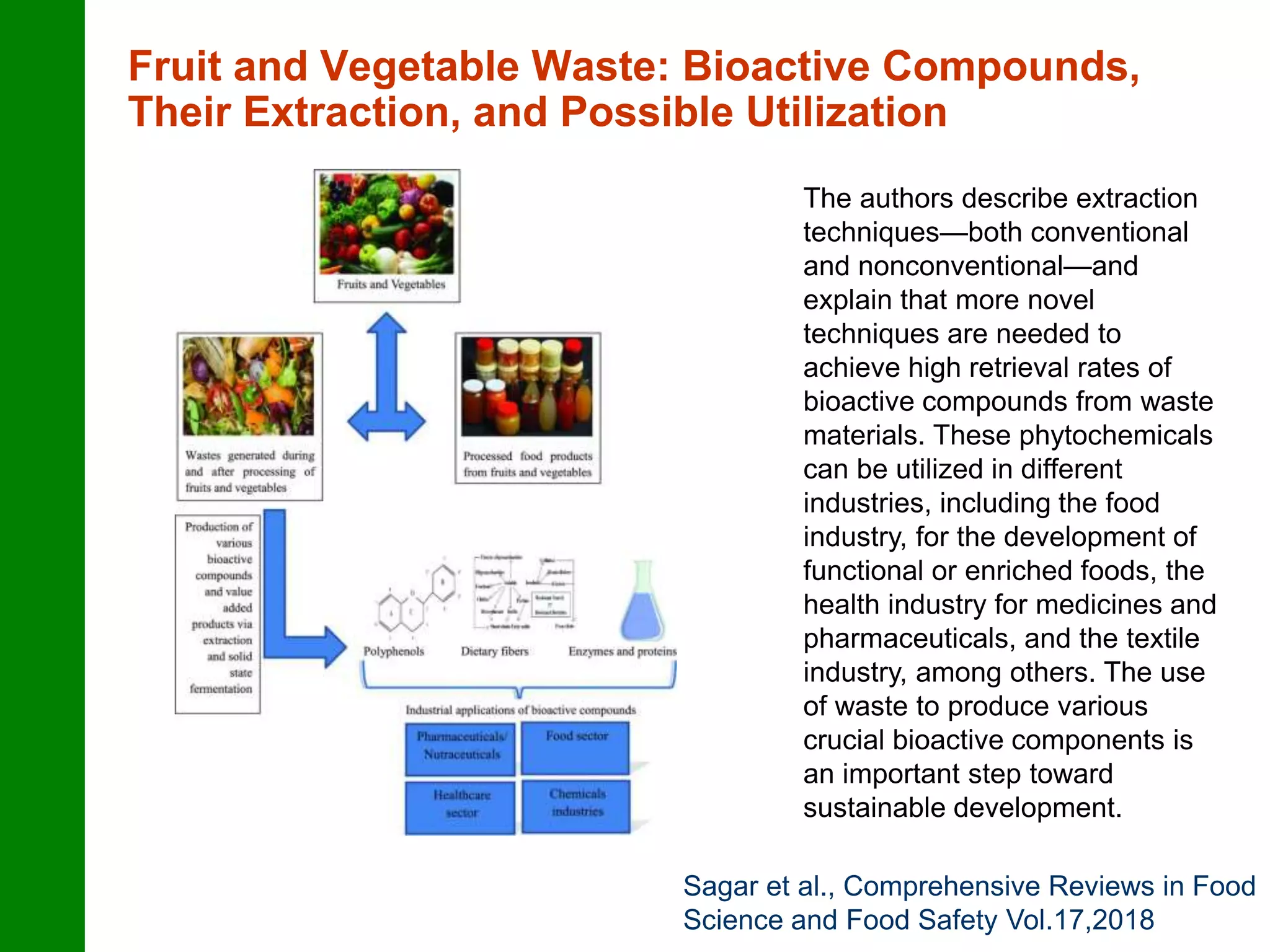
Fruit and Vegetable Waste: Bioactive Compounds,
Their Extraction, and Possible Utilization
The authors describe extraction
techniques—both conventional
and nonconventional—and
explain that more novel
techniques are needed to
achieve high retrieval rates of
bioactive compounds from waste
materials. These phytochemicals
can be utilized in different
industries, including the food
industry, for the development of
functional or enriched foods, the
health industry for medicines and
pharmaceuticals, and the textile
industry, among others. The use
of waste to produce various
crucial bioactive components is
an important step toward
sustainable development.
Sagar et al., Comprehensive Reviews in Food
Science and Food Safety Vol.17,2018
“Η Λαική αγορά”
Παναγιώτης Τέτσης, Εθνική Πινακοθήκη

Lecture 2. Bioactivity introduction.ppt

  • 1.
    Λειτουργικά Τρόφιμα καιΔιατροφή Εισαγωγή, Μέρος Β
  • 2.
  • 3.
  • 4.
    Τι είναι ταλειτουργικά τρόφιμα;  Είναι τα τρόφιμα που προσφέρονται με τον ισχυρισμό ότι προάγουν την υγεία ή γενικότερα ότι παρέχουν ωφέλη στον οργανισμό πέραν των αναμενόμενων.  Ο ισχυρισμός αυτός μπορεί να βασίζεται σε ενδογενή ή εξωγενή συστατικά του τροφίμου.
  • 6.
    https://www.eatright.org/food/nutrition/healthy-eating/functional-foods Functional foods covera variety of foods, including whole foods along with fortified, enriched or enhanced foods. Generally, they have a potentially beneficial effect on health when consumed on a regular basis at certain levels. Functional foods may include: •Conventional foods such as grains, fruits, vegetables and nuts. •Modified foods such as yogurt, cereals and orange juice.
  • 7.
    Κατηγορίες λειτουργικών τροφίμων ΚΑΤΗΓΟΡΙΑΠΑΡΑΔΕΙΓΜΑ φρέσκα τρόφιμα καρότο επεξεργασμένα τρόφιμα δημητριακά βρώμης τρόφιμα στα οποία έχουν ενισχυθεί ενδογενή συστατικά με συγκεκριμένες φυσιολογικές ιδιότητες ντομάτα με αυξημένη περιεκτικότητα σε λυκοπένιο τρόφιμα στα οποία έχουν προστεθεί συστατικά με συγκεκριμένες φυσιολογικές ιδιότητες γάλα με προσθήκη σιδήρου
  • 8.
    Παραδείγματα λειτουργικών συστατικών Λειτουργικόσυστατικό Πηγή Πιθανό όφελος λυκοπένιο ντομάτα μειώνει το κίνδυνο καρκίνου του προστάτη β-γλυκάνες βρώμη μειώνει το κίνδυνο καρδιακών παθήσεων ω-3 λιπαρά οξέα λίπος ψαριών μειώνει το κίνδυνο καρδιακών παθήσεων κατεχίνες τσάι αντιοξειδωτική δράση, μειώνει το κίνδυνο καρδιακών παθήσεων στανόλες φυτικά έλαια παρεμποδίζει την απορρόφηση της χοληστερόληςκαι μειώνει το κίνδυνο καρδιακών παθήσεων Lactobacilius γιαούρτι βελτιώνει την υγεία του γαστρεντερικού συστήματος Ισοφλαβόνες σόγια μειώνει τα συμπτώματα εμμηνόπαυσης ασβέστιο γάλα μειώνει τον κίνδυνο οστεοπόρωσης Λιπαρά οξέα Καροτενοειδή Διαιτητικές ίνες Φυτοοιστροφόνα Μεταλλικά στοιχεία Πολυφαινόλες Φυτοστερόλες Προβιοτικά βακτήρια
  • 10.
    Consider eating moreof these nutrient-dense, functional foods. 1.Cold-Water Fish — Sardines and Salmon These protein-packed fish are lower in mercury and have higher amounts of omega-3 fatty acids, which may help lower risk of heart disease and improve infant health when consumed by women during pregnancy or while breast-feeding. 2.Nuts They make a great snack, help you feel full and may help promote heart health. Bonus: most unsalted nuts, including cashews and almonds, are good sources of magnesium, which plays a role in managing blood pressure. 3.Whole Grains — Barley Often overshadowed by the fame of oatmeal, barley delivers similar benefits. It's high in dietary fiber, an underconsumed nutrient of public health concern in the U.S., and may help lower cholesterol and assist with blood sugar control. 4.Beans Beans provide dietary fiber, as well as protein, potassium and folate. While canned beans are fine, look for those with no salt added. If you do choose beans with salt added, rinse and drain them before use, which reduces sodium significantly. 5.Berries Whether you opt for strawberries, cranberries, blueberries, raspberries or blackberries, berries in general are wonderful functional foods. Not only are they low in calories, their anthocyanin pigments, which give them color, may offer health promoting benefits. If you can't get fresh berries, frozen unsweetened berries make a fine alternative. https://www.eatright.org/food/nutrition/healthy-eating/functional-foods
  • 11.
    Η ανάπτυξη τωνλειτουργικών τροφίμων εντάσσεται στην στρατηγική για την βελτίωση της διατροφικής πρόσληψης Είναι αναγκαία η βελτίωση της διατροφικής πρόσληψης;
  • 12.
    Ρόλος και ευθύνητης Βιομηχανίας Τροφίμων “Food manufacturers can contribute to improving the quality of diet by increasing the availability of palatable, easily prepared food products that will help people to follow the dietary principles.” Surgeon General’s Report on Nutrition and Health, 1988
  • 13.
    Βασικά ερωτήματα πάνωστα λειτουργικά τρόφιμα  Ποιές ανάγκες στοχεύουν να καλύψουν και πως;  Είναι αποτελεσματικά στο πληθυσμό και πότε;  Τι δείχνει η διεθνής εμπειρία;
  • 14.
    Evidence-Based Methodology 1. Developresearch questions 2. Create and implement literature search and sort plans www.nutritionevidencelibrary.govSpahn JM, et al. The systematic review methodology used to support the 2010 Dietary Guidelines Advisory Committee. JADA. (In Press). 3. Develop evidence portfolios 4. Synthesize the bodies of evidence 5. Develop conclusion statements and grade the evidence 6. Describe research recommendations
  • 15.
    Grading the Strengthof the Evidence ■ Grading criteria: • Quality of studies • Quantity of studies and subjects • Consistency of findings across studies • Magnitude of the effect or public health impact • Generalizability to the population of interest ■ Qualitative words used to describe the strength of the evidence: • Strong, Moderate, Limited, Expert Opinion, and Grade Not Assignable
  • 16.
    Top 10 trendsfor 2017 (ift.org)  1. Prep-It: Semi-prepared foods  2. Lifestyle Foods: single serve packaging and individually portioned multi-packs  3. Kid-Specific: products for babies, toddlers, and kids  4. New Nationalism: Consumers have expressed a newfound pride in all things American  5. Nutritionals: Demand for a simpler way to live a healthy lifestyle  6. Dinner Redesigned: A main dish  7. Ag Alternatives: Americans continue to experiment with plant- based meals  8. Upgrading to Premium: gourmet  9. Claim It: quick and easy  10. Natural Living: chemical free, sustainable-focused life
  • 17.
    Top 10 trendsfor 2018 (ift.org) 1. Floral Flavors 2. Super Powders 3. Functional Mushrooms 4. Feast from the Middle East 5. Transparency 2.0: More is more when it comes to product labeling. Consumers want to know the real story behind their food, and how that item made its way from the source to the store. GMO transparency is top-of- mind, but shoppers seek out other details, too, such as Fair-Trade certification, responsible production, and animal welfare standards. 6. High-Tech Goes Plant-Forward: Plant-based diets and dishes continue to dominate the food world, and now the tech industry has a seat at the table, too. By using science to advance recipes and manipulate plant-based ingredients and proteins, these techniques are creating alternatives like “bleeding” vegan burgers or sushi-grade “not-tuna” made from tomatoes. These new production techniques are also bringing some new varieties of nut milks and yogurts made from pili nuts, peas, bananas, macadamia nuts, and pecans. 7. Puffed & Popped Snacks: 8. Tacos Come Out of Their Shell: 9. Root-to-Stem: Between nose-to-tail butchery and reducing food waste, a few forces are combining to inspire root-to-stem cooking, which makes use of the entire fruit or vegetable, including the stems or leaves that are less commonly eaten. Recipes like pickled watermelon rinds, beet-green pesto or broccoli-stem slaw have introduced consumers to new flavors and textures from old favorites. 10. Say Cheers to the Other Bubbly: LaCroix may have paved the way, but now there’s an entire booming category of sparkling beverages vying for consumer attention. Flavored sparkling waters like plant-derived options from Sap!(made with maple and birch) and sparkling cold brew from Stumptown will are shaking up a fizzy fix.
  • 18.
    Top 10 trendsfor 2019 (ift.org) https://www.ift.org/news-and-publications/food-technology- magazine/issues/2019/april/features/2019-top-10-food-trends
  • 19.
    Μελετώντας την βιοδιαθεσιμότητα,την βιοπροσβασιμότητα και την βιοενεργότητα Η πώς συνδέουμε την Χημεία με την Διατροφική Πολιτική
  • 20.
  • 21.
    Bioavailability  Bioavailability includesgastrointestinal (GI) digestion, absorption, metabolism, tissue distribution, and bioactivity.  From the nutritional point of view, bioavailability refers to the fraction of the nutrient that is stored or being available in physiological functions.  It is a key term for nutritional effectiveness, as not all the amounts of bioactive compounds are used effectively by the organism.  Therefore, bioavailability expresses the fraction of ingested nutrient or bioactive compound that reaches the systemic circulation and ultimately utilized.
  • 22.
    Bioaccessibility  Bioaccessibility isdefined as the quantity of a compound that is released from its matrix in the gastrointestinal tract, becoming available for absorption (e.g. enters the blood stream).  This term includes digestive transformations of foods into material ready for assimilation, the absorption/assimilation into intestinal epithelium cells as well as the presystemic, intestinal and hepatic metabolism.  However, beneficial effects of unabsorbed nutrients such as calcium binding of bile salts in the tract are missed by definitions based on absorption.  Bioaccessibility is usually evaluated by in vitro digestion procedures, generally simulating gastric and small intestinal digestion, sometimes followed by Caco-2 cells uptake.
  • 23.
    Bioactivity  Bioactivity isthe specific effect upon exposure to a substance.  It includes tissue uptake and the consequent physiological response (e.g. antioxidant, anti-inflammatory, etc). It also includes information on how the bioactive compounds are transported and reached the target tissue, how they interact with biomolecules, metabolism and biotransformation characteristics, as well as the biomarkers’ generation and the consequent physiological responses.  Digestibility applies specifically to the fraction of food components that is transformed into potentially accessible matter through all physical andchemical processes that take place in the lumen.
  • 25.
    Fruit and VegetableWaste: Bioactive Compounds, Their Extraction, and Possible Utilization The authors describe extraction techniques—both conventional and nonconventional—and explain that more novel techniques are needed to achieve high retrieval rates of bioactive compounds from waste materials. These phytochemicals can be utilized in different industries, including the food industry, for the development of functional or enriched foods, the health industry for medicines and pharmaceuticals, and the textile industry, among others. The use of waste to produce various crucial bioactive components is an important step toward sustainable development. Sagar et al., Comprehensive Reviews in Food Science and Food Safety Vol.17,2018
  • 26.
    “Η Λαική αγορά” ΠαναγιώτηςΤέτσης, Εθνική Πινακοθήκη

Editor's Notes

  • #15 The NEL systematic evidence-based review methodology includes six steps. This methodology was developed with assistance from the Agency for Healthcare Research and Quality, through a contract with the American Dietetic Association, and was informed by the US Cochrane Collaboration process. For the DGAC work, Committee members led the evidence analysis reviews through topic subcommittees. Each subcommittee completed systematic reviews related to their content area. Subcommittee members were provided with technical assistance from USDA staff with help from HHS staff. 1. The first step in the evidence analysis process was the development of research questions. A total of 130 questions were approved by the full Committee for systematic review. The PICO (Population, Intervention, Comparator, and Outcome[s]) method was used to focus each of the research questions. 2. After the research questions were approved by the full DGAC, subcommittees developed a literature search and sort plan to guide the identification of scientific articles that could be used to answer each research question. Components of this step included: establishing inclusion and exclusion criteria for study selection; defining the search strategy; conducting the literature search; and determining which studies should be included and excluded, based on the predetermined criteria. The date range for the updated searches, for questions that were addressed by the 2005 DGAC, was usually 2004 through 2009. In some cases, previously published systematic reviews served as a starting point for a review. For questions not addressed by the 2005 DGAC, the date range was often extended based on expert opinion and exploratory literature searches. 3. The next step in the review process was to develop evidence portfolios for each research question. This step involved: extracting relevant evidence and evaluating the methodological rigor of each study; and developing an evidence paragraph and table entry for each study to briefly summarize each included study and report relevant data. 4. The fourth step involved the synthesis of the body of evidence. In this step, the subcommittee reviewed the portfolio of evidence; discussed the findings; and identified key findings. 5. Next, the subcommittee members deliberated on the body of evidence as they developed a conclusion statement to answer each research question. The subcommittee also evaluated the strength of the body of evidence supporting each conclusion statement. 6. Finally, the subcommittees identified research recommendations related to the questions and topic areas.
  • #16 The Committee evaluated the strength of the body of evidence supporting each conclusion using criteria they had approved earlier in the process. The grading criteria included an assessment of: The quality of the studies included in the review – considering the scientific rigor and validity as well as study design and execution; The quantity of studies and the number of subjects in the studies; The consistency of findings across studies; The magnitude of the effect or public health impact; and The generalizability to the population of interest. The Committee selected the following qualitative words to describe the strength of the evidence supporting their conclusion statements: strong, moderate, limited, expert opinion, and grade not assignable. The systematic reviews were completed within each subcommittee. Once a subcommittee reached agreement on a conclusion statement and grade, the conclusion and portfolio of evidence was presented at a Science Review Subcommittee meeting for further deliberation. Finally, each graded conclusion statement was presented to the entire DGAC at a public meeting, and the conclusion statements and grades were revised until consensus was reached.