MICROENCAPSULATION
1
gorepravin77@gmail.com
 Introduction
 Advantages & disadvantages
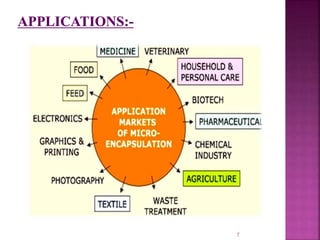
 Applications/reasons
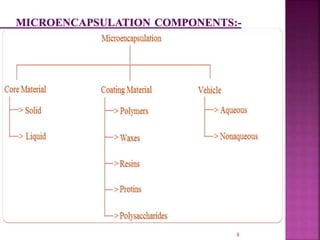
 Components-core, coating material & vehicle
 Methods or techniques of microcapsules-
physical & chemical
 Release mechanisms
 References 2
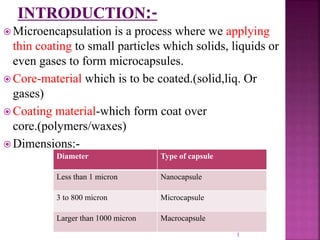
 Microencapsulation is a process where we applying
thin coating to small particles which solids, liquids or
even gases to form microcapsules.
 Core-material which is to be coated.(solid,liq. Or
gases)
 Coating material-which form coat over
core.(polymers/waxes)
 Dimensions:-
Diameter Type of capsule
Less than 1 micron Nanocapsule
3 to 800 micron Microcapsule
Larger than 1000 micron Macrocapsule
3
4
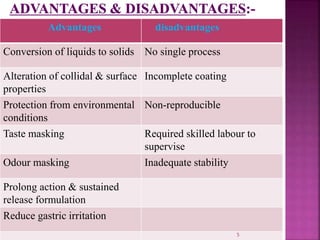
Advantages disadvantages
Conversion of liquids to solids No single process
Alteration of collidal & surface
properties
Incomplete coating
Protection from environmental
conditions
Non-reproducible
Taste masking Required skilled labour to
supervise
Odour masking Inadequate stability
Prolong action & sustained
release formulation
Reduce gastric irritation
5
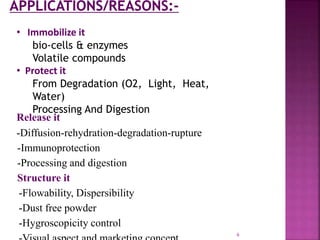
• Immobilize it
bio-cells & enzymes
Volatile compounds
• Protect it
From Degradation (O2, Light, Heat,
Water)
Processing And Digestion
Release it
-Diffusion-rehydration-degradation-rupture
-Immunoprotection
-Processing and digestion
Structure it
-Flowability, Dispersibility
-Dust free powder
-Hygroscopicity control
6
7
8
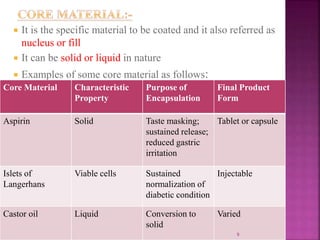
 It is the specific material to be coated and it also referred as
nucleus or fill
 It can be solid or liquid in nature
 Examples of some core material as follows:
Core Material Characteristic
Property
Purpose of
Encapsulation
Final Product
Form
Aspirin Solid Taste masking;
sustained release;
reduced gastric
irritation
Tablet or capsule
Islets of
Langerhans
Viable cells Sustained
normalization of
diabetic condition
Injectable
Castor oil Liquid Conversion to
solid
Varied
9
10
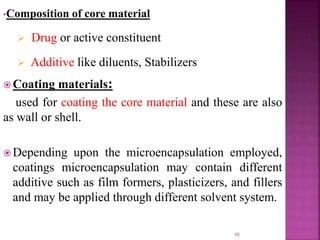
•Composition of core material
 Drug or active constituent
 Additive like diluents, Stabilizers
 Coating materials:
used for coating the core material and these are also
as wall or shell.
 Depending upon the microencapsulation employed,
coatings microencapsulation may contain different
additive such as film formers, plasticizers, and fillers
and may be applied through different solvent system.
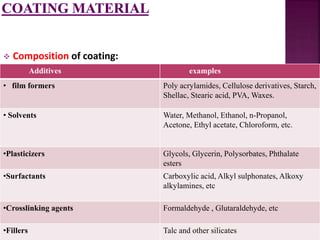
 Composition of coating:
11
Additives examples
• film formers Poly acrylamides, Cellulose derivatives, Starch,
Shellac, Stearic acid, PVA, Waxes.
• Solvents Water, Methanol, Ethanol, n-Propanol,
Acetone, Ethyl acetate, Chloroform, etc.
•Plasticizers Glycols, Glycerin, Polysorbates, Phthalate
esters
•Surfactants Carboxylic acid, Alkyl sulphonates, Alkoxy
alkylamines, etc
•Crosslinking agents Formaldehyde , Glutaraldehyde, etc
•Fillers Talc and other silicates
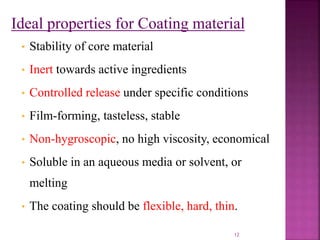
Ideal properties for Coating material
• Stability of core material
• Inert towards active ingredients
• Controlled release under specific conditions
• Film-forming, tasteless, stable
• Non-hygroscopic, no high viscosity, economical
• Soluble in an aqueous media or solvent, or
melting
• The coating should be flexible, hard, thin.
12
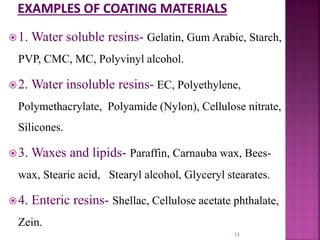
1. Water soluble resins- Gelatin, Gum Arabic, Starch,
PVP, CMC, MC, Polyvinyl alcohol.
2. Water insoluble resins- EC, Polyethylene,
Polymethacrylate, Polyamide (Nylon), Cellulose nitrate,
Silicones.
3. Waxes and lipids- Paraffin, Carnauba wax, Bees-
wax, Stearic acid, Stearyl alcohol, Glyceryl stearates.
4. Enteric resins- Shellac, Cellulose acetate phthalate,
Zein.
13
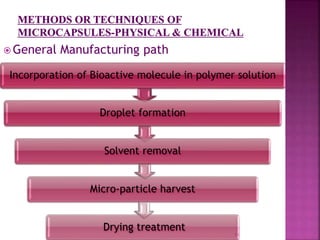
 General Manufacturing path
14
Incorporation of Bioactive molecule in polymer solution
Droplet formation
Solvent removal
Micro-particle harvest
Drying treatment
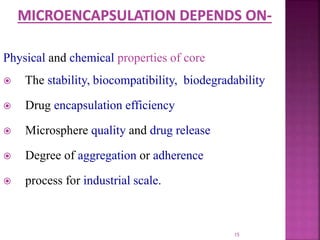
Physical and chemical properties of core
 The stability, biocompatibility, biodegradability
 Drug encapsulation efficiency
 Microsphere quality and drug release
 Degree of aggregation or adherence
 process for industrial scale.
15
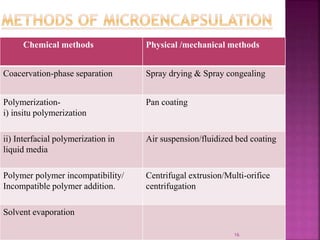
Chemical methods Physical /mechanical methods
Coacervation-phase separation Spray drying & Spray congealing
Polymerization-
i) insitu polymerization
Pan coating
ii) Interfacial polymerization in
liquid media
Air suspension/fluidized bed coating
Polymer polymer incompatibility/
Incompatible polymer addition.
Centrifugal extrusion/Multi-orifice
centrifugation
Solvent evaporation
16
 [1]Coacervation-phase separation:-
 Coacervation means formation of aggregates to form
pdt.
 Process-three steps carried out under continuous
agitation:
1. Formation of three immiscible chemical
phases
2. Deposition of the coating
3. Rigidization of the coating
17
 Three immiscible chemical phases are liquid
manufacturing vehicle phase, core material phase &
coating material phase
 The coating material phase, an immiscible polymer in
a liquid state, is formed by utilizing one the methods
of phase separation-coacervation:
1. By changing the temperature of the polymer
solution
2. By adding a salt to the polymer solution
3. By adding a non-solvent to the polymer solution
4. By adding incompatible polymer to the polymer
solution
5. By inducing a polymer-polymer interaction18
 This step consists of depositing the liquid polymer coating
upon the core material.
 Deposition of the liquid polymer coating around the core
material occurs if the polymer adsorbed at the interface formed
between the core material and liquid vehicle phase, and this
adsorption phenomenon is a prerequisite to effective coating.
 The continued deposition of the coating material is promoted
by a reduction in total free interfacial energy of the system
 RIGIDIZATION OF THE COATING carried out usually by
thermal cross-linking or desolvation technique, to form self
sustaining microcapsules.
19
20
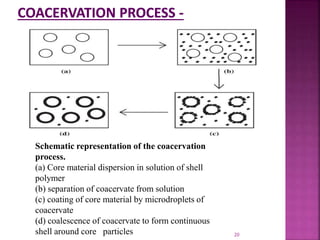
Schematic representation of the coacervation
process.
(a) Core material dispersion in solution of shell
polymer
(b) separation of coacervate from solution
(c) coating of core material by microdroplets of
coacervate
(d) coalescence of coacervate to form continuous
shell around core particles
 Core material is dispersed in the polymer solution,
 on evaporation polymer shrinks around the core
 Dissolved core material in the coating polymer
solution, gives matrix - type microcapsule is formed
The core materials may be water soluble/water -
insoluble materials.
 This technique is based on the evaporation of the internal
phase of an emulsion by agitation
 This technique has following types:
1. Single emulsion evaporation
2. Multiple emulsion evaporation 21
 It is also known as normal polymerization.
 By this technique, one can produce microcapsules
and particles in micrometer and nanometer range.
 Polymerization techniques of pharmaceutical interest
is carried out in liquid phase and they have following
types
1. Bulk polymerization
2. Suspension polymerization
3. Emulsion polymerization
22
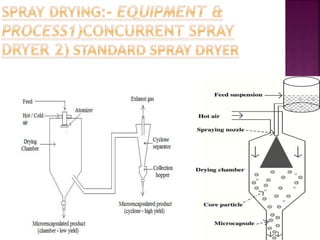
1) Spray drying and spray congealing:-
 In spray drying process the core substance is dispersed in a solution of coating material,
which is then atomized and the dried off using heated air.
 Spray congealing, the substance which has property of melting at elevated temperature
when being atomized and congealing when the droplet formed meet cool air on spray
dyer.
 Coating solidification is accomplished by spraying
the hot mixture into a cool air stream
 Spray drying is affected by rapid evaporation of a
solvent in which the coating material is dissolved
23
Advantages:
 Rapid, single stage operation, can be used for heat
sensitive substance
Disadvantages:
 Porous coating, not suitable for taste & odor masking
and for controlled release formulation, high cost of
production.
24
25
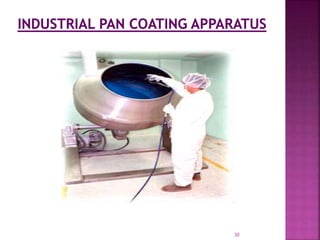
 Oldest industrial procedures
 for large size particles i.e. 600-5000 μm
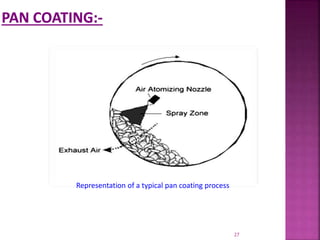
 Coating solution is applied as a solution or atomized
spray
 Warm air is passed to remove the coating solvent
 The particles are tumbled in a pan or other device
while the coating material is applied slowly
 Medicaments are usually coated onto various
spherical substrates e.g. sugar seeds, and then coated.
26
27
Representation of a typical pan coating process
 Also core material may contain wide range of
additive may serve to modify release properties of
formulation.
 Pan coating method of microencapsulation process
contains two steps:
1. Preparation of core material
2. Coating procedure
1. Preparation of core material:-
core particles should be of greater than 500 micron,
spherical shape, adequate hardness and low
friability.
28
29
 2. Coating procedure:-
Steps involved in coating of batch of cores:
1. Roughening of inner surface of pan if it not contain
baffle
2. Screening of core material to remove dust
3. Coating material addition
a. Pour method
b. Pan method
4. Addition of dusting powder such as talc at the critical
moment just as core become tacky and just in
sufficient amount to free up any clumps
5. Drying and jogging after each application of coating
6. 20-50 application of coating & drying in flat trays at
400C
30
 Process consists dispersing of solid core materials in a
supporting air stream and the spray-coating of the air
suspended particles
 Equipment capacities ranging in 990 pounds per hr
 Micron or submicron particles can be encapsulated
 advantages over pan coating:
1. More rapid
2. No need of skilled labor, often fully automated
3. Coat continuity is superior & less coating solution
required
4. No loss of coating material as being closed
system. 31
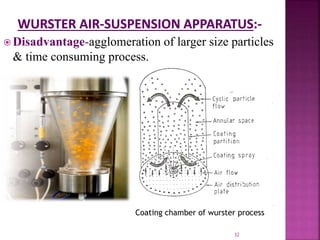
 Disadvantage-agglomeration of larger size particles
& time consuming process.
32
Coating chamber of wurster process
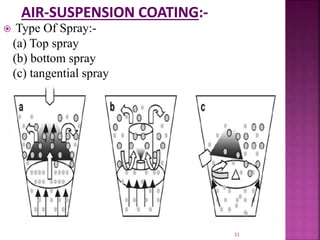
 Type Of Spray:-
(a) Top spray
(b) bottom spray
(c) tangential spray
33
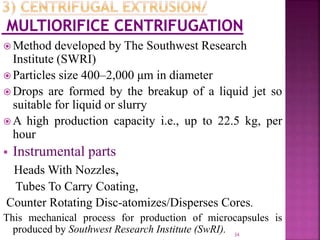
 Method developed by The Southwest Research
Institute (SWRI)
 Particles size 400–2,000 μm in diameter
 Drops are formed by the breakup of a liquid jet so
suitable for liquid or slurry
 A high production capacity i.e., up to 22.5 kg, per
hour
 Instrumental parts
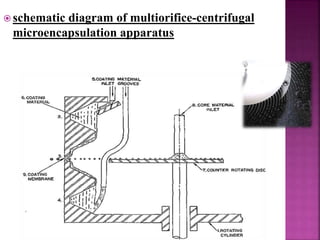
Heads With Nozzles,
Tubes To Carry Coating,
Counter Rotating Disc-atomizes/Disperses Cores.
This mechanical process for production of microcapsules is
produced by Southwest Research Institute (SwRI). 34
 schematic diagram of multiorifice-centrifugal
microencapsulation apparatus
35
 centrifugal forces to hurl a core material particle.
Processing variables include
 the rotational speed of the cylinder,
 the flow rate of the core and coating materials
 the concentration
 viscosity and surface tension of the core material.
36
 1. Degradation controlled monolithic system:
-The drug is dissolved in matrix and is distributed
uniformly throughout. The drug is strongly attached to the
matrix and is released on degradation of the matrix. The
diffusion of the drug is slow as compared with
degradation of the matrix.
 2. Diffusion controlled monolithic system:
-the active agent is released by diffusion . Rate of release
also depend upon where the polymer degrades by
homogeneous or heterogeneous mechanism.
37
 3. Diffusion controlled reservoir system:
- the active agent is encapsulated by a rate controlling
membrane through which the agent diffuses and the
membrane erodes only after its delivery is completed.
 4. Erosion:
-Erosion of the coat due to pH and enzymatic hydrolysis
causes drug release with certain coat material like
glyceryl mono stearate, beeswax and steryl alcohol,etc.
38
 N. K. Jain, Controlled and Novel drug delivery, 04
Edition, pg.no-236-237.
 S. P. Vyas and R. K. Khar, Targeted and Controlled drug
delivery, 07 Edition, 418.
 Lachman LA, Liberman HA, Kanig JL. The Theory and
Practice of Industrial Pharmacy. Mumbai, India:
Varghese Publishing House;3 pg.no:414-415.
 Remington GA. The Science and Practice of Pharmacy.
Delhi, India: BI publication;2006, 21st Edition, Volume I:
pg no:924.
39
40

Microencapsulation by Pravin Gore

  • 1.
  • 2.
     Introduction  Advantages& disadvantages  Applications/reasons  Components-core, coating material & vehicle  Methods or techniques of microcapsules- physical & chemical  Release mechanisms  References 2
  • 3.
     Microencapsulation isa process where we applying thin coating to small particles which solids, liquids or even gases to form microcapsules.  Core-material which is to be coated.(solid,liq. Or gases)  Coating material-which form coat over core.(polymers/waxes)  Dimensions:- Diameter Type of capsule Less than 1 micron Nanocapsule 3 to 800 micron Microcapsule Larger than 1000 micron Macrocapsule 3
  • 4.
  • 5.
    Advantages disadvantages Conversion ofliquids to solids No single process Alteration of collidal & surface properties Incomplete coating Protection from environmental conditions Non-reproducible Taste masking Required skilled labour to supervise Odour masking Inadequate stability Prolong action & sustained release formulation Reduce gastric irritation 5
  • 6.
    • Immobilize it bio-cells& enzymes Volatile compounds • Protect it From Degradation (O2, Light, Heat, Water) Processing And Digestion Release it -Diffusion-rehydration-degradation-rupture -Immunoprotection -Processing and digestion Structure it -Flowability, Dispersibility -Dust free powder -Hygroscopicity control 6
  • 7.
  • 8.
  • 9.
     It isthe specific material to be coated and it also referred as nucleus or fill  It can be solid or liquid in nature  Examples of some core material as follows: Core Material Characteristic Property Purpose of Encapsulation Final Product Form Aspirin Solid Taste masking; sustained release; reduced gastric irritation Tablet or capsule Islets of Langerhans Viable cells Sustained normalization of diabetic condition Injectable Castor oil Liquid Conversion to solid Varied 9
  • 10.
    10 •Composition of corematerial  Drug or active constituent  Additive like diluents, Stabilizers  Coating materials: used for coating the core material and these are also as wall or shell.  Depending upon the microencapsulation employed, coatings microencapsulation may contain different additive such as film formers, plasticizers, and fillers and may be applied through different solvent system.
  • 11.
     Composition ofcoating: 11 Additives examples • film formers Poly acrylamides, Cellulose derivatives, Starch, Shellac, Stearic acid, PVA, Waxes. • Solvents Water, Methanol, Ethanol, n-Propanol, Acetone, Ethyl acetate, Chloroform, etc. •Plasticizers Glycols, Glycerin, Polysorbates, Phthalate esters •Surfactants Carboxylic acid, Alkyl sulphonates, Alkoxy alkylamines, etc •Crosslinking agents Formaldehyde , Glutaraldehyde, etc •Fillers Talc and other silicates
  • 12.
    Ideal properties forCoating material • Stability of core material • Inert towards active ingredients • Controlled release under specific conditions • Film-forming, tasteless, stable • Non-hygroscopic, no high viscosity, economical • Soluble in an aqueous media or solvent, or melting • The coating should be flexible, hard, thin. 12
  • 13.
    1. Water solubleresins- Gelatin, Gum Arabic, Starch, PVP, CMC, MC, Polyvinyl alcohol. 2. Water insoluble resins- EC, Polyethylene, Polymethacrylate, Polyamide (Nylon), Cellulose nitrate, Silicones. 3. Waxes and lipids- Paraffin, Carnauba wax, Bees- wax, Stearic acid, Stearyl alcohol, Glyceryl stearates. 4. Enteric resins- Shellac, Cellulose acetate phthalate, Zein. 13
  • 14.
     General Manufacturingpath 14 Incorporation of Bioactive molecule in polymer solution Droplet formation Solvent removal Micro-particle harvest Drying treatment
  • 15.
    Physical and chemicalproperties of core  The stability, biocompatibility, biodegradability  Drug encapsulation efficiency  Microsphere quality and drug release  Degree of aggregation or adherence  process for industrial scale. 15
  • 16.
    Chemical methods Physical/mechanical methods Coacervation-phase separation Spray drying & Spray congealing Polymerization- i) insitu polymerization Pan coating ii) Interfacial polymerization in liquid media Air suspension/fluidized bed coating Polymer polymer incompatibility/ Incompatible polymer addition. Centrifugal extrusion/Multi-orifice centrifugation Solvent evaporation 16
  • 17.
     [1]Coacervation-phase separation:- Coacervation means formation of aggregates to form pdt.  Process-three steps carried out under continuous agitation: 1. Formation of three immiscible chemical phases 2. Deposition of the coating 3. Rigidization of the coating 17
  • 18.
     Three immisciblechemical phases are liquid manufacturing vehicle phase, core material phase & coating material phase  The coating material phase, an immiscible polymer in a liquid state, is formed by utilizing one the methods of phase separation-coacervation: 1. By changing the temperature of the polymer solution 2. By adding a salt to the polymer solution 3. By adding a non-solvent to the polymer solution 4. By adding incompatible polymer to the polymer solution 5. By inducing a polymer-polymer interaction18
  • 19.
     This stepconsists of depositing the liquid polymer coating upon the core material.  Deposition of the liquid polymer coating around the core material occurs if the polymer adsorbed at the interface formed between the core material and liquid vehicle phase, and this adsorption phenomenon is a prerequisite to effective coating.  The continued deposition of the coating material is promoted by a reduction in total free interfacial energy of the system  RIGIDIZATION OF THE COATING carried out usually by thermal cross-linking or desolvation technique, to form self sustaining microcapsules. 19
  • 20.
    20 Schematic representation ofthe coacervation process. (a) Core material dispersion in solution of shell polymer (b) separation of coacervate from solution (c) coating of core material by microdroplets of coacervate (d) coalescence of coacervate to form continuous shell around core particles
  • 21.
     Core materialis dispersed in the polymer solution,  on evaporation polymer shrinks around the core  Dissolved core material in the coating polymer solution, gives matrix - type microcapsule is formed The core materials may be water soluble/water - insoluble materials.  This technique is based on the evaporation of the internal phase of an emulsion by agitation  This technique has following types: 1. Single emulsion evaporation 2. Multiple emulsion evaporation 21
  • 22.
     It isalso known as normal polymerization.  By this technique, one can produce microcapsules and particles in micrometer and nanometer range.  Polymerization techniques of pharmaceutical interest is carried out in liquid phase and they have following types 1. Bulk polymerization 2. Suspension polymerization 3. Emulsion polymerization 22
  • 23.
    1) Spray dryingand spray congealing:-  In spray drying process the core substance is dispersed in a solution of coating material, which is then atomized and the dried off using heated air.  Spray congealing, the substance which has property of melting at elevated temperature when being atomized and congealing when the droplet formed meet cool air on spray dyer.  Coating solidification is accomplished by spraying the hot mixture into a cool air stream  Spray drying is affected by rapid evaporation of a solvent in which the coating material is dissolved 23
  • 24.
    Advantages:  Rapid, singlestage operation, can be used for heat sensitive substance Disadvantages:  Porous coating, not suitable for taste & odor masking and for controlled release formulation, high cost of production. 24
  • 25.
  • 26.
     Oldest industrialprocedures  for large size particles i.e. 600-5000 μm  Coating solution is applied as a solution or atomized spray  Warm air is passed to remove the coating solvent  The particles are tumbled in a pan or other device while the coating material is applied slowly  Medicaments are usually coated onto various spherical substrates e.g. sugar seeds, and then coated. 26
  • 27.
    27 Representation of atypical pan coating process
  • 28.
     Also corematerial may contain wide range of additive may serve to modify release properties of formulation.  Pan coating method of microencapsulation process contains two steps: 1. Preparation of core material 2. Coating procedure 1. Preparation of core material:- core particles should be of greater than 500 micron, spherical shape, adequate hardness and low friability. 28
  • 29.
    29  2. Coatingprocedure:- Steps involved in coating of batch of cores: 1. Roughening of inner surface of pan if it not contain baffle 2. Screening of core material to remove dust 3. Coating material addition a. Pour method b. Pan method 4. Addition of dusting powder such as talc at the critical moment just as core become tacky and just in sufficient amount to free up any clumps 5. Drying and jogging after each application of coating 6. 20-50 application of coating & drying in flat trays at 400C
  • 30.
  • 31.
     Process consistsdispersing of solid core materials in a supporting air stream and the spray-coating of the air suspended particles  Equipment capacities ranging in 990 pounds per hr  Micron or submicron particles can be encapsulated  advantages over pan coating: 1. More rapid 2. No need of skilled labor, often fully automated 3. Coat continuity is superior & less coating solution required 4. No loss of coating material as being closed system. 31
  • 32.
     Disadvantage-agglomeration oflarger size particles & time consuming process. 32 Coating chamber of wurster process
  • 33.
     Type OfSpray:- (a) Top spray (b) bottom spray (c) tangential spray 33
  • 34.
     Method developedby The Southwest Research Institute (SWRI)  Particles size 400–2,000 μm in diameter  Drops are formed by the breakup of a liquid jet so suitable for liquid or slurry  A high production capacity i.e., up to 22.5 kg, per hour  Instrumental parts Heads With Nozzles, Tubes To Carry Coating, Counter Rotating Disc-atomizes/Disperses Cores. This mechanical process for production of microcapsules is produced by Southwest Research Institute (SwRI). 34
  • 35.
     schematic diagramof multiorifice-centrifugal microencapsulation apparatus 35
  • 36.
     centrifugal forcesto hurl a core material particle. Processing variables include  the rotational speed of the cylinder,  the flow rate of the core and coating materials  the concentration  viscosity and surface tension of the core material. 36
  • 37.
     1. Degradationcontrolled monolithic system: -The drug is dissolved in matrix and is distributed uniformly throughout. The drug is strongly attached to the matrix and is released on degradation of the matrix. The diffusion of the drug is slow as compared with degradation of the matrix.  2. Diffusion controlled monolithic system: -the active agent is released by diffusion . Rate of release also depend upon where the polymer degrades by homogeneous or heterogeneous mechanism. 37
  • 38.
     3. Diffusioncontrolled reservoir system: - the active agent is encapsulated by a rate controlling membrane through which the agent diffuses and the membrane erodes only after its delivery is completed.  4. Erosion: -Erosion of the coat due to pH and enzymatic hydrolysis causes drug release with certain coat material like glyceryl mono stearate, beeswax and steryl alcohol,etc. 38
  • 39.
     N. K.Jain, Controlled and Novel drug delivery, 04 Edition, pg.no-236-237.  S. P. Vyas and R. K. Khar, Targeted and Controlled drug delivery, 07 Edition, 418.  Lachman LA, Liberman HA, Kanig JL. The Theory and Practice of Industrial Pharmacy. Mumbai, India: Varghese Publishing House;3 pg.no:414-415.  Remington GA. The Science and Practice of Pharmacy. Delhi, India: BI publication;2006, 21st Edition, Volume I: pg no:924. 39
  • 40.