NEPHELOTURBIDOMETRY
MADHUMITHA.S
B.PHARM IV-YEAR
INTRODUCTION
NEPHLOMETRY
• Nephlometry is the measurement of scattered light as a function
of concentration of suspended particles.
TURBIDIMETRY
• Turbidimetry is the measurement of transmitted light as a
function of concentration of suspended paricles.
PRINCIPLE:
• At low concentrations of a suspension, there is uniform
scattering.Hence the intensity of scattered light is proportional to
the concentration .
• The intensity of scattered light can be measured at 45°, 60°, 90°
and 135°also.
• For higher concentration suspensions scattering is non uniform
and light becomes scattered in all possible directions.
• Hence, it is difficult to measure the intensity of scatter radiation at
specific angles.
• So, the intensity of transmitted light (that is unscattered) direction
is measured at 180.
• The intensity of transmitted light (It) is a function of concentration
i.e. when the concentration increases the intensity of transmitted
light is less and when concentration is less the intensity in high.
• Depending on the sample concentration of the suspension either
nephelometry or turbidometry is chosen.
• Suspensions with lower concentration nephelometry and for
higher concentration turbidometry are utilised.
INSTRUMENTATION:
• There are separate instruments available as nephelometer and
turbidimeter.
• Also, they are combined to form a Nephloturbidometer.
• Following are the common instrumental components:
1. Source of light :
 Tungsten lamp is used when a polychromatic light is necessary
and a Mercury arc lamp is used when a monochromatic light is
necessary.
2. Filters and Monochromators :
When polychromatic light is used filters and monochromators are
not required but when monochromatic light is necessary a filters
or monochromator is used.
 In turbidimeter blue filter 530 nm is used and in a nephelometer
visible filter is used as a secondary .
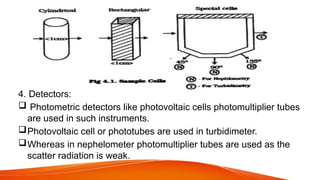
3.Sample cells:
Various shapes of sample cells are used , they maybe cylindrical
with 1cm path length.
rectangular cells are also used but cell walls maybe coated with
black to avoid any reflection.
 Special cells are also used to measure scattered light at different
angles like 45°,90°,135°.
4. Detectors:
 Photometric detectors like photovoltaic cells photomultiplier tubes
are used in such instruments.
Photovoltaic cell or phototubes are used in turbidimeter.
Whereas in nephelometer photomultiplier tubes are used as the
scatter radiation is weak.
NEPHELOTURBIDiMETER
If is suspension is to be measured whose concentration is unknown then A
nepheloturbidimeter can be effectively used as it can detect both low
concentration as well as high concentration suspensions. It has two detectors
one for measuring the scattered light at 90° and the other one at 180° for
transmitted light. The ratio of the response of two detectors is displayed as
nepheloturbidimetric units or NTUs which is proportional to the ability of the
suspension.
APPLICATIONS:
Analysis of water
Determination of carbondioxide
Determination of inorganic substances
Quantitative analysis of ions
Turbidimetric titrations
Miscellaneous
THANK YOU

NEPHELOTURBIDOMETRY b.pharmacy college .

  • 1.
  • 2.
    INTRODUCTION NEPHLOMETRY • Nephlometry isthe measurement of scattered light as a function of concentration of suspended particles. TURBIDIMETRY • Turbidimetry is the measurement of transmitted light as a function of concentration of suspended paricles.
  • 3.
    PRINCIPLE: • At lowconcentrations of a suspension, there is uniform scattering.Hence the intensity of scattered light is proportional to the concentration . • The intensity of scattered light can be measured at 45°, 60°, 90° and 135°also. • For higher concentration suspensions scattering is non uniform and light becomes scattered in all possible directions. • Hence, it is difficult to measure the intensity of scatter radiation at specific angles.
  • 4.
    • So, theintensity of transmitted light (that is unscattered) direction is measured at 180. • The intensity of transmitted light (It) is a function of concentration i.e. when the concentration increases the intensity of transmitted light is less and when concentration is less the intensity in high. • Depending on the sample concentration of the suspension either nephelometry or turbidometry is chosen. • Suspensions with lower concentration nephelometry and for higher concentration turbidometry are utilised.
  • 5.
    INSTRUMENTATION: • There areseparate instruments available as nephelometer and turbidimeter. • Also, they are combined to form a Nephloturbidometer. • Following are the common instrumental components: 1. Source of light :  Tungsten lamp is used when a polychromatic light is necessary and a Mercury arc lamp is used when a monochromatic light is necessary.
  • 6.
    2. Filters andMonochromators : When polychromatic light is used filters and monochromators are not required but when monochromatic light is necessary a filters or monochromator is used.  In turbidimeter blue filter 530 nm is used and in a nephelometer visible filter is used as a secondary . 3.Sample cells: Various shapes of sample cells are used , they maybe cylindrical with 1cm path length. rectangular cells are also used but cell walls maybe coated with black to avoid any reflection.  Special cells are also used to measure scattered light at different angles like 45°,90°,135°.
  • 7.
    4. Detectors:  Photometricdetectors like photovoltaic cells photomultiplier tubes are used in such instruments. Photovoltaic cell or phototubes are used in turbidimeter. Whereas in nephelometer photomultiplier tubes are used as the scatter radiation is weak.
  • 8.
    NEPHELOTURBIDiMETER If is suspensionis to be measured whose concentration is unknown then A nepheloturbidimeter can be effectively used as it can detect both low concentration as well as high concentration suspensions. It has two detectors one for measuring the scattered light at 90° and the other one at 180° for transmitted light. The ratio of the response of two detectors is displayed as nepheloturbidimetric units or NTUs which is proportional to the ability of the suspension.
  • 9.
    APPLICATIONS: Analysis of water Determinationof carbondioxide Determination of inorganic substances Quantitative analysis of ions Turbidimetric titrations Miscellaneous
  • 10.