ASSIGNMENT REPORT
SEMESTER-I
(M. PHARM- PHARMACEUTICS)
IN THE FACULTY OF SCIENCE AND TECHNOLOGY
SUBMITTED BY,
Miss. BHAGYASHRI VIJAY SOUNDANE
UNDER THE GUIDANCE OF
DR. AVINASH BALASAHEB GANGURDE M. PHARM. PH.D.
RESEARCH CENTRE
K. B. H. S. S. TRUSTS
INSTITUTE OF PHARMACY
MALEGAON CAMP, MALEGAON, NASHIK- 423105
2023-24
Compression and Compaction
Compression and consolidation
P a g e | 2
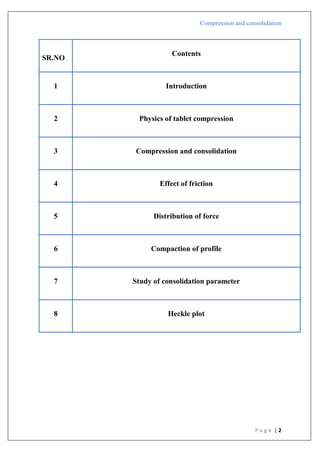
SR.NO
Contents
1 Introduction
2 Physics of tablet compression
3 Compression and consolidation
4 Effect of friction
5 Distribution of force
6 Compaction of profile
7 Study of consolidation parameter
8 Heckle plot
Compression and consolidation
P a g e | 3
 Introduction
About 70–80% of all dose formulations are tablets. Tablets are typically produced using three
primary procedures. As one of the most significant unit activities in the pharmaceutical
business, compaction is vital. When materials experience a specific level of mechanical force,
this process takes place. The compression and consolidation of a two-phase system as a result
of applied force can be used to identify the physics governing the compaction process. The
qualities of the powder must be taken into consideration when thinking about the compaction
and compression of tablets since they play a part in these processes. Important characteristics
may be quantified with the use of derived properties of powder, such as volume, density,
porosity, flow properties, and angle of repose, among others.
 Definitions:
1) Compression:
Compression is the reduction of a material's bulk volume produced by the application of
pressure to remove the gaseous phase (air).
2) Consolidation:
Consolidation is the process by which a material's mechanical strength increases as a result of
interactions between individual particles.
3) Compaction:
Compaction of the powder" is the state in which the materials are exposed to a certain amount
of mechanical force.
Compression involves solid-gas phase consolidation with force application in compaction.
 Physics of tablet compression:
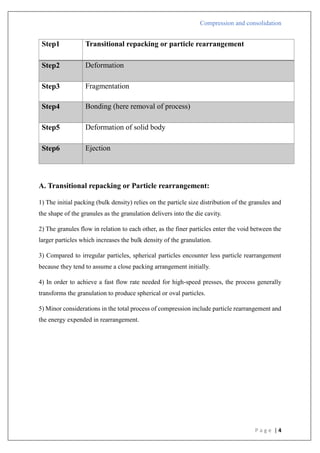
Steps involved in the compression of Tablet:
Compression and consolidation
P a g e | 4
Step1 Transitional repacking or particle rearrangement
Step2 Deformation
Step3 Fragmentation
Step4 Bonding (here removal of process)
Step5 Deformation of solid body
Step6 Ejection
A. Transitional repacking or Particle rearrangement:
1) The initial packing (bulk density) relies on the particle size distribution of the granules and
the shape of the granules as the granulation delivers into the die cavity.
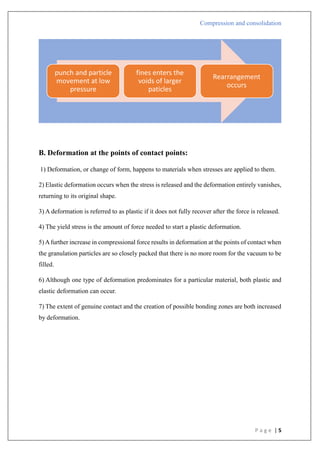
2) The granules flow in relation to each other, as the finer particles enter the void between the
larger particles which increases the bulk density of the granulation.
3) Compared to irregular particles, spherical particles encounter less particle rearrangement
because they tend to assume a close packing arrangement initially.
4) In order to achieve a fast flow rate needed for high-speed presses, the process generally
transforms the granulation to produce spherical or oval particles.
5) Minor considerations in the total process of compression include particle rearrangement and
the energy expended in rearrangement.
Compression and consolidation
P a g e | 5
B. Deformation at the points of contact points:
1) Deformation, or change of form, happens to materials when stresses are applied to them.
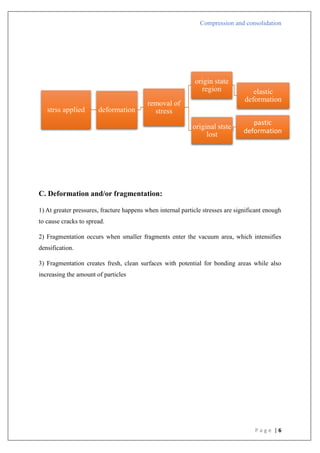
2) Elastic deformation occurs when the stress is released and the deformation entirely vanishes,
returning to its original shape.
3) A deformation is referred to as plastic if it does not fully recover after the force is released.
4) The yield stress is the amount of force needed to start a plastic deformation.
5) Afurther increase in compressional force results in deformation at the points of contact when
the granulation particles are so closely packed that there is no more room for the vacuum to be
filled.
6) Although one type of deformation predominates for a particular material, both plastic and
elastic deformation can occur.
7) The extent of genuine contact and the creation of possible bonding zones are both increased
by deformation.
punch and particle
movement at low
pressure
fines enters the
voids of larger
paticles
Rearrangement
occurs
Compression and consolidation
P a g e | 6
C. Deformation and/or fragmentation:
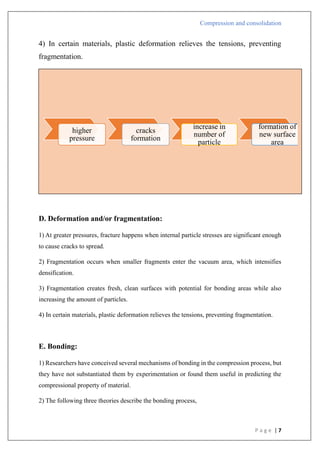
1) At greater pressures, fracture happens when internal particle stresses are significant enough
to cause cracks to spread.
2) Fragmentation occurs when smaller fragments enter the vacuum area, which intensifies
densification.
3) Fragmentation creates fresh, clean surfaces with potential for bonding areas while also
increasing the amount of particles
strss applied deformation
removal of
stress
origin state
region elastic
deformation
original stste
lost
pastic
deformation
Compression and consolidation
P a g e | 7
4) In certain materials, plastic deformation relieves the tensions, preventing
fragmentation.
D. Deformation and/or fragmentation:
1) At greater pressures, fracture happens when internal particle stresses are significant enough
to cause cracks to spread.
2) Fragmentation occurs when smaller fragments enter the vacuum area, which intensifies
densification.
3) Fragmentation creates fresh, clean surfaces with potential for bonding areas while also
increasing the amount of particles.
4) In certain materials, plastic deformation relieves the tensions, preventing fragmentation.
E. Bonding:
1) Researchers have conceived several mechanisms of bonding in the compression process, but
they have not substantiated them by experimentation or found them useful in predicting the
compressional property of material.
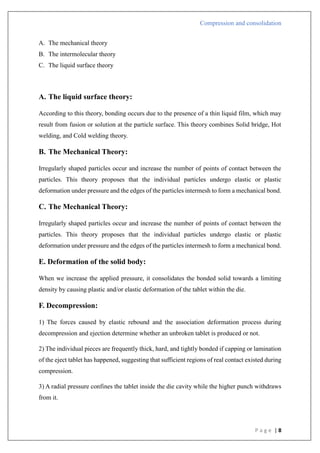
2) The following three theories describe the bonding process,
higher
pressure
cracks
formation
increase in
number of
particle
formation of
new surface
area
Compression and consolidation
P a g e | 8
A. The mechanical theory
B. The intermolecular theory
C. The liquid surface theory
A. The liquid surface theory:
According to this theory, bonding occurs due to the presence of a thin liquid film, which may
result from fusion or solution at the particle surface. This theory combines Solid bridge, Hot
welding, and Cold welding theory.
B. The Mechanical Theory:
Irregularly shaped particles occur and increase the number of points of contact between the
particles. This theory proposes that the individual particles undergo elastic or plastic
deformation under pressure and the edges of the particles intermesh to form a mechanical bond.
C. The Mechanical Theory:
Irregularly shaped particles occur and increase the number of points of contact between the
particles. This theory proposes that the individual particles undergo elastic or plastic
deformation under pressure and the edges of the particles intermesh to form a mechanical bond.
E. Deformation of the solid body:
When we increase the applied pressure, it consolidates the bonded solid towards a limiting
density by causing plastic and/or elastic deformation of the tablet within the die.
F. Decompression:
1) The forces caused by elastic rebound and the association deformation process during
decompression and ejection determine whether an unbroken tablet is produced or not.
2) The individual pieces are frequently thick, hard, and tightly bonded if capping or lamination
of the eject tablet has happened, suggesting that sufficient regions of real contact existed during
compression.
3) A radial pressure confines the tablet inside the die cavity while the higher punch withdraws
from it.
Compression and consolidation
P a g e | 9
4) If just elastic deformation took place, any bonds that could have formed under pressure
would ideally be broken by the granules returning to their original shape when the axial
pressure was suddenly removed.
5) Because the elastic material contracted radially and recovered axially, the die wall pressure
will also be zero.
6) The tension from axial elastic recovery and radial contraction results in capping because the
tablet's movement is constrained by friction and die wall pressure that remains after the
movement has occurred.
7) The cause of capping is the die cavity's uniaxial relaxation at the point where the top punch
pressure is released.
8) There is less capping if decompression happens concurrently in all directions.
9) Plastic deformation's stress relaxation depends on time.
G. Ejection:
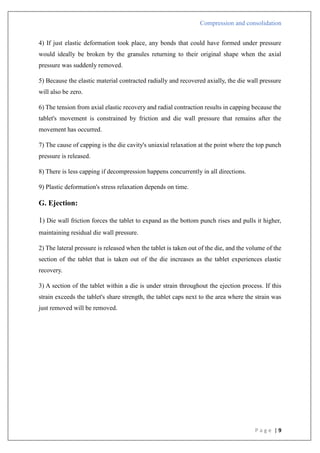
1) Die wall friction forces the tablet to expand as the bottom punch rises and pulls it higher,
maintaining residual die wall pressure.
2) The lateral pressure is released when the tablet is taken out of the die, and the volume of the
section of the tablet that is taken out of the die increases as the tablet experiences elastic
recovery.
3) A section of the tablet within a die is under strain throughout the ejection process. If this
strain exceeds the tablet's share strength, the tablet caps next to the area where the strain was
just removed will be removed.
Compression and consolidation
P a g e | 10
 Compression process:
Rising of lower punch
Continuation of residual die wall friction
Energy expression due to die-wall-die
friction
Removal of tablet relief of lateral pressure.
2 to 10% increase in volume of the
removed.
Compression and consolidation
P a g e | 11
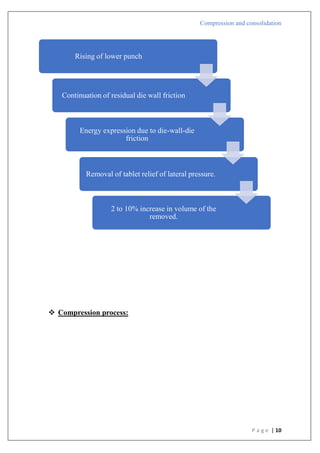
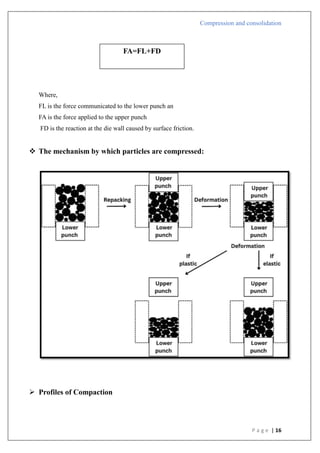
 Compression processes consist of:
 Particle in the die,
 Rearrangement of particle,
 Fragmentation,
 Elastic deformation and plastic deformation
Fig: Compression process
Compression and consolidation
P a g e | 12
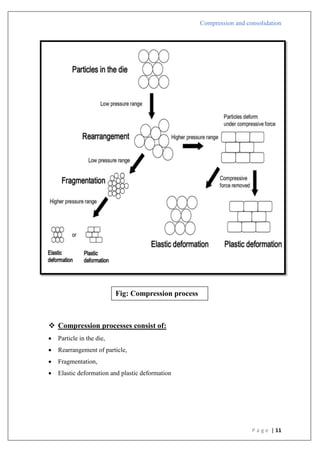
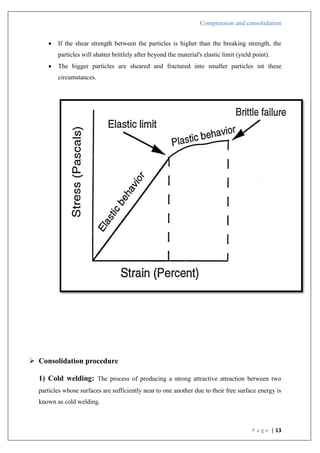
1) Elastic deformation:
A spontaneously reversible deformation of the compact in which the powder mass returns to
its initial shape when the load is removed. Elastic deformation occurs in most materials to some
degree. Rubber would compress due to elastic deformation.
2) Plastic deformation:
When a deformation reaches the material's elastic limit (yield point), the particles may
experience viscous flow. When the shear strength between the particles is smaller than the
breaking strength, this is the main mechanism at work. The process of plastic deformation is
time-dependent.
3) Brittle fracture:
Compression and consolidation
P a g e | 13
 If the shear strength between the particles is higher than the breaking strength, the
particles will shatter brittlely after beyond the material's elastic limit (yield point).
 The bigger particles are sheared and fractured into smaller particles int these
circumstances.
 Consolidation procedure
1) Cold welding: The process of producing a strong attractive attraction between two
particles whose surfaces are sufficiently near to one another due to their free surface energy is
known as cold welding.
Compression and consolidation
P a g e | 14
2) Fusion bonding: When a load is applied to a particle, multiple point contacts generate
heat, which leads to fusion or melting. It solidifies and increases the mass's mechanical strength
when the load is released.
 Factor affecting on Consolidation:
1.One of the factors influencing consolidation is the material's chemical composition.
2. The size of the surface that is accessible.
3. The existence of pollutants on the surface.
4. The distance between surfaces.
Force distribution:
1.The majority of research is done on eccentric presses, or single station presses, or even on
separate punch and die sets combined with a hydraulic press.
2. There needs to be an axial force balance.
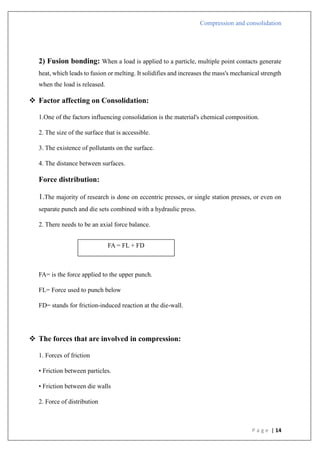
FA= is the force applied to the upper punch.
FL= Force used to punch below
FD= stands for friction-induced reaction at the die-wall.
 The forces that are involved in compression:
1. Forces of friction
• Friction between particles.
• Friction between die walls
2. Force of distribution
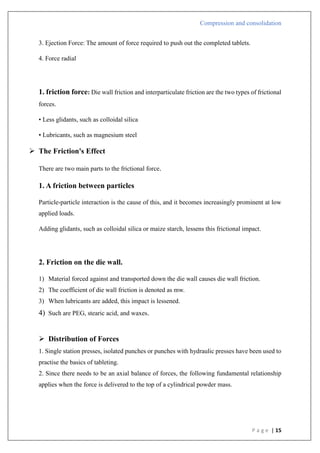
FA = FL + FD
Compression and consolidation
P a g e | 15
3. Ejection Force: The amount of force required to push out the completed tablets.
4. Force radial
1. friction force: Die wall friction and interparticulate friction are the two types of frictional
forces.
• Less glidants, such as colloidal silica
• Lubricants, such as magnesium steel
 The Friction's Effect
There are two main parts to the frictional force.
1. A friction between particles
Particle-particle interaction is the cause of this, and it becomes increasingly prominent at low
applied loads.
Adding glidants, such as colloidal silica or maize starch, lessens this frictional impact.
2. Friction on the die wall.
1) Material forced against and transported down the die wall causes die wall friction.
2) The coefficient of die wall friction is denoted as mw.
3) When lubricants are added, this impact is lessened.
4) Such are PEG, stearic acid, and waxes.
 Distribution of Forces
1. Single station presses, isolated punches or punches with hydraulic presses have been used to
practise the basics of tableting.
2. Since there needs to be an axial balance of forces, the following fundamental relationship
applies when the force is delivered to the top of a cylindrical powder mass.
Compression and consolidation
P a g e | 16
Where,
FL is the force communicated to the lower punch an
FA is the force applied to the upper punch
FD is the reaction at the die wall caused by surface friction.
 The mechanism by which particles are compressed:
 Profiles of Compaction
FA=FL+FD
Compression and consolidation
P a g e | 17
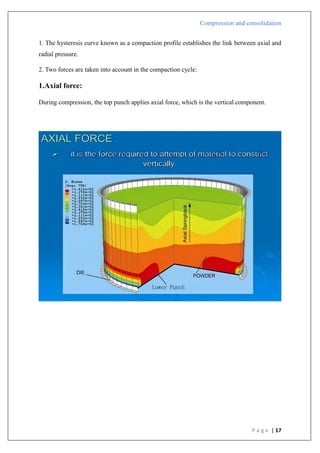
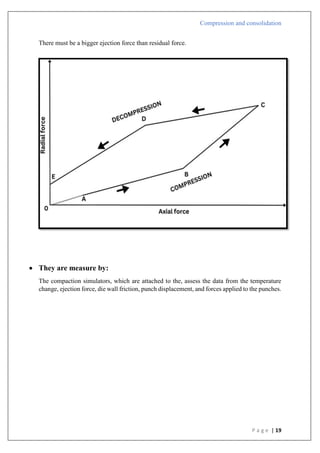
1. The hysteresis curve known as a compaction profile establishes the link between axial and
radial pressure.
2. Two forces are taken into account in the compaction cycle:
1.Axial force:
During compression, the top punch applies axial force, which is the vertical component.
Compression and consolidation
P a g e | 18
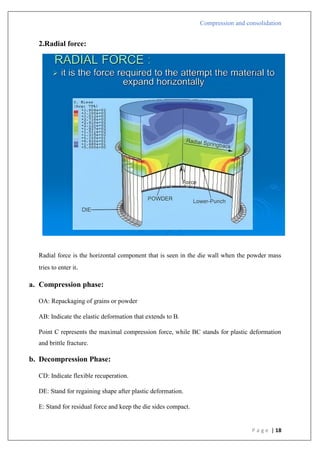
2.Radial force:
Radial force is the horizontal component that is seen in the die wall when the powder mass
tries to enter it.
a. Compression phase:
OA: Repackaging of grains or powder
AB: Indicate the elastic deformation that extends to B.
Point C represents the maximal compression force, while BC stands for plastic deformation
and brittle fracture.
b. Decompression Phase:
CD: Indicate flexible recuperation.
DE: Stand for regaining shape after plastic deformation.
E: Stand for residual force and keep the die sides compact.
Compression and consolidation
P a g e | 19
There must be a bigger ejection force than residual force.
 They are measure by:
The compaction simulators, which are attached to the, assess the data from the temperature
change, ejection force, die wall friction, punch displacement, and forces applied to the punches.
Compression and consolidation
P a g e | 20
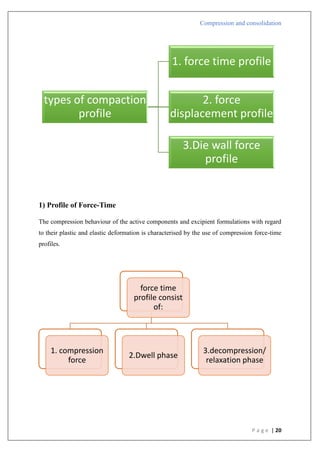
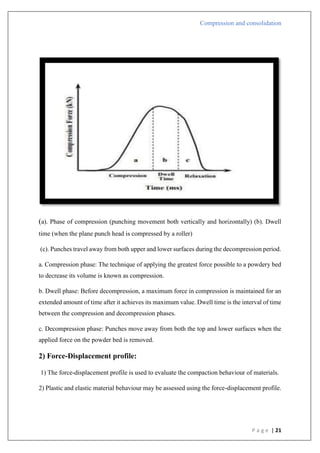
1) Profile of Force-Time
The compression behaviour of the active components and excipient formulations with regard
to their plastic and elastic deformation is characterised by the use of compression force-time
profiles.
types of compaction
profile
1. force time profile
2. force
displacement profile
3.Die wall force
profile
force time
profile consist
of:
1. compression
force
2.Dwell phase
3.decompression/
relaxation phase
Compression and consolidation
P a g e | 21
(a). Phase of compression (punching movement both vertically and horizontally) (b). Dwell
time (when the plane punch head is compressed by a roller)
(c). Punches travel away from both upper and lower surfaces during the decompression period.
a. Compression phase: The technique of applying the greatest force possible to a powdery bed
to decrease its volume is known as compression.
b. Dwell phase: Before decompression, a maximum force in compression is maintained for an
extended amount of time after it achieves its maximum value. Dwell time is the interval of time
between the compression and decompression phases.
c. Decompression phase: Punches move away from both the top and lower surfaces when the
applied force on the powder bed is removed.
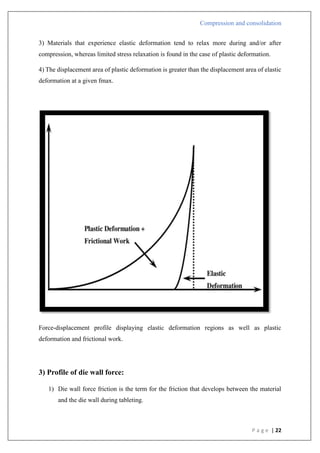
2) Force-Displacement profile:
1) The force-displacement profile is used to evaluate the compaction behaviour of materials.
2) Plastic and elastic material behaviour may be assessed using the force-displacement profile.
Compression and consolidation
P a g e | 22
3) Materials that experience elastic deformation tend to relax more during and/or after
compression, whereas limited stress relaxation is found in the case of plastic deformation.
4) The displacement area of plastic deformation is greater than the displacement area of elastic
deformation at a given fmax.
Force-displacement profile displaying elastic deformation regions as well as plastic
deformation and frictional work.
3) Profile of die wall force:
1) Die wall force friction is the term for the friction that develops between the material
and the die wall during tableting.
Compression and consolidation
P a g e | 23
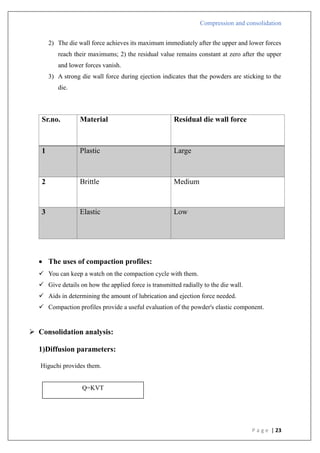
2) The die wall force achieves its maximum immediately after the upper and lower forces
reach their maximums; 2) the residual value remains constant at zero after the upper
and lower forces vanish.
3) A strong die wall force during ejection indicates that the powders are sticking to the
die.
Sr.no. Material Residual die wall force
1 Plastic Large
2 Brittle Medium
3 Elastic Low
 The uses of compaction profiles:
 You can keep a watch on the compaction cycle with them.
 Give details on how the applied force is transmitted radially to the die wall.
 Aids in determining the amount of lubrication and ejection force needed.
 Compaction profiles provide a useful evaluation of the powder's elastic component.
 Consolidation analysis:
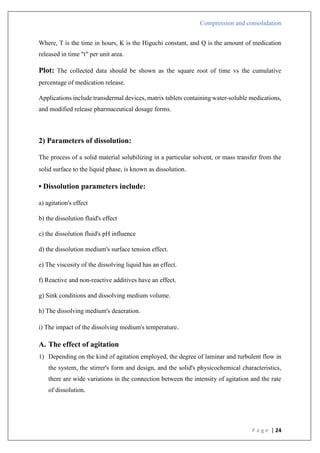
1)Diffusion parameters:
Higuchi provides them.
Q=KVT
Compression and consolidation
P a g e | 24
Where, T is the time in hours, K is the Higuchi constant, and Q is the amount of medication
released in time "t" per unit area.
Plot: The collected data should be shown as the square root of time vs the cumulative
percentage of medication release.
Applications include transdermal devices, matrix tablets containing water-soluble medications,
and modified release pharmaceutical dosage forms.
2) Parameters of dissolution:
The process of a solid material solubilizing in a particular solvent, or mass transfer from the
solid surface to the liquid phase, is known as dissolution.
• Dissolution parameters include:
a) agitation's effect
b) the dissolution fluid's effect
c) the dissolution fluid's pH influence
d) the dissolution medium's surface tension effect.
e) The viscosity of the dissolving liquid has an effect.
f) Reactive and non-reactive additives have an effect.
g) Sink conditions and dissolving medium volume.
h) The dissolving medium's deaeration.
i) The impact of the dissolving medium's temperature.
A. The effect of agitation
1) Depending on the kind of agitation employed, the degree of laminar and turbulent flow in
the system, the stirrer's form and design, and the solid's physicochemical characteristics,
there are wide variations in the connection between the intensity of agitation and the rate
of dissolution.
Compression and consolidation
P a g e | 25
2) High-speed agitation dissolution tests may not have discriminative value and may provide
false findings.
3) Consequently, the compendial procedures are often carried out in a relatively low-agitation
state.
4) 100 rpm is often used for the basket method, while 50–75 rpm is advised for the paddle
operation.
5) A flow rate of 10-100 MI/min is frequently used in non-official continuous flow, column
type procedures.
B. The dissolving fluid's effect
1) The physicochemical characteristics of the medication play a major role in the appropriate
medium selection for dissolving testing.
2) A lot of work was put into simulating the in vivo circumstances in the gastrointestinal
system in the early 1960s, when dissolution was still in its infancy.
3) This included sink conditions, pH, surface tension, and viscosity.
C. The impact of the dissolving fluid's pH
1) In 1949, distilled water was suggested as the test medium for the disintegration test by a
committee appointed by the American drug and pharmaceutical manufacturing groups.
2) It was found that diluted acid and water frequently produced outcomes that were very similar.
3) USP XV used artificial stomach fluid as a test medium for tablets that included substances
(such calcium carbonate) that reacted more easily in an acidic solution than in water.
4) In the USP XVIII, the medium was once more switched to water.
PH variations have the most impact on a drug's solubility.
5)The rate of dissolution rises with increasing pH for weak acids and decreases with lowering
pH for weak bases.
6) (The average stomach pH for men is 1.9, while it is 2.5 for women). Therefore, if the pH of
the dissolving medium was greater than 3, the dissolution rate of acetylsalicylic acid (pKa =
3.5) tablets and capsules would be predicted to rise.
7) Unless a tablet contains a specific excipient that is affected by pH, the dissolving rate of
tablets containing active substances, whose solubilities are independent of pH, does not change
appreciably with changes in the pH of the dissolution medium.
Compression and consolidation
P a g e | 26
8) Because rapid disintegration enhances the effective surface area, tablets manufactured with
carbon dioxide-producing chemicals, such as calcium, magnesium, or sodium bicarbonate, tend
to dissolve slightly more quickly in acidic media than in water.
D. Impact of the dissolving medium's surface tension
1) The diffusion film hypothesis states that the drug's dissolution is controlled by the interaction
of two processes: the drug's release from the solid surface and its transmission throughout the
majority of the dissolution medium.
2) For hydrophilic pharmaceuticals, the transfer process is more likely to be the rate-limiting
phase; for hydrophobic medications, the dissolution rate is predominantly driven by the release
mechanisms.
3) By lowering the interfacial tension and micelle formation, the addition of surface active
substances to the dissolving media should accelerate the dissolution of a medication that is
poorly soluble in solid dosage forms.
4) By improving solvent penetration into the tablet and increasing drug surface availability,
adding surfactant below the Critical micelle concentration (CMC) can greatly accelerate the
rate of dissolution.
E. The effect of the dissolving medium's viscosity
1) It is predicted that the dissolution rate will decrease as viscosity increases if the contact at
the interfaces happens considerably quicker than the rate of transport, as in the case of
diffusion-controlled dissolution processes.
2) The rate at which zinc dissolved in an HCl solution containing sucrose was negatively
correlated with the solution's viscosity.
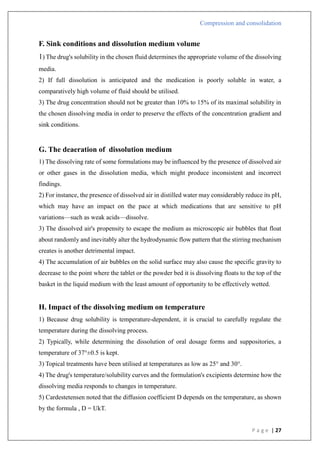
3) The diffusion coefficient is expressed as a function of viscosity in the Stokes-Einstein
equation, as the treatment that follows demonstrates.
 Mobility (velocity at one dyne force) is equal to μ.
 Boltzmann constant (k) = 1.38 × 10⁻¹⁶
D = ukT
Compression and consolidation
P a g e | 27
F. Sink conditions and dissolution medium volume
1) The drug's solubility in the chosen fluid determines the appropriate volume of the dissolving
media.
2) If full dissolution is anticipated and the medication is poorly soluble in water, a
comparatively high volume of fluid should be utilised.
3) The drug concentration should not be greater than 10% to 15% of its maximal solubility in
the chosen dissolving media in order to preserve the effects of the concentration gradient and
sink conditions.
G. The deaeration of dissolution medium
1) The dissolving rate of some formulations may be influenced by the presence of dissolved air
or other gases in the dissolution media, which might produce inconsistent and incorrect
findings.
2) For instance, the presence of dissolved air in distilled water may considerably reduce its pH,
which may have an impact on the pace at which medications that are sensitive to pH
variations—such as weak acids—dissolve.
3) The dissolved air's propensity to escape the medium as microscopic air bubbles that float
about randomly and inevitably alter the hydrodynamic flow pattern that the stirring mechanism
creates is another detrimental impact.
4) The accumulation of air bubbles on the solid surface may also cause the specific gravity to
decrease to the point where the tablet or the powder bed it is dissolving floats to the top of the
basket in the liquid medium with the least amount of opportunity to be effectively wetted.
H. Impact of the dissolving medium on temperature
1) Because drug solubility is temperature-dependent, it is crucial to carefully regulate the
temperature during the dissolving process.
2) Typically, while determining the dissolution of oral dosage forms and suppositories, a
temperature of 37°±0.5 is kept.
3) Topical treatments have been utilised at temperatures as low as 25° and 30°.
4) The drug's temperature/solubility curves and the formulation's excipients determine how the
dissolving media responds to changes in temperature.
5) Cardestetensen noted that the diffusion coefficient D depends on the temperature, as shown
by the formula , D = UkT.
Compression and consolidation
P a g e | 28
U is for mobility, which is the speed under a one dyne force.
Boltzmann constant equals k
T is the temperature in absolute terms.
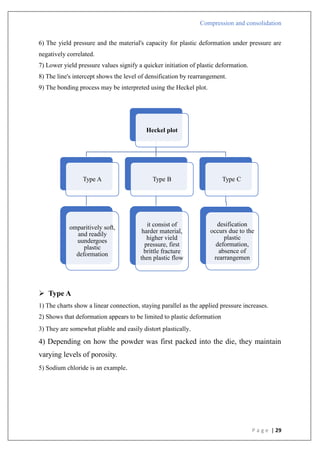
Heckel plot:
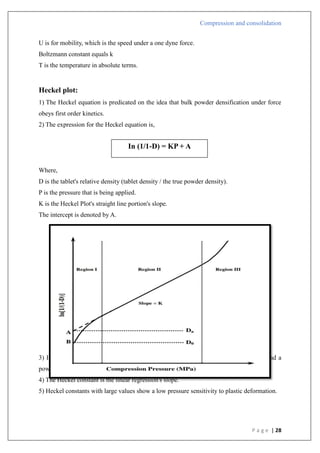
1) The Heckel equation is predicated on the idea that bulk powder densification under force
obeys first order kinetics.
2) The expression for the Heckel equation is,
Where,
D is the tablet's relative density (tablet density / the true powder density).
P is the pressure that is being applied.
K is the Heckel Plot's straight line portion's slope.
The intercept is denoted by A.
3) Heckel proposed a linear connection in 1961 between the pressure that is applied and a
powder's relative porosity, or inverse density.
4) The Heckel constant is the linear regression's slope.
5) Heckel constants with large values show a low pressure sensitivity to plastic deformation.
In (1/1-D) = KP + A
Compression and consolidation
P a g e | 29
6) The yield pressure and the material's capacity for plastic deformation under pressure are
negatively correlated.
7) Lower yield pressure values signify a quicker initiation of plastic deformation.
8) The line's intercept shows the level of densification by rearrangement.
9) The bonding process may be interpreted using the Heckel plot.
 Type A
1) The charts show a linear connection, staying parallel as the applied pressure increases.
2) Shows that deformation appears to be limited to plastic deformation
3) They are somewhat pliable and easily distort plastically.
4) Depending on how the powder was first packed into the die, they maintain
varying levels of porosity.
5) Sodium chloride is an example.
Heckel plot
Type A
omparitively soft,
and readily
uundergoes
plastic
deformation
Type B
it consist of
harder material,
higher vield
pressure, first
brittle fracture
then plastic flow
Type C
desification
occurs due to the
plastic
deformation,
absence of
rearrangemen
Compression and consolidation
P a g e | 30
Compression pressure
 Type B
1) There is a straight line that comes after the first curved area.
2) Shows that early in the compression phase, the particles begin breaking apart.
3) Plastic flow is preceded by bristle fracture.
4) Take place with stronger materials that have greater yield pressures.
5) To create a denser packing, such materials are first compressed by fragmentation.
6) Lactose as an example.
Type A
In
[1/(1-D)]
Compression and consolidation
P a g e | 31
Compression pressure
 Type C
1) There is an initial steep linear zone that becomes overlaid in such materials.
2) As more pressure is applied, this overlaid area flattens out.
It was determined that this conduct resulted from the lack of a rearrangement stage.
4) Asperity melting and plastic deformation are the causes of densification.
5) Starch is an example.
Type B
In
[1/(1-D)]
Compression and consolidation
P a g e | 32
Compression pressure
 Applications
1) The values of K in the Heckel plot may be used to correlate the crushing strength of tablets;
larger K values correspond to tougher tablets.
2) When creating tablet formulations, binder selection may be done using information from
Heckel plots.
3) The lubricant effectiveness may be verified using the Heckler plot.
4) The consolidation method may be understood by using plot information.
5) Heckel plots are another tool for differentiating between drugs with various accumulation
mechanisms.
6) It may also be applied to evaluate plasticity.
 Limitations:
1) A small fluctuation in the real density might affect Heckel graphs.
2) Differences in particle size
3) Total compression time
Type C
In
[1/(1-D)]
Compression and consolidation
P a g e | 33
4) Lubrication level
5) Die size.
Therefore, Heckel plots' sensitivity both makes them helpful and restricts how they may be
used. Since a small change has an impact on the plot.
Compression and consolidation
P a g e | 34
 References:
1) Banker GS, Anderson NR. Tablets, In: Lachman L, Liberman HA, Kanig JL, editors. The
Theory and Practice of Industrial Pharmacy, 3rd ed., Bombay, Varghese Publishing, 1976.
2) Marshall K. Compression and consolidation of powdered solids, In: Lachman L, Lieberman
HA, Kanig JL, editors. The Theory and Practice of Industrial Pharmacy, 3rd ed. Bombay,
Varghese Publishing
3) Subrahmanyam C.V. Micromeritics, Textbook Of Physical Pharmaceutics, Second Edition,
vallabh prakashan,delhi, Pp-180-234.
4) https://suntextreviews.org/uploads/journals/pdfs/1672138095.pdf
5) https://www.researchgate.net/publication/261727464_Compression_physics_of_pharmaceuti
cal_powders_A_review
6) https://globalresearchonline.net/journalcontents/volume7issue2/article-013.pdf
7) Jones, T.M: J. Pharm. Sci.,57:2015,196
8) Travers, D.N., Celik, M., and Buttery, T.C.: Drug Devel. Ind. Pharm., 9:139,1983 .Rankell,
A.S., and Higuchi, T.:J. Pharm. Sci. Ed.,48:26,1959.
9) The Theory and Practice of Industrial Pharmacy Leon Lachman, Herbert A. Lieberman, Joseph
L. Kanic
10) mages an Video: Source Google and Wikipedia.
11) Keith marshall 1987, Compression and consolidation of powderd solids, Leon lachman,
Herbert a.Liberman, & Joseph kanig The theory and practice of industrial pharmacy, third
edition varghese publication house, bombay, pp. 66,68,70-88.
12) Eugene parrott, 2007, Compression, Herbert A.Liberman, Leon Lachman & Joseph
B.Schwartz, Pharmaceutical dosage forms, tablets, volume ii,pp.201-241.

compression and compaction- Physics of tablet compression.pdf

  • 1.
    ASSIGNMENT REPORT SEMESTER-I (M. PHARM-PHARMACEUTICS) IN THE FACULTY OF SCIENCE AND TECHNOLOGY SUBMITTED BY, Miss. BHAGYASHRI VIJAY SOUNDANE UNDER THE GUIDANCE OF DR. AVINASH BALASAHEB GANGURDE M. PHARM. PH.D. RESEARCH CENTRE K. B. H. S. S. TRUSTS INSTITUTE OF PHARMACY MALEGAON CAMP, MALEGAON, NASHIK- 423105 2023-24 Compression and Compaction
  • 2.
    Compression and consolidation Pa g e | 2 SR.NO Contents 1 Introduction 2 Physics of tablet compression 3 Compression and consolidation 4 Effect of friction 5 Distribution of force 6 Compaction of profile 7 Study of consolidation parameter 8 Heckle plot
  • 3.
    Compression and consolidation Pa g e | 3  Introduction About 70–80% of all dose formulations are tablets. Tablets are typically produced using three primary procedures. As one of the most significant unit activities in the pharmaceutical business, compaction is vital. When materials experience a specific level of mechanical force, this process takes place. The compression and consolidation of a two-phase system as a result of applied force can be used to identify the physics governing the compaction process. The qualities of the powder must be taken into consideration when thinking about the compaction and compression of tablets since they play a part in these processes. Important characteristics may be quantified with the use of derived properties of powder, such as volume, density, porosity, flow properties, and angle of repose, among others.  Definitions: 1) Compression: Compression is the reduction of a material's bulk volume produced by the application of pressure to remove the gaseous phase (air). 2) Consolidation: Consolidation is the process by which a material's mechanical strength increases as a result of interactions between individual particles. 3) Compaction: Compaction of the powder" is the state in which the materials are exposed to a certain amount of mechanical force. Compression involves solid-gas phase consolidation with force application in compaction.  Physics of tablet compression: Steps involved in the compression of Tablet:
  • 4.
    Compression and consolidation Pa g e | 4 Step1 Transitional repacking or particle rearrangement Step2 Deformation Step3 Fragmentation Step4 Bonding (here removal of process) Step5 Deformation of solid body Step6 Ejection A. Transitional repacking or Particle rearrangement: 1) The initial packing (bulk density) relies on the particle size distribution of the granules and the shape of the granules as the granulation delivers into the die cavity. 2) The granules flow in relation to each other, as the finer particles enter the void between the larger particles which increases the bulk density of the granulation. 3) Compared to irregular particles, spherical particles encounter less particle rearrangement because they tend to assume a close packing arrangement initially. 4) In order to achieve a fast flow rate needed for high-speed presses, the process generally transforms the granulation to produce spherical or oval particles. 5) Minor considerations in the total process of compression include particle rearrangement and the energy expended in rearrangement.
  • 5.
    Compression and consolidation Pa g e | 5 B. Deformation at the points of contact points: 1) Deformation, or change of form, happens to materials when stresses are applied to them. 2) Elastic deformation occurs when the stress is released and the deformation entirely vanishes, returning to its original shape. 3) A deformation is referred to as plastic if it does not fully recover after the force is released. 4) The yield stress is the amount of force needed to start a plastic deformation. 5) Afurther increase in compressional force results in deformation at the points of contact when the granulation particles are so closely packed that there is no more room for the vacuum to be filled. 6) Although one type of deformation predominates for a particular material, both plastic and elastic deformation can occur. 7) The extent of genuine contact and the creation of possible bonding zones are both increased by deformation. punch and particle movement at low pressure fines enters the voids of larger paticles Rearrangement occurs
  • 6.
    Compression and consolidation Pa g e | 6 C. Deformation and/or fragmentation: 1) At greater pressures, fracture happens when internal particle stresses are significant enough to cause cracks to spread. 2) Fragmentation occurs when smaller fragments enter the vacuum area, which intensifies densification. 3) Fragmentation creates fresh, clean surfaces with potential for bonding areas while also increasing the amount of particles strss applied deformation removal of stress origin state region elastic deformation original stste lost pastic deformation
  • 7.
    Compression and consolidation Pa g e | 7 4) In certain materials, plastic deformation relieves the tensions, preventing fragmentation. D. Deformation and/or fragmentation: 1) At greater pressures, fracture happens when internal particle stresses are significant enough to cause cracks to spread. 2) Fragmentation occurs when smaller fragments enter the vacuum area, which intensifies densification. 3) Fragmentation creates fresh, clean surfaces with potential for bonding areas while also increasing the amount of particles. 4) In certain materials, plastic deformation relieves the tensions, preventing fragmentation. E. Bonding: 1) Researchers have conceived several mechanisms of bonding in the compression process, but they have not substantiated them by experimentation or found them useful in predicting the compressional property of material. 2) The following three theories describe the bonding process, higher pressure cracks formation increase in number of particle formation of new surface area
  • 8.
    Compression and consolidation Pa g e | 8 A. The mechanical theory B. The intermolecular theory C. The liquid surface theory A. The liquid surface theory: According to this theory, bonding occurs due to the presence of a thin liquid film, which may result from fusion or solution at the particle surface. This theory combines Solid bridge, Hot welding, and Cold welding theory. B. The Mechanical Theory: Irregularly shaped particles occur and increase the number of points of contact between the particles. This theory proposes that the individual particles undergo elastic or plastic deformation under pressure and the edges of the particles intermesh to form a mechanical bond. C. The Mechanical Theory: Irregularly shaped particles occur and increase the number of points of contact between the particles. This theory proposes that the individual particles undergo elastic or plastic deformation under pressure and the edges of the particles intermesh to form a mechanical bond. E. Deformation of the solid body: When we increase the applied pressure, it consolidates the bonded solid towards a limiting density by causing plastic and/or elastic deformation of the tablet within the die. F. Decompression: 1) The forces caused by elastic rebound and the association deformation process during decompression and ejection determine whether an unbroken tablet is produced or not. 2) The individual pieces are frequently thick, hard, and tightly bonded if capping or lamination of the eject tablet has happened, suggesting that sufficient regions of real contact existed during compression. 3) A radial pressure confines the tablet inside the die cavity while the higher punch withdraws from it.
  • 9.
    Compression and consolidation Pa g e | 9 4) If just elastic deformation took place, any bonds that could have formed under pressure would ideally be broken by the granules returning to their original shape when the axial pressure was suddenly removed. 5) Because the elastic material contracted radially and recovered axially, the die wall pressure will also be zero. 6) The tension from axial elastic recovery and radial contraction results in capping because the tablet's movement is constrained by friction and die wall pressure that remains after the movement has occurred. 7) The cause of capping is the die cavity's uniaxial relaxation at the point where the top punch pressure is released. 8) There is less capping if decompression happens concurrently in all directions. 9) Plastic deformation's stress relaxation depends on time. G. Ejection: 1) Die wall friction forces the tablet to expand as the bottom punch rises and pulls it higher, maintaining residual die wall pressure. 2) The lateral pressure is released when the tablet is taken out of the die, and the volume of the section of the tablet that is taken out of the die increases as the tablet experiences elastic recovery. 3) A section of the tablet within a die is under strain throughout the ejection process. If this strain exceeds the tablet's share strength, the tablet caps next to the area where the strain was just removed will be removed.
  • 10.
    Compression and consolidation Pa g e | 10  Compression process: Rising of lower punch Continuation of residual die wall friction Energy expression due to die-wall-die friction Removal of tablet relief of lateral pressure. 2 to 10% increase in volume of the removed.
  • 11.
    Compression and consolidation Pa g e | 11  Compression processes consist of:  Particle in the die,  Rearrangement of particle,  Fragmentation,  Elastic deformation and plastic deformation Fig: Compression process
  • 12.
    Compression and consolidation Pa g e | 12 1) Elastic deformation: A spontaneously reversible deformation of the compact in which the powder mass returns to its initial shape when the load is removed. Elastic deformation occurs in most materials to some degree. Rubber would compress due to elastic deformation. 2) Plastic deformation: When a deformation reaches the material's elastic limit (yield point), the particles may experience viscous flow. When the shear strength between the particles is smaller than the breaking strength, this is the main mechanism at work. The process of plastic deformation is time-dependent. 3) Brittle fracture:
  • 13.
    Compression and consolidation Pa g e | 13  If the shear strength between the particles is higher than the breaking strength, the particles will shatter brittlely after beyond the material's elastic limit (yield point).  The bigger particles are sheared and fractured into smaller particles int these circumstances.  Consolidation procedure 1) Cold welding: The process of producing a strong attractive attraction between two particles whose surfaces are sufficiently near to one another due to their free surface energy is known as cold welding.
  • 14.
    Compression and consolidation Pa g e | 14 2) Fusion bonding: When a load is applied to a particle, multiple point contacts generate heat, which leads to fusion or melting. It solidifies and increases the mass's mechanical strength when the load is released.  Factor affecting on Consolidation: 1.One of the factors influencing consolidation is the material's chemical composition. 2. The size of the surface that is accessible. 3. The existence of pollutants on the surface. 4. The distance between surfaces. Force distribution: 1.The majority of research is done on eccentric presses, or single station presses, or even on separate punch and die sets combined with a hydraulic press. 2. There needs to be an axial force balance. FA= is the force applied to the upper punch. FL= Force used to punch below FD= stands for friction-induced reaction at the die-wall.  The forces that are involved in compression: 1. Forces of friction • Friction between particles. • Friction between die walls 2. Force of distribution FA = FL + FD
  • 15.
    Compression and consolidation Pa g e | 15 3. Ejection Force: The amount of force required to push out the completed tablets. 4. Force radial 1. friction force: Die wall friction and interparticulate friction are the two types of frictional forces. • Less glidants, such as colloidal silica • Lubricants, such as magnesium steel  The Friction's Effect There are two main parts to the frictional force. 1. A friction between particles Particle-particle interaction is the cause of this, and it becomes increasingly prominent at low applied loads. Adding glidants, such as colloidal silica or maize starch, lessens this frictional impact. 2. Friction on the die wall. 1) Material forced against and transported down the die wall causes die wall friction. 2) The coefficient of die wall friction is denoted as mw. 3) When lubricants are added, this impact is lessened. 4) Such are PEG, stearic acid, and waxes.  Distribution of Forces 1. Single station presses, isolated punches or punches with hydraulic presses have been used to practise the basics of tableting. 2. Since there needs to be an axial balance of forces, the following fundamental relationship applies when the force is delivered to the top of a cylindrical powder mass.
  • 16.
    Compression and consolidation Pa g e | 16 Where, FL is the force communicated to the lower punch an FA is the force applied to the upper punch FD is the reaction at the die wall caused by surface friction.  The mechanism by which particles are compressed:  Profiles of Compaction FA=FL+FD
  • 17.
    Compression and consolidation Pa g e | 17 1. The hysteresis curve known as a compaction profile establishes the link between axial and radial pressure. 2. Two forces are taken into account in the compaction cycle: 1.Axial force: During compression, the top punch applies axial force, which is the vertical component.
  • 18.
    Compression and consolidation Pa g e | 18 2.Radial force: Radial force is the horizontal component that is seen in the die wall when the powder mass tries to enter it. a. Compression phase: OA: Repackaging of grains or powder AB: Indicate the elastic deformation that extends to B. Point C represents the maximal compression force, while BC stands for plastic deformation and brittle fracture. b. Decompression Phase: CD: Indicate flexible recuperation. DE: Stand for regaining shape after plastic deformation. E: Stand for residual force and keep the die sides compact.
  • 19.
    Compression and consolidation Pa g e | 19 There must be a bigger ejection force than residual force.  They are measure by: The compaction simulators, which are attached to the, assess the data from the temperature change, ejection force, die wall friction, punch displacement, and forces applied to the punches.
  • 20.
    Compression and consolidation Pa g e | 20 1) Profile of Force-Time The compression behaviour of the active components and excipient formulations with regard to their plastic and elastic deformation is characterised by the use of compression force-time profiles. types of compaction profile 1. force time profile 2. force displacement profile 3.Die wall force profile force time profile consist of: 1. compression force 2.Dwell phase 3.decompression/ relaxation phase
  • 21.
    Compression and consolidation Pa g e | 21 (a). Phase of compression (punching movement both vertically and horizontally) (b). Dwell time (when the plane punch head is compressed by a roller) (c). Punches travel away from both upper and lower surfaces during the decompression period. a. Compression phase: The technique of applying the greatest force possible to a powdery bed to decrease its volume is known as compression. b. Dwell phase: Before decompression, a maximum force in compression is maintained for an extended amount of time after it achieves its maximum value. Dwell time is the interval of time between the compression and decompression phases. c. Decompression phase: Punches move away from both the top and lower surfaces when the applied force on the powder bed is removed. 2) Force-Displacement profile: 1) The force-displacement profile is used to evaluate the compaction behaviour of materials. 2) Plastic and elastic material behaviour may be assessed using the force-displacement profile.
  • 22.
    Compression and consolidation Pa g e | 22 3) Materials that experience elastic deformation tend to relax more during and/or after compression, whereas limited stress relaxation is found in the case of plastic deformation. 4) The displacement area of plastic deformation is greater than the displacement area of elastic deformation at a given fmax. Force-displacement profile displaying elastic deformation regions as well as plastic deformation and frictional work. 3) Profile of die wall force: 1) Die wall force friction is the term for the friction that develops between the material and the die wall during tableting.
  • 23.
    Compression and consolidation Pa g e | 23 2) The die wall force achieves its maximum immediately after the upper and lower forces reach their maximums; 2) the residual value remains constant at zero after the upper and lower forces vanish. 3) A strong die wall force during ejection indicates that the powders are sticking to the die. Sr.no. Material Residual die wall force 1 Plastic Large 2 Brittle Medium 3 Elastic Low  The uses of compaction profiles:  You can keep a watch on the compaction cycle with them.  Give details on how the applied force is transmitted radially to the die wall.  Aids in determining the amount of lubrication and ejection force needed.  Compaction profiles provide a useful evaluation of the powder's elastic component.  Consolidation analysis: 1)Diffusion parameters: Higuchi provides them. Q=KVT
  • 24.
    Compression and consolidation Pa g e | 24 Where, T is the time in hours, K is the Higuchi constant, and Q is the amount of medication released in time "t" per unit area. Plot: The collected data should be shown as the square root of time vs the cumulative percentage of medication release. Applications include transdermal devices, matrix tablets containing water-soluble medications, and modified release pharmaceutical dosage forms. 2) Parameters of dissolution: The process of a solid material solubilizing in a particular solvent, or mass transfer from the solid surface to the liquid phase, is known as dissolution. • Dissolution parameters include: a) agitation's effect b) the dissolution fluid's effect c) the dissolution fluid's pH influence d) the dissolution medium's surface tension effect. e) The viscosity of the dissolving liquid has an effect. f) Reactive and non-reactive additives have an effect. g) Sink conditions and dissolving medium volume. h) The dissolving medium's deaeration. i) The impact of the dissolving medium's temperature. A. The effect of agitation 1) Depending on the kind of agitation employed, the degree of laminar and turbulent flow in the system, the stirrer's form and design, and the solid's physicochemical characteristics, there are wide variations in the connection between the intensity of agitation and the rate of dissolution.
  • 25.
    Compression and consolidation Pa g e | 25 2) High-speed agitation dissolution tests may not have discriminative value and may provide false findings. 3) Consequently, the compendial procedures are often carried out in a relatively low-agitation state. 4) 100 rpm is often used for the basket method, while 50–75 rpm is advised for the paddle operation. 5) A flow rate of 10-100 MI/min is frequently used in non-official continuous flow, column type procedures. B. The dissolving fluid's effect 1) The physicochemical characteristics of the medication play a major role in the appropriate medium selection for dissolving testing. 2) A lot of work was put into simulating the in vivo circumstances in the gastrointestinal system in the early 1960s, when dissolution was still in its infancy. 3) This included sink conditions, pH, surface tension, and viscosity. C. The impact of the dissolving fluid's pH 1) In 1949, distilled water was suggested as the test medium for the disintegration test by a committee appointed by the American drug and pharmaceutical manufacturing groups. 2) It was found that diluted acid and water frequently produced outcomes that were very similar. 3) USP XV used artificial stomach fluid as a test medium for tablets that included substances (such calcium carbonate) that reacted more easily in an acidic solution than in water. 4) In the USP XVIII, the medium was once more switched to water. PH variations have the most impact on a drug's solubility. 5)The rate of dissolution rises with increasing pH for weak acids and decreases with lowering pH for weak bases. 6) (The average stomach pH for men is 1.9, while it is 2.5 for women). Therefore, if the pH of the dissolving medium was greater than 3, the dissolution rate of acetylsalicylic acid (pKa = 3.5) tablets and capsules would be predicted to rise. 7) Unless a tablet contains a specific excipient that is affected by pH, the dissolving rate of tablets containing active substances, whose solubilities are independent of pH, does not change appreciably with changes in the pH of the dissolution medium.
  • 26.
    Compression and consolidation Pa g e | 26 8) Because rapid disintegration enhances the effective surface area, tablets manufactured with carbon dioxide-producing chemicals, such as calcium, magnesium, or sodium bicarbonate, tend to dissolve slightly more quickly in acidic media than in water. D. Impact of the dissolving medium's surface tension 1) The diffusion film hypothesis states that the drug's dissolution is controlled by the interaction of two processes: the drug's release from the solid surface and its transmission throughout the majority of the dissolution medium. 2) For hydrophilic pharmaceuticals, the transfer process is more likely to be the rate-limiting phase; for hydrophobic medications, the dissolution rate is predominantly driven by the release mechanisms. 3) By lowering the interfacial tension and micelle formation, the addition of surface active substances to the dissolving media should accelerate the dissolution of a medication that is poorly soluble in solid dosage forms. 4) By improving solvent penetration into the tablet and increasing drug surface availability, adding surfactant below the Critical micelle concentration (CMC) can greatly accelerate the rate of dissolution. E. The effect of the dissolving medium's viscosity 1) It is predicted that the dissolution rate will decrease as viscosity increases if the contact at the interfaces happens considerably quicker than the rate of transport, as in the case of diffusion-controlled dissolution processes. 2) The rate at which zinc dissolved in an HCl solution containing sucrose was negatively correlated with the solution's viscosity. 3) The diffusion coefficient is expressed as a function of viscosity in the Stokes-Einstein equation, as the treatment that follows demonstrates.  Mobility (velocity at one dyne force) is equal to μ.  Boltzmann constant (k) = 1.38 × 10⁻¹⁶ D = ukT
  • 27.
    Compression and consolidation Pa g e | 27 F. Sink conditions and dissolution medium volume 1) The drug's solubility in the chosen fluid determines the appropriate volume of the dissolving media. 2) If full dissolution is anticipated and the medication is poorly soluble in water, a comparatively high volume of fluid should be utilised. 3) The drug concentration should not be greater than 10% to 15% of its maximal solubility in the chosen dissolving media in order to preserve the effects of the concentration gradient and sink conditions. G. The deaeration of dissolution medium 1) The dissolving rate of some formulations may be influenced by the presence of dissolved air or other gases in the dissolution media, which might produce inconsistent and incorrect findings. 2) For instance, the presence of dissolved air in distilled water may considerably reduce its pH, which may have an impact on the pace at which medications that are sensitive to pH variations—such as weak acids—dissolve. 3) The dissolved air's propensity to escape the medium as microscopic air bubbles that float about randomly and inevitably alter the hydrodynamic flow pattern that the stirring mechanism creates is another detrimental impact. 4) The accumulation of air bubbles on the solid surface may also cause the specific gravity to decrease to the point where the tablet or the powder bed it is dissolving floats to the top of the basket in the liquid medium with the least amount of opportunity to be effectively wetted. H. Impact of the dissolving medium on temperature 1) Because drug solubility is temperature-dependent, it is crucial to carefully regulate the temperature during the dissolving process. 2) Typically, while determining the dissolution of oral dosage forms and suppositories, a temperature of 37°±0.5 is kept. 3) Topical treatments have been utilised at temperatures as low as 25° and 30°. 4) The drug's temperature/solubility curves and the formulation's excipients determine how the dissolving media responds to changes in temperature. 5) Cardestetensen noted that the diffusion coefficient D depends on the temperature, as shown by the formula , D = UkT.
  • 28.
    Compression and consolidation Pa g e | 28 U is for mobility, which is the speed under a one dyne force. Boltzmann constant equals k T is the temperature in absolute terms. Heckel plot: 1) The Heckel equation is predicated on the idea that bulk powder densification under force obeys first order kinetics. 2) The expression for the Heckel equation is, Where, D is the tablet's relative density (tablet density / the true powder density). P is the pressure that is being applied. K is the Heckel Plot's straight line portion's slope. The intercept is denoted by A. 3) Heckel proposed a linear connection in 1961 between the pressure that is applied and a powder's relative porosity, or inverse density. 4) The Heckel constant is the linear regression's slope. 5) Heckel constants with large values show a low pressure sensitivity to plastic deformation. In (1/1-D) = KP + A
  • 29.
    Compression and consolidation Pa g e | 29 6) The yield pressure and the material's capacity for plastic deformation under pressure are negatively correlated. 7) Lower yield pressure values signify a quicker initiation of plastic deformation. 8) The line's intercept shows the level of densification by rearrangement. 9) The bonding process may be interpreted using the Heckel plot.  Type A 1) The charts show a linear connection, staying parallel as the applied pressure increases. 2) Shows that deformation appears to be limited to plastic deformation 3) They are somewhat pliable and easily distort plastically. 4) Depending on how the powder was first packed into the die, they maintain varying levels of porosity. 5) Sodium chloride is an example. Heckel plot Type A omparitively soft, and readily uundergoes plastic deformation Type B it consist of harder material, higher vield pressure, first brittle fracture then plastic flow Type C desification occurs due to the plastic deformation, absence of rearrangemen
  • 30.
    Compression and consolidation Pa g e | 30 Compression pressure  Type B 1) There is a straight line that comes after the first curved area. 2) Shows that early in the compression phase, the particles begin breaking apart. 3) Plastic flow is preceded by bristle fracture. 4) Take place with stronger materials that have greater yield pressures. 5) To create a denser packing, such materials are first compressed by fragmentation. 6) Lactose as an example. Type A In [1/(1-D)]
  • 31.
    Compression and consolidation Pa g e | 31 Compression pressure  Type C 1) There is an initial steep linear zone that becomes overlaid in such materials. 2) As more pressure is applied, this overlaid area flattens out. It was determined that this conduct resulted from the lack of a rearrangement stage. 4) Asperity melting and plastic deformation are the causes of densification. 5) Starch is an example. Type B In [1/(1-D)]
  • 32.
    Compression and consolidation Pa g e | 32 Compression pressure  Applications 1) The values of K in the Heckel plot may be used to correlate the crushing strength of tablets; larger K values correspond to tougher tablets. 2) When creating tablet formulations, binder selection may be done using information from Heckel plots. 3) The lubricant effectiveness may be verified using the Heckler plot. 4) The consolidation method may be understood by using plot information. 5) Heckel plots are another tool for differentiating between drugs with various accumulation mechanisms. 6) It may also be applied to evaluate plasticity.  Limitations: 1) A small fluctuation in the real density might affect Heckel graphs. 2) Differences in particle size 3) Total compression time Type C In [1/(1-D)]
  • 33.
    Compression and consolidation Pa g e | 33 4) Lubrication level 5) Die size. Therefore, Heckel plots' sensitivity both makes them helpful and restricts how they may be used. Since a small change has an impact on the plot.
  • 34.
    Compression and consolidation Pa g e | 34  References: 1) Banker GS, Anderson NR. Tablets, In: Lachman L, Liberman HA, Kanig JL, editors. The Theory and Practice of Industrial Pharmacy, 3rd ed., Bombay, Varghese Publishing, 1976. 2) Marshall K. Compression and consolidation of powdered solids, In: Lachman L, Lieberman HA, Kanig JL, editors. The Theory and Practice of Industrial Pharmacy, 3rd ed. Bombay, Varghese Publishing 3) Subrahmanyam C.V. Micromeritics, Textbook Of Physical Pharmaceutics, Second Edition, vallabh prakashan,delhi, Pp-180-234. 4) https://suntextreviews.org/uploads/journals/pdfs/1672138095.pdf 5) https://www.researchgate.net/publication/261727464_Compression_physics_of_pharmaceuti cal_powders_A_review 6) https://globalresearchonline.net/journalcontents/volume7issue2/article-013.pdf 7) Jones, T.M: J. Pharm. Sci.,57:2015,196 8) Travers, D.N., Celik, M., and Buttery, T.C.: Drug Devel. Ind. Pharm., 9:139,1983 .Rankell, A.S., and Higuchi, T.:J. Pharm. Sci. Ed.,48:26,1959. 9) The Theory and Practice of Industrial Pharmacy Leon Lachman, Herbert A. Lieberman, Joseph L. Kanic 10) mages an Video: Source Google and Wikipedia. 11) Keith marshall 1987, Compression and consolidation of powderd solids, Leon lachman, Herbert a.Liberman, & Joseph kanig The theory and practice of industrial pharmacy, third edition varghese publication house, bombay, pp. 66,68,70-88. 12) Eugene parrott, 2007, Compression, Herbert A.Liberman, Leon Lachman & Joseph B.Schwartz, Pharmaceutical dosage forms, tablets, volume ii,pp.201-241.