











DIFFUSION-CONTROLLED
SYSTEMS, SOLVENT-ACTIVATED
SYSTEM, CHEMICALLY
CONTROLLED SYSTEM
PRESENTED BY-Biswajit Maity
M.Sc. (POLYMER SCIENCE)
3/29/2017 1
CONTENTS
• DIFFUSION CONTROLLED SYSTEM
• What is diffusion controlled system
• Reservoir and matrix
• Problems with the reservoir system
• Advantage & Disadvantage
• SOLVENT-ACTIVATED SYSTEM
• What is solvent-activated system
• Classification
• Osmotically controlled systems
• Swelling-controlled systems
• CHEMICALLY CONTROLLED SYSTEM
• What is chemically controlled system
• Classification
• Pendant-chain system
• Bio-erodible or biodegradable system
• Major advantages of erodible systems
• MAGNETICALLY CONTROLLED SYSTEMS
• Reference
3/29/2017 2
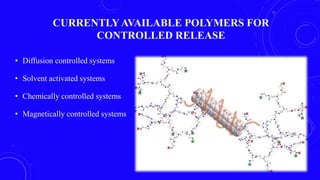
CURRENTLYAVAILABLE POLYMERS FOR
CONTROLLED RELEASE
• Diffusion controlled systems
• Solvent activated systems
• Chemically controlled systems
• Magnetically controlled systems
3/29/2017 3
DIFFUSION-CONTROLLED SYSTEM
Reservoir type Shape spherical, cylindrical, disk-like Core,
Powdered or liquid forms Properties of the drug and the polymer
diffusion rate and release rate into the bloodstream.
Problems - removal of the system, accidental rupture Matrix type Uniform
distribution and uniform release rate No danger of drug dumping
3/29/2017 4
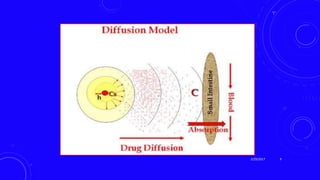
DIFFUSION LAYER MODEL
• Also called ‘film theory’.
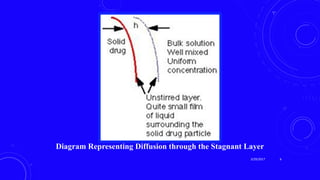
• Formation of a thin film at the interface, called as stagnant layer.
• 2 steps are involved:
1) Interaction of solvent with drug surface to form a saturated drug
layer , called stagnant layer.
2) Diffusion of drug molecules from stagnant layer into bulk of the
system.
3/29/2017 5
Diagram Representing Diffusion through the Stagnant Layer
3/29/2017 6
Noyes- Whitney’s equation:
dC/dt = Dissolution rate of the drug,
k = Dissolution rate constant,
Cs = Concentration of drug in the stagnant
layer, and
Cb = Concentration of drug in the bulk of the
solution at time t
3/29/2017 7
Modified Noyes-Whitney’s equation:
• Where,
• D = Diffusion coefficient (diffusivity) of the drug
• A = Surface area of the dissolving solid
• Kw/o = Water/oil partition coefficient of the drug.
• V = Volume of dissolution medium
• h = Thickness of the stagnant layer
• (Cs – Cb)= Concentration gradient for diffusion of drug.
3/29/2017 8
3/29/2017 9
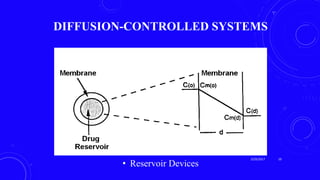
DIFFUSION-CONTROLLED SYSTEMS
• Reservoir Devices
3/29/2017 10
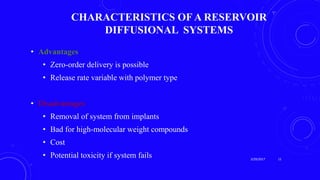
CHARACTERISTICS OF A RESERVOIR
DIFFUSIONAL SYSTEMS
• Advantages
• Zero-order delivery is possible
• Release rate variable with polymer type
• Disadvantages
• Removal of system from implants
• Bad for high-molecular weight compounds
• Cost
• Potential toxicity if system fails 3/29/2017 11
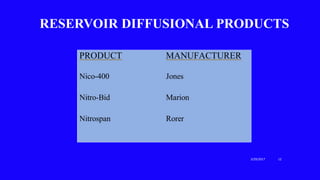
RESERVOIR DIFFUSIONAL PRODUCTS
PRODUCT MANUFACTURER
Nico-400 Jones
Nitro-Bid Marion
Nitrospan Rorer
3/29/2017 12
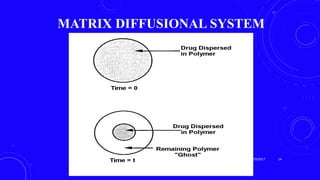
MATRIX DEVICES
• Consists of drug dispersed homogeneously throughout a polymer
matrix.
• Drug in the outside layer is exposed to the bathing solution is
dissolved and diffuses out of the matrix.
• This process continues with the interface between bathing solution
and the solid drug moving toward the interior.
3/29/2017 13
MATRIX DIFFUSIONAL SYSTEM
3/29/2017 14
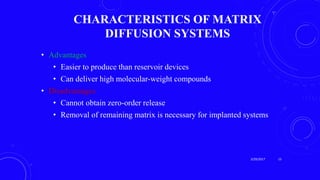
CHARACTERISTICS OF MATRIX
DIFFUSION SYSTEMS
• Advantages
• Easier to produce than reservoir devices
• Can deliver high molecular-weight compounds
• Disadvantages
• Cannot obtain zero-order release
• Removal of remaining matrix is necessary for implanted systems
3/29/2017 15
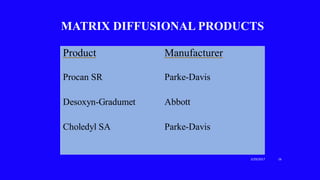
MATRIX DIFFUSIONAL PRODUCTS
Product Manufacturer
Procan SR Parke-Davis
Desoxyn-Gradumet Abbott
Choledyl SA Parke-Davis
3/29/2017 16
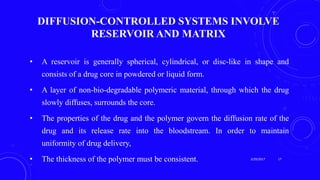
DIFFUSION-CONTROLLED SYSTEMS INVOLVE
RESERVOIR AND MATRIX
• A reservoir is generally spherical, cylindrical, or disc-like in shape and
consists of a drug core in powdered or liquid form.
• A layer of non-bio-degradable polymeric material, through which the drug
slowly diffuses, surrounds the core.
• The properties of the drug and the polymer govern the diffusion rate of the
drug and its release rate into the bloodstream. In order to maintain
uniformity of drug delivery,
• The thickness of the polymer must be consistent. 3/29/2017 17
PROBLEMS WITH THE RESERVOIR SYSTEM
-One of the problems with the reservoir system is that such a system must be
removed from the body after the drug is depleted because the polymer remains
intact.
-Another potential problem is that if the reservoir membrane accidentally
ruptures, a large amount of drug may be suddenly released into the bloodstream
(known as “drug dumping”).
3/29/2017 18
ADVANTAGE & DISADVANTAGE
• Advantage:-In the matrix type of diffusion-control system, the drug is
uniformly distributed throughout the polymer matrix and is released from the
matrix at a uniform rate as drug particles dislodge from the polymer network.
• In such a system, unlike the reservoir, there is no danger of drug dumping in
case of an accidental rupture of the membrane.
• Disadvantage:- Diffusion rate and release rate into the bloodstream
Problems - removal of the system 3/29/2017 19
SOLVENT-ACTIVATED SYSTEM
SOLVENT ACTIVATED SYSTEM Osmotically controlled system
Semipermeable membrane Osmotic pressure decrease concentration
gradient Inward movement of fluid, out of the device through a small
orifice Swelling controlled system Hydrophilic macromolecules cross-
linked to form a three-dimensional network Permeability for solute at a
controlled rate as the polymer swells.
• Solvent-activated systems are also of two types:-
• Swelling-controlled systems
• Osmotically controlled systems
3/29/2017 20
Swelling-controlled systems:-
• In the swelling-controlled systems, the polymer holds a large
quantity of water without dissolving.
• The system consists of hydrophilic macromolecules cross-linked to
form a three-dimensional network.
• A characteristic of such systems is their permeability, for low
molecular weight solutes, at a controlled rate as the polymer swells.
3/29/2017 21
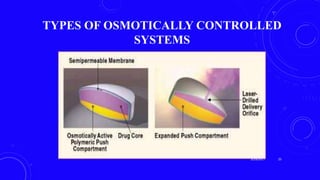
Osmotically controlled systems:-
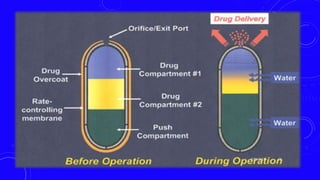
In the osmotically controlled system, an external fluid containing a
low concentration of a drug moves across a semipermeable
membrane to a region inside the device, where the drug is in high
concentration. Osmotic pressure tends to decrease the concentration
gradient between one side of the membrane and the other. The inward
movement of fluid forces the dissolved drug out of the device
through a small orifice.
3/29/2017 22
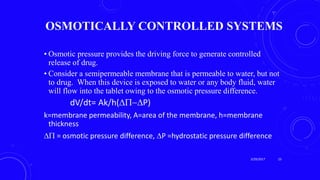
OSMOTICALLY CONTROLLED SYSTEMS
• Osmotic pressure provides the driving force to generate controlled
release of drug.
• Consider a semipermeable membrane that is permeable to water, but not
to drug. When this device is exposed to water or any body fluid, water
will flow into the tablet owing to the osmotic pressure difference.
dV/dt= Ak/h(P)
k=membrane permeability, A=area of the membrane, h=membrane
thickness
 = osmotic pressure difference, P =hydrostatic pressure difference
3/29/2017 23
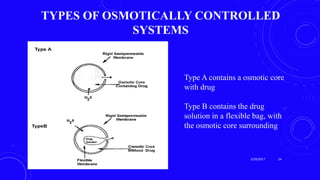
TYPES OF OSMOTICALLY CONTROLLED
SYSTEMS
Type A contains a osmotic core
with drug
Type B contains the drug
solution in a flexible bag, with
the osmotic core surrounding
3/29/2017 24
TYPES OF OSMOTICALLY CONTROLLED
SYSTEMS
3/29/2017 25
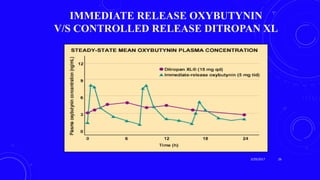
IMMEDIATE RELEASE OXYBUTYNIN
V/S CONTROLLED RELEASE DITROPAN XL
3/29/2017 26
CHARACTERISTICS OF OSMOTICALLY
CONTROLLED DEVICES
• Advantages
• Zero-order release is obtainable
• Reformulation is not required for different drugs
• Release of drug is independent of environment of the system
• Disadvantages
• Systems can be very expensive
• Quality control is more extensive
3/29/2017 27
EXAMPLES OF OSMOTIC PUMP
SYSTEMS
• Acutrim Appetite suppressant
• Concerta ADHD
• Procardia Hypertension/angina
• Volmax Bronchiodilator
• Ditropan Overactive bladder
3/29/2017 28
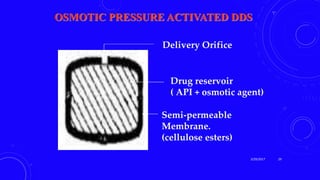
OSMOTIC PRESSURE ACTIVATED DDS
Drug reservoir
( API + osmotic agent)
Delivery Orifice
Semi-permeable
Membrane.
(cellulose esters)
3/29/2017 29
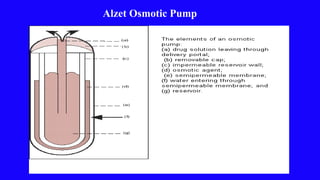
Alzet Osmotic Pump
3/29/2017 30
MAJOR COMPANIES INVOLVED IN
POLYMERIC DELIVERY TECHNOLOGY
• Alza - DUROS, OROS
• Alkermes Inc - Ring Caps
• Nobex Corp. - Drug/Polymer Conjugates
• Elan - MODAS, PRODAS
• Andrx - SCOT, DPHS
3/29/2017 31
CHEMICALLY CONTROLLED SYSTEM
CHEMICALLY CONTROLLED SYSTEMS Pendant-chain system
Drug,chemically linked to the backbone
Chemical hydrolysis or enzymatic cleavage Linked directly or via a
spacer group Bioerodable or biodegradable system Drug: uniformly
dispersed Slow released as the polymer disintegrates No removal
from the body Irrespective of solubility of drug in water
Chemically controlled systems also have two classes:-
• The “pendant-chain” system and
• The bio-erodible or biodegradable, system.
3/29/2017 32
• Pendant-chain system:- A “pendant chain system” is one in which
the drug molecule is chemically linked to the backbone of the
polymer. In the body, in the presence of enzymes and biological
fluids, chemical hydrolysis, or enzymatic cleavage, occurs with
concomitant release of the drug at a controlled rate. The drug may be
linked directly to the polymer or via a “spacer group”.
3/29/2017 33
Bio-erodible or biodegradable, system:- In the bio-erodible system, the
controlled release of the drug involves polymers that gradually decompose. The
drug is dispersed uniformly throughout the polymer and is slowly released as the
polymer disintegrates.
3/29/2017 34
TWO MAJOR ADVANTAGES OF ERODIBLE
SYSTEMS ARE
(1) Polymers do not have to be removed from the body after the drug
supply is exhausted,
(2) The drug does not have to be water-soluble .In fact, because of
these factors, future use of bio-erodible polymers is likely to increase
more than any other type of polymer in the future.
3/29/2017 35
BIOERODIBLE AND COMBINATION
DIFFUSION AND DISSOLUTION SYSTEM
• Strictly speaking, therapeutic systems will never be dependent on dissolution only
or diffusion only.
• Bioerodibile devices, however, constitute a group of systems for which
mathematical descriptions of release is complex.
• The complexity of the system arises from the fact that, as the polymer dissolves,
the diffusion path length for the drug may change. this usually results in a
moving-boundary diffusion system.
• Zero-order release can occur only if surface erosion occurs and surface area does
not change with time.
• The inherent advantage of such a system is that the bioerodible property of the
matrix does not result in a ghost matrix.
3/29/2017 36
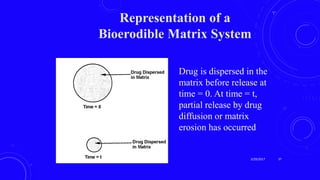
Representation of a
Bioerodible Matrix System
Drug is dispersed in the
matrix before release at
time = 0. At time = t,
partial release by drug
diffusion or matrix
erosion has occurred
3/29/2017 37
CHARACTERISTICS OF
BIOERODIBLE MATRIX SYSTEMS
• Advantages
• All the advantages of matrix dissolution system
• Removal from implant sites is not necessary
• Disadvantages
• Difficult to control kinetics owing to multiple processes of release
• Potential toxicity of degraded polymer
3/29/2017 38
BIOERODIBLE AND BIODEGRADABLE CONTROLLED
RELEASE POLYMERS
These polymers are designed to degrade within the body
• Polylactides (PLA)
• Polyglycolides (PGA)
• Polylactide-co-glycolides (PLGA)
• Polyanhydrides
• Polyorthoesters
3/29/2017 39
DEGRADATION OF BIODEGRADABLE
POLYMERS
These materials degrade within the body as a result of natural
biological processes, eliminating the need to remove a drug delivery
system after release of the active agent has been completed
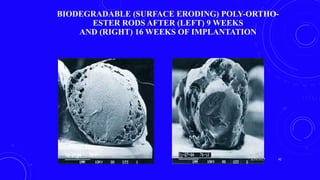
• Bulk hydrolysis - the polymer degrades in a fairly uniform manner
throughout the matrix
• Surface Eroding - degradation occurs only at the surface of the
polymer, resulting in a release rate that is proportional to the surface
area of the drug delivery system
3/29/2017 40
BIODEGRADABLE POLYMERS
Drug delivery from
(a) Bulk-eroding
(b) Surface-eroding
biodegradable systems.
3/29/2017 41
BIODEGRADABLE (SURFACE ERODING) POLY-ORTHO-
ESTER RODS AFTER (LEFT) 9 WEEKS
AND (RIGHT) 16 WEEKS OF IMPLANTATION
Drug delivery from
(a) bulk-eroding and
(b) surface-eroding
biodegradable systems.
3/29/2017 42
MAJOR COMPANIES INVOLVED IN
POLYMERIC DELIVERY TECHNOLOGY
• Alza - DUROS, OROS
• Alkermes Inc - Ring Caps
• Nobex Corp. - Drug/Polymer Conjugates
• Elan - MODAS, PRODAS
• Andrx - SCOT, DPHS
3/29/2017 43
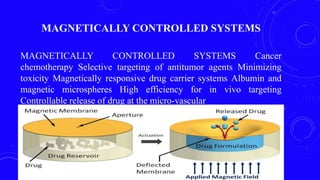
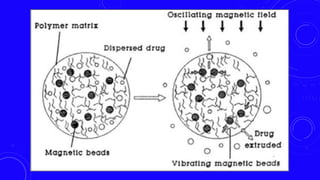
MAGNETICALLY CONTROLLED SYSTEMS
MAGNETICALLY CONTROLLED SYSTEMS Cancer
chemotherapy Selective targeting of antitumor agents Minimizing
toxicity Magnetically responsive drug carrier systems Albumin and
magnetic microspheres High efficiency for in vivo targeting
Controllable release of drug at the micro-vascular
3/29/2017 44
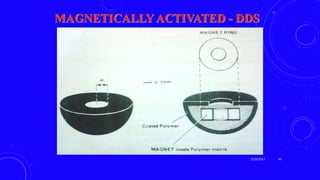
MAGNETICALLY ACTIVATED - DDS
3/29/2017 45
 In this type, drug reservoir is a dispersion of peptide or
protein powders in polymer matrix from which
macromolecular drug can be delivered only at a
relatively slow rate.
 Device is fabricated by positioning a tiny magnet ring
in core of hemispherical drug dispersing polymer
matrix.
 The external surface is coated with drug impermeable
polymer (ethylene vinyl acetate or silicone elastomer)
except one cavity at the centre of the flat surface.
3/29/2017 46
 This delivery device used to deliver protein
drugs such as bovine serum albumin, at a low
basal rate, by a simple diffusion process under
non triggering condition.
 As the magnet is activated to vibrate by an
external electromagnetic field, the drug
molecules are delivered at a much higher rate.
3/29/2017 47
3/29/2017 48
POLYMERS FOR CONTROLLED RELEASE
These are some of the first materials selected for delivery systems
bases on their intended non-biological physical properties:
• Polyurethanes for elasticity
• Polysiloxanes for insulating ability
• Polymethyl methacrylate for physical strength and transparency
• Polyvinyl alcohol for hydrophilicity and swelling
• Polyvinyl pyrrolidone for suspension capabilities
3/29/2017 49
3/29/2017 50
REFERENCE
• Drug delivery systems ( second edition) –Vasant V.Ranade, A.Mannfred
Hollinger
• http://www.purac.com/purac-biomaterials
Leon lachman – The theory and practic of industrial pharmacy.
 Michael E Alton - Pharmaceutics
The science of dosage form design.
 N.K. Jain – Controlled & novel drug delivery.
 S.P. Vyas & Khar – Controlled Drug delivery,
 Brahmankar – Text Book of Biopharmaceutics & Pharmacokinetics.
 Yie.W.Chein- Controlled & Novel Drug Delivery, CBS publishers.3/29/2017 51
3/29/2017 52

Diffusion controlled systems, solvent-activated system, chemically controlled system

  • 1.
    DIFFUSION-CONTROLLED SYSTEMS, SOLVENT-ACTIVATED SYSTEM, CHEMICALLY CONTROLLEDSYSTEM PRESENTED BY-Biswajit Maity M.Sc. (POLYMER SCIENCE) 3/29/2017 1
  • 2.
    CONTENTS • DIFFUSION CONTROLLEDSYSTEM • What is diffusion controlled system • Reservoir and matrix • Problems with the reservoir system • Advantage & Disadvantage • SOLVENT-ACTIVATED SYSTEM • What is solvent-activated system • Classification • Osmotically controlled systems • Swelling-controlled systems • CHEMICALLY CONTROLLED SYSTEM • What is chemically controlled system • Classification • Pendant-chain system • Bio-erodible or biodegradable system • Major advantages of erodible systems • MAGNETICALLY CONTROLLED SYSTEMS • Reference 3/29/2017 2
  • 3.
    CURRENTLYAVAILABLE POLYMERS FOR CONTROLLEDRELEASE • Diffusion controlled systems • Solvent activated systems • Chemically controlled systems • Magnetically controlled systems 3/29/2017 3
  • 4.
    DIFFUSION-CONTROLLED SYSTEM Reservoir typeShape spherical, cylindrical, disk-like Core, Powdered or liquid forms Properties of the drug and the polymer diffusion rate and release rate into the bloodstream. Problems - removal of the system, accidental rupture Matrix type Uniform distribution and uniform release rate No danger of drug dumping 3/29/2017 4
  • 5.
    DIFFUSION LAYER MODEL •Also called ‘film theory’. • Formation of a thin film at the interface, called as stagnant layer. • 2 steps are involved: 1) Interaction of solvent with drug surface to form a saturated drug layer , called stagnant layer. 2) Diffusion of drug molecules from stagnant layer into bulk of the system. 3/29/2017 5
  • 6.
    Diagram Representing Diffusionthrough the Stagnant Layer 3/29/2017 6
  • 7.
    Noyes- Whitney’s equation: dC/dt= Dissolution rate of the drug, k = Dissolution rate constant, Cs = Concentration of drug in the stagnant layer, and Cb = Concentration of drug in the bulk of the solution at time t 3/29/2017 7
  • 8.
    Modified Noyes-Whitney’s equation: •Where, • D = Diffusion coefficient (diffusivity) of the drug • A = Surface area of the dissolving solid • Kw/o = Water/oil partition coefficient of the drug. • V = Volume of dissolution medium • h = Thickness of the stagnant layer • (Cs – Cb)= Concentration gradient for diffusion of drug. 3/29/2017 8
  • 9.
  • 10.
  • 11.
    CHARACTERISTICS OF ARESERVOIR DIFFUSIONAL SYSTEMS • Advantages • Zero-order delivery is possible • Release rate variable with polymer type • Disadvantages • Removal of system from implants • Bad for high-molecular weight compounds • Cost • Potential toxicity if system fails 3/29/2017 11
  • 12.
    RESERVOIR DIFFUSIONAL PRODUCTS PRODUCTMANUFACTURER Nico-400 Jones Nitro-Bid Marion Nitrospan Rorer 3/29/2017 12
  • 13.
    MATRIX DEVICES • Consistsof drug dispersed homogeneously throughout a polymer matrix. • Drug in the outside layer is exposed to the bathing solution is dissolved and diffuses out of the matrix. • This process continues with the interface between bathing solution and the solid drug moving toward the interior. 3/29/2017 13
  • 14.
  • 15.
    CHARACTERISTICS OF MATRIX DIFFUSIONSYSTEMS • Advantages • Easier to produce than reservoir devices • Can deliver high molecular-weight compounds • Disadvantages • Cannot obtain zero-order release • Removal of remaining matrix is necessary for implanted systems 3/29/2017 15
  • 16.
    MATRIX DIFFUSIONAL PRODUCTS ProductManufacturer Procan SR Parke-Davis Desoxyn-Gradumet Abbott Choledyl SA Parke-Davis 3/29/2017 16
  • 17.
    DIFFUSION-CONTROLLED SYSTEMS INVOLVE RESERVOIRAND MATRIX • A reservoir is generally spherical, cylindrical, or disc-like in shape and consists of a drug core in powdered or liquid form. • A layer of non-bio-degradable polymeric material, through which the drug slowly diffuses, surrounds the core. • The properties of the drug and the polymer govern the diffusion rate of the drug and its release rate into the bloodstream. In order to maintain uniformity of drug delivery, • The thickness of the polymer must be consistent. 3/29/2017 17
  • 18.
    PROBLEMS WITH THERESERVOIR SYSTEM -One of the problems with the reservoir system is that such a system must be removed from the body after the drug is depleted because the polymer remains intact. -Another potential problem is that if the reservoir membrane accidentally ruptures, a large amount of drug may be suddenly released into the bloodstream (known as “drug dumping”). 3/29/2017 18
  • 19.
    ADVANTAGE & DISADVANTAGE •Advantage:-In the matrix type of diffusion-control system, the drug is uniformly distributed throughout the polymer matrix and is released from the matrix at a uniform rate as drug particles dislodge from the polymer network. • In such a system, unlike the reservoir, there is no danger of drug dumping in case of an accidental rupture of the membrane. • Disadvantage:- Diffusion rate and release rate into the bloodstream Problems - removal of the system 3/29/2017 19
  • 20.
    SOLVENT-ACTIVATED SYSTEM SOLVENT ACTIVATEDSYSTEM Osmotically controlled system Semipermeable membrane Osmotic pressure decrease concentration gradient Inward movement of fluid, out of the device through a small orifice Swelling controlled system Hydrophilic macromolecules cross- linked to form a three-dimensional network Permeability for solute at a controlled rate as the polymer swells. • Solvent-activated systems are also of two types:- • Swelling-controlled systems • Osmotically controlled systems 3/29/2017 20
  • 21.
    Swelling-controlled systems:- • Inthe swelling-controlled systems, the polymer holds a large quantity of water without dissolving. • The system consists of hydrophilic macromolecules cross-linked to form a three-dimensional network. • A characteristic of such systems is their permeability, for low molecular weight solutes, at a controlled rate as the polymer swells. 3/29/2017 21
  • 22.
    Osmotically controlled systems:- Inthe osmotically controlled system, an external fluid containing a low concentration of a drug moves across a semipermeable membrane to a region inside the device, where the drug is in high concentration. Osmotic pressure tends to decrease the concentration gradient between one side of the membrane and the other. The inward movement of fluid forces the dissolved drug out of the device through a small orifice. 3/29/2017 22
  • 23.
    OSMOTICALLY CONTROLLED SYSTEMS •Osmotic pressure provides the driving force to generate controlled release of drug. • Consider a semipermeable membrane that is permeable to water, but not to drug. When this device is exposed to water or any body fluid, water will flow into the tablet owing to the osmotic pressure difference. dV/dt= Ak/h(P) k=membrane permeability, A=area of the membrane, h=membrane thickness  = osmotic pressure difference, P =hydrostatic pressure difference 3/29/2017 23
  • 24.
    TYPES OF OSMOTICALLYCONTROLLED SYSTEMS Type A contains a osmotic core with drug Type B contains the drug solution in a flexible bag, with the osmotic core surrounding 3/29/2017 24
  • 25.
    TYPES OF OSMOTICALLYCONTROLLED SYSTEMS 3/29/2017 25
  • 26.
    IMMEDIATE RELEASE OXYBUTYNIN V/SCONTROLLED RELEASE DITROPAN XL 3/29/2017 26
  • 27.
    CHARACTERISTICS OF OSMOTICALLY CONTROLLEDDEVICES • Advantages • Zero-order release is obtainable • Reformulation is not required for different drugs • Release of drug is independent of environment of the system • Disadvantages • Systems can be very expensive • Quality control is more extensive 3/29/2017 27
  • 28.
    EXAMPLES OF OSMOTICPUMP SYSTEMS • Acutrim Appetite suppressant • Concerta ADHD • Procardia Hypertension/angina • Volmax Bronchiodilator • Ditropan Overactive bladder 3/29/2017 28
  • 29.
    OSMOTIC PRESSURE ACTIVATEDDDS Drug reservoir ( API + osmotic agent) Delivery Orifice Semi-permeable Membrane. (cellulose esters) 3/29/2017 29
  • 30.
  • 31.
    MAJOR COMPANIES INVOLVEDIN POLYMERIC DELIVERY TECHNOLOGY • Alza - DUROS, OROS • Alkermes Inc - Ring Caps • Nobex Corp. - Drug/Polymer Conjugates • Elan - MODAS, PRODAS • Andrx - SCOT, DPHS 3/29/2017 31
  • 32.
    CHEMICALLY CONTROLLED SYSTEM CHEMICALLYCONTROLLED SYSTEMS Pendant-chain system Drug,chemically linked to the backbone Chemical hydrolysis or enzymatic cleavage Linked directly or via a spacer group Bioerodable or biodegradable system Drug: uniformly dispersed Slow released as the polymer disintegrates No removal from the body Irrespective of solubility of drug in water Chemically controlled systems also have two classes:- • The “pendant-chain” system and • The bio-erodible or biodegradable, system. 3/29/2017 32
  • 33.
    • Pendant-chain system:-A “pendant chain system” is one in which the drug molecule is chemically linked to the backbone of the polymer. In the body, in the presence of enzymes and biological fluids, chemical hydrolysis, or enzymatic cleavage, occurs with concomitant release of the drug at a controlled rate. The drug may be linked directly to the polymer or via a “spacer group”. 3/29/2017 33
  • 34.
    Bio-erodible or biodegradable,system:- In the bio-erodible system, the controlled release of the drug involves polymers that gradually decompose. The drug is dispersed uniformly throughout the polymer and is slowly released as the polymer disintegrates. 3/29/2017 34
  • 35.
    TWO MAJOR ADVANTAGESOF ERODIBLE SYSTEMS ARE (1) Polymers do not have to be removed from the body after the drug supply is exhausted, (2) The drug does not have to be water-soluble .In fact, because of these factors, future use of bio-erodible polymers is likely to increase more than any other type of polymer in the future. 3/29/2017 35
  • 36.
    BIOERODIBLE AND COMBINATION DIFFUSIONAND DISSOLUTION SYSTEM • Strictly speaking, therapeutic systems will never be dependent on dissolution only or diffusion only. • Bioerodibile devices, however, constitute a group of systems for which mathematical descriptions of release is complex. • The complexity of the system arises from the fact that, as the polymer dissolves, the diffusion path length for the drug may change. this usually results in a moving-boundary diffusion system. • Zero-order release can occur only if surface erosion occurs and surface area does not change with time. • The inherent advantage of such a system is that the bioerodible property of the matrix does not result in a ghost matrix. 3/29/2017 36
  • 37.
    Representation of a BioerodibleMatrix System Drug is dispersed in the matrix before release at time = 0. At time = t, partial release by drug diffusion or matrix erosion has occurred 3/29/2017 37
  • 38.
    CHARACTERISTICS OF BIOERODIBLE MATRIXSYSTEMS • Advantages • All the advantages of matrix dissolution system • Removal from implant sites is not necessary • Disadvantages • Difficult to control kinetics owing to multiple processes of release • Potential toxicity of degraded polymer 3/29/2017 38
  • 39.
    BIOERODIBLE AND BIODEGRADABLECONTROLLED RELEASE POLYMERS These polymers are designed to degrade within the body • Polylactides (PLA) • Polyglycolides (PGA) • Polylactide-co-glycolides (PLGA) • Polyanhydrides • Polyorthoesters 3/29/2017 39
  • 40.
    DEGRADATION OF BIODEGRADABLE POLYMERS Thesematerials degrade within the body as a result of natural biological processes, eliminating the need to remove a drug delivery system after release of the active agent has been completed • Bulk hydrolysis - the polymer degrades in a fairly uniform manner throughout the matrix • Surface Eroding - degradation occurs only at the surface of the polymer, resulting in a release rate that is proportional to the surface area of the drug delivery system 3/29/2017 40
  • 41.
    BIODEGRADABLE POLYMERS Drug deliveryfrom (a) Bulk-eroding (b) Surface-eroding biodegradable systems. 3/29/2017 41
  • 42.
    BIODEGRADABLE (SURFACE ERODING)POLY-ORTHO- ESTER RODS AFTER (LEFT) 9 WEEKS AND (RIGHT) 16 WEEKS OF IMPLANTATION Drug delivery from (a) bulk-eroding and (b) surface-eroding biodegradable systems. 3/29/2017 42
  • 43.
    MAJOR COMPANIES INVOLVEDIN POLYMERIC DELIVERY TECHNOLOGY • Alza - DUROS, OROS • Alkermes Inc - Ring Caps • Nobex Corp. - Drug/Polymer Conjugates • Elan - MODAS, PRODAS • Andrx - SCOT, DPHS 3/29/2017 43
  • 44.
    MAGNETICALLY CONTROLLED SYSTEMS MAGNETICALLYCONTROLLED SYSTEMS Cancer chemotherapy Selective targeting of antitumor agents Minimizing toxicity Magnetically responsive drug carrier systems Albumin and magnetic microspheres High efficiency for in vivo targeting Controllable release of drug at the micro-vascular 3/29/2017 44
  • 45.
    MAGNETICALLY ACTIVATED -DDS 3/29/2017 45
  • 46.
     In thistype, drug reservoir is a dispersion of peptide or protein powders in polymer matrix from which macromolecular drug can be delivered only at a relatively slow rate.  Device is fabricated by positioning a tiny magnet ring in core of hemispherical drug dispersing polymer matrix.  The external surface is coated with drug impermeable polymer (ethylene vinyl acetate or silicone elastomer) except one cavity at the centre of the flat surface. 3/29/2017 46
  • 47.
     This deliverydevice used to deliver protein drugs such as bovine serum albumin, at a low basal rate, by a simple diffusion process under non triggering condition.  As the magnet is activated to vibrate by an external electromagnetic field, the drug molecules are delivered at a much higher rate. 3/29/2017 47
  • 48.
  • 49.
    POLYMERS FOR CONTROLLEDRELEASE These are some of the first materials selected for delivery systems bases on their intended non-biological physical properties: • Polyurethanes for elasticity • Polysiloxanes for insulating ability • Polymethyl methacrylate for physical strength and transparency • Polyvinyl alcohol for hydrophilicity and swelling • Polyvinyl pyrrolidone for suspension capabilities 3/29/2017 49
  • 50.
  • 51.
    REFERENCE • Drug deliverysystems ( second edition) –Vasant V.Ranade, A.Mannfred Hollinger • http://www.purac.com/purac-biomaterials Leon lachman – The theory and practic of industrial pharmacy.  Michael E Alton - Pharmaceutics The science of dosage form design.  N.K. Jain – Controlled & novel drug delivery.  S.P. Vyas & Khar – Controlled Drug delivery,  Brahmankar – Text Book of Biopharmaceutics & Pharmacokinetics.  Yie.W.Chein- Controlled & Novel Drug Delivery, CBS publishers.3/29/2017 51
  • 52.