POLYMERS
Presented By; Mr Ashok Kumar
M.Pharm 1st sem
Department : Pharmaceutics
GEETANJALI INSTITUTE OF PHARMACY
CONTENTS
• Introduction
• Types of Polymer
• Classification of Polymer
• Characteristics of Polymer
• Application
• References
INTRODUCTION
• Polymers are very large molecules made when hundreds of monomers join together
to form long chains .
• The word POLYMER comes from the Greek words poly means many and mer
means parts .
• Polymer is used as a synonym for plastic .
• All plastics are polymers , but not all polymers are plastics
N(CH2-CH2) (-CH2-CH2-)s
Ethylene Polyethylene
TYPES OF POLYMER
• Natural Polymers
• Homopolymer
• Copolymer
• Thermoplastics
• Thermosets
• Long chain Polymers
NATURAL POLYMERS
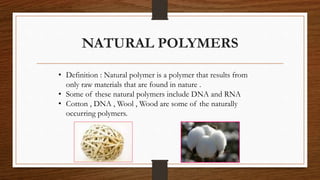
• Definition : Natural polymer is a polymer that results from
only raw materials that are found in nature .
• Some of these natural polymers include DNA and RNA
• Cotton , DNA , Wool , Wood are some of the naturally
occurring polymers.
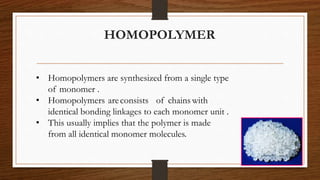
HOMOPOLYMER
• Homopolymers are synthesized from a single type
of monomer .
• Homopolymers areconsists of chains with
identical bonding linkages to each monomer unit .
• This usually implies that the polymer is made
from all identical monomer molecules.
COPOLYMER
• When two or more different monomers togetherto polymerize their
result is called as copolymer .
• This process is called as copolymerization .
• Types of Copolymer :
I. Statistical copolymer
II. Alternating copolymer
III. Block copolymer
IV. Graft copolymer
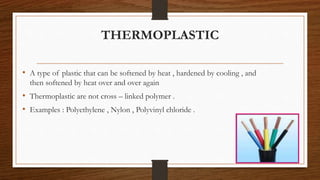
THERMOPLASTIC
• A type of plastic that can be softened by heat , hardened by cooling , and
then softened by heat over and over again
• Thermoplastic are not cross – linked polymer .
• Examples : Polyethylene , Nylon , Polyvinyl chloride .
THERMOSETS
• Thermoset having the property of becoming permanently hard and rigid
when heated .
• Thermosets are hard and rigid at room temperature and do not soften on
heating .
• Examples : Epoxy resins , Phenolic resins , Unsaturated polyester resins
LONG CHAIN POLYMERS
• A very long strand of repeating molecules linked together by primary bond .
• Polymer chains are orient themselves in lines as they enter a mold but may
be annealed so they can recoil .
BASED ON ORIGIN OF SOURCE
• Natural natural Polymer :- Polymers which are isolated from materials are
called as Natural Polymers . E.g. Cotton , silk , wool , rubber.
• Synthetic Polymer :- Polymers which are synthesized from low molecular
weight compounds are called as Synthetic Polymers . E.g. : Polyethylene ,
nylon , terylene.
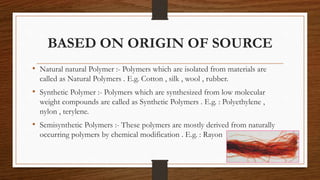
• Semisynthetic Polymers :- These polymers are mostly derived from naturally
occurring polymers by chemical modification . E.g. : Rayon
BASED ON STRUCTURE
• Linear Polymer : Molecules form long chains without
branches.
• Branched Polymer : Molecules having branch points that
connect 3 or more segments .
• Cross-Linked Polymer : It includes interconnections
between chains .
• Network Polymer : A cross linked polymer that includes
numerous interconnections between chains .
BASED ON MODE OF
POLYMERISATION
• Additional Polymerization :
🗸Same kind of monomers are straight forwardly added .
🗸 It is rapid chain reaction having chemically activated mers.
🗸Each reaction sets up the condition for another to proceed.
🗸 It consists of 3 stages :
INITIATION
(Birth)
PROPAGATION
(Growth)
TERMINATION
(Death)
CONT…
Condensation Polymerization :
🗸 It involves a polymerization reaction between two monomers with
the expulsion of a simple by product .
A+B AB + Simple by Product
🗸 It involves individual chemical reaction between reactive mer .
🗸By product is formed and condensed out .
🗸This reaction is slower than additional polymerization.
🗸Need reactive functional groups .
CHARACTERISTICS OF POLYMER
• Low density
• Low coefficient of friction
• Good corrosion resistance
• Good mould ability
• Poor tensile strength
• Low mechanical properties
• Poor temperature resistance
• Can be produced transparent or different colours
APPLICATION
• Medicine : Many biomaterials especially heart valve replacements and blood
vessels are made up of polymers like dacron , teflon .
• Consumer Science : Plastic containers of all shapes and sizes are light weight
and economically less expensive than more traditional containers .
• Industry : Automobile parts , pipes , tanks , packing material , adhesives are
all polymer application used in industrial market .
• Sports : Playground equipment , golf clubs , swimming pools and protective
helmets are produced from polymers.
REFERENCES
• Robinson J R and Lee V H ; Controlled Drug Delivery – Fundamentals and
Applications ; Marcel Dekker .
• Jain N K ; Controlled and Novel Drug Delivery ; CBS publication .
Polymer ppt M pharm

Polymer ppt M pharm

  • 1.
    POLYMERS Presented By; MrAshok Kumar M.Pharm 1st sem Department : Pharmaceutics GEETANJALI INSTITUTE OF PHARMACY
  • 2.
    CONTENTS • Introduction • Typesof Polymer • Classification of Polymer • Characteristics of Polymer • Application • References
  • 3.
    INTRODUCTION • Polymers arevery large molecules made when hundreds of monomers join together to form long chains . • The word POLYMER comes from the Greek words poly means many and mer means parts . • Polymer is used as a synonym for plastic . • All plastics are polymers , but not all polymers are plastics N(CH2-CH2) (-CH2-CH2-)s Ethylene Polyethylene
  • 4.
    TYPES OF POLYMER •Natural Polymers • Homopolymer • Copolymer • Thermoplastics • Thermosets • Long chain Polymers
  • 5.
    NATURAL POLYMERS • Definition: Natural polymer is a polymer that results from only raw materials that are found in nature . • Some of these natural polymers include DNA and RNA • Cotton , DNA , Wool , Wood are some of the naturally occurring polymers.
  • 6.
    HOMOPOLYMER • Homopolymers aresynthesized from a single type of monomer . • Homopolymers areconsists of chains with identical bonding linkages to each monomer unit . • This usually implies that the polymer is made from all identical monomer molecules.
  • 7.
    COPOLYMER • When twoor more different monomers togetherto polymerize their result is called as copolymer . • This process is called as copolymerization . • Types of Copolymer : I. Statistical copolymer II. Alternating copolymer III. Block copolymer IV. Graft copolymer
  • 8.
    THERMOPLASTIC • A typeof plastic that can be softened by heat , hardened by cooling , and then softened by heat over and over again • Thermoplastic are not cross – linked polymer . • Examples : Polyethylene , Nylon , Polyvinyl chloride .
  • 9.
    THERMOSETS • Thermoset havingthe property of becoming permanently hard and rigid when heated . • Thermosets are hard and rigid at room temperature and do not soften on heating . • Examples : Epoxy resins , Phenolic resins , Unsaturated polyester resins
  • 10.
    LONG CHAIN POLYMERS •A very long strand of repeating molecules linked together by primary bond . • Polymer chains are orient themselves in lines as they enter a mold but may be annealed so they can recoil .
  • 12.
    BASED ON ORIGINOF SOURCE • Natural natural Polymer :- Polymers which are isolated from materials are called as Natural Polymers . E.g. Cotton , silk , wool , rubber. • Synthetic Polymer :- Polymers which are synthesized from low molecular weight compounds are called as Synthetic Polymers . E.g. : Polyethylene , nylon , terylene. • Semisynthetic Polymers :- These polymers are mostly derived from naturally occurring polymers by chemical modification . E.g. : Rayon
  • 13.
    BASED ON STRUCTURE •Linear Polymer : Molecules form long chains without branches. • Branched Polymer : Molecules having branch points that connect 3 or more segments . • Cross-Linked Polymer : It includes interconnections between chains . • Network Polymer : A cross linked polymer that includes numerous interconnections between chains .
  • 14.
    BASED ON MODEOF POLYMERISATION • Additional Polymerization : 🗸Same kind of monomers are straight forwardly added . 🗸 It is rapid chain reaction having chemically activated mers. 🗸Each reaction sets up the condition for another to proceed. 🗸 It consists of 3 stages : INITIATION (Birth) PROPAGATION (Growth) TERMINATION (Death)
  • 15.
    CONT… Condensation Polymerization : 🗸It involves a polymerization reaction between two monomers with the expulsion of a simple by product . A+B AB + Simple by Product 🗸 It involves individual chemical reaction between reactive mer . 🗸By product is formed and condensed out . 🗸This reaction is slower than additional polymerization. 🗸Need reactive functional groups .
  • 16.
    CHARACTERISTICS OF POLYMER •Low density • Low coefficient of friction • Good corrosion resistance • Good mould ability • Poor tensile strength • Low mechanical properties • Poor temperature resistance • Can be produced transparent or different colours
  • 17.
    APPLICATION • Medicine :Many biomaterials especially heart valve replacements and blood vessels are made up of polymers like dacron , teflon . • Consumer Science : Plastic containers of all shapes and sizes are light weight and economically less expensive than more traditional containers . • Industry : Automobile parts , pipes , tanks , packing material , adhesives are all polymer application used in industrial market . • Sports : Playground equipment , golf clubs , swimming pools and protective helmets are produced from polymers.
  • 18.
    REFERENCES • Robinson JR and Lee V H ; Controlled Drug Delivery – Fundamentals and Applications ; Marcel Dekker . • Jain N K ; Controlled and Novel Drug Delivery ; CBS publication .