WELCOME
Dr. Hamima Hasnat
Assistant Professor
Department of Microbiology
Eastern Medical College, Cumilla
Microbial Genetics
Learning objectives :
• Mutations
• Transfer of DNA Within Bacterial Cells
• Transfer of DNA Between Bacterial Cells
1. Conjugation
2. Transduction
3. Transformation
• Recombination
MUTATION
• A mutation is a change in the base sequence of DNA.
• It results by insertion of a different amino-acid (A.A) into a
protein; and this leads to the development of an altered
phenotype.
Mutations result from three types of molecular changes:
a) Base substitution
b) Frameshift mutation,
c) Transposon mutation.
a) Base substitution:
• When one base is inserted in place of another
• It takes place at the time of DNA replication.
It occurs in two ways:
-Missense mutation: When the base substitution results in a
codon that simply causes a different amino acid to be inserted,
but protein synthesis continues.
-Nonsense mutations: When the base substitution generates a
termination codon that stops protein synthesis prematurely.
(b) Frameshift mutation:
• Occurs when one or more base pairs are added or deleted.
• This results in production of an inactive protein.
c) Transposon mutation:
• Transposons are jumping genes that move within or between
bacterial cells.
• This mutation occurs when transposons or insertion sequences
are integrated into DNA
• The newly inserted pieces of DNA will lead to profound
changes in the genes. This occurs when one or more base pairs
are added or deleted.
Transposon mutation
Mutations can be caused by :
• Caused spontaneously (mistakes in DNA synthesis).
• Induced by Physicochemical forces like:-
1. Chemicals:- nitrous acid, alkylating agents, 5-bromouracil,
benzpyrene.
2. Radiation:- X-rays and ultraviolet light.
• Viruses:- Certain viruses, such as the bacterial virus Mu
(mutator bacteriophage), cause a high frequency of mutations
when their DNA is inserted into the bacterial chromosome.
TRANSFER OF DNA WITHIN BACTERIAL CELL
This can occur by the following:
• Transposons: Transfer DNA from one site on the bacterial
chromosome to another site or to a plasmid. The transposon
does this by forming a copy of its DNA, and then inserts this
copy at another site of the bacterial chromosome or the
plasmid.
Transposone mediated DNA transfer
• Programmed Rearrangements: Movement of a gene from a
silent storage site (gene not expressed) to an active site
(transcription and translation occur). Hence bacteria develop
antigen changes.
• These gene rearrangements account for many of the antigenic
changes seen in Neisseria gonorrhoeae and Borrelia
recurrentis.
Programmed rearrangements
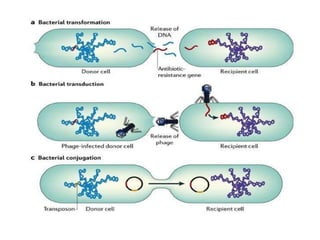
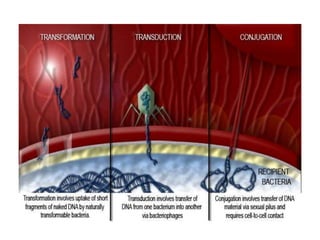
TRANSFER OF DNA BETWEEN BACTERIAL CELLS
• Conjugation,
• Transduction, &
• Transformation
Two most important consequences of DNA transfer are ;
(1) that antibiotic resistance genes are spread from one
bacterium to another primarily by conjugation and
(2) that several important exotoxins are encoded by
bacteriophage genes and are transferred by transduction.
Conjugation
• Conjugation is the mating of two bacterial cells, during which
DNA is transferred from the donor to the recipient cell.
• This mating process is controlled by the fertility plasmid
(F-factor).
• Bacteria that have a F plasmid are referred to as as F+ or male.
And those do not have an F plasmid are F- or female.
• After an enzymatic cleavage of the F factor DNA in the
donor cell, one strand is transferred by the sex pilus
(conjugaton tube) into the recipient cell.
• Then complementary strand is synthesised to form a
double-stranded F factor plasmid in both the donor and
recipient cells. The recipient is now an F+ male cell that
is capable of transmitting the plasmid further.
Steps of conjugation
• When the F+ plasmid is integrated within the bacterial
chromosome, the cell is called an Hfr cell (high frequency of
recombination cell).
Hfr conjugation
• During conjugation, an Hfr cell can transfer chromosomal
DNA to an F– cell.
• Usually, the Hfr chromosome breaks before it is fully
transferred
Transduction
• Transfer of cell DNA by a bacteriophage.
• During the growth of the virus within the cell, a piece of
bacterial DNA is incorporated into the virus particle and is
carried into the recipient cell at the time of infection &
integrates to its DNA and the cell can acquire a new trait. This
process called lysogenic conversion .
• By this process non-pathogenic bacteria become pathogenic.
• Diphtheria toxin, botulinum toxin, cholera toxin, and
erythrogenic toxin (Streptococcus pyogenes) are encoded by
bacteriophages and can be transferred by transduction.
Transduction
• Types of transduction :
1.Generalized:
• Occurs when the virus carries a segment from any part of the
bacterial chromosome.
2. Specialized:
• Occurs when the virus DNA that has integrated into the cell
DNA is excised and carries with it an adjacent part of the cell
DNA.
Transformation
Transfer of all cell DNA from one cell to another.
This occurs by one of the following:
(i) In nature: DNA released from dying bacteria is taken up
by recipient cells. Certain bacteria, such as Neisseria,
Haemophilus, and Streptococci, synthesize receptors on
the cell surface that play a role in the uptake of DNA from
the environment.
(ii) In laboratory: DNA of one cell may be extracted and
introduced into another cell.
Transformation
RECOMBINATION
• DNA is transferred from donor cell to recipient cell and
becomes integrated in the host cell chromosome.
• There are two types of recombination:
(i) Homologous recombination: Two pieces of DNA with
homologous regions will pair up and exchange their pieces .
(ii) Non-homologous recombination: No homology is available.
hamimahasnat@yahoo.com
Thank you

Microbial genetics

  • 1.
    WELCOME Dr. Hamima Hasnat AssistantProfessor Department of Microbiology Eastern Medical College, Cumilla
  • 2.
  • 3.
    Learning objectives : •Mutations • Transfer of DNA Within Bacterial Cells • Transfer of DNA Between Bacterial Cells 1. Conjugation 2. Transduction 3. Transformation • Recombination
  • 4.
    MUTATION • A mutationis a change in the base sequence of DNA. • It results by insertion of a different amino-acid (A.A) into a protein; and this leads to the development of an altered phenotype.
  • 5.
    Mutations result fromthree types of molecular changes: a) Base substitution b) Frameshift mutation, c) Transposon mutation.
  • 6.
    a) Base substitution: •When one base is inserted in place of another • It takes place at the time of DNA replication.
  • 7.
    It occurs intwo ways: -Missense mutation: When the base substitution results in a codon that simply causes a different amino acid to be inserted, but protein synthesis continues. -Nonsense mutations: When the base substitution generates a termination codon that stops protein synthesis prematurely.
  • 10.
    (b) Frameshift mutation: •Occurs when one or more base pairs are added or deleted. • This results in production of an inactive protein.
  • 12.
    c) Transposon mutation: •Transposons are jumping genes that move within or between bacterial cells. • This mutation occurs when transposons or insertion sequences are integrated into DNA • The newly inserted pieces of DNA will lead to profound changes in the genes. This occurs when one or more base pairs are added or deleted.
  • 13.
  • 14.
    Mutations can becaused by : • Caused spontaneously (mistakes in DNA synthesis). • Induced by Physicochemical forces like:- 1. Chemicals:- nitrous acid, alkylating agents, 5-bromouracil, benzpyrene. 2. Radiation:- X-rays and ultraviolet light.
  • 15.
    • Viruses:- Certainviruses, such as the bacterial virus Mu (mutator bacteriophage), cause a high frequency of mutations when their DNA is inserted into the bacterial chromosome.
  • 16.
    TRANSFER OF DNAWITHIN BACTERIAL CELL This can occur by the following: • Transposons: Transfer DNA from one site on the bacterial chromosome to another site or to a plasmid. The transposon does this by forming a copy of its DNA, and then inserts this copy at another site of the bacterial chromosome or the plasmid.
  • 17.
  • 18.
    • Programmed Rearrangements:Movement of a gene from a silent storage site (gene not expressed) to an active site (transcription and translation occur). Hence bacteria develop antigen changes. • These gene rearrangements account for many of the antigenic changes seen in Neisseria gonorrhoeae and Borrelia recurrentis.
  • 19.
  • 20.
    TRANSFER OF DNABETWEEN BACTERIAL CELLS • Conjugation, • Transduction, & • Transformation
  • 21.
    Two most importantconsequences of DNA transfer are ; (1) that antibiotic resistance genes are spread from one bacterium to another primarily by conjugation and (2) that several important exotoxins are encoded by bacteriophage genes and are transferred by transduction.
  • 23.
    Conjugation • Conjugation isthe mating of two bacterial cells, during which DNA is transferred from the donor to the recipient cell. • This mating process is controlled by the fertility plasmid (F-factor). • Bacteria that have a F plasmid are referred to as as F+ or male. And those do not have an F plasmid are F- or female.
  • 24.
    • After anenzymatic cleavage of the F factor DNA in the donor cell, one strand is transferred by the sex pilus (conjugaton tube) into the recipient cell. • Then complementary strand is synthesised to form a double-stranded F factor plasmid in both the donor and recipient cells. The recipient is now an F+ male cell that is capable of transmitting the plasmid further.
  • 25.
  • 26.
    • When theF+ plasmid is integrated within the bacterial chromosome, the cell is called an Hfr cell (high frequency of recombination cell).
  • 27.
    Hfr conjugation • Duringconjugation, an Hfr cell can transfer chromosomal DNA to an F– cell. • Usually, the Hfr chromosome breaks before it is fully transferred
  • 29.
    Transduction • Transfer ofcell DNA by a bacteriophage. • During the growth of the virus within the cell, a piece of bacterial DNA is incorporated into the virus particle and is carried into the recipient cell at the time of infection & integrates to its DNA and the cell can acquire a new trait. This process called lysogenic conversion .
  • 30.
    • By thisprocess non-pathogenic bacteria become pathogenic. • Diphtheria toxin, botulinum toxin, cholera toxin, and erythrogenic toxin (Streptococcus pyogenes) are encoded by bacteriophages and can be transferred by transduction.
  • 31.
  • 32.
    • Types oftransduction : 1.Generalized: • Occurs when the virus carries a segment from any part of the bacterial chromosome. 2. Specialized: • Occurs when the virus DNA that has integrated into the cell DNA is excised and carries with it an adjacent part of the cell DNA.
  • 34.
    Transformation Transfer of allcell DNA from one cell to another. This occurs by one of the following: (i) In nature: DNA released from dying bacteria is taken up by recipient cells. Certain bacteria, such as Neisseria, Haemophilus, and Streptococci, synthesize receptors on the cell surface that play a role in the uptake of DNA from the environment.
  • 35.
    (ii) In laboratory:DNA of one cell may be extracted and introduced into another cell.
  • 36.
  • 39.
    RECOMBINATION • DNA istransferred from donor cell to recipient cell and becomes integrated in the host cell chromosome. • There are two types of recombination: (i) Homologous recombination: Two pieces of DNA with homologous regions will pair up and exchange their pieces . (ii) Non-homologous recombination: No homology is available.
  • 41.
  • 42.