MICROBIAL ENZYMES IN FOOD PROCESSING
Many enzymes are used in the processing of food and food additives. About 80% of the total
enzymes produced, on a dollar basis, is used by the food industries. Use of specific enzymes
instead of microorganisms has several advantages. A specific substrate can be converted into a
specific product by an enzyme through a single-step reaction. Thus, production of different
metabolites by live cells from the same substrate can be avoided. In addition, a reaction step can
be controlled and enhanced more easily by using purified enzymes. Finally, by using
recombinant DNA technology, the efficiency of enzymes can be improved and, by immobilizing,
they can be recycled. The main disadvantage of using enzymes is that if a substrate is converted
to a product through many steps (such as glucose to lactic acid), microbial cells must be used for
their efficient and economical production.
A. Enzymes Used
Among the five classes of enzymes, three are predominantly used in food processing: hydrolases
(hydrolyze C–C, C–O, C–N, etc., bonds), isomerases (isomerization and racemization), and
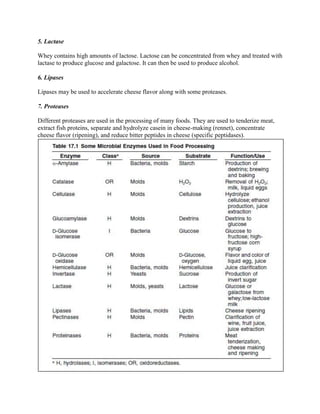
oxidoreductases (oxygenation or hydrogenation). Some of these are listed in Table 17.1 and their
uses are discussed here.
1. a-Amylase, Glucoamylase, and Glucose Isomerase
Together, these three enzymes are used to produce high-fructose corn syrup from starch. a-
Amylase hydrolyzes starch at a-1 position randomly and produces oligosaccharide (containing
three hexose units or more, e.g., dextrins). Glucoamylase hydrolyzes dextrins to glucose units,
which are then converted to fructose by glucose isomerase. a-Amylase is also used in bread
making to slow down staling (starch crystallization due to loss of water). Partial hydrolysis of
starch by a-amylase can help reduce the water loss and extend the shelf life of bread.
2. Catalase
Raw milk and liquid eggs can be preserved with H2O2 before pasteurization. However, the H2O2
needs to be hydrolyzed by adding catalase before heat processing of the products.
3. Cellulase, Hemicellulase, and Pectinase
Because of their ability to hydrolyze respective substrates, the use of these enzymes in citrus
juice extraction has increased juice yield. Normally, these insoluble polysaccharides trap juice
during pressing. Also, they get into the juice and increase viscosity, causing problems during
juice concentration. They also cloud the juice. By using these hydrolyzing enzymes, such
problems can be reduced.
4. Invertase
Invertase can be used to hydrolyze sucrose to invert sugars (mixture of glucose and fructose) and
increase sweetness. It is used in chocolate processing.
5. Lactase
Whey contains high amounts of lactose. Lactose can be concentrated from whey and treated with
lactase to produce glucose and galactose. It can then be used to produce alcohol.
6. Lipases
Lipases may be used to accelerate cheese flavor along with some proteases.
7. Proteases
Different proteases are used in the processing of many foods. They are used to tenderize meat,
extract fish proteins, separate and hydrolyze casein in cheese-making (rennet), concentrate
cheese flavor (ripening), and reduce bitter peptides in cheese (specific peptidases).
B. Enzyme Production by Recombinant DNA Technology
The enzymes that are currently used in food processing are obtained from bacteria, yeasts,
molds, plants, and mammalian sources. They have been approved by regulatory agencies, and
their sources have been included in the GRAS list. There are some disadvantages of obtaining
enzymes from plant and animal sources. The supply of these enzymes can be limited and thus
costly. Also, molds grow slower than bacteria or yeast, and some strains can produce
mycotoxins. It would be more convenient and cost-effective if the enzymes now obtained from
nonbacterial sources (including yeasts, as their genetic system is more complicated than bacteria)
could be produced in bacteria. This can be hypothetically achieved through recombinant DNA
technology. However, in trying to do so, one has to recognize that the bacterial host strains need
to be approved by regulatory agencies if they are not in the GRAS list. Also, regulatory approval
will be necessary for the source if it is not currently in the GRAS list.
The technique is rapidly going through many improvements. In brief, it involves separating
specific mRNA (while growing on a substrate) and using the mRNA to synthesize cDNA by
employing the reverse transcriptase enzyme. The cDNA (double stranded) is cloned in a suitable
plasmid vector, which is then introduced by transformation in the cells of a suitable bacterial
strain (e.g., Esc. coli). The transformants are then examined to determine the expression and
efficiency of production of the enzyme. This method has been successfully used to produce
rennin (of calf) and cellulase (of molds) by bacteria. Rennin thus produced is used to make
cheese.
C. Immobilized Enzymes
Enzymes are biocatalysts and can be recycled. An enzyme is used only once when added to a
substrate in liquid or solid food. In contrast, if the molecules of an enzyme are attached to a solid
surface (immobilized), the enzyme can be exposed repeatedly to a specific substrate. The major
advantage is the economical use of an enzyme, especially if the enzyme is very costly.
Enzymes can be immobilized by several physical, chemical, or mechanical means. The
techniques can be divided into four major categories (Figure 17.1).
1. Adsorption on a Solid Support
This technique relies on the affinity of the support for enzyme molecules. The technique involves
adding an enzyme solution to the support (such as ion-exchange resins) and washing away the
unattached molecules. The association is very weak, and the molecules can be desorbed and
removed.
2. Covalent Bonding
The enzyme molecules are covalently bound to a solid surface (such as porous ceramics) by a
chemical agent. The enzyme molecules are accessible to the substrate molecules. The enzymes
are more stable.
3. Entrapping
The enzyme molecules are enclosed in a polymeric gel (e.g., alginate) that has an opening for the
substrate molecules to come in contact with the catalytic sites. The enzymes are added to the
monomer before polymerization.
4. Crosslinking
Crosslinking is achieved by making chemical connections between the enzyme molecules to
form large aggregates that are insoluble. This is a very stable system. There are several
disadvantages in enzyme immobilization. Immobilization can reduce the activity of an enzyme.
Substrate molecules may not be freely accessible to the immobilized enzymes. The method may
not be applicable if the substrate molecules are large. a-Amylase may not be a good candidate for
immobilizationbecause starch molecules, its substrate, are fairly large. However, glucose
isomerase can be immobilized, as its substrate is small glucose molecules. The supporting
materials can be contaminated with microorganisms that are difficult to remove and can be a
source of contamination in food. The materials to be used as support should not be made of
substances that are unsafe and should be approved by regulatory agencies. Some of the
immobilized enzymes currently used are glucose isomerase, b-galactosidase, and aminoacylase.
Microbial cells can also be immobilized by the methods listed previously, and the techniques
have been studied in the production of some food ingredients and beverages. Examples include
Asp. niger (for citric acid and gluconic acid), Saccharomyces cerevisiae (for alcoholic
beverages), and Lactobacillus species (for lactic acid).
D. Thermostable Enzymes
The term thermostable enzymes is generally used for those enzymes that can catalyze reactions
above 60o
C.10 There are several advantages of using thermostable enzymes in a process. The
rate of an enzyme reaction doubles for every 10o
C increase in temperature; thus, production rate
can be increased or the amount of enzyme used can be reduced. At high temperatures, when an
enzyme is used for a long time (as in the case of immobilized enzymes), the problems of
microbial growth and contamination can be reduced.
At high temperature, enzymes denature because of unfolding of their three-dimensional
structures. The stability of the three-dimensional structure of an enzyme is influenced by the
ionic charges, hydrogen bonding, and hydrophobic interaction among the amino acids. Thus, the
linear sequences of amino acids in an enzyme greatly influence its three-dimensional structure
and stability. Studies have revealed that increase in both ion pairing and hydrogen bonding on
the surface of an enzyme (on three-dimensional structure) and increases in internal
hydrophobicity increase the thermostability of an enzyme. For example, the enzyme tyrosinase
from a thermolabile strain of Neurospora species denatures in 4 min at 60o
C, but from a
thermostable strain of the same species it denatures in 70 min at 60o
C. An analysis of the amino
acid sequences revealed that at position 96, tyrosinase has an aspargine (uncharged) in the
thermolabile strain, but aspartic acid (charged) in the thermostable strain. Thus, an extra ionic
charge (on the surface) increases the thermostability of this enzyme.
Several methods, such as chemical and recombinant DNA techniques, can be used to increase
thermostability of an enzyme. Recombinant DNA technology can be used in two ways. If the
enzyme is present in a thermostable form in a microorganism that is not in the GRAS list, the
gene can be cloned in a suitable vector, which can then be introduced in a GRAS-listed
microorganism and examined for expression and economical production. The other method is
more complicated and involves determining the amino acid sequence of the enzyme and its
three-dimensional structure (by computer modeling) to recognize the amino acids on the surface
(or inside). The next step involves changing one or more amino acids on the surface to increase
ionic or hydrogen bonding. This can be achieved by site-specific mutagenesis of base sequences
of cDNA for the specific amino acid. The synthesized DNA can be incorporated in a vector and
introduced in a desired microbial strain for expression of the enzyme and testing for its
thermostability. Several thermostable enzymes obtained from microorganisms on the GRAS list
are currently being used. It is expected that in the future their production by different methods
and use in food will increase.
E. Enzymes in Food Waste Treatment
Food industries generate large volumes of both solid and liquid wastes. Waste disposal methods
have used different physical, chemical, and some biological methods. Biological methods
include anaerobic digestion and production of SCPs. Because of an increase in regulatory
restrictions in waste disposal, effective and economical alternative methods are being researched.
The possibility of using enzymes to reduce wastes and convert the wastes to value-added
products is being developed. The availability of specific enzymes at low costs has been a major
incentive in their use for waste disposal.
Some of the enzymes used in food waste treatments are polysaccharidases (cellulase, pectinase,
hemicellulase, chitinase, and amylase), lactase, and proteinases. Treatment of fruits with
cellulase and pectinase has increased juice yield and improved separation of solids from the
juice. The solids can be used as animal feed. Chitinases are used to depolymerize the shells of
shellfish, and the product used to produce SCPs. Amylases are used to treat starch-containing
wastewater to produce glucose syrup for use in alcohol production by yeasts. Lactose in whey
has been treated with lactase (b-galactosidase) to produce glucose and galactose, which are then
used in alcohol production by yeast or to produce bakers’ yeasts. Proteases are used to treat
wastewater from fish and meat-processing operations. Some of these products are used as fish
food. In the future, development of better and low-cost enzymes through recombinant DNA
technology will increase their uses in food waste treatment.
IV. CONCLUSION
The materials discussed in this chapter briefly summarize some of the cell components,
metabolic end products, and enzymes produced by food-grade and regulatory agency- approved
microorganisms that are used in foods as additives to improve the nutritional and acceptance
qualities of foods. Recent advances in genetic engineering and metabolic engineering of these
bacteria have helped develop strains that can produce many unique products. As our knowledge
on genome sequences and function of the genes of these strains increases, many new strains will
be developed to produce other unique products. The future potential in this area is very high.

Microbial enzymes in_food_processing_notes

  • 1.
    MICROBIAL ENZYMES INFOOD PROCESSING Many enzymes are used in the processing of food and food additives. About 80% of the total enzymes produced, on a dollar basis, is used by the food industries. Use of specific enzymes instead of microorganisms has several advantages. A specific substrate can be converted into a specific product by an enzyme through a single-step reaction. Thus, production of different metabolites by live cells from the same substrate can be avoided. In addition, a reaction step can be controlled and enhanced more easily by using purified enzymes. Finally, by using recombinant DNA technology, the efficiency of enzymes can be improved and, by immobilizing, they can be recycled. The main disadvantage of using enzymes is that if a substrate is converted to a product through many steps (such as glucose to lactic acid), microbial cells must be used for their efficient and economical production. A. Enzymes Used Among the five classes of enzymes, three are predominantly used in food processing: hydrolases (hydrolyze C–C, C–O, C–N, etc., bonds), isomerases (isomerization and racemization), and oxidoreductases (oxygenation or hydrogenation). Some of these are listed in Table 17.1 and their uses are discussed here. 1. a-Amylase, Glucoamylase, and Glucose Isomerase Together, these three enzymes are used to produce high-fructose corn syrup from starch. a- Amylase hydrolyzes starch at a-1 position randomly and produces oligosaccharide (containing three hexose units or more, e.g., dextrins). Glucoamylase hydrolyzes dextrins to glucose units, which are then converted to fructose by glucose isomerase. a-Amylase is also used in bread making to slow down staling (starch crystallization due to loss of water). Partial hydrolysis of starch by a-amylase can help reduce the water loss and extend the shelf life of bread. 2. Catalase Raw milk and liquid eggs can be preserved with H2O2 before pasteurization. However, the H2O2 needs to be hydrolyzed by adding catalase before heat processing of the products. 3. Cellulase, Hemicellulase, and Pectinase Because of their ability to hydrolyze respective substrates, the use of these enzymes in citrus juice extraction has increased juice yield. Normally, these insoluble polysaccharides trap juice during pressing. Also, they get into the juice and increase viscosity, causing problems during juice concentration. They also cloud the juice. By using these hydrolyzing enzymes, such problems can be reduced. 4. Invertase Invertase can be used to hydrolyze sucrose to invert sugars (mixture of glucose and fructose) and increase sweetness. It is used in chocolate processing.
  • 2.
    5. Lactase Whey containshigh amounts of lactose. Lactose can be concentrated from whey and treated with lactase to produce glucose and galactose. It can then be used to produce alcohol. 6. Lipases Lipases may be used to accelerate cheese flavor along with some proteases. 7. Proteases Different proteases are used in the processing of many foods. They are used to tenderize meat, extract fish proteins, separate and hydrolyze casein in cheese-making (rennet), concentrate cheese flavor (ripening), and reduce bitter peptides in cheese (specific peptidases).
  • 3.
    B. Enzyme Productionby Recombinant DNA Technology The enzymes that are currently used in food processing are obtained from bacteria, yeasts, molds, plants, and mammalian sources. They have been approved by regulatory agencies, and their sources have been included in the GRAS list. There are some disadvantages of obtaining enzymes from plant and animal sources. The supply of these enzymes can be limited and thus costly. Also, molds grow slower than bacteria or yeast, and some strains can produce mycotoxins. It would be more convenient and cost-effective if the enzymes now obtained from nonbacterial sources (including yeasts, as their genetic system is more complicated than bacteria) could be produced in bacteria. This can be hypothetically achieved through recombinant DNA technology. However, in trying to do so, one has to recognize that the bacterial host strains need to be approved by regulatory agencies if they are not in the GRAS list. Also, regulatory approval will be necessary for the source if it is not currently in the GRAS list. The technique is rapidly going through many improvements. In brief, it involves separating specific mRNA (while growing on a substrate) and using the mRNA to synthesize cDNA by employing the reverse transcriptase enzyme. The cDNA (double stranded) is cloned in a suitable plasmid vector, which is then introduced by transformation in the cells of a suitable bacterial strain (e.g., Esc. coli). The transformants are then examined to determine the expression and efficiency of production of the enzyme. This method has been successfully used to produce rennin (of calf) and cellulase (of molds) by bacteria. Rennin thus produced is used to make cheese. C. Immobilized Enzymes Enzymes are biocatalysts and can be recycled. An enzyme is used only once when added to a substrate in liquid or solid food. In contrast, if the molecules of an enzyme are attached to a solid surface (immobilized), the enzyme can be exposed repeatedly to a specific substrate. The major advantage is the economical use of an enzyme, especially if the enzyme is very costly. Enzymes can be immobilized by several physical, chemical, or mechanical means. The techniques can be divided into four major categories (Figure 17.1). 1. Adsorption on a Solid Support This technique relies on the affinity of the support for enzyme molecules. The technique involves adding an enzyme solution to the support (such as ion-exchange resins) and washing away the unattached molecules. The association is very weak, and the molecules can be desorbed and removed. 2. Covalent Bonding The enzyme molecules are covalently bound to a solid surface (such as porous ceramics) by a chemical agent. The enzyme molecules are accessible to the substrate molecules. The enzymes are more stable.
  • 4.
    3. Entrapping The enzymemolecules are enclosed in a polymeric gel (e.g., alginate) that has an opening for the substrate molecules to come in contact with the catalytic sites. The enzymes are added to the monomer before polymerization. 4. Crosslinking Crosslinking is achieved by making chemical connections between the enzyme molecules to form large aggregates that are insoluble. This is a very stable system. There are several disadvantages in enzyme immobilization. Immobilization can reduce the activity of an enzyme. Substrate molecules may not be freely accessible to the immobilized enzymes. The method may not be applicable if the substrate molecules are large. a-Amylase may not be a good candidate for immobilizationbecause starch molecules, its substrate, are fairly large. However, glucose isomerase can be immobilized, as its substrate is small glucose molecules. The supporting materials can be contaminated with microorganisms that are difficult to remove and can be a source of contamination in food. The materials to be used as support should not be made of substances that are unsafe and should be approved by regulatory agencies. Some of the immobilized enzymes currently used are glucose isomerase, b-galactosidase, and aminoacylase. Microbial cells can also be immobilized by the methods listed previously, and the techniques have been studied in the production of some food ingredients and beverages. Examples include Asp. niger (for citric acid and gluconic acid), Saccharomyces cerevisiae (for alcoholic beverages), and Lactobacillus species (for lactic acid).
  • 5.
    D. Thermostable Enzymes Theterm thermostable enzymes is generally used for those enzymes that can catalyze reactions above 60o C.10 There are several advantages of using thermostable enzymes in a process. The rate of an enzyme reaction doubles for every 10o C increase in temperature; thus, production rate can be increased or the amount of enzyme used can be reduced. At high temperatures, when an enzyme is used for a long time (as in the case of immobilized enzymes), the problems of microbial growth and contamination can be reduced. At high temperature, enzymes denature because of unfolding of their three-dimensional structures. The stability of the three-dimensional structure of an enzyme is influenced by the ionic charges, hydrogen bonding, and hydrophobic interaction among the amino acids. Thus, the linear sequences of amino acids in an enzyme greatly influence its three-dimensional structure and stability. Studies have revealed that increase in both ion pairing and hydrogen bonding on the surface of an enzyme (on three-dimensional structure) and increases in internal hydrophobicity increase the thermostability of an enzyme. For example, the enzyme tyrosinase from a thermolabile strain of Neurospora species denatures in 4 min at 60o C, but from a thermostable strain of the same species it denatures in 70 min at 60o C. An analysis of the amino acid sequences revealed that at position 96, tyrosinase has an aspargine (uncharged) in the thermolabile strain, but aspartic acid (charged) in the thermostable strain. Thus, an extra ionic charge (on the surface) increases the thermostability of this enzyme. Several methods, such as chemical and recombinant DNA techniques, can be used to increase thermostability of an enzyme. Recombinant DNA technology can be used in two ways. If the enzyme is present in a thermostable form in a microorganism that is not in the GRAS list, the gene can be cloned in a suitable vector, which can then be introduced in a GRAS-listed microorganism and examined for expression and economical production. The other method is more complicated and involves determining the amino acid sequence of the enzyme and its three-dimensional structure (by computer modeling) to recognize the amino acids on the surface (or inside). The next step involves changing one or more amino acids on the surface to increase ionic or hydrogen bonding. This can be achieved by site-specific mutagenesis of base sequences of cDNA for the specific amino acid. The synthesized DNA can be incorporated in a vector and introduced in a desired microbial strain for expression of the enzyme and testing for its thermostability. Several thermostable enzymes obtained from microorganisms on the GRAS list are currently being used. It is expected that in the future their production by different methods and use in food will increase. E. Enzymes in Food Waste Treatment Food industries generate large volumes of both solid and liquid wastes. Waste disposal methods have used different physical, chemical, and some biological methods. Biological methods include anaerobic digestion and production of SCPs. Because of an increase in regulatory restrictions in waste disposal, effective and economical alternative methods are being researched. The possibility of using enzymes to reduce wastes and convert the wastes to value-added products is being developed. The availability of specific enzymes at low costs has been a major incentive in their use for waste disposal.
  • 6.
    Some of theenzymes used in food waste treatments are polysaccharidases (cellulase, pectinase, hemicellulase, chitinase, and amylase), lactase, and proteinases. Treatment of fruits with cellulase and pectinase has increased juice yield and improved separation of solids from the juice. The solids can be used as animal feed. Chitinases are used to depolymerize the shells of shellfish, and the product used to produce SCPs. Amylases are used to treat starch-containing wastewater to produce glucose syrup for use in alcohol production by yeasts. Lactose in whey has been treated with lactase (b-galactosidase) to produce glucose and galactose, which are then used in alcohol production by yeast or to produce bakers’ yeasts. Proteases are used to treat wastewater from fish and meat-processing operations. Some of these products are used as fish food. In the future, development of better and low-cost enzymes through recombinant DNA technology will increase their uses in food waste treatment. IV. CONCLUSION The materials discussed in this chapter briefly summarize some of the cell components, metabolic end products, and enzymes produced by food-grade and regulatory agency- approved microorganisms that are used in foods as additives to improve the nutritional and acceptance qualities of foods. Recent advances in genetic engineering and metabolic engineering of these bacteria have helped develop strains that can produce many unique products. As our knowledge on genome sequences and function of the genes of these strains increases, many new strains will be developed to produce other unique products. The future potential in this area is very high.