ENZYMES FROM MICROBIAL
SOURCES
Presented by :-
SONIA NARZARY
ROLL NO : 17
MSc 2nd SEMESTER
PAPER CODE : MIBCC 204
DEPARTMENT OF MICROBIOLOGY
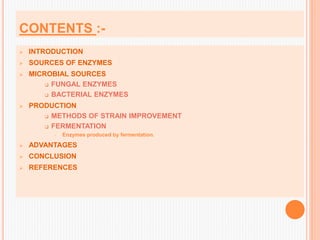
CONTENTS :-
 INTRODUCTION
 SOURCES OF ENZYMES
 MICROBIAL SOURCES
 FUNGAL ENZYMES
 BACTERIAL ENZYMES
 PRODUCTION
 METHODS OF STRAIN IMPROVEMENT
 FERMENTATION
 Enzymes produced by fermentation.
 ADVANTAGES
 CONCLUSION
 REFERENCES
INTRODUCTION :-
 Enzymes are biocatalysts produced by living cells to
bring about specific biochemical reactions generally
forming parts of the metabolic processes of the cells.
 All enzymes which have been purified are protein in
nature ,and may or may not possess a non protein
prosthetic group.
 Enzyme in their biologically active form can be isolated
from any living organism.
 A very wide range of sources are currently being used for
production of enzymes.
SOURCES OF ENZYMES :-
 Basically there are 3 major sources of enzymes. They
are-
• Animals Source
• Plants Source
• Microbial Source
MICROBIAL SOURCES :-
o It contribute about 80% of the overall enzyme production.
Over half of the microbial enzymes that are being used
industrially are sourced either from fungi or from yeast.
While 1/3rd of the enzyme production is derived from
bacteria.
The remaining ones obtained from animal and
plant sources.
o It provide an important source for isolation of numerous
enzymes that are applicable to various domains of
enzymatic catalysis.
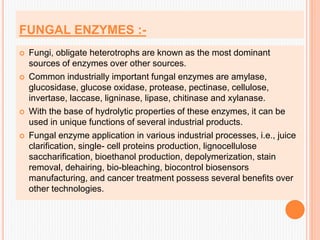
FUNGAL ENZYMES :-
 Fungi, obligate heterotrophs are known as the most dominant
sources of enzymes over other sources.
 Common industrially important fungal enzymes are amylase,
glucosidase, glucose oxidase, protease, pectinase, cellulose,
invertase, laccase, ligninase, lipase, chitinase and xylanase.
 With the base of hydrolytic properties of these enzymes, it can be
used in unique functions of several industrial products.
 Fungal enzyme application in various industrial processes, i.e., juice
clarification, single- cell proteins production, lignocellulose
saccharification, bioethanol production, depolymerization, stain
removal, dehairing, bio-bleaching, biocontrol biosensors
manufacturing, and cancer treatment possess several benefits over
other technologies.
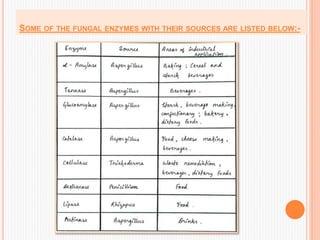
SOME OF THE FUNGAL ENZYMES WITH THEIR SOURCES ARE LISTED BELOW:-
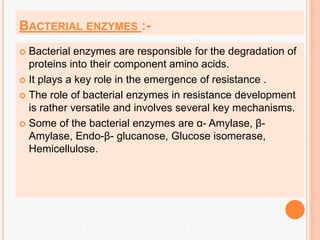
BACTERIAL ENZYMES :-
 Bacterial enzymes are responsible for the degradation of
proteins into their component amino acids.
 It plays a key role in the emergence of resistance .
 The role of bacterial enzymes in resistance development
is rather versatile and involves several key mechanisms.
 Some of the bacterial enzymes are α- Amylase, β-
Amylase, Endo-β- glucanose, Glucose isomerase,
Hemicellulose.
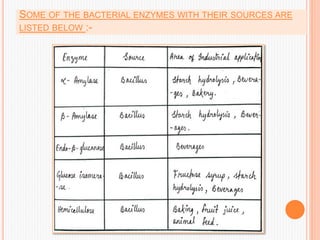
SOME OF THE BACTERIAL ENZYMES WITH THEIR SOURCES ARE
LISTED BELOW :-
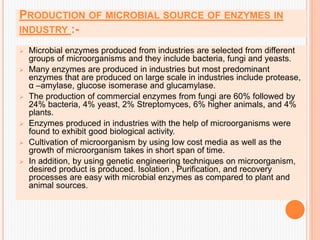
PRODUCTION OF MICROBIAL SOURCE OF ENZYMES IN
INDUSTRY :-
 Microbial enzymes produced from industries are selected from different
groups of microorganisms and they include bacteria, fungi and yeasts.
 Many enzymes are produced in industries but most predominant
enzymes that are produced on large scale in industries include protease,
α –amylase, glucose isomerase and glucamylase.
 The production of commercial enzymes from fungi are 60% followed by
24% bacteria, 4% yeast, 2% Streptomyces, 6% higher animals, and 4%
plants.
 Enzymes produced in industries with the help of microorganisms were
found to exhibit good biological activity.
 Cultivation of microorganism by using low cost media as well as the
growth of microorganism takes in short span of time.
 In addition, by using genetic engineering techniques on microorganism,
desired product is produced. Isolation , Purification, and recovery
processes are easy with microbial enzymes as compared to plant and
animal sources.
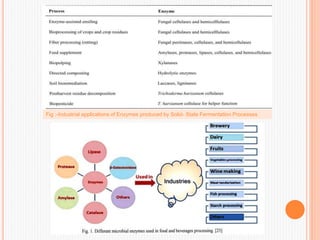
Fig :-Industrial applications of Enzymes produced by Solid- State Fermentation Processes
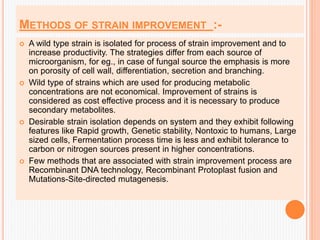
METHODS OF STRAIN IMPROVEMENT :-
 A wild type strain is isolated for process of strain improvement and to
increase productivity. The strategies differ from each source of
microorganism, for eg., in case of fungal source the emphasis is more
on porosity of cell wall, differentiation, secretion and branching.
 Wild type of strains which are used for producing metabolic
concentrations are not economical. Improvement of strains is
considered as cost effective process and it is necessary to produce
secondary metabolites.
 Desirable strain isolation depends on system and they exhibit following
features like Rapid growth, Genetic stability, Nontoxic to humans, Large
sized cells, Fermentation process time is less and exhibit tolerance to
carbon or nitrogen sources present in higher concentrations.
 Few methods that are associated with strain improvement process are
Recombinant DNA technology, Recombinant Protoplast fusion and
Mutations-Site-directed mutagenesis.
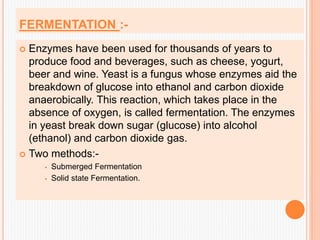
FERMENTATION :-
 Enzymes have been used for thousands of years to
produce food and beverages, such as cheese, yogurt,
beer and wine. Yeast is a fungus whose enzymes aid the
breakdown of glucose into ethanol and carbon dioxide
anaerobically. This reaction, which takes place in the
absence of oxygen, is called fermentation. The enzymes
in yeast break down sugar (glucose) into alcohol
(ethanol) and carbon dioxide gas.
 Two methods:-
 Submerged Fermentation
 Solid state Fermentation.
THE ENZYMES PRODUCED BY FERMENTATION :-
1. α- Amylase:- Sources of α- amylase are plants, animals and
microorganisms, but commercially viable amylases are produced from
microorganisms, especially bacterial and fungal species. Thermostable
α amylase is produced by some potential bacterial species like
Bacillus licheniformis and Bacillus stearothermophillus, Pseudomonas,
and the Clostridium family. Starch- converting properties of α-
amylases are playing an important role in the food, beverage, and
sugar industries. They are also employed in many other aspects of the
food industry like clarification of beer, fruit juices, etc.
2. Lactase :- Lactase enzymes catalyze the breakdown of the milk sugar
lactose into simple sugar monomer units like glucose and galactose.
Microbial source lactases are obtained from bacteria, fungus, yeasts
and molds. Commercial production of lactase enzymes is developed
from Aspergillus niger , A. oryzae, and Kluyveromyces lactis. Fungal
origin lactases have optimum activity at acidic pH ranges, and yeast
and bacterial originated lactases have optimum pH ranges near to
neutral.
3. PROTEASE
 Proteases are commercially obtained from microorganisms,
especially bacterial and fungal species.
 Microorganisms secrete the extracellular and intracellular
proteases in both the submerged and solid- state fermentation
process.
 Bacillus species of bacteria, like Bacillus licheniformis, Bacillus
subtilis, and Aspergillus species of fungus like Aspergillus
niger, A. flavus, A. fumigatus, A. oryzae, are the best sources
of protease enzyme.
 Protease enzymes increases their application in the food-
processing industry, the major role in cheese and dairy product
manufacturing.
WHY MICROBIAL SOURCE IS PREFERRED OVER PLANTS AND
ANIMALS SOURCE FOR PRODUCTION OF ENZYMES?
 Enzymes can be produced on large scale and are
economical.
 The process of extraction and purification of enzymes
from microbial sources is easier in comparison with plant
and animal sources.
 Microbial sources are capable of producing variety of
enzymes in different environmental conditions in limited
space and time period.
 Genetic manipulation is carried out to yield higher
quantity of enzymes produced from microbial sources.
CONCLUSION :-
Enzymes find application in food, detergent, pharmaceutical and
paper industries. Nowadays , the enzymatic hydrolysis and enzyme-
based processes are preferred to the chemical ones due to the
environmentally friendly nature, efficient process control, high yield ,
low refining costs and process safety.
In comparison with plant and animal enzymes, microbial
enzymes can be produced very effectively by different fermentation
techniques.
Many of the enzymes of microbial sources are still unexplored
and there are many opportunities for finding wider industrial
application of microbial enzymes, especially in food sector.
REFERENCES :-
1. Enzymes in Industry, Edited by Wolfgang Aehle Third, Completely
Revised Edition.
2. https://www.ncbi.nlm.nih.gov/pmc/articles/PMC4030947/
3. https://www.biologydiscussion.com/industrial-microbiology-2/top-6-
microbial-sources-of-enzymes-industrial-microbiology/55800
4. Robinson,P.K. Enzymes: principles and biotechnological
applications. Essays in biochemistry, 2015.
5. Singh, R., et al., Microbial enzymes ;Industrial progress in 21st
century.3 Biotech, 2016.
204 PPT.pptx

204 PPT.pptx

  • 1.
    ENZYMES FROM MICROBIAL SOURCES Presentedby :- SONIA NARZARY ROLL NO : 17 MSc 2nd SEMESTER PAPER CODE : MIBCC 204 DEPARTMENT OF MICROBIOLOGY
  • 2.
    CONTENTS :-  INTRODUCTION SOURCES OF ENZYMES  MICROBIAL SOURCES  FUNGAL ENZYMES  BACTERIAL ENZYMES  PRODUCTION  METHODS OF STRAIN IMPROVEMENT  FERMENTATION  Enzymes produced by fermentation.  ADVANTAGES  CONCLUSION  REFERENCES
  • 3.
    INTRODUCTION :-  Enzymesare biocatalysts produced by living cells to bring about specific biochemical reactions generally forming parts of the metabolic processes of the cells.  All enzymes which have been purified are protein in nature ,and may or may not possess a non protein prosthetic group.  Enzyme in their biologically active form can be isolated from any living organism.  A very wide range of sources are currently being used for production of enzymes.
  • 4.
    SOURCES OF ENZYMES:-  Basically there are 3 major sources of enzymes. They are- • Animals Source • Plants Source • Microbial Source
  • 5.
    MICROBIAL SOURCES :- oIt contribute about 80% of the overall enzyme production. Over half of the microbial enzymes that are being used industrially are sourced either from fungi or from yeast. While 1/3rd of the enzyme production is derived from bacteria. The remaining ones obtained from animal and plant sources. o It provide an important source for isolation of numerous enzymes that are applicable to various domains of enzymatic catalysis.
  • 6.
    FUNGAL ENZYMES :- Fungi, obligate heterotrophs are known as the most dominant sources of enzymes over other sources.  Common industrially important fungal enzymes are amylase, glucosidase, glucose oxidase, protease, pectinase, cellulose, invertase, laccase, ligninase, lipase, chitinase and xylanase.  With the base of hydrolytic properties of these enzymes, it can be used in unique functions of several industrial products.  Fungal enzyme application in various industrial processes, i.e., juice clarification, single- cell proteins production, lignocellulose saccharification, bioethanol production, depolymerization, stain removal, dehairing, bio-bleaching, biocontrol biosensors manufacturing, and cancer treatment possess several benefits over other technologies.
  • 7.
    SOME OF THEFUNGAL ENZYMES WITH THEIR SOURCES ARE LISTED BELOW:-
  • 8.
    BACTERIAL ENZYMES :- Bacterial enzymes are responsible for the degradation of proteins into their component amino acids.  It plays a key role in the emergence of resistance .  The role of bacterial enzymes in resistance development is rather versatile and involves several key mechanisms.  Some of the bacterial enzymes are α- Amylase, β- Amylase, Endo-β- glucanose, Glucose isomerase, Hemicellulose.
  • 9.
    SOME OF THEBACTERIAL ENZYMES WITH THEIR SOURCES ARE LISTED BELOW :-
  • 10.
    PRODUCTION OF MICROBIALSOURCE OF ENZYMES IN INDUSTRY :-  Microbial enzymes produced from industries are selected from different groups of microorganisms and they include bacteria, fungi and yeasts.  Many enzymes are produced in industries but most predominant enzymes that are produced on large scale in industries include protease, α –amylase, glucose isomerase and glucamylase.  The production of commercial enzymes from fungi are 60% followed by 24% bacteria, 4% yeast, 2% Streptomyces, 6% higher animals, and 4% plants.  Enzymes produced in industries with the help of microorganisms were found to exhibit good biological activity.  Cultivation of microorganism by using low cost media as well as the growth of microorganism takes in short span of time.  In addition, by using genetic engineering techniques on microorganism, desired product is produced. Isolation , Purification, and recovery processes are easy with microbial enzymes as compared to plant and animal sources.
  • 11.
    Fig :-Industrial applicationsof Enzymes produced by Solid- State Fermentation Processes
  • 12.
    METHODS OF STRAINIMPROVEMENT :-  A wild type strain is isolated for process of strain improvement and to increase productivity. The strategies differ from each source of microorganism, for eg., in case of fungal source the emphasis is more on porosity of cell wall, differentiation, secretion and branching.  Wild type of strains which are used for producing metabolic concentrations are not economical. Improvement of strains is considered as cost effective process and it is necessary to produce secondary metabolites.  Desirable strain isolation depends on system and they exhibit following features like Rapid growth, Genetic stability, Nontoxic to humans, Large sized cells, Fermentation process time is less and exhibit tolerance to carbon or nitrogen sources present in higher concentrations.  Few methods that are associated with strain improvement process are Recombinant DNA technology, Recombinant Protoplast fusion and Mutations-Site-directed mutagenesis.
  • 13.
    FERMENTATION :-  Enzymeshave been used for thousands of years to produce food and beverages, such as cheese, yogurt, beer and wine. Yeast is a fungus whose enzymes aid the breakdown of glucose into ethanol and carbon dioxide anaerobically. This reaction, which takes place in the absence of oxygen, is called fermentation. The enzymes in yeast break down sugar (glucose) into alcohol (ethanol) and carbon dioxide gas.  Two methods:-  Submerged Fermentation  Solid state Fermentation.
  • 14.
    THE ENZYMES PRODUCEDBY FERMENTATION :- 1. α- Amylase:- Sources of α- amylase are plants, animals and microorganisms, but commercially viable amylases are produced from microorganisms, especially bacterial and fungal species. Thermostable α amylase is produced by some potential bacterial species like Bacillus licheniformis and Bacillus stearothermophillus, Pseudomonas, and the Clostridium family. Starch- converting properties of α- amylases are playing an important role in the food, beverage, and sugar industries. They are also employed in many other aspects of the food industry like clarification of beer, fruit juices, etc. 2. Lactase :- Lactase enzymes catalyze the breakdown of the milk sugar lactose into simple sugar monomer units like glucose and galactose. Microbial source lactases are obtained from bacteria, fungus, yeasts and molds. Commercial production of lactase enzymes is developed from Aspergillus niger , A. oryzae, and Kluyveromyces lactis. Fungal origin lactases have optimum activity at acidic pH ranges, and yeast and bacterial originated lactases have optimum pH ranges near to neutral.
  • 15.
    3. PROTEASE  Proteasesare commercially obtained from microorganisms, especially bacterial and fungal species.  Microorganisms secrete the extracellular and intracellular proteases in both the submerged and solid- state fermentation process.  Bacillus species of bacteria, like Bacillus licheniformis, Bacillus subtilis, and Aspergillus species of fungus like Aspergillus niger, A. flavus, A. fumigatus, A. oryzae, are the best sources of protease enzyme.  Protease enzymes increases their application in the food- processing industry, the major role in cheese and dairy product manufacturing.
  • 16.
    WHY MICROBIAL SOURCEIS PREFERRED OVER PLANTS AND ANIMALS SOURCE FOR PRODUCTION OF ENZYMES?  Enzymes can be produced on large scale and are economical.  The process of extraction and purification of enzymes from microbial sources is easier in comparison with plant and animal sources.  Microbial sources are capable of producing variety of enzymes in different environmental conditions in limited space and time period.  Genetic manipulation is carried out to yield higher quantity of enzymes produced from microbial sources.
  • 17.
    CONCLUSION :- Enzymes findapplication in food, detergent, pharmaceutical and paper industries. Nowadays , the enzymatic hydrolysis and enzyme- based processes are preferred to the chemical ones due to the environmentally friendly nature, efficient process control, high yield , low refining costs and process safety. In comparison with plant and animal enzymes, microbial enzymes can be produced very effectively by different fermentation techniques. Many of the enzymes of microbial sources are still unexplored and there are many opportunities for finding wider industrial application of microbial enzymes, especially in food sector.
  • 18.
    REFERENCES :- 1. Enzymesin Industry, Edited by Wolfgang Aehle Third, Completely Revised Edition. 2. https://www.ncbi.nlm.nih.gov/pmc/articles/PMC4030947/ 3. https://www.biologydiscussion.com/industrial-microbiology-2/top-6- microbial-sources-of-enzymes-industrial-microbiology/55800 4. Robinson,P.K. Enzymes: principles and biotechnological applications. Essays in biochemistry, 2015. 5. Singh, R., et al., Microbial enzymes ;Industrial progress in 21st century.3 Biotech, 2016.