Strategies for Engineering Stress
tolerance
Stress tolerance :
• Plants are subjected to many types of fluctuation in physical
environment
• Plants therefore depend largely upon internal mechanism for tolerating
variations in external environment.
• Acute or chronic extremes of environmental conditions lead to
environmental stress that has the potential to damage the plant.
 Cold stress
 Heat stress
 Water deficit stress
Water deficit stress:
• General physical changes in the environment leads to water deficit.
• The water status of a cell is described by water potential and relative
water content.
• The continued water deficit condition would lead to dehydration and
death.
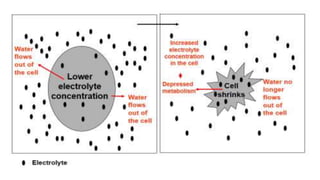
• Damaging to all cells because of the increase in the concentration of
foric ions and loss of the productive hydration shell around vulnerable
molecules like protein.
• Plant cells respond to osmotic stress by producing compounds called
compatible solutes to reduce the osmotic potential.
Compatible solutes fall into two broad classes
1. Sugar and Sugar alchohols (sorbitol, mannitol)
2. Zwitter ionic compounds (Quatenary ammonium compound – Glycine betine)
Basic strategies for engineering resistance to water deficit stress focused on the
production of osmoprotectants as a mechanism for overcoming osmotic stress
generated by water deficit.
Glycine Betaine Production
• Glycine betaine is a quaternary ammonium salt found in flowering plants
and marine algae
• These molecules help in stabilizing proteins and membranes
Production:
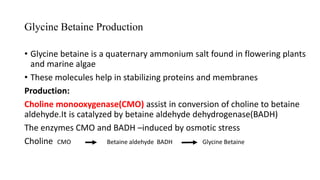
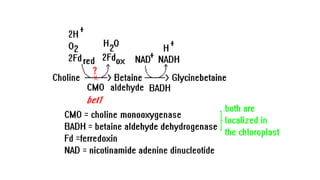
Choline monooxygenase(CMO) assist in conversion of choline to betaine
aldehyde.It is catalyzed by betaine aldehyde dehydrogenase(BADH)
The enzymes CMO and BADH –induced by osmotic stress
Choline CMO Betaine aldehyde BADH Glycine Betaine
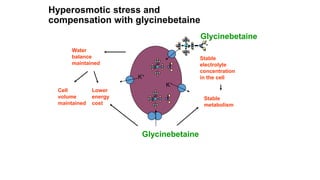
Hyperosmotic stress and
compensation with glycinebetaine
K+
Water
balance
maintained
Cell
volume
maintained
Lower
energy
cost
Stable
metabolism
Stable
electrolyte
concentration
in the cell
Glycinebetaine
K+
Glycinebetaine
N C C
C
C
C
O
O
H
H
H
H
H
H
H
H
H H
H
+ -
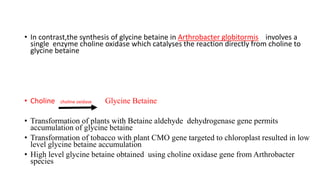
• In contrast,the synthesis of glycine betaine in Arthrobacter globitormis involves a
single enzyme choline oxidase which catalyses the reaction directly from choline to
glycine betaine
• Choline choline oxidase Glycine Betaine
• Transformation of plants with Betaine aldehyde dehydrogenase gene permits
accumulation of glycine betaine
• Transformation of tobacco with plant CMO gene targeted to chloroplast resulted in low
level glycine betaine accumulation
• High level glycine betaine obtained using choline oxidase gene from Arthrobacter
species
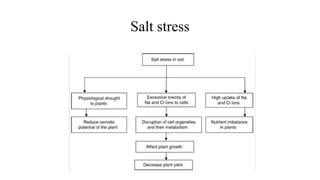
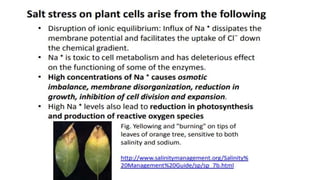
Salt stress
Salt stress
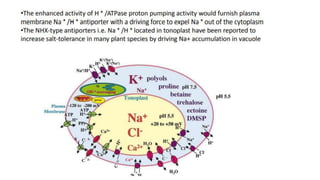
• Salt tolerance enhanced by halophytes to transport Na+ ions out of cytoplasam-
first transgenic experiment.
• This transport worked against concentration gradient ,it requires input of
energy. This is done by coupling the transport protein to a proton pump,
transporting H+ ions in opposite direction.
• The vacuolar Na+/H+ antiport protein AT NHX1 of Arabidopsis known to
coupled with proton pump such as AVP1, a vacuolar H+ translocating
pyrophosphatase
• This approach has been used to engineer salt tolerance in tomato plants by
transformation with AT NHX1 antiport protein gene
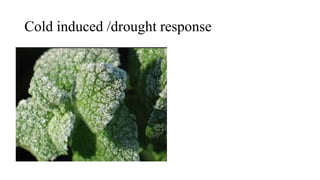
Cold induced /drought response
Cold Stress
• Cold tolerance is one of the trait that plant breeders have selected for over
many countries.
• Plants produce number of cold induced proteins during period of acclimation
which play a role in subsequent cold resistance.
• Cold stress fall into two categories:
• Late Embryogenesis Abundant Protein(LEA) and
• Cold Responsive Genes(COR).
• Over expression of cold induced proteins could be a possible route to specific
engineering of cold or freezing stress.
• Constitutive expression of small hydrophilic ,chloroplast targeted COR, protein
COR15a in Arabidopsis improved the freezing tolerance of chloroplast frozen
in sites
Cold induced /drought response
• Number of cold induced COR genes have been characterized and sequence were
compared.
• COR- in these promoters share a common regulatory element termed as c-repeat or
low-temperature responsive elements(LTRE)
• The LTRE region is bound by CBF transcription factor.
• CBF posses a nuclear localization sequences, DNA binding domain which binds and
intiates CBF1 expression by cold acclimation and leads to expression of COR genes.
• CBF1 is a member of small family
• CBF2,CBF3 are also transcription factors.
• CBF3 over expression results in several biochemical changes associated with cold
acclimization such as elevated level of compatible solutes,osmolytes and soluble
sugars.
Heat Stress
• Heat stress applied to organism which induce specific set of Heat Shock
Proteins(HSP)
• HSP fall into 5 categories : HSP-100,HSP-90,HSP-70 & HSP-60 which functions
as molecular chaperons
• These proteins are involved in countering the effects of heat stress by
protecting or refolding denaturing proteins.
• The rapid heat shock response is co-ordinated by a Heat Shock Factor(HSF)
• The protein is expressed constitutively and exists as monomer bound to one
of HSP70 proteins.
• Upon heat stress, HSP70 dissociates and HSF assembles into a trimer, which
binds to heat shock elements

STRESS TOLERANCE

  • 1.
  • 2.
    Stress tolerance : •Plants are subjected to many types of fluctuation in physical environment • Plants therefore depend largely upon internal mechanism for tolerating variations in external environment. • Acute or chronic extremes of environmental conditions lead to environmental stress that has the potential to damage the plant.  Cold stress  Heat stress  Water deficit stress
  • 4.
    Water deficit stress: •General physical changes in the environment leads to water deficit. • The water status of a cell is described by water potential and relative water content. • The continued water deficit condition would lead to dehydration and death. • Damaging to all cells because of the increase in the concentration of foric ions and loss of the productive hydration shell around vulnerable molecules like protein. • Plant cells respond to osmotic stress by producing compounds called compatible solutes to reduce the osmotic potential.
  • 5.
    Compatible solutes fallinto two broad classes 1. Sugar and Sugar alchohols (sorbitol, mannitol) 2. Zwitter ionic compounds (Quatenary ammonium compound – Glycine betine) Basic strategies for engineering resistance to water deficit stress focused on the production of osmoprotectants as a mechanism for overcoming osmotic stress generated by water deficit.
  • 7.
    Glycine Betaine Production •Glycine betaine is a quaternary ammonium salt found in flowering plants and marine algae • These molecules help in stabilizing proteins and membranes Production: Choline monooxygenase(CMO) assist in conversion of choline to betaine aldehyde.It is catalyzed by betaine aldehyde dehydrogenase(BADH) The enzymes CMO and BADH –induced by osmotic stress Choline CMO Betaine aldehyde BADH Glycine Betaine
  • 8.
    Hyperosmotic stress and compensationwith glycinebetaine K+ Water balance maintained Cell volume maintained Lower energy cost Stable metabolism Stable electrolyte concentration in the cell Glycinebetaine K+ Glycinebetaine N C C C C C O O H H H H H H H H H H H + -
  • 10.
    • In contrast,thesynthesis of glycine betaine in Arthrobacter globitormis involves a single enzyme choline oxidase which catalyses the reaction directly from choline to glycine betaine • Choline choline oxidase Glycine Betaine • Transformation of plants with Betaine aldehyde dehydrogenase gene permits accumulation of glycine betaine • Transformation of tobacco with plant CMO gene targeted to chloroplast resulted in low level glycine betaine accumulation • High level glycine betaine obtained using choline oxidase gene from Arthrobacter species
  • 11.
  • 13.
    Salt stress • Salttolerance enhanced by halophytes to transport Na+ ions out of cytoplasam- first transgenic experiment. • This transport worked against concentration gradient ,it requires input of energy. This is done by coupling the transport protein to a proton pump, transporting H+ ions in opposite direction. • The vacuolar Na+/H+ antiport protein AT NHX1 of Arabidopsis known to coupled with proton pump such as AVP1, a vacuolar H+ translocating pyrophosphatase • This approach has been used to engineer salt tolerance in tomato plants by transformation with AT NHX1 antiport protein gene
  • 15.
  • 16.
    Cold Stress • Coldtolerance is one of the trait that plant breeders have selected for over many countries. • Plants produce number of cold induced proteins during period of acclimation which play a role in subsequent cold resistance. • Cold stress fall into two categories: • Late Embryogenesis Abundant Protein(LEA) and • Cold Responsive Genes(COR). • Over expression of cold induced proteins could be a possible route to specific engineering of cold or freezing stress. • Constitutive expression of small hydrophilic ,chloroplast targeted COR, protein COR15a in Arabidopsis improved the freezing tolerance of chloroplast frozen in sites
  • 17.
    Cold induced /droughtresponse • Number of cold induced COR genes have been characterized and sequence were compared. • COR- in these promoters share a common regulatory element termed as c-repeat or low-temperature responsive elements(LTRE) • The LTRE region is bound by CBF transcription factor. • CBF posses a nuclear localization sequences, DNA binding domain which binds and intiates CBF1 expression by cold acclimation and leads to expression of COR genes. • CBF1 is a member of small family • CBF2,CBF3 are also transcription factors. • CBF3 over expression results in several biochemical changes associated with cold acclimization such as elevated level of compatible solutes,osmolytes and soluble sugars.
  • 18.
    Heat Stress • Heatstress applied to organism which induce specific set of Heat Shock Proteins(HSP) • HSP fall into 5 categories : HSP-100,HSP-90,HSP-70 & HSP-60 which functions as molecular chaperons • These proteins are involved in countering the effects of heat stress by protecting or refolding denaturing proteins. • The rapid heat shock response is co-ordinated by a Heat Shock Factor(HSF) • The protein is expressed constitutively and exists as monomer bound to one of HSP70 proteins. • Upon heat stress, HSP70 dissociates and HSF assembles into a trimer, which binds to heat shock elements