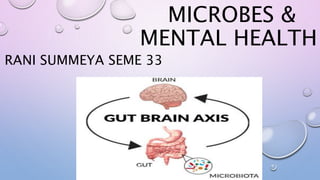
MICROBES &
MENTAL HEALTH
RANI SUMMEYA SEME 33
OUTLINE
• Introduction
• Gut Microbiota
• Microbiota Gut Brain Axis
• Communication pathways & Neurobiological Mechanism
• Neurotransmitter & Neuropeptide
• Influence of Microbioata GBA on Anxiety & Depression
• Gut Microbioata Treatment
• Conclusion & Future Direction
INTRODUCTION
• GI------100 trillion MO
Like bacteria, yeast, archea etc.
• Imp in development & functioning
Like digestion, growth etc.
• Role in diseases
Obesity, asthma, diabetes type 2
• Recent studies ----- GBA ---- CNS ----- Neuropsychiatric Disorder
Mechanism ----- not well understood
Research ----- bidirectional communication
b/w GMB & CNS
Anxiety & depression
THE GUT MICROBIOTA
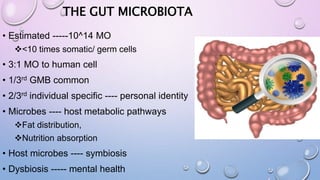
• Estimated -----10^14 MO
<10 times somatic/ germ cells
• 3:1 MO to human cell
• 1/3rd GMB common
• 2/3rd individual specific ---- personal identity
• Microbes ---- host metabolic pathways
Fat distribution,
Nutrition absorption
• Host microbes ---- symbiosis
• Dysbiosis ----- mental health
Microbiota Gut Brain Axis
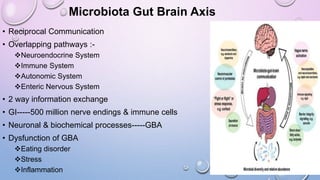
• Reciprocal Communication
• Overlapping pathways :-
Neuroendocrine System
Immune System
Autonomic System
Enteric Nervous System
• 2 way information exchange
• GI-----500 million nerve endings & immune cells
• Neuronal & biochemical processes-----GBA
• Dysfunction of GBA
Eating disorder
Stress
Inflammation
Communication pathways &
Neurobiological Mechanism
• VAGUS NERVE (X CRANIAL NERVE)
Link b/w GB
• CELL WALL COMPONENT & IMMUNE RESPONSES
Bacterial cell wall activate
Innate Response
Adaptive Response
• METABOLITES
Digestion & MB Fermentation
Imp mediator of GBA
CONTINUE…
FATTY ACIDS
• Brain is enriched
• Help on regulation
Neurotransmission
Cell survival
Neuroinflammation
• Production of Eicosanoid----Immune & Inflammatory response
• Regulate gene transcription
• Microbial derived SCFA---- anti inflammatory properties
• Primary metabolite of GB
• Spp. Eubacterium, Bifidobacterium, Enterobacter & Lactobacillus
CONTINUE…
• Produces acetate, butyrate, isobutyrtate, isopropionate
• N-butyrate & propionate------neuroactive properties
• Role in Enteroendocrine
TRYPTOPHAN
• Synthesis of serotonin---depression----gut
• Tryptophan & Tryptophan Hydroxylase
• Co-influence of tryptophan & immune system
• CNS function & Mood disorder
• Tryptophan metabolism---- Desregulation ---- Brain & GI disorders
NEUROTRANSMITER &
NEUROPEPTIDE
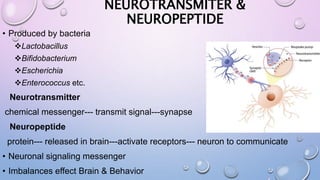
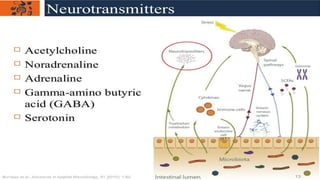
• Produced by bacteria
Lactobacillus
Bifidobacterium
Escherichia
Enterococcus etc.
Neurotransmitter
chemical messenger--- transmit signal---synapse
Neuropeptide
protein--- released in brain---activate receptors--- neuron to communicate
• Neuronal signaling messenger
• Imbalances effect Brain & Behavior
CONTINUE…
GABA
• Inhibitory neurotransmitter
• Produced by Glutamate metabolism
• Dysfunction----Chronic Disease
Anxiety
Depression
• Bifidobacterium & Lactobacillus----produces GABA from Glutamate
• L.rhamnosus---modulate expression of GABA in CNS
• Treatment of depression & anxiety
• Vagus Nerve-----necessary
• Behavioral & Molecular changes
CONTINUE…
SEROTONIN
• Monoamine Neurotransmitter
• Regulate all brain functions
• Modulate physiological processes
Mood
Sleep
Pain
Aggression,
• Dysregulation-----Neuropsychiatric Disorders
Anxiety & Depression
• 90% produced-----enterochromaffin cell in GI
• Spp. Of Escherichia & Enterococcus
Directly influence CNS function
CONTINUE…
BDNF
• Neurotrophin-----CNS
Survival of existing neuron
Encourages growth
Differentiation of Neurons & Synapses
• Decreased level----chronic depression
• mRNA & protein level associated with GBA
• Intestinal microbioata-----increases BDNF
• In mice infected with
Truchuris muris-----decreased level of BDNF
B. longum-----BDNF level normalized
INFLUENCE OF MICROBIOATA GBA ON
ANXIETY & DEPRESSION
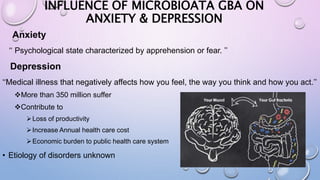
Anxiety
‘‘ Psychological state characterized by apprehension or fear. ’’
Depression
‘‘Medical illness that negatively affects how you feel, the way you think and how you act.’’
More than 350 million suffer
Contribute to
Loss of productivity
Increase Annual health care cost
Economic burden to public health care system
• Etiology of disorders unknown
CONTINUE…
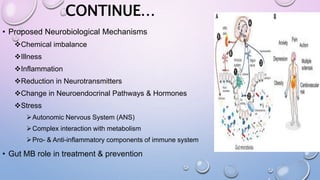
• Proposed Neurobiological Mechanisms
Chemical imbalance
Illness
Inflammation
Reduction in Neurotransmitters
Change in Neuroendocrinal Pathways & Hormones
Stress
Autonomic Nervous System (ANS)
Complex interaction with metabolism
Pro- & Anti-inflammatory components of immune system
• Gut MB role in treatment & prevention
CONTINUE…
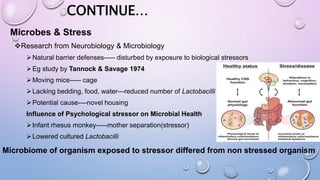
Microbes & Stress
Research from Neurobiology & Microbiology
Natural barrier defenses----- disturbed by exposure to biological stressors
Eg study by Tannock & Savage 1974
Moving mice----- cage
Lacking bedding, food, water---reduced number of Lactobacilli
Potential cause----novel housing
Influence of Psychological stressor on Microbial Health
Infant rhesus monkey-----mother separation(stressor)
Lowered cultured Lactobacilli
Microbiome of organism exposed to stressor differed from non stressed organism
GUT MICROBIOATA TREATMENT
• Probiotics
‘‘Living MO that believed to provide health benefits when consumed.’’
Lactobacillus & Bifidobacterium
Alter composition & diversity of GMB
• Antibiotics
Antibacterials
Used in treatment & prevention of bacteria
Effect microbiota GBA
Eg mice---antibiotics---7 days
Reduced anxiety like & increase exploratory behavior
• Transplant
FMT---effective
CONCLUSION & FUTURE DIRECTION
• Early stage of understanding
• Microbe play imp role in
Immune function
Stress responding
Brain function and behavior
• Stress affect composition of GMB
• Various treatment alter GMB---behavior & health outcome
• These studies----innovative approach---prevention & treatment of disorders
• Future work---elucidate---interceptive connection
• Advancement in brain based disorders
Microbes & Mental Health

Microbes & Mental Health

  • 2.
  • 3.
    OUTLINE • Introduction • GutMicrobiota • Microbiota Gut Brain Axis • Communication pathways & Neurobiological Mechanism • Neurotransmitter & Neuropeptide • Influence of Microbioata GBA on Anxiety & Depression • Gut Microbioata Treatment • Conclusion & Future Direction
  • 4.
    INTRODUCTION • GI------100 trillionMO Like bacteria, yeast, archea etc. • Imp in development & functioning Like digestion, growth etc. • Role in diseases Obesity, asthma, diabetes type 2 • Recent studies ----- GBA ---- CNS ----- Neuropsychiatric Disorder Mechanism ----- not well understood Research ----- bidirectional communication b/w GMB & CNS Anxiety & depression
  • 5.
    THE GUT MICROBIOTA •Estimated -----10^14 MO <10 times somatic/ germ cells • 3:1 MO to human cell • 1/3rd GMB common • 2/3rd individual specific ---- personal identity • Microbes ---- host metabolic pathways Fat distribution, Nutrition absorption • Host microbes ---- symbiosis • Dysbiosis ----- mental health
  • 6.
    Microbiota Gut BrainAxis • Reciprocal Communication • Overlapping pathways :- Neuroendocrine System Immune System Autonomic System Enteric Nervous System • 2 way information exchange • GI-----500 million nerve endings & immune cells • Neuronal & biochemical processes-----GBA • Dysfunction of GBA Eating disorder Stress Inflammation
  • 7.
    Communication pathways & NeurobiologicalMechanism • VAGUS NERVE (X CRANIAL NERVE) Link b/w GB • CELL WALL COMPONENT & IMMUNE RESPONSES Bacterial cell wall activate Innate Response Adaptive Response • METABOLITES Digestion & MB Fermentation Imp mediator of GBA
  • 8.
    CONTINUE… FATTY ACIDS • Brainis enriched • Help on regulation Neurotransmission Cell survival Neuroinflammation • Production of Eicosanoid----Immune & Inflammatory response • Regulate gene transcription • Microbial derived SCFA---- anti inflammatory properties • Primary metabolite of GB • Spp. Eubacterium, Bifidobacterium, Enterobacter & Lactobacillus
  • 9.
    CONTINUE… • Produces acetate,butyrate, isobutyrtate, isopropionate • N-butyrate & propionate------neuroactive properties • Role in Enteroendocrine TRYPTOPHAN • Synthesis of serotonin---depression----gut • Tryptophan & Tryptophan Hydroxylase • Co-influence of tryptophan & immune system • CNS function & Mood disorder • Tryptophan metabolism---- Desregulation ---- Brain & GI disorders
  • 10.
    NEUROTRANSMITER & NEUROPEPTIDE • Producedby bacteria Lactobacillus Bifidobacterium Escherichia Enterococcus etc. Neurotransmitter chemical messenger--- transmit signal---synapse Neuropeptide protein--- released in brain---activate receptors--- neuron to communicate • Neuronal signaling messenger • Imbalances effect Brain & Behavior
  • 12.
    CONTINUE… GABA • Inhibitory neurotransmitter •Produced by Glutamate metabolism • Dysfunction----Chronic Disease Anxiety Depression • Bifidobacterium & Lactobacillus----produces GABA from Glutamate • L.rhamnosus---modulate expression of GABA in CNS • Treatment of depression & anxiety • Vagus Nerve-----necessary • Behavioral & Molecular changes
  • 13.
    CONTINUE… SEROTONIN • Monoamine Neurotransmitter •Regulate all brain functions • Modulate physiological processes Mood Sleep Pain Aggression, • Dysregulation-----Neuropsychiatric Disorders Anxiety & Depression • 90% produced-----enterochromaffin cell in GI • Spp. Of Escherichia & Enterococcus Directly influence CNS function
  • 14.
    CONTINUE… BDNF • Neurotrophin-----CNS Survival ofexisting neuron Encourages growth Differentiation of Neurons & Synapses • Decreased level----chronic depression • mRNA & protein level associated with GBA • Intestinal microbioata-----increases BDNF • In mice infected with Truchuris muris-----decreased level of BDNF B. longum-----BDNF level normalized
  • 15.
    INFLUENCE OF MICROBIOATAGBA ON ANXIETY & DEPRESSION Anxiety ‘‘ Psychological state characterized by apprehension or fear. ’’ Depression ‘‘Medical illness that negatively affects how you feel, the way you think and how you act.’’ More than 350 million suffer Contribute to Loss of productivity Increase Annual health care cost Economic burden to public health care system • Etiology of disorders unknown
  • 16.
    CONTINUE… • Proposed NeurobiologicalMechanisms Chemical imbalance Illness Inflammation Reduction in Neurotransmitters Change in Neuroendocrinal Pathways & Hormones Stress Autonomic Nervous System (ANS) Complex interaction with metabolism Pro- & Anti-inflammatory components of immune system • Gut MB role in treatment & prevention
  • 17.
    CONTINUE… Microbes & Stress Researchfrom Neurobiology & Microbiology Natural barrier defenses----- disturbed by exposure to biological stressors Eg study by Tannock & Savage 1974 Moving mice----- cage Lacking bedding, food, water---reduced number of Lactobacilli Potential cause----novel housing Influence of Psychological stressor on Microbial Health Infant rhesus monkey-----mother separation(stressor) Lowered cultured Lactobacilli Microbiome of organism exposed to stressor differed from non stressed organism
  • 18.
    GUT MICROBIOATA TREATMENT •Probiotics ‘‘Living MO that believed to provide health benefits when consumed.’’ Lactobacillus & Bifidobacterium Alter composition & diversity of GMB • Antibiotics Antibacterials Used in treatment & prevention of bacteria Effect microbiota GBA Eg mice---antibiotics---7 days Reduced anxiety like & increase exploratory behavior • Transplant FMT---effective
  • 19.
    CONCLUSION & FUTUREDIRECTION • Early stage of understanding • Microbe play imp role in Immune function Stress responding Brain function and behavior • Stress affect composition of GMB • Various treatment alter GMB---behavior & health outcome • These studies----innovative approach---prevention & treatment of disorders • Future work---elucidate---interceptive connection • Advancement in brain based disorders