Fighting Superbugs
RANI SUMMEYA SEME 33
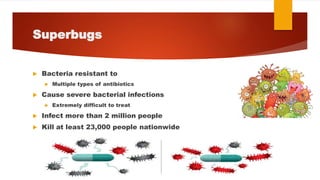
Superbugs
 Bacteria resistant to
 Multiple types of antibiotics
 Cause severe bacterial infections
 Extremely difficult to treat
 Infect more than 2 million people
 Kill at least 23,000 people nationwide
Term Usage
 Originally coined by the media
 To describe bacteria that cannot be killed using
multiple antibiotics
 Doctors often use phrases like multidrug-
resistant bacteria
 Because a superbug isn't necessarily
resistant to all antibiotics
 Superbugs aren't specific types of bacteria
 All bacteria spp. can turn into superbugs
 Misusing antibiotics
 Taking to treat viral infection
 Eventually doctors will run out of antibiotics to
treat them
The rise of superbugs is
the global threat of
antimicrobial resistance.
“
”
The rise of antimicrobial resistance
is a global crisis, recognized as one
of the greatest threats to health
today. It is a slow motion tsunami.
Dr. Margaret Chan, then- director general of WHO 2016.
On January 2019 CNN emphasized on this matter by writing
‘Drug resistant superbugs are as big a threat to the world
As climate change or war’
Drug resistant infections will
kill an extra 10M people a year
world wide. More than
currently die for cancer- by
2050 unless action is taken
And left unchecked, deaths would rise more than 10 fold by 2050
Common superbugs
Carbapenem-Resistant Enterobacteriaceae
(CRE)
Found in stomachs,
Cause life-threatening blood infections
Are resistant to all antibiotics
Multidrug-Resistant Acinetobacter
 Acinetobacter baumannii
 Found in
 Soil
 Water
 Skin
 Most common in hospitals
Neisseria gonorrhoeae
 causes the STD gonorrheae
MRSA
 Methicillin-resistant Staphylococcus
aureus
 Difficult-to-treat
Clostridium difficile
Found in
intestines
Can overgrow
Cause severe
diarrhea
Passed
spores
In bathrooms
On clothing
and
Not treated, C.
diff can be
Fighting Superbugs
 Bacteriophages
 Small Streptomyces molecules
 Traditional Medicine
 Combining Existing Drugs
 Molecular Drills
 Double Trojan Horse Drug
 Blue Light
 Nanoparticles
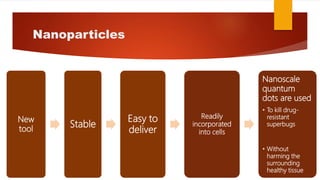
Nanoparticles
New
tool
Stable
Easy to
deliver
Readily
incorporated
into cells
Nanoscale
quantum
dots are used
• To kill drug-
resistant
superbugs
• Without
harming the
surrounding
healthy tissue
Working of Nanoparticles
Once introduced into the body
• The quantum dots do nothing until
• Activated by having a light shined on them
• Any visible light source can be used for this
• A lamp
• Room light
• Sunlight
Topical infections on the skin
Contiue…
When activated by light
• Quantum dots start generating electrons
• Attach to dissolved oxygen in the cells
• Creating radical ions
Ions interrupt biochemical reactions
• Cells rely on for communication
• Basic life functions
Target and kill specific bacterial cells
• That cause illnesses
Fighting superbugs

Fighting superbugs

Editor's Notes

  • #4 We normally associate the word super with something that’s good—superman, superfoods, superpowers—but when it comes to superbugs, the end result is anything but good. Antibiotics have been an important part of modern medicine since the 1930s. Their use has resulted in improved health and increased life-span, and has enabled many of the medical breakthroughs—such as any surgery and neonatal care—that we now take for granted. However, antibiotics have been used for so long, and so widely, around the world that many of the infectious organisms they are designed to eliminate have adapted and become resistant to them
  • #6 (such as taking them when you don't need them or not finishing all of your medicine) is the single leading factor contributing to this problem,
  • #16 5It can be passed among individuals through spores in bathrooms and on clothing and is not always able to be treated with antibiotics. If not treated, C. diff can be fatal.
  • #18 Million times smaller than a milimeter – minuscule semiconductor particles with specific light-absorption properties –
  • #19 ; deeper inside the body, brighter lights or more nanoparticles may be needed