INTRODUCTION
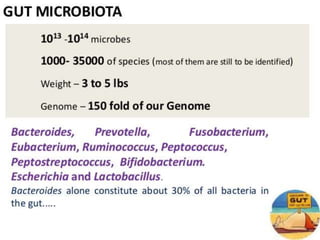
 Human gastrointestinal tract - 10¹⁴
Number of cells- 10¹³
 Gut microbiome plays an important role in adaptive as well as
innate immune system.
 More than 1000 sp. and more than 7000 strains
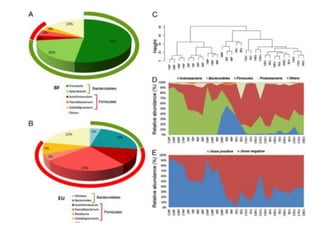
 Bacteroidetes and Firmicutes are the two predominant
phylotypes.
 Others are Proteobacteria, Actinobacteria, Fusobacteria and
Verrucomicrobia phyla in lower abundance.
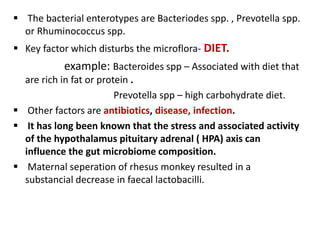
 The bacterial enterotypes are Bacteriodes spp. , Prevotella spp.
or Rhuminococcus spp.
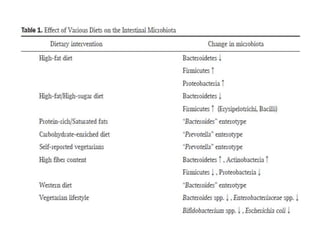
 Key factor which disturbs the microflora- DIET.
example: Bacteroides spp – Associated with diet that
are rich in fat or protein .
Prevotella spp – high carbohydrate diet.
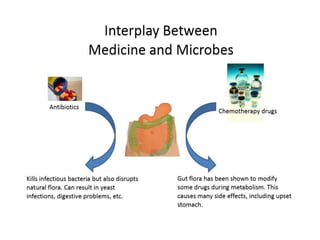
 Other factors are antibiotics, disease, infection.
 It has long been known that the stress and associated activity
of the hypothalamus pituitary adrenal ( HPA) axis can
influence the gut microbiome composition.
 Maternal seperation of rhesus monkey resulted in a
substancial decrease in faecal lactobacilli.
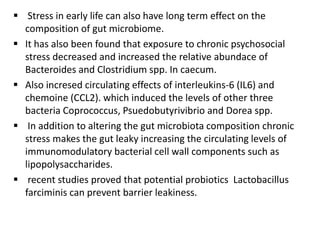
 Stress in early life can also have long term effect on the
composition of gut microbiome.
 It has also been found that exposure to chronic psychosocial
stress decreased and increased the relative abundace of
Bacteroides and Clostridium spp. In caecum.
 Also incresed circulating effects of interleukins-6 (IL6) and
chemoine (CCL2). which induced the levels of other three
bacteria Coprococcus, Psuedobutyrivibrio and Dorea spp.
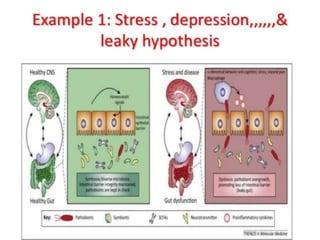
 In addition to altering the gut microbiota composition chronic
stress makes the gut leaky increasing the circulating levels of
immunomodulatory bacterial cell wall components such as
lipopolysaccharides.
 recent studies proved that potential probiotics Lactobacillus
farciminis can prevent barrier leakiness.
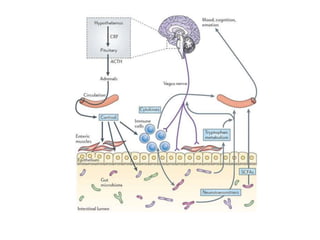
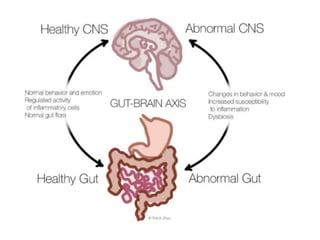
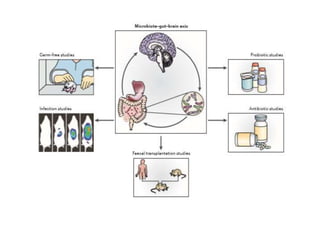
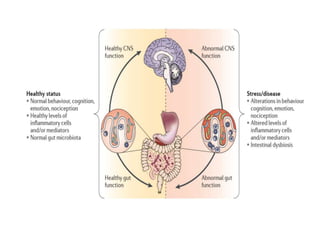
GUT –BRAIN AXIS
 Biochemical signalling that takes place between the
gastrointestinal tract and central nervous system.
 It includes the,
1)central nervous system,
2)neuroendocrine and
3)neuroimmune systems including the hypothalamic-
pituitary-adrenal axis, sympathetic parasympathetic arms of
autonomous nervous system vagus nerve and gut microbiota.
REGULATION OF NEUROLOGICAL FUNCTION
BY GUT MICROBIOME
 Potential contribution of bidirectional communication
between the gut and the CNS suggests high rates of
conditions between gastrointestinal and psychiatric illness.
 For example; mood disorders effect more than half of the
patients with irritable bowel syndrome with antideppressants
being administered for irritable bowel syndrome.
 The microbiome can easily be altered by the factors such as
diet antibiotics and disrupted sleep patterns.
 Approaches that have been used to elucidate the role of gut
microbiota on behaviour and cognition include use of
i. Germ free animals
ii. Animals with pathogenic bacterial infection
iii. Animals exposed to probiotics or antibiotics.
a) Germ free animals.
• Enables assessment of role of microbiota in all aspects of
physiology.
• gastrointestinal invironment is sterile and colonisation occurs
postnatally
• an adult germ free mice exposed to mild restraint stress
• Stress respose in germ free mice can be partially reversed by
colonization with the faecal matter from control animals.
• and was fully reversed by the mono association with
Bifidobacterium infantis.
• the earlier the colonization the greater the reversal effects.
• full reversal can be seen in adult offspring when germ free
mothers were inoculated with specific bacterial strains before
giving birth.
b) Bacterial infections
• Mice were injected with Trichuris muris similar to human
parasite Trichuris trichiuria.
• the mice showed increased anxiety like behavior and
decreased levels of Brain Derived Nuerotropic Factor (BDNF) a
key neurotropin involoved in the growth and survival of
neurons and increased levels of inflammatory cytokines and
tumour necrosis factor-α and interferon-γ.
• Vagotomy before infection did not prevent anxiety like
behaviour which proves that vagus nerve do not mediate in
the behavioural effects of infection.
• Administration of Bifidobacterium longum also normalised
behaviour. Restored bdnf levels mRNA levels.
c) Probiotics
• Probiotics are live organisms that when administered in
adequate amount exerts a health benefit on the host.
• For example in the case of gastroinstestinal symptoms of
disorders such as inflammatory bowel syndrome.
• clinical evidences also to support the role of probiotics in
reducing anxiety decreasing stress and improving mood in
individuals with IBS with chronic fatigue.
• Recently the combination of probiotics Lactobacillus helveticus
and Bifidobacterium longum proved to reduce anxiety like
behaviour and beneficial psychological effects and decreased
serum cortisol level in humans.
• Also reversed depression related behavioral effects.
• B.infantis have antidepressant effect and normalised
peripheral proinflammatory cytokine and tryptophan
concentration.
d) ANTIBIOTICS
• The use of antimicrobial drugs are the most commonly used
method to induce intestinal dysbiosis.
• Oral administration of non adsorbable antimicrobial neomycin
and bacitracin along with antifungal natamycin in adult mice
increased visceral hypersensitivity in response to colorectal
distension an effect that can be reversed by the
administration of Lactobacillus paracasei.
• Interestingly no vagotomy nor sympathetomy affected the
ability of the antimicrobials to induce their effect on the brain.
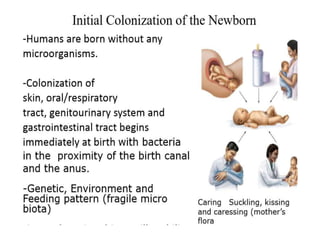
• ROLE OF MICROBIOME IN BRAIN DEVELOPMENT
A. PRENATAL DEVELOPMENT
 Brain development spans from the prenatal stage to the post
adolesence.
 Also involoves the interplay of genetic as well as environmental
factors.
 Neural development starts in early embrionic life within the
womb of the mother.
 During this period maternal immunity and metabolism
represents a link between neuraldevelopment in the womb
and the external environment.
 Challenges to maternal homeostasis such as infection poor
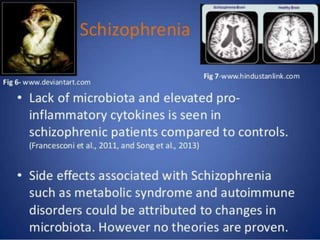
nutrition prenatal stress leads to neurodevelopmental
disorders such as anxiety, autism, attention deficit
hyperactivity disorder depression and schizophrenia.
• Increased levels of circulating cytokines during pregnancy have
been shown as negative impact on neuraldevelopment.
• Infact children born through normal delivery have normal
microbiota whereas children both by cesarian are deprived of
contact with maternal microbiota.
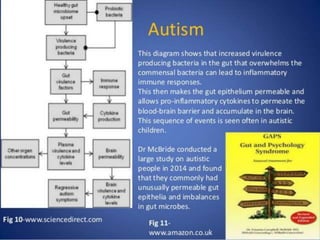
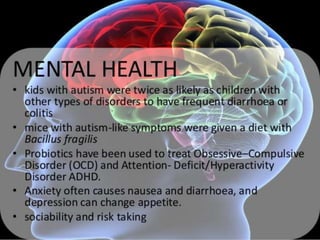
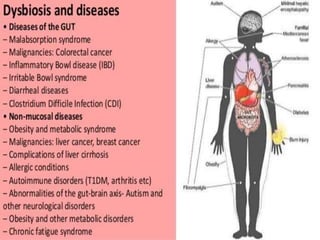
 AUTISM (ASD)
 Neurodevelopmental disorder characterised by impairments in
social interactions
 Gastrointesinal symptoms were reported and this led to
assumption that gastrointestinal disturbancesperhaps linked to
an abnormal gut microbiome have a significant role in ASD.
 Also there are studies which demonstrated that there is altered
microbiota in children with ASD compared with neurotypical
children.
 Notable intracerebroventricular administration of relatively
high dodes of long chain fatty acid propionic acid in animals
resulted in autistic-like behaviors.
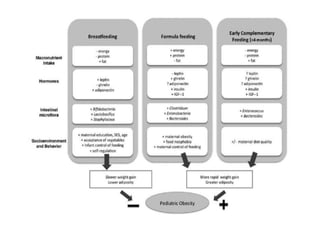
 OBESITY
 The role of gut microbiota in the regulation of body weight and
metabolism has received attention in recent years.
 The germ free mice had less total body fat than conventionally
reared mice and are resistant to diet induced obesity.
Presentation gut microbiota

Presentation gut microbiota

  • 3.
    INTRODUCTION  Human gastrointestinaltract - 10¹⁴ Number of cells- 10¹³  Gut microbiome plays an important role in adaptive as well as innate immune system.  More than 1000 sp. and more than 7000 strains  Bacteroidetes and Firmicutes are the two predominant phylotypes.  Others are Proteobacteria, Actinobacteria, Fusobacteria and Verrucomicrobia phyla in lower abundance.
  • 7.
     The bacterialenterotypes are Bacteriodes spp. , Prevotella spp. or Rhuminococcus spp.  Key factor which disturbs the microflora- DIET. example: Bacteroides spp – Associated with diet that are rich in fat or protein . Prevotella spp – high carbohydrate diet.  Other factors are antibiotics, disease, infection.  It has long been known that the stress and associated activity of the hypothalamus pituitary adrenal ( HPA) axis can influence the gut microbiome composition.  Maternal seperation of rhesus monkey resulted in a substancial decrease in faecal lactobacilli.
  • 8.
     Stress inearly life can also have long term effect on the composition of gut microbiome.  It has also been found that exposure to chronic psychosocial stress decreased and increased the relative abundace of Bacteroides and Clostridium spp. In caecum.  Also incresed circulating effects of interleukins-6 (IL6) and chemoine (CCL2). which induced the levels of other three bacteria Coprococcus, Psuedobutyrivibrio and Dorea spp.  In addition to altering the gut microbiota composition chronic stress makes the gut leaky increasing the circulating levels of immunomodulatory bacterial cell wall components such as lipopolysaccharides.  recent studies proved that potential probiotics Lactobacillus farciminis can prevent barrier leakiness.
  • 10.
    GUT –BRAIN AXIS Biochemical signalling that takes place between the gastrointestinal tract and central nervous system.  It includes the, 1)central nervous system, 2)neuroendocrine and 3)neuroimmune systems including the hypothalamic- pituitary-adrenal axis, sympathetic parasympathetic arms of autonomous nervous system vagus nerve and gut microbiota.
  • 14.
    REGULATION OF NEUROLOGICALFUNCTION BY GUT MICROBIOME  Potential contribution of bidirectional communication between the gut and the CNS suggests high rates of conditions between gastrointestinal and psychiatric illness.  For example; mood disorders effect more than half of the patients with irritable bowel syndrome with antideppressants being administered for irritable bowel syndrome.  The microbiome can easily be altered by the factors such as diet antibiotics and disrupted sleep patterns.
  • 15.
     Approaches thathave been used to elucidate the role of gut microbiota on behaviour and cognition include use of i. Germ free animals ii. Animals with pathogenic bacterial infection iii. Animals exposed to probiotics or antibiotics. a) Germ free animals. • Enables assessment of role of microbiota in all aspects of physiology. • gastrointestinal invironment is sterile and colonisation occurs postnatally • an adult germ free mice exposed to mild restraint stress
  • 16.
    • Stress resposein germ free mice can be partially reversed by colonization with the faecal matter from control animals. • and was fully reversed by the mono association with Bifidobacterium infantis. • the earlier the colonization the greater the reversal effects. • full reversal can be seen in adult offspring when germ free mothers were inoculated with specific bacterial strains before giving birth.
  • 18.
    b) Bacterial infections •Mice were injected with Trichuris muris similar to human parasite Trichuris trichiuria. • the mice showed increased anxiety like behavior and decreased levels of Brain Derived Nuerotropic Factor (BDNF) a key neurotropin involoved in the growth and survival of neurons and increased levels of inflammatory cytokines and tumour necrosis factor-α and interferon-γ. • Vagotomy before infection did not prevent anxiety like behaviour which proves that vagus nerve do not mediate in the behavioural effects of infection. • Administration of Bifidobacterium longum also normalised behaviour. Restored bdnf levels mRNA levels.
  • 19.
    c) Probiotics • Probioticsare live organisms that when administered in adequate amount exerts a health benefit on the host. • For example in the case of gastroinstestinal symptoms of disorders such as inflammatory bowel syndrome. • clinical evidences also to support the role of probiotics in reducing anxiety decreasing stress and improving mood in individuals with IBS with chronic fatigue. • Recently the combination of probiotics Lactobacillus helveticus and Bifidobacterium longum proved to reduce anxiety like behaviour and beneficial psychological effects and decreased serum cortisol level in humans. • Also reversed depression related behavioral effects.
  • 20.
    • B.infantis haveantidepressant effect and normalised peripheral proinflammatory cytokine and tryptophan concentration. d) ANTIBIOTICS • The use of antimicrobial drugs are the most commonly used method to induce intestinal dysbiosis. • Oral administration of non adsorbable antimicrobial neomycin and bacitracin along with antifungal natamycin in adult mice increased visceral hypersensitivity in response to colorectal distension an effect that can be reversed by the administration of Lactobacillus paracasei. • Interestingly no vagotomy nor sympathetomy affected the ability of the antimicrobials to induce their effect on the brain.
  • 22.
    • ROLE OFMICROBIOME IN BRAIN DEVELOPMENT A. PRENATAL DEVELOPMENT  Brain development spans from the prenatal stage to the post adolesence.  Also involoves the interplay of genetic as well as environmental factors.  Neural development starts in early embrionic life within the womb of the mother.  During this period maternal immunity and metabolism represents a link between neuraldevelopment in the womb and the external environment.  Challenges to maternal homeostasis such as infection poor nutrition prenatal stress leads to neurodevelopmental disorders such as anxiety, autism, attention deficit hyperactivity disorder depression and schizophrenia.
  • 23.
    • Increased levelsof circulating cytokines during pregnancy have been shown as negative impact on neuraldevelopment. • Infact children born through normal delivery have normal microbiota whereas children both by cesarian are deprived of contact with maternal microbiota.
  • 27.
     AUTISM (ASD) Neurodevelopmental disorder characterised by impairments in social interactions  Gastrointesinal symptoms were reported and this led to assumption that gastrointestinal disturbancesperhaps linked to an abnormal gut microbiome have a significant role in ASD.  Also there are studies which demonstrated that there is altered microbiota in children with ASD compared with neurotypical children.  Notable intracerebroventricular administration of relatively high dodes of long chain fatty acid propionic acid in animals resulted in autistic-like behaviors.
  • 32.
     OBESITY  Therole of gut microbiota in the regulation of body weight and metabolism has received attention in recent years.  The germ free mice had less total body fat than conventionally reared mice and are resistant to diet induced obesity.