GUT MICROBIOTA
The Human Bacteria
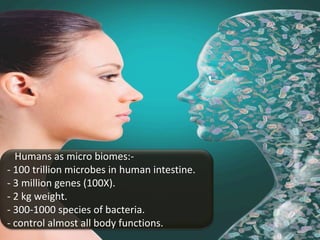
Humans as micro biomes:-
- 100 trillion microbes in human intestine.
- 3 million genes (100X).
- 2 kg weight.
- 300-1000 species of bacteria.
- control almost all body functions.
COMPOSITION
• 99 % from 30 – 40
species.
• 4 dominant phyla :
- Bacteriodetes.
- Fermicutes.
- Actinobacteria.
- Proteobacteria.
• Enterotypes :
- Prevotella.
- Bacteroides.
- Ruminococcus.
Variation of Gut Micro biota :
- Dependence on Age
- Dependence on Geography
- Dependence on Diet
Variation with Age
Variation with Diet
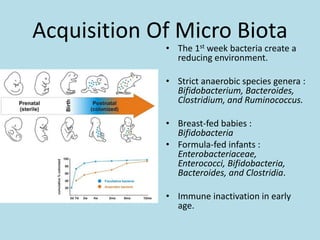
Acquisition Of Micro Biota
• The 1st week bacteria create a
reducing environment.
• Strict anaerobic species genera :
Bifidobacterium, Bacteroides,
Clostridium, and Ruminococcus.
• Breast-fed babies :
Bifidobacteria
• Formula-fed infants :
Enterobacteriaceae,
Enterococci, Bifidobacteria,
Bacteroides, and Clostridia.
• Immune inactivation in early
age.
FUNCTIONS
NUTRITION
• 30% more calories.
• Short-Chain Fatty Acids (SCFAs)
• SACCHAROLYTIC FERMENTATION
• Acetic acid, Propionic acid and
Butyric acid.
• SCFAs in the caecum. Intestinal
SCFAs directly provide energy to
colonocytes, absorption into the
portal circulation, stimulates
adipogenesis.
• PROTEOLYTIC FERMENTATION
• Collagen and Elastin
• Toxins, Carcinogens, SCFAs
TROPHIC EFFECTS
• Growth of intestinal epithelial cells, lymphoid tissue
and control their proliferation and differentiation
• Sodium/Glucose transporters
METABOLISM
• Positively control the intestinal epithelial cell
differentiation , proliferation by production of Short-Chain
Fatty Acids.
• Syntheses of vitamins like Biotin and Folic Acid
• Absorption of ions including Magnesium, Calcium and Iron.
• Metabolize dietary carcinogens - Micro components &
Macro components
• Micro - Genotoxic , Heterocyclic Amines (HCAs)
• Macro - Excessive intake of Fat and Sodium Chloride
IMMUNITY
• Oral Tolerance
• Immune Exclusion - IgA
• Expression of TLRs
PROTECTIVE FUNCTIONS
• Competitive Exclusion by BARRIER EFFECT
• Bacteriocins
• produces lactic acid and fatty acids, serves to
lower the pH in the colon
• In alergic patients, C. difficile and S. aureus are
higher and lower prevalence of Bacteroides and
Bifidobacteria
• Prevention of IBD
SPECIATION
• Nasonia giraulti, N. longicornis, N. vitripennis
• Halogenome
OBESITY
• fewer Bacteroidetes and more Firmicutes
• differences in the energy-reabsorbing potential
• Roux-en-Y gastric bypass (RYGB)
• Results in significant weight loss improvements
in conditions like Type 2 diabetes.
• 29% of their body weight within 3 weeks, despite
no change in net food intake.
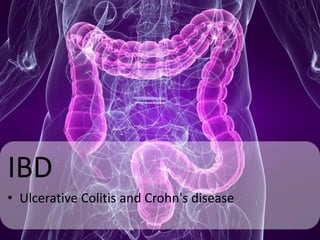
IBD
• Ulcerative Colitis and Crohn's disease
CANCER
• Bacteroides and Clostridium
• Lactobacillus and Bifidobacteria
TRANSLOCATION
• Too much growth of bacteria in the small intestine
• Reduced immunity of the host
• Increased gut lining permeability in diseases like cirrhosis
MENTAL HEALTH
• kids with autism were twice as likely as children with
other types of disorders to have frequent diarrhoea or
colitis
• mice with autism-like symptoms were given a diet with
Bacillus fragilis
• Probiotics have been used to treat Obsessive–Compulsive
Disorder (OCD) and Attention- Deficit/Hyperactivity
Disorder ADHD.
• Anxiety often causes nausea and diarrhoea, and
depression can change appetite.
• sociability and risk taking
HEART DISEASE
• Trimethylamine N-oxide (TMAO)
• Atherosclerosis
• L-carnitine & Red Meat.
ALTERATIONS
ANTIBIOTICS
• Antibiotic-Associated
Diarrhoea (AAD)
• Antibiotic-Resistant bacteria.
• C. difficile and Salmonella
kedougou
• Selective Digestive Tract
Decontamination (SDD)
• Children who were given
antibiotics during the first 6
months of life were more
likely to have a higher body
mass
PHARMABIOTICS
• Probiotic bacteria
• Probiotic-derived biologically active metabolites
• Prebiotics
• Synbiotics or genetically modified commensal
bacteria
• IBD, Atopy, Infection, Diarrhoea, Cancer & Arthritis
STUDY OF MICROBIOTA
TECHNIQUES OF STUDY
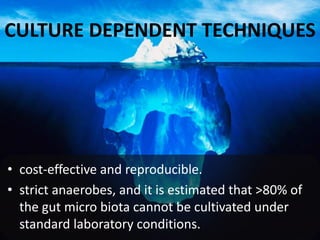
CULTURE DEPENDENT TECHNIQUES
• cost-effective and reproducible.
• strict anaerobes, and it is estimated that >80% of
the gut micro biota cannot be cultivated under
standard laboratory conditions.
CULTURE INDEPENDENT TECHNIQUES
• Molecular-based techniques.
• 16S ribosomal RNA (rRNA) gene.
MODELS OF STUDY
• Germ Free Animals
• Mono-, Bi-, Poly- Associated Animals
• Human Flora Associated Animals.
ARE WE REALLY MORE OF
BACTERIAL MICROBIOME
THAN MAMMALS?
Microbiota as a
FORGOTTEN ORGAN ?
What would be the advantage of
unicellular organisms becoming
multi-cellular?
What differentiates a multi-cellular
unit from a colony of unicellular
beings living in proximity?
Whether this association will evolve
into a more complex system in
further evolution of human
digestive system?
Human Microbiome - Gut Microbiota

Human Microbiome - Gut Microbiota

  • 1.
  • 3.
    Humans as microbiomes:- - 100 trillion microbes in human intestine. - 3 million genes (100X). - 2 kg weight. - 300-1000 species of bacteria. - control almost all body functions.
  • 4.
    COMPOSITION • 99 %from 30 – 40 species. • 4 dominant phyla : - Bacteriodetes. - Fermicutes. - Actinobacteria. - Proteobacteria. • Enterotypes : - Prevotella. - Bacteroides. - Ruminococcus.
  • 5.
    Variation of GutMicro biota : - Dependence on Age - Dependence on Geography - Dependence on Diet
  • 6.
  • 7.
  • 8.
    Acquisition Of MicroBiota • The 1st week bacteria create a reducing environment. • Strict anaerobic species genera : Bifidobacterium, Bacteroides, Clostridium, and Ruminococcus. • Breast-fed babies : Bifidobacteria • Formula-fed infants : Enterobacteriaceae, Enterococci, Bifidobacteria, Bacteroides, and Clostridia. • Immune inactivation in early age.
  • 9.
  • 10.
    NUTRITION • 30% morecalories. • Short-Chain Fatty Acids (SCFAs) • SACCHAROLYTIC FERMENTATION • Acetic acid, Propionic acid and Butyric acid. • SCFAs in the caecum. Intestinal SCFAs directly provide energy to colonocytes, absorption into the portal circulation, stimulates adipogenesis. • PROTEOLYTIC FERMENTATION • Collagen and Elastin • Toxins, Carcinogens, SCFAs
  • 11.
    TROPHIC EFFECTS • Growthof intestinal epithelial cells, lymphoid tissue and control their proliferation and differentiation • Sodium/Glucose transporters
  • 12.
    METABOLISM • Positively controlthe intestinal epithelial cell differentiation , proliferation by production of Short-Chain Fatty Acids. • Syntheses of vitamins like Biotin and Folic Acid • Absorption of ions including Magnesium, Calcium and Iron. • Metabolize dietary carcinogens - Micro components & Macro components • Micro - Genotoxic , Heterocyclic Amines (HCAs) • Macro - Excessive intake of Fat and Sodium Chloride
  • 13.
    IMMUNITY • Oral Tolerance •Immune Exclusion - IgA • Expression of TLRs
  • 14.
    PROTECTIVE FUNCTIONS • CompetitiveExclusion by BARRIER EFFECT • Bacteriocins • produces lactic acid and fatty acids, serves to lower the pH in the colon • In alergic patients, C. difficile and S. aureus are higher and lower prevalence of Bacteroides and Bifidobacteria • Prevention of IBD
  • 15.
    SPECIATION • Nasonia giraulti,N. longicornis, N. vitripennis • Halogenome
  • 17.
    OBESITY • fewer Bacteroidetesand more Firmicutes • differences in the energy-reabsorbing potential • Roux-en-Y gastric bypass (RYGB) • Results in significant weight loss improvements in conditions like Type 2 diabetes. • 29% of their body weight within 3 weeks, despite no change in net food intake.
  • 18.
    IBD • Ulcerative Colitisand Crohn's disease
  • 19.
    CANCER • Bacteroides andClostridium • Lactobacillus and Bifidobacteria TRANSLOCATION • Too much growth of bacteria in the small intestine • Reduced immunity of the host • Increased gut lining permeability in diseases like cirrhosis
  • 20.
    MENTAL HEALTH • kidswith autism were twice as likely as children with other types of disorders to have frequent diarrhoea or colitis • mice with autism-like symptoms were given a diet with Bacillus fragilis • Probiotics have been used to treat Obsessive–Compulsive Disorder (OCD) and Attention- Deficit/Hyperactivity Disorder ADHD. • Anxiety often causes nausea and diarrhoea, and depression can change appetite. • sociability and risk taking
  • 21.
    HEART DISEASE • TrimethylamineN-oxide (TMAO) • Atherosclerosis • L-carnitine & Red Meat.
  • 22.
  • 23.
    ANTIBIOTICS • Antibiotic-Associated Diarrhoea (AAD) •Antibiotic-Resistant bacteria. • C. difficile and Salmonella kedougou • Selective Digestive Tract Decontamination (SDD) • Children who were given antibiotics during the first 6 months of life were more likely to have a higher body mass
  • 24.
    PHARMABIOTICS • Probiotic bacteria •Probiotic-derived biologically active metabolites • Prebiotics • Synbiotics or genetically modified commensal bacteria • IBD, Atopy, Infection, Diarrhoea, Cancer & Arthritis
  • 25.
  • 26.
  • 27.
    CULTURE DEPENDENT TECHNIQUES •cost-effective and reproducible. • strict anaerobes, and it is estimated that >80% of the gut micro biota cannot be cultivated under standard laboratory conditions.
  • 28.
    CULTURE INDEPENDENT TECHNIQUES •Molecular-based techniques. • 16S ribosomal RNA (rRNA) gene.
  • 29.
    MODELS OF STUDY •Germ Free Animals • Mono-, Bi-, Poly- Associated Animals • Human Flora Associated Animals.
  • 30.
    ARE WE REALLYMORE OF BACTERIAL MICROBIOME THAN MAMMALS?
  • 31.
  • 32.
    What would bethe advantage of unicellular organisms becoming multi-cellular?
  • 33.
    What differentiates amulti-cellular unit from a colony of unicellular beings living in proximity?
  • 34.
    Whether this associationwill evolve into a more complex system in further evolution of human digestive system?