MICROARRAYS
HARIPRIYA U VARMA
2ND
MSC BIOTECHNOLOGY
INTRODUCTION
 Microarrays are the
powerful tools in
molecular biology for
studying gene
expression and other
genomic features.
 They allow
researchers to
analyze thousands of
genes or DNA
sequences
simultaneously.
OLIGONUCLEOTIDE MICROARRAYS
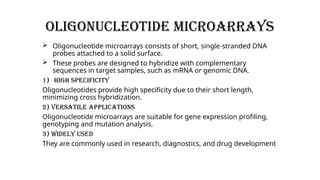
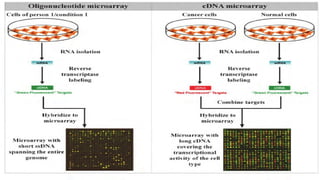
 Oligonucleotide microarrays consists of short, single-stranded DNA
probes attached to a solid surface.
 These probes are designed to hybridize with complementary
sequences in target samples, such as mRNA or genomic DNA.
1) HIGH SPECIFICITY
Oligonucleotides provide high specificity due to their short length,
minimizing cross hybridization.
2) Versatile applications
Oligonucleotide microarrays are suitable for gene expression profiling,
genotyping and mutation analysis.
3) Widely used
They are commonly used in research, diagnostics, and drug development
cDNA microarrays
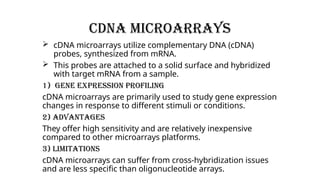
 cDNA microarrays utilize complementary DNA (cDNA)
probes, synthesized from mRNA.
 This probes are attached to a solid surface and hybridized
with target mRNA from a sample.
1) Gene expression profiling
cDNA microarrays are primarily used to study gene expression
changes in response to different stimuli or conditions.
2) Advantages
They offer high sensitivity and are relatively inexpensive
compared to other microarrays platforms.
3) Limitations
cDNA microarrays can suffer from cross-hybridization issues
and are less specific than oligonucleotide arrays.
PROTEIN MICROARRAYS
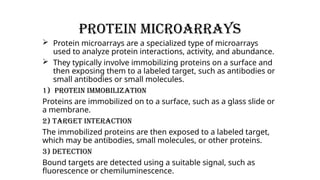
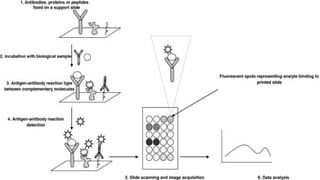
 Protein microarrays are a specialized type of microarrays
used to analyze protein interactions, activity, and abundance.
 They typically involve immobilizing proteins on a surface and
then exposing them to a labeled target, such as antibodies or
small antibodies or small molecules.
1) Protein immobilization
Proteins are immobilized on to a surface, such as a glass slide or
a membrane.
2) Target interaction
The immobilized proteins are then exposed to a labeled target,
which may be antibodies, small molecules, or other proteins.
3) Detection
Bound targets are detected using a suitable signal, such as
fluorescence or chemiluminescence.
Tissue microarrays
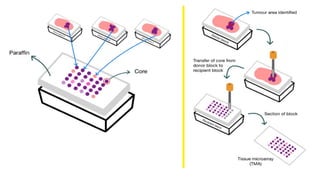
 Tissue microarrays (TMAs) are specialized microarrays
used to analyze multiple tissue samples on a single slide.
 TMAs are created by extracting small cores of tissues
from multiple donors and arranging them in a grid-like
pattern on a single slide.
1) high-throughput analysis
TMAs allow for the simultaneous analysis of hundreds or
even thousands of tissue samples, providing a cost-
effective and efficient way to study tissue heterogeneity
and disease progression.
2) Improved efficiency
TMAs eliminate the need to process multiple individual
slides, saving time and resources.
Comparative genomic hybridization
(cgh) microarrays
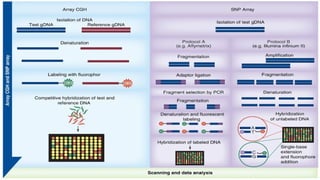
 CGH microarrays are used to detect copy number
variations (CNVs)in DNA.
 They compare the genomic DNA from a test sample to a
reference sample, allowing researchers to identify gains
or loses of DNA segments.
1) Cancer detection
CGH microarrays are commonly used in cancer research to
identify genomic alterations associated with tumorigenesis.
2) Developmental disorders
They can also be used to detect CNVs associated with
developmental disorders, such as autism as autism
spectrum disorder.
Single nucleotide polymorphism (snp)
microarrays
 SNP microarrays are designed to detect single
nucleotide polymorphisms (SNP), which are
variations in the DNA sequence that occur at a
single nucleotide.
1) Disease associated studies
SNP microarrays can be used to identify SNPs that are
associated with an increased risk of developing a
particular disease.
2) Pharmacogenomics
They can also be used to identify SNPs that influence
an individual’s response to drugs, leading to
personalized medicine.
conclusion
 Microarrays are
powerful tools with a
wide range of
applications in
molecular biology
and biomedical
research.
 They are used in
various various fields,
including drug
discovery,
diagnostics,
personalized
medicine and
agricultural
biotechnology.
MICROARRAYS - Bioinformatics and Genetic Engineering

MICROARRAYS - Bioinformatics and Genetic Engineering

  • 1.
  • 2.
    INTRODUCTION  Microarrays arethe powerful tools in molecular biology for studying gene expression and other genomic features.  They allow researchers to analyze thousands of genes or DNA sequences simultaneously.
  • 3.
    OLIGONUCLEOTIDE MICROARRAYS  Oligonucleotidemicroarrays consists of short, single-stranded DNA probes attached to a solid surface.  These probes are designed to hybridize with complementary sequences in target samples, such as mRNA or genomic DNA. 1) HIGH SPECIFICITY Oligonucleotides provide high specificity due to their short length, minimizing cross hybridization. 2) Versatile applications Oligonucleotide microarrays are suitable for gene expression profiling, genotyping and mutation analysis. 3) Widely used They are commonly used in research, diagnostics, and drug development
  • 4.
    cDNA microarrays  cDNAmicroarrays utilize complementary DNA (cDNA) probes, synthesized from mRNA.  This probes are attached to a solid surface and hybridized with target mRNA from a sample. 1) Gene expression profiling cDNA microarrays are primarily used to study gene expression changes in response to different stimuli or conditions. 2) Advantages They offer high sensitivity and are relatively inexpensive compared to other microarrays platforms. 3) Limitations cDNA microarrays can suffer from cross-hybridization issues and are less specific than oligonucleotide arrays.
  • 6.
    PROTEIN MICROARRAYS  Proteinmicroarrays are a specialized type of microarrays used to analyze protein interactions, activity, and abundance.  They typically involve immobilizing proteins on a surface and then exposing them to a labeled target, such as antibodies or small antibodies or small molecules. 1) Protein immobilization Proteins are immobilized on to a surface, such as a glass slide or a membrane. 2) Target interaction The immobilized proteins are then exposed to a labeled target, which may be antibodies, small molecules, or other proteins. 3) Detection Bound targets are detected using a suitable signal, such as fluorescence or chemiluminescence.
  • 8.
    Tissue microarrays  Tissuemicroarrays (TMAs) are specialized microarrays used to analyze multiple tissue samples on a single slide.  TMAs are created by extracting small cores of tissues from multiple donors and arranging them in a grid-like pattern on a single slide. 1) high-throughput analysis TMAs allow for the simultaneous analysis of hundreds or even thousands of tissue samples, providing a cost- effective and efficient way to study tissue heterogeneity and disease progression. 2) Improved efficiency TMAs eliminate the need to process multiple individual slides, saving time and resources.
  • 10.
    Comparative genomic hybridization (cgh)microarrays  CGH microarrays are used to detect copy number variations (CNVs)in DNA.  They compare the genomic DNA from a test sample to a reference sample, allowing researchers to identify gains or loses of DNA segments. 1) Cancer detection CGH microarrays are commonly used in cancer research to identify genomic alterations associated with tumorigenesis. 2) Developmental disorders They can also be used to detect CNVs associated with developmental disorders, such as autism as autism spectrum disorder.
  • 11.
    Single nucleotide polymorphism(snp) microarrays  SNP microarrays are designed to detect single nucleotide polymorphisms (SNP), which are variations in the DNA sequence that occur at a single nucleotide. 1) Disease associated studies SNP microarrays can be used to identify SNPs that are associated with an increased risk of developing a particular disease. 2) Pharmacogenomics They can also be used to identify SNPs that influence an individual’s response to drugs, leading to personalized medicine.
  • 13.
    conclusion  Microarrays are powerfultools with a wide range of applications in molecular biology and biomedical research.  They are used in various various fields, including drug discovery, diagnostics, personalized medicine and agricultural biotechnology.