DNA
Microarray:
Sunil Bhandari
Balkumari College
©sunilbhandariv@gmail.com
Microarray
Microarrays are used in various areas such as:
• Functional genomics research (retrieving differentially expressed genes)
• Target discovery (organism identification, gene identification)
• Biomarker determination
• Pharmacology
• Toxicology (to find effects of drugs and toxic compounds respectively on
living cells)
• Predicting disease prognosis, and
• sub classifying disease
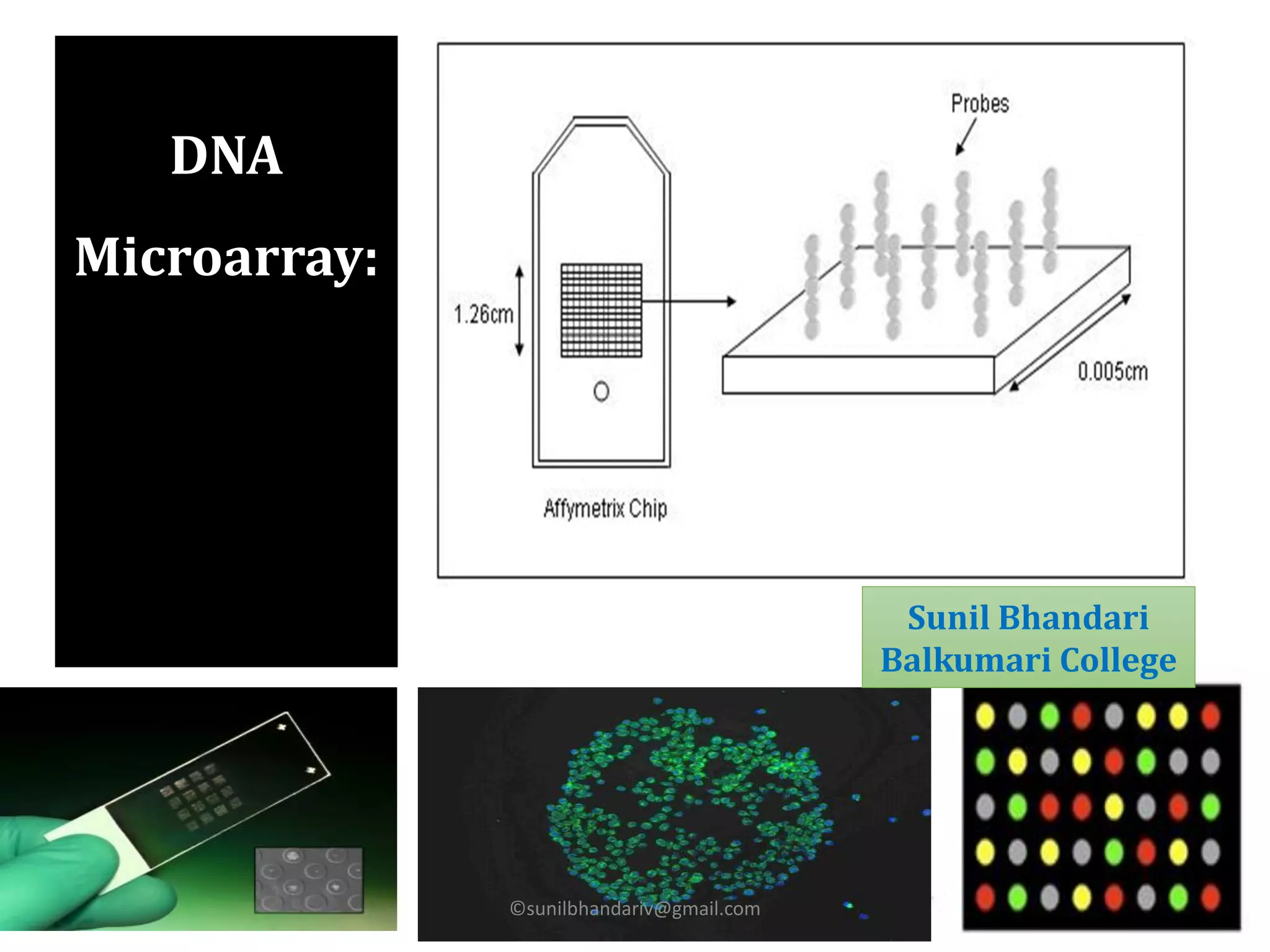
Microarrays are glass slides that contain
particular molecules (DNA-probes) attached to their
surface by robotic arms, each of which can
specifically bind (hybridize) a particular target
molecule on our sample.
©sunilbhandariv@gmail.com
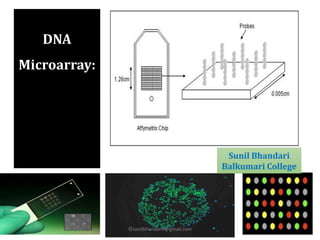
In general, DNA microarrays are
microscope slides that are printed
with thousands of tiny spots in
defined positions, with each spot
containing a known DNA sequence
or gene called Probe.
Average size of array in slide =1.28cm X
1.28cm = 1.6384cm2
Average size of each tiny spots =
0.005cm X 0.005cm = 0.000025cm2
Thus average number of spots in
microarray = 1.6384/0.000025 = 65,536
(such tiny spots may ranges from 65 thousand to
6.5 millions per array)
• The probes are designed with average
of 25base pairs long. ©sunilbhandariv@gmail.com
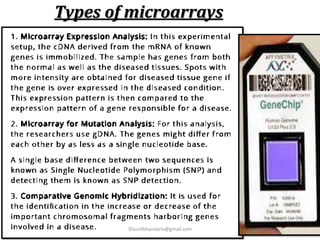
Types of microarrays
©sunilbhandariv@gmail.com
Process of microarray:
Sample
mRNA isolation
cDNA preparation
cDNA labelling
Mixing-hybridization
Washing Scan the array Array image
Image processing
Intensity data retrieval
Data expression
Fig: Process of Microarray
©sunilbhandariv@gmail.com
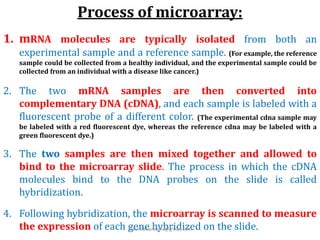
Process of microarray:
1. mRNA molecules are typically isolated from both an
experimental sample and a reference sample. (For example, the reference
sample could be collected from a healthy individual, and the experimental sample could be
collected from an individual with a disease like cancer.)
2. The two mRNA samples are then converted into
complementary DNA (cDNA), and each sample is labeled with a
fluorescent probe of a different color. (The experimental cdna sample may
be labeled with a red fluorescent dye, whereas the reference cdna may be labeled with a
green fluorescent dye.)
3. The two samples are then mixed together and allowed to
bind to the microarray slide. The process in which the cDNA
molecules bind to the DNA probes on the slide is called
hybridization.
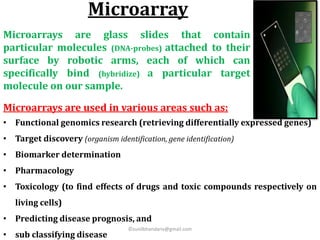
4. Following hybridization, the microarray is scanned to measure
the expression of each gene hybridized on the slide.
©sunilbhandariv@gmail.com
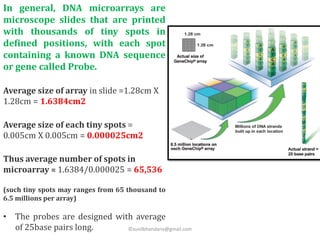
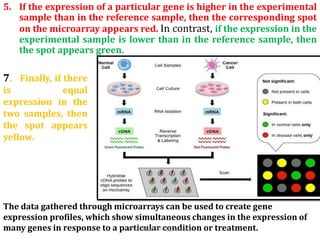
5. If the expression of a particular gene is higher in the experimental
sample than in the reference sample, then the corresponding spot
on the microarray appears red. In contrast, if the expression in the
experimental sample is lower than in the reference sample, then
the spot appears green.
7. Finally, if there
is equal
expression in the
two samples, then
the spot appears
yellow.
The data gathered through microarrays can be used to create gene
expression profiles, which show simultaneous changes in the expression of
many genes in response to a particular condition or treatment.
©sunilbhandariv@gmail.com
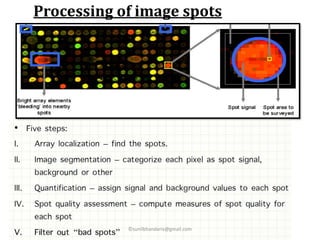
Processing of image spots
©sunilbhandariv@gmail.com
Expression of microarray data
1. Ratio data
Ratio data is calculated for comparison of two or more sample
based on the amount their fluorescence intensity produced on
specific spots. Different color dye (Cy-3 and Cy-5) are used to label
the individual sample and respective color produced after
illumination is captured. These data gives the individual as well as
relative information of the sample under study,
2. Intensity data
Intensity data represents the microarray outcomes of individual
data of single type of sample labelled with single type of dyes. Color
intensity of fluorescence gives the information about identification
of sample as well as strength/amount of targets in sample. Data are
not meant for comparison purpose.
©sunilbhandariv@gmail.com
Application of Microarray
©sunilbhandariv@gmail.com

Microarray

  • 1.
  • 2.
    Microarray Microarrays are usedin various areas such as: • Functional genomics research (retrieving differentially expressed genes) • Target discovery (organism identification, gene identification) • Biomarker determination • Pharmacology • Toxicology (to find effects of drugs and toxic compounds respectively on living cells) • Predicting disease prognosis, and • sub classifying disease Microarrays are glass slides that contain particular molecules (DNA-probes) attached to their surface by robotic arms, each of which can specifically bind (hybridize) a particular target molecule on our sample. ©sunilbhandariv@gmail.com
  • 3.
    In general, DNAmicroarrays are microscope slides that are printed with thousands of tiny spots in defined positions, with each spot containing a known DNA sequence or gene called Probe. Average size of array in slide =1.28cm X 1.28cm = 1.6384cm2 Average size of each tiny spots = 0.005cm X 0.005cm = 0.000025cm2 Thus average number of spots in microarray = 1.6384/0.000025 = 65,536 (such tiny spots may ranges from 65 thousand to 6.5 millions per array) • The probes are designed with average of 25base pairs long. ©sunilbhandariv@gmail.com
  • 4.
  • 5.
    Process of microarray: Sample mRNAisolation cDNA preparation cDNA labelling Mixing-hybridization Washing Scan the array Array image Image processing Intensity data retrieval Data expression Fig: Process of Microarray ©sunilbhandariv@gmail.com
  • 6.
    Process of microarray: 1.mRNA molecules are typically isolated from both an experimental sample and a reference sample. (For example, the reference sample could be collected from a healthy individual, and the experimental sample could be collected from an individual with a disease like cancer.) 2. The two mRNA samples are then converted into complementary DNA (cDNA), and each sample is labeled with a fluorescent probe of a different color. (The experimental cdna sample may be labeled with a red fluorescent dye, whereas the reference cdna may be labeled with a green fluorescent dye.) 3. The two samples are then mixed together and allowed to bind to the microarray slide. The process in which the cDNA molecules bind to the DNA probes on the slide is called hybridization. 4. Following hybridization, the microarray is scanned to measure the expression of each gene hybridized on the slide. ©sunilbhandariv@gmail.com
  • 7.
    5. If theexpression of a particular gene is higher in the experimental sample than in the reference sample, then the corresponding spot on the microarray appears red. In contrast, if the expression in the experimental sample is lower than in the reference sample, then the spot appears green. 7. Finally, if there is equal expression in the two samples, then the spot appears yellow. The data gathered through microarrays can be used to create gene expression profiles, which show simultaneous changes in the expression of many genes in response to a particular condition or treatment. ©sunilbhandariv@gmail.com
  • 8.
    Processing of imagespots ©sunilbhandariv@gmail.com
  • 9.
    Expression of microarraydata 1. Ratio data Ratio data is calculated for comparison of two or more sample based on the amount their fluorescence intensity produced on specific spots. Different color dye (Cy-3 and Cy-5) are used to label the individual sample and respective color produced after illumination is captured. These data gives the individual as well as relative information of the sample under study, 2. Intensity data Intensity data represents the microarray outcomes of individual data of single type of sample labelled with single type of dyes. Color intensity of fluorescence gives the information about identification of sample as well as strength/amount of targets in sample. Data are not meant for comparison purpose. ©sunilbhandariv@gmail.com
  • 10.