Micro and Macroeconomics
MD Siyam HossainMD Siyam Hossain
Bangladesh Institute of Business & Technology.Bangladesh Institute of Business & Technology.
Narayangonj,DhakaNarayangonj,Dhaka
Dhaka,BangladeshDhaka,Bangladesh
www.facebook.com/mdsiyamhossain
Division of Economics
 The modern economists divided economics into:
Microeconomics, and
Macroeconomics.
1. Microeconomics
 An economy could be looked as a whole or in terms of its decision-making units
 Microeconomics considers economy as units of smaller parts
Microeconomics considers and studies:
 Consuming units (individual consumers and households)
 Production units (firms, farms, businesses and mining concerns)
 Individual production factors (labourers, landowners, capitalists, entrepreneurs), and
 Individual industries (textiles, iron and steel, toy making, transport, power production
and supple, telecommunication, etc)
Microeconomics studies the behaviour:
 Consumers,
 Resource owners
 Business firms, etc
 Flow of factors of production (land, labour, capital) from resource owners to business
firms, and
 Flow of goods and services from business firms to consumers
1.1 Function of Microeconomics
Microeconomics explains:
 The functioning of the free enterprises
 The decisions making criteria of the producers
 The decisions making criteria of millions of consumers
 How through market mechanism goods and services are produced
and distributed in the community
 The price building process of products and productive services
 It helps in the formulation of policies for promoting efficiency in
the production and the welfare of the society
 It tells us how economy operates, which is its positive role
 It explains how it should it operate to promote general welfare of
the society, which is normative role
1.2. Limitation of microeconomics
Microeconomics suffers from following limitations:
 It cannot give any idea how the whole economy functions
 It can not explain why some units of the economy flourish and at the same
other suffer from crisis
 Microeconomics assumes full employment, which is unrealistic
 In capitalistic economic system, full employment is attained very seldom and
only for short time
2. Macroeconomics
 Macroeconomics looks economy as a whole
 Macroeconomics is concerned with aggregates and average of the entire
economy
 It is also denoted as Income Theory
Macroeconomics is concerned with:
Average National Income,
Aggregate output,
Total employment,
Aggregate demand,
Aggregate supply,
Average general level of price, etc.
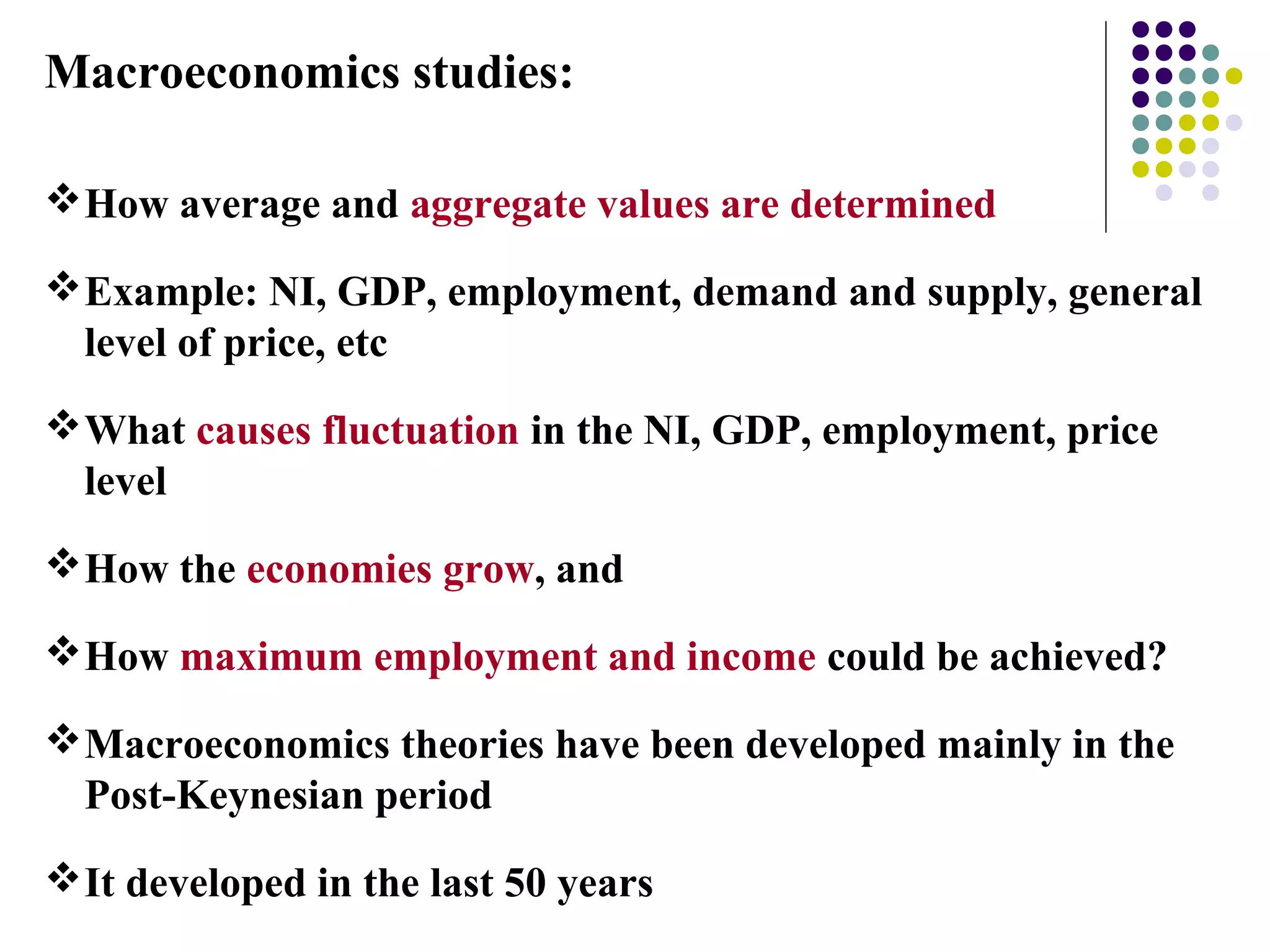
Macroeconomics studies:
How average and aggregate values are determined
Example: NI, GDP, employment, demand and supply, general
level of price, etc
What causes fluctuation in the NI, GDP, employment, price
level
How the economies grow, and
How maximum employment and income could be achieved?
Macroeconomics theories have been developed mainly in the
Post-Keynesian period
It developed in the last 50 years
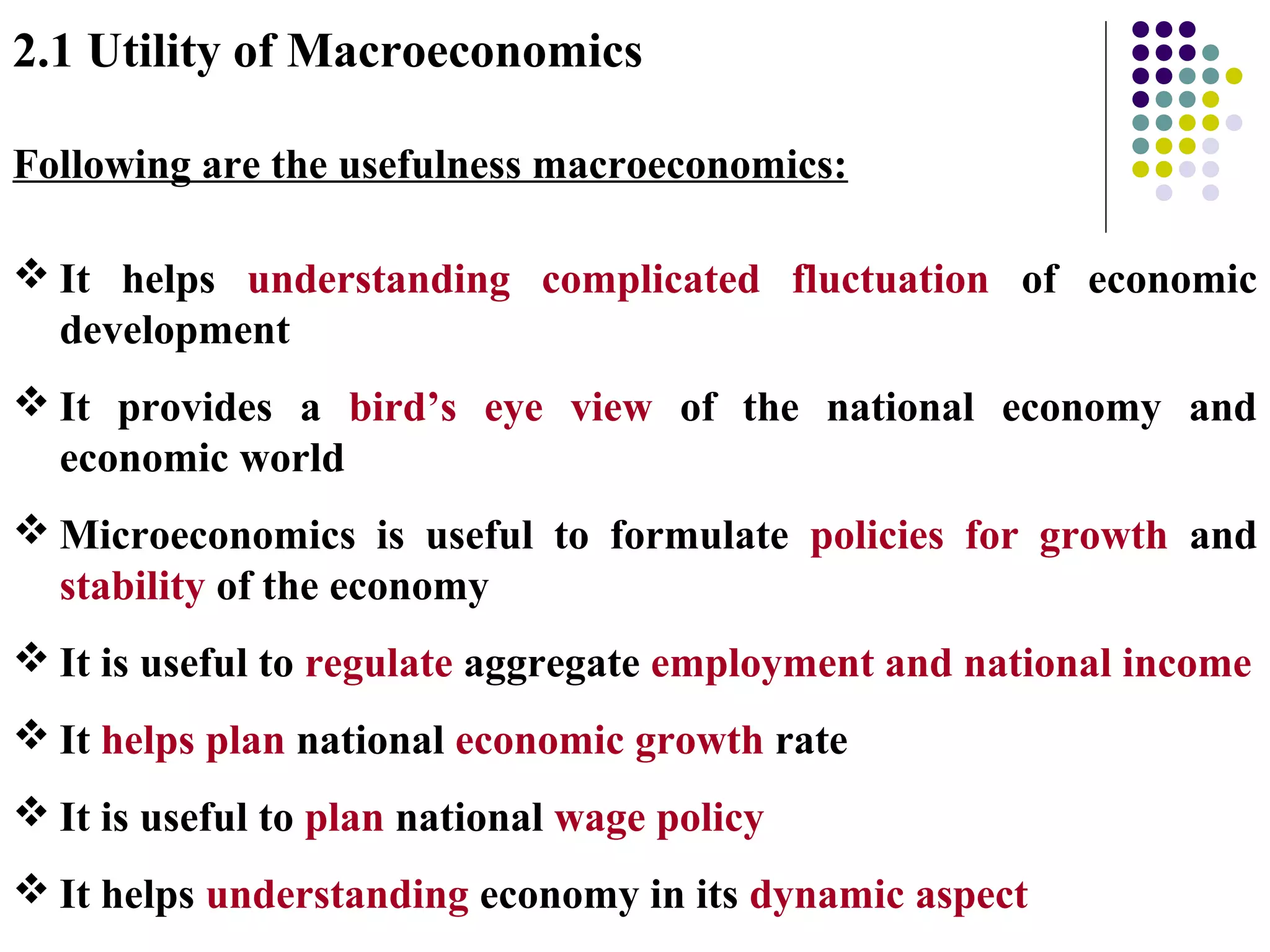
2.1 Utility of Macroeconomics
Following are the usefulness macroeconomics:
 It helps understanding complicated fluctuation of economic
development
 It provides a bird’s eye view of the national economy and
economic world
 Microeconomics is useful to formulate policies for growth and
stability of the economy
 It is useful to regulate aggregate employment and national income
 It helps plan national economic growth rate
 It is useful to plan national wage policy
 It helps understanding economy in its dynamic aspect
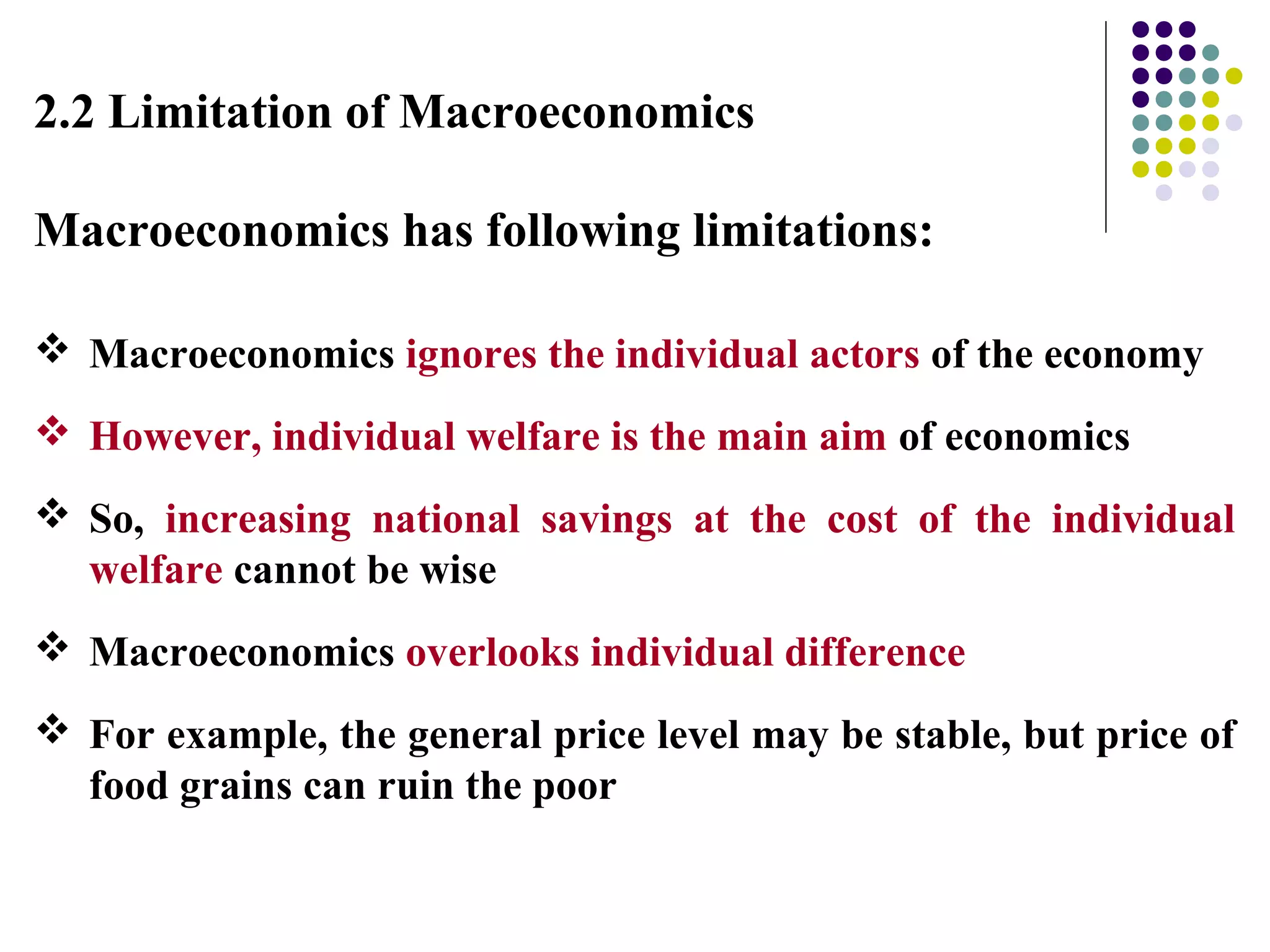
2.2 Limitation of Macroeconomics
Macroeconomics has following limitations:
 Macroeconomics ignores the individual actors of the economy
 However, individual welfare is the main aim of economics
 So, increasing national savings at the cost of the individual
welfare cannot be wise
 Macroeconomics overlooks individual difference
 For example, the general price level may be stable, but price of
food grains can ruin the poor
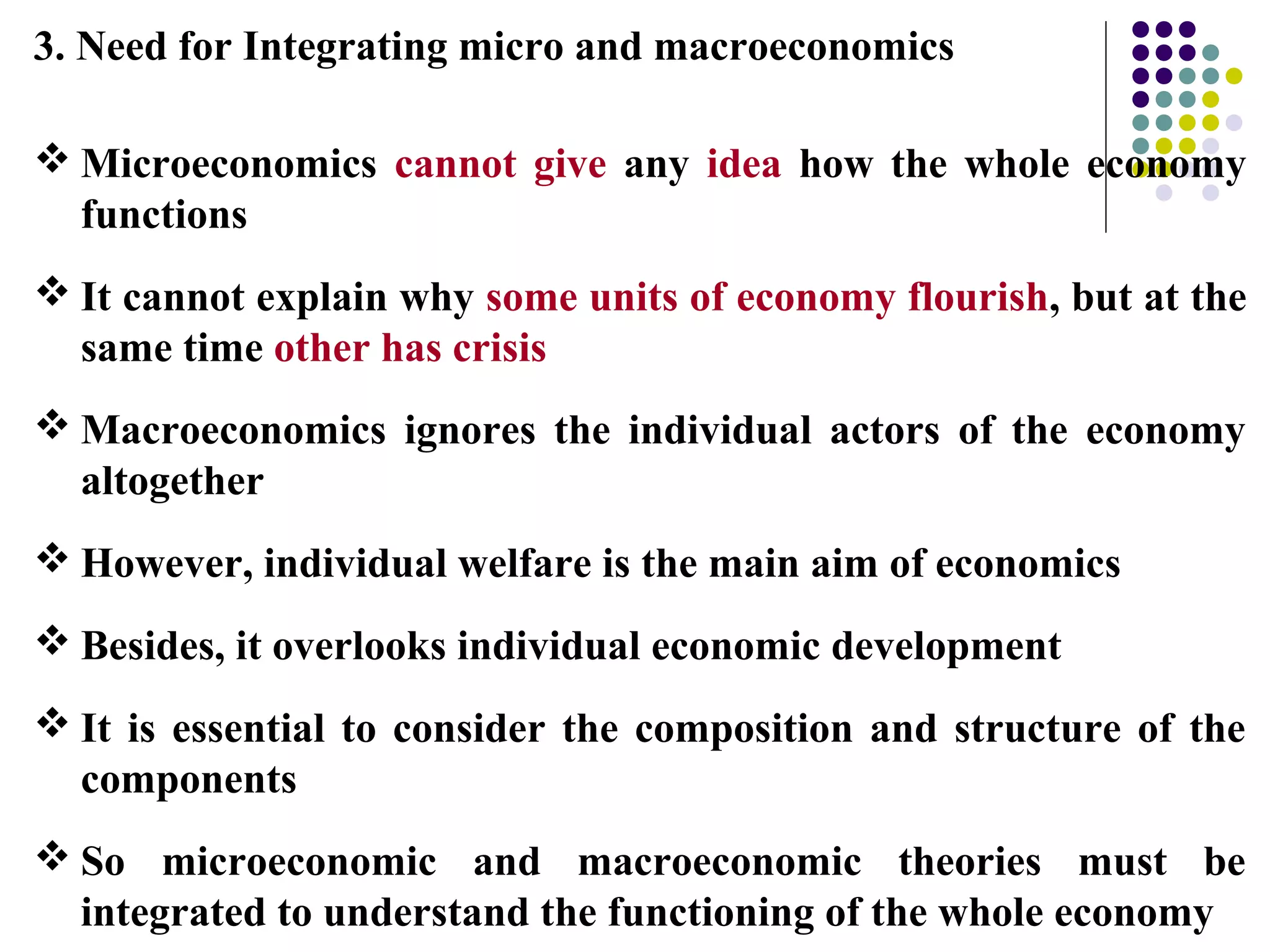
3. Need for Integrating micro and macroeconomics
 Microeconomics cannot give any idea how the whole economy
functions
 It cannot explain why some units of economy flourish, but at the
same time other has crisis
 Macroeconomics ignores the individual actors of the economy
altogether
 However, individual welfare is the main aim of economics
 Besides, it overlooks individual economic development
 It is essential to consider the composition and structure of the
components
 So microeconomic and macroeconomic theories must be
integrated to understand the functioning of the whole economy
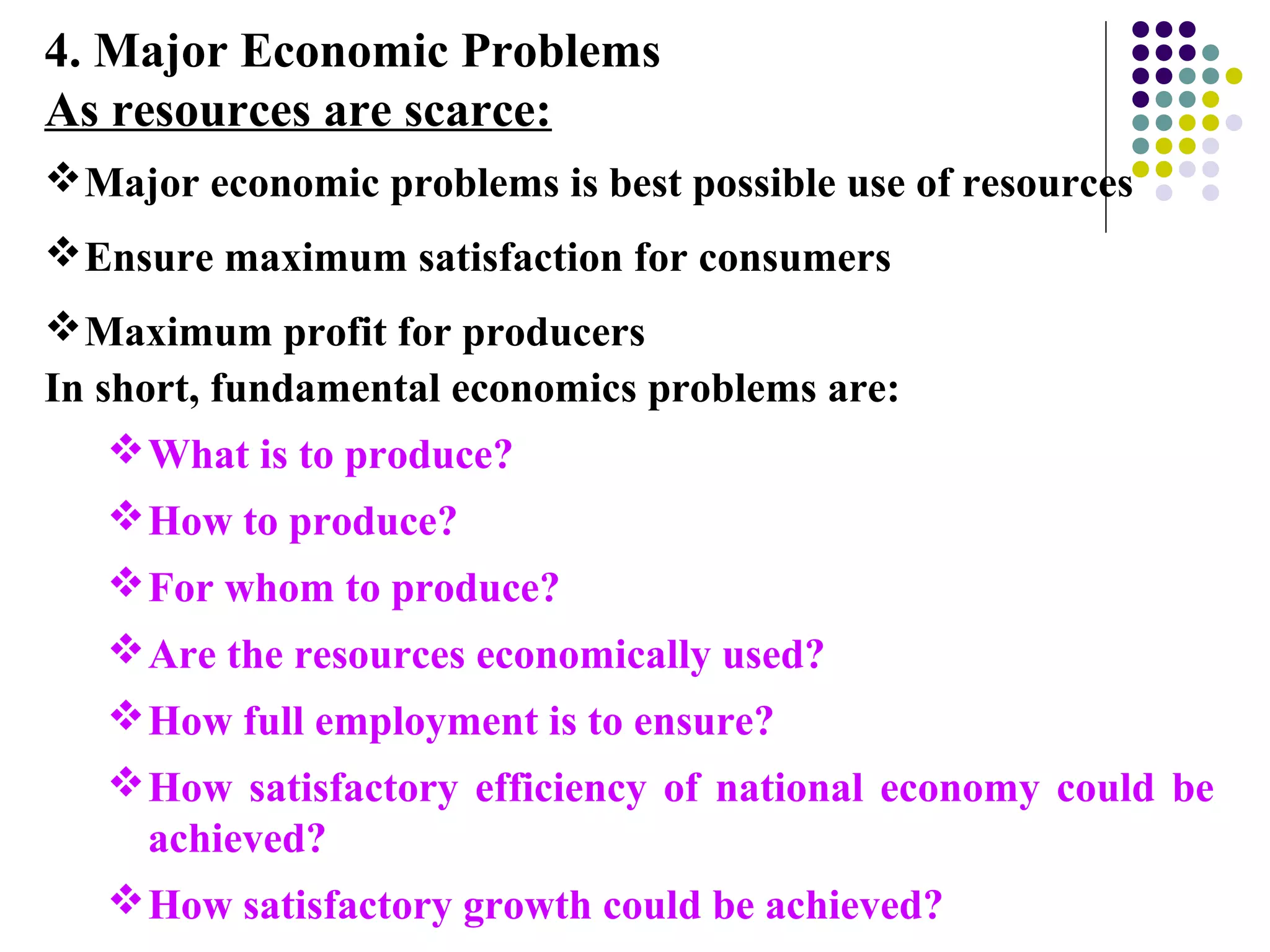
4. Major Economic Problems
As resources are scarce:
Major economic problems is best possible use of resources
Ensure maximum satisfaction for consumers
Maximum profit for producers
In short, fundamental economics problems are:
What is to produce?
How to produce?
For whom to produce?
Are the resources economically used?
How full employment is to ensure?
How satisfactory efficiency of national economy could be
achieved?
How satisfactory growth could be achieved?
4. Major Economic Problems
As resources are scarce:
Major economic problems is best possible use of resources
Ensure maximum satisfaction for consumers
Maximum profit for producers
In short, fundamental economics problems are:
What is to produce?
How to produce?
For whom to produce?
Are the resources economically used?
How full employment is to ensure?
How satisfactory efficiency of national economy could be
achieved?
How satisfactory growth could be achieved?

Micro and Macroeconomics

  • 1.
    Micro and Macroeconomics MDSiyam HossainMD Siyam Hossain Bangladesh Institute of Business & Technology.Bangladesh Institute of Business & Technology. Narayangonj,DhakaNarayangonj,Dhaka Dhaka,BangladeshDhaka,Bangladesh www.facebook.com/mdsiyamhossain
  • 2.
    Division of Economics The modern economists divided economics into: Microeconomics, and Macroeconomics. 1. Microeconomics  An economy could be looked as a whole or in terms of its decision-making units  Microeconomics considers economy as units of smaller parts Microeconomics considers and studies:  Consuming units (individual consumers and households)  Production units (firms, farms, businesses and mining concerns)  Individual production factors (labourers, landowners, capitalists, entrepreneurs), and  Individual industries (textiles, iron and steel, toy making, transport, power production and supple, telecommunication, etc) Microeconomics studies the behaviour:  Consumers,  Resource owners  Business firms, etc  Flow of factors of production (land, labour, capital) from resource owners to business firms, and  Flow of goods and services from business firms to consumers
  • 3.
    1.1 Function ofMicroeconomics Microeconomics explains:  The functioning of the free enterprises  The decisions making criteria of the producers  The decisions making criteria of millions of consumers  How through market mechanism goods and services are produced and distributed in the community  The price building process of products and productive services  It helps in the formulation of policies for promoting efficiency in the production and the welfare of the society  It tells us how economy operates, which is its positive role  It explains how it should it operate to promote general welfare of the society, which is normative role
  • 4.
    1.2. Limitation ofmicroeconomics Microeconomics suffers from following limitations:  It cannot give any idea how the whole economy functions  It can not explain why some units of the economy flourish and at the same other suffer from crisis  Microeconomics assumes full employment, which is unrealistic  In capitalistic economic system, full employment is attained very seldom and only for short time 2. Macroeconomics  Macroeconomics looks economy as a whole  Macroeconomics is concerned with aggregates and average of the entire economy  It is also denoted as Income Theory Macroeconomics is concerned with: Average National Income, Aggregate output, Total employment, Aggregate demand, Aggregate supply, Average general level of price, etc.
  • 5.
    Macroeconomics studies: How averageand aggregate values are determined Example: NI, GDP, employment, demand and supply, general level of price, etc What causes fluctuation in the NI, GDP, employment, price level How the economies grow, and How maximum employment and income could be achieved? Macroeconomics theories have been developed mainly in the Post-Keynesian period It developed in the last 50 years
  • 6.
    2.1 Utility ofMacroeconomics Following are the usefulness macroeconomics:  It helps understanding complicated fluctuation of economic development  It provides a bird’s eye view of the national economy and economic world  Microeconomics is useful to formulate policies for growth and stability of the economy  It is useful to regulate aggregate employment and national income  It helps plan national economic growth rate  It is useful to plan national wage policy  It helps understanding economy in its dynamic aspect
  • 7.
    2.2 Limitation ofMacroeconomics Macroeconomics has following limitations:  Macroeconomics ignores the individual actors of the economy  However, individual welfare is the main aim of economics  So, increasing national savings at the cost of the individual welfare cannot be wise  Macroeconomics overlooks individual difference  For example, the general price level may be stable, but price of food grains can ruin the poor
  • 8.
    3. Need forIntegrating micro and macroeconomics  Microeconomics cannot give any idea how the whole economy functions  It cannot explain why some units of economy flourish, but at the same time other has crisis  Macroeconomics ignores the individual actors of the economy altogether  However, individual welfare is the main aim of economics  Besides, it overlooks individual economic development  It is essential to consider the composition and structure of the components  So microeconomic and macroeconomic theories must be integrated to understand the functioning of the whole economy
  • 9.
    4. Major EconomicProblems As resources are scarce: Major economic problems is best possible use of resources Ensure maximum satisfaction for consumers Maximum profit for producers In short, fundamental economics problems are: What is to produce? How to produce? For whom to produce? Are the resources economically used? How full employment is to ensure? How satisfactory efficiency of national economy could be achieved? How satisfactory growth could be achieved?
  • 10.
    4. Major EconomicProblems As resources are scarce: Major economic problems is best possible use of resources Ensure maximum satisfaction for consumers Maximum profit for producers In short, fundamental economics problems are: What is to produce? How to produce? For whom to produce? Are the resources economically used? How full employment is to ensure? How satisfactory efficiency of national economy could be achieved? How satisfactory growth could be achieved?