My
National
Income
Concepts of National Income:
There are various concepts of national income.
These are explained below one by one:
(1) Gross National Product (GNP).
(2) Net National Product (NNP)/National Income.
(3) Gross Domestic Product (GDP).
(4) National Income at Factor Cost.
(5) Personal Income.
(6) Disposable Personal Income.
Gross National Product
(GNP)
"The total money value of all final goods and
services produced by the residents of a country
in one year period".
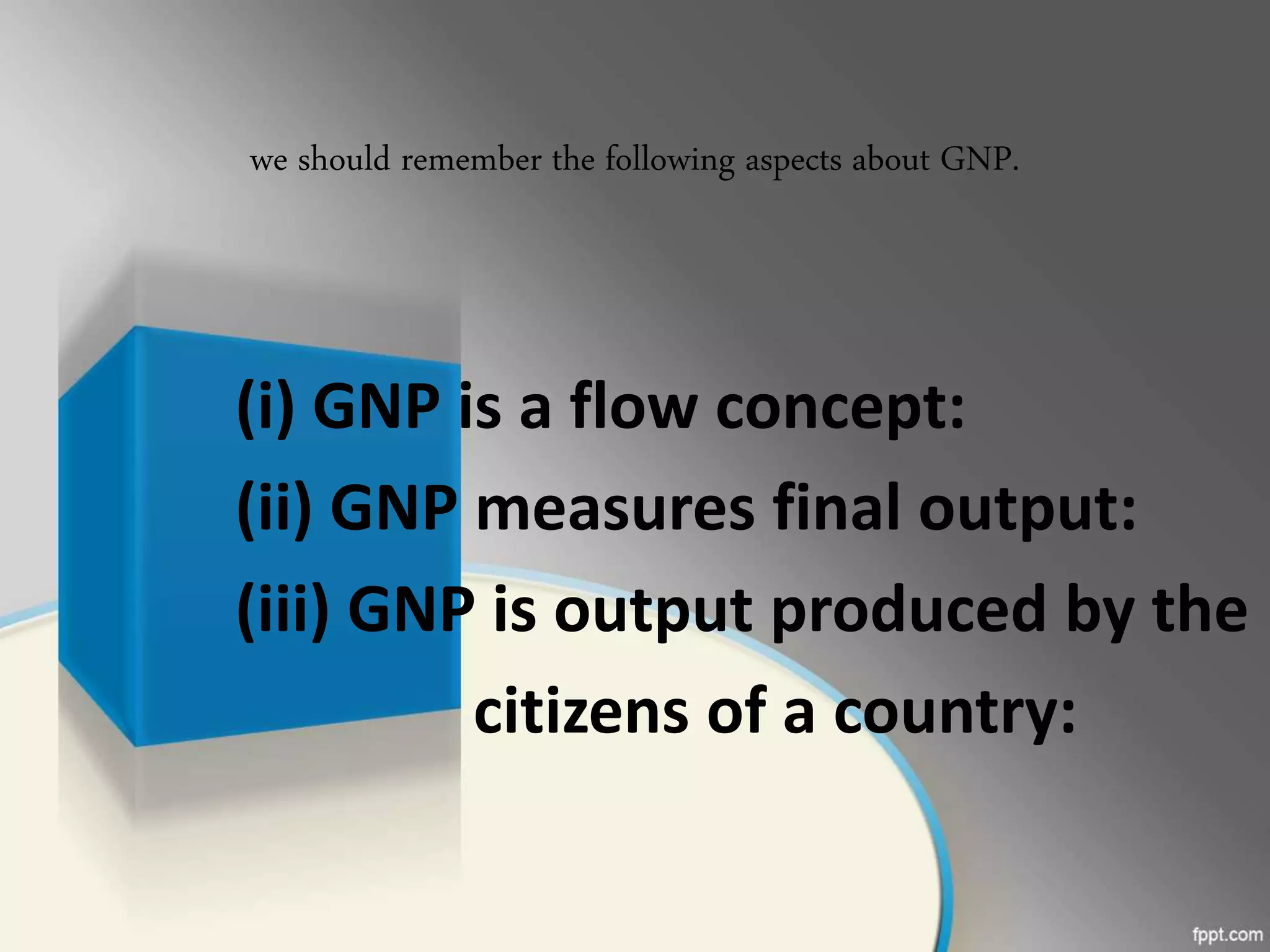
we should remember the following aspects about GNP.
(i) GNP is a flow concept:
(ii) GNP measures final output:
(iii) GNP is output produced by the
citizens of a country:
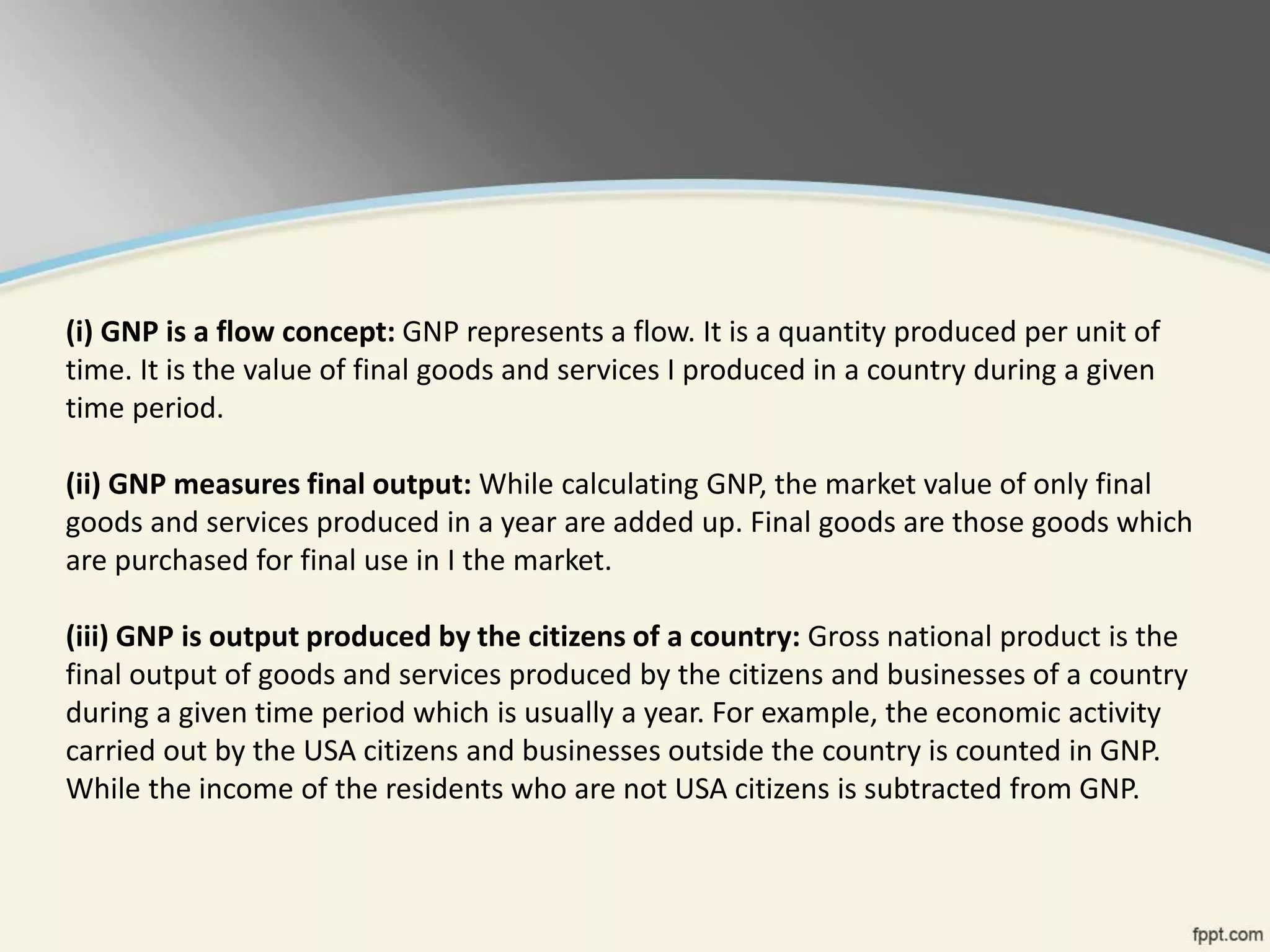
(i) GNP is a flow concept: GNP represents a flow. It is a quantity produced per unit of
time. It is the value of final goods and services I produced in a country during a given
time period.
(ii) GNP measures final output: While calculating GNP, the market value of only final
goods and services produced in a year are added up. Final goods are those goods which
are purchased for final use in I the market.
(iii) GNP is output produced by the citizens of a country: Gross national product is the
final output of goods and services produced by the citizens and businesses of a country
during a given time period which is usually a year. For example, the economic activity
carried out by the USA citizens and businesses outside the country is counted in GNP.
While the income of the residents who are not USA citizens is subtracted from GNP.
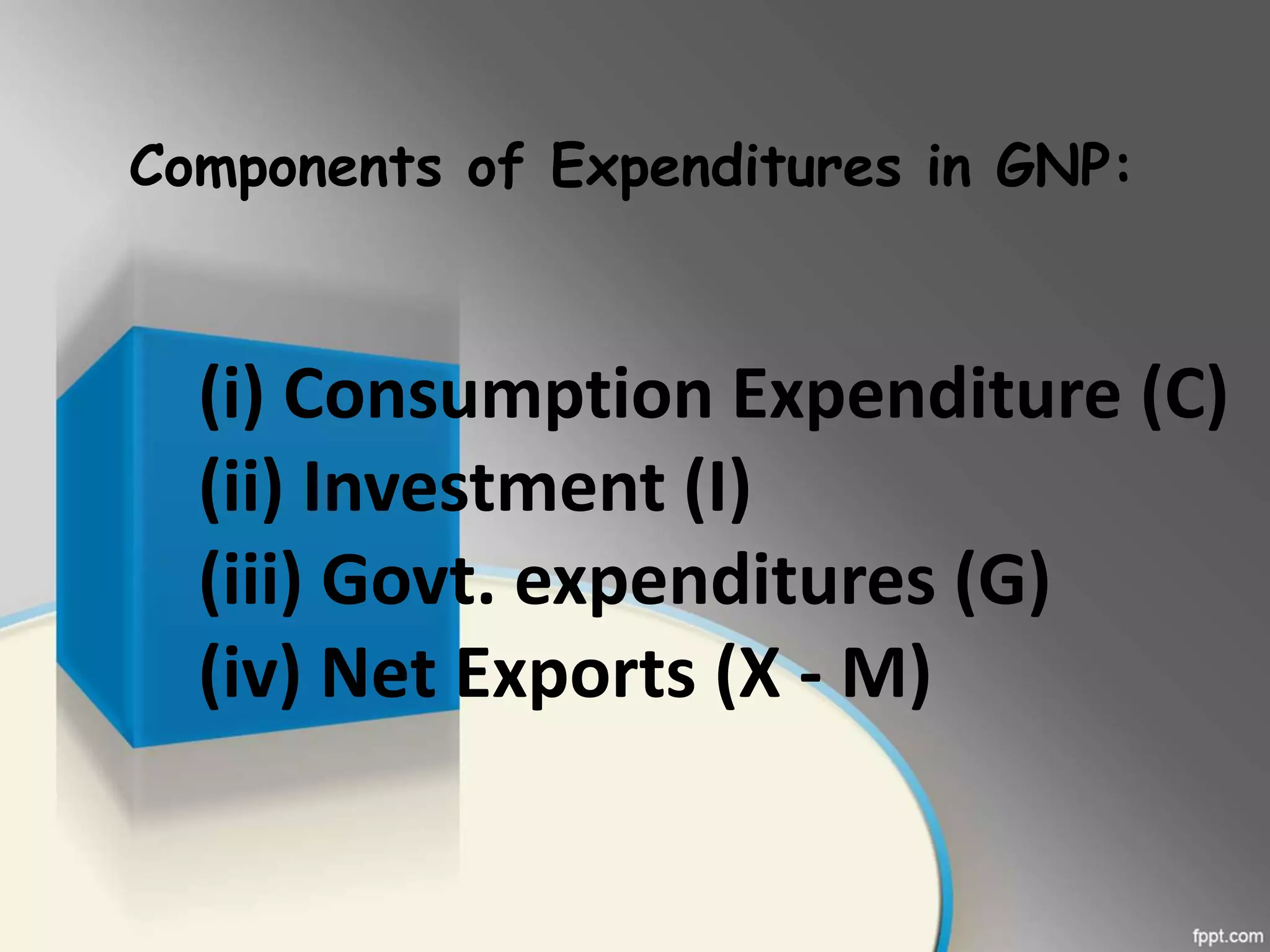
Components of Expenditures in GNP:
(i) Consumption Expenditure (C)
(ii) Investment (I)
(iii) Govt. expenditures (G)
(iv) Net Exports (X - M)
(i) Consumption Expenditure (C): It includes all personal expenditure incurred by the
citizens of a country on durable and non-durable goods in a period of one year.
(ii) Investment (I): It is the total expenditure incurred by firms or households on
capital goods.
(iii) Govt. expenditures (G): It includes all types of expenditure incurred by Federal,
Provincial, Local Councils on the purchases of goods and services such as national
defense, law and order, street lighting etc.
(iv) Net Exports (X - M): Net exports of goods and services are value of exports
minus the value of imports.
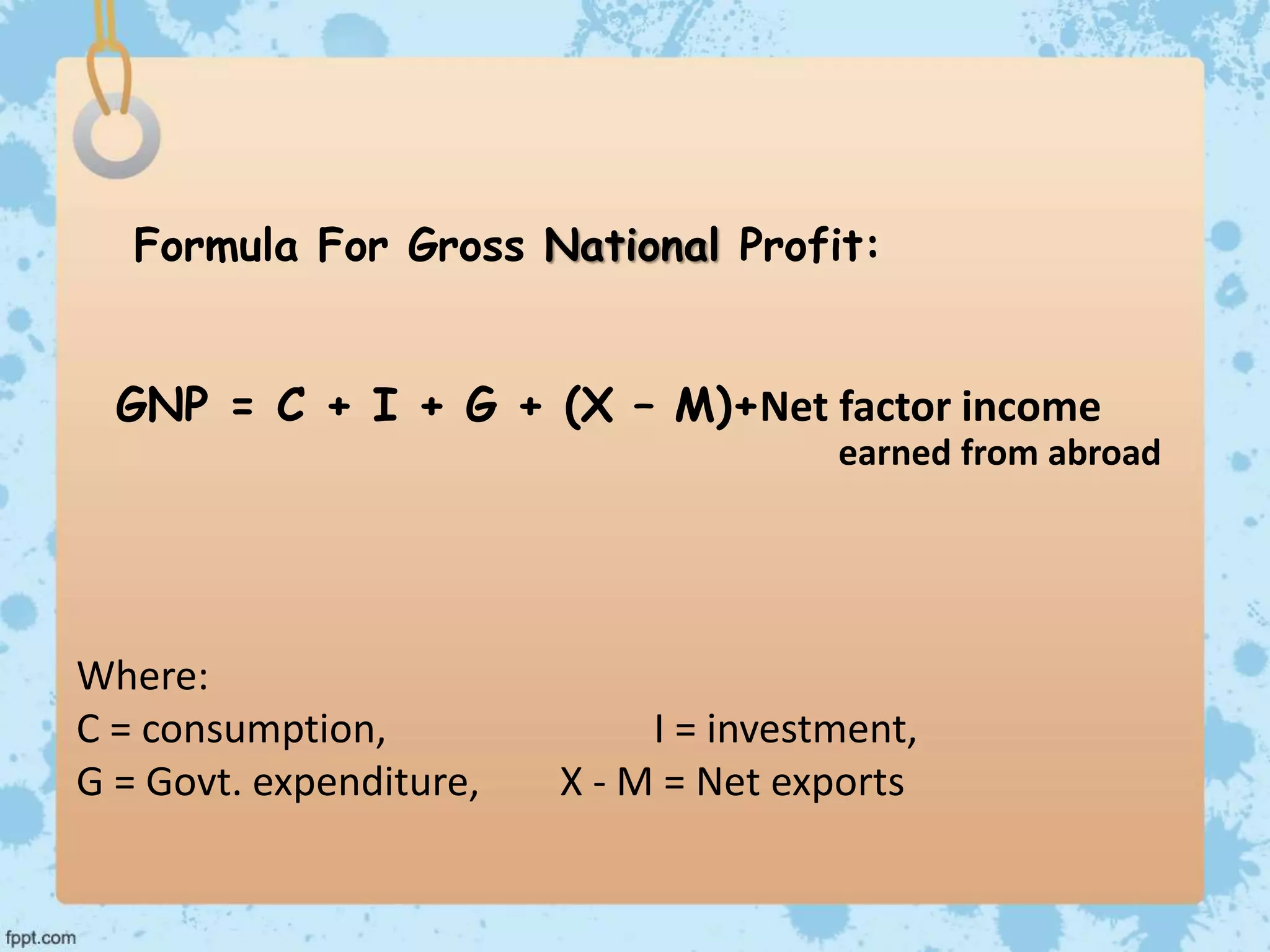
Formula For Gross National Profit:
GNP = C + I + G + (X – M)+Net factor income
earned from abroad
Where:
C = consumption, I = investment,
G = Govt. expenditure, X - M = Net exports
Gross Domestic Product
(GDP)
‘’The total market value at current prices of all final goods and services produced
within a year by the factors of production located within a country"
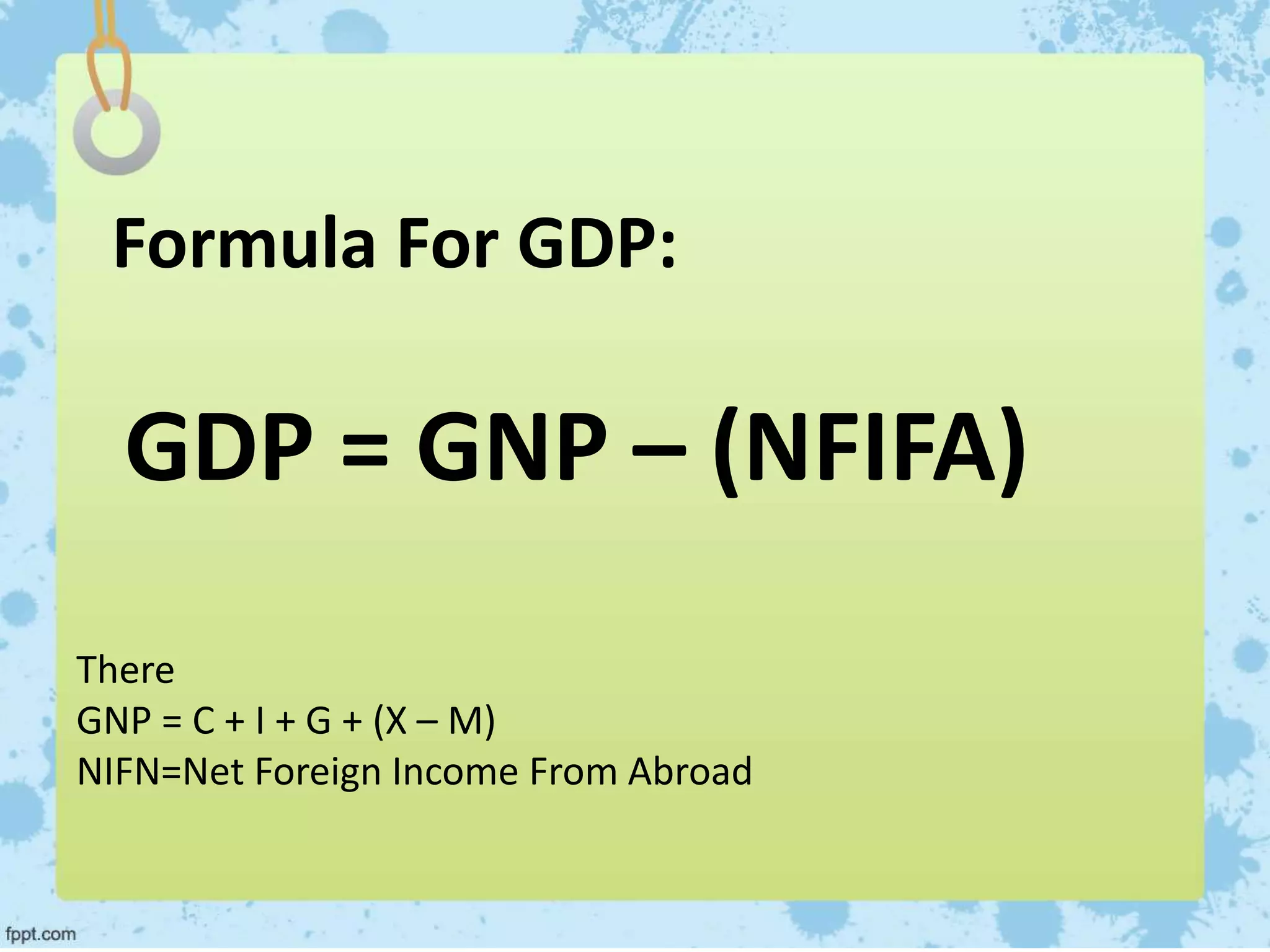
Formula For GDP:
GDP = GNP – (NFIFA)
There
GNP = C + I + G + (X – M)
NIFN=Net Foreign Income From Abroad
There are some Problems
in Measuring GDP
While calculating the gross domestic product (GDP), the value of only those goods
are added which have reached their final stage of production and are available for
consumption. The primary or intermediate goods are not counted in GDP. For
example, table made of wood is the final product. The wood used in making the
table is a primary good. While calculating GDP, if we include the value of wood as
a separate item and the value of table separate, it will be a case of double
counting and this leads to inflated rise in GDP.
(i) Stress on final output.
Stage of Production Form of the Product Price at Each Stage ($)
Value Added at Each
Process ($)
1st Jungle Wood 0.25 0.25
2nd
The price of wood after
transporting to the city
0.38 0.13
3rd Paper manufacturing 2.00 1.62
4th Printing of book 5.00 3.00
5th Binding and title, etc. 6.00 1.00
6th Sale price 10.00 4.00
$23.63 $10.00
(ii) Value added method.
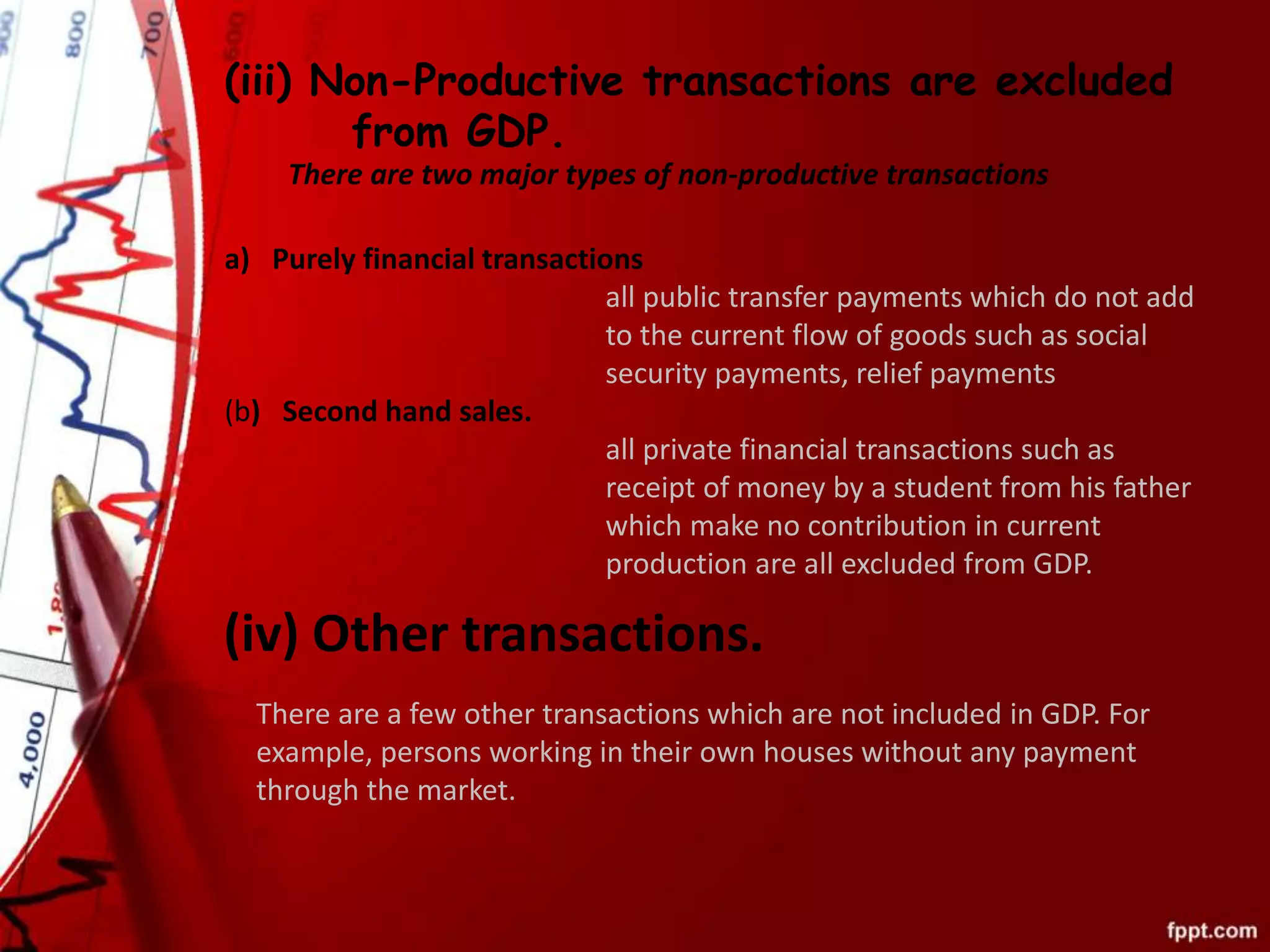
(iii) Non-Productive transactions are excluded
from GDP.
There are two major types of non-productive transactions
a) Purely financial transactions
all public transfer payments which do not add
to the current flow of goods such as social
security payments, relief payments
(b) Second hand sales.
all private financial transactions such as
receipt of money by a student from his father
which make no contribution in current
production are all excluded from GDP.
(iv) Other transactions.
There are a few other transactions which are not included in GDP. For
example, persons working in their own houses without any payment
through the market.
GDP is the value of output produced by factors of production located within a
country. It excludes the output produced abroad by domestically owned factors
of production.
Exclusion of output production abroad.
Thank You

GDP and GNP

  • 1.
  • 2.
    Concepts of NationalIncome: There are various concepts of national income. These are explained below one by one: (1) Gross National Product (GNP). (2) Net National Product (NNP)/National Income. (3) Gross Domestic Product (GDP). (4) National Income at Factor Cost. (5) Personal Income. (6) Disposable Personal Income.
  • 3.
    Gross National Product (GNP) "Thetotal money value of all final goods and services produced by the residents of a country in one year period".
  • 4.
    we should rememberthe following aspects about GNP. (i) GNP is a flow concept: (ii) GNP measures final output: (iii) GNP is output produced by the citizens of a country:
  • 5.
    (i) GNP isa flow concept: GNP represents a flow. It is a quantity produced per unit of time. It is the value of final goods and services I produced in a country during a given time period. (ii) GNP measures final output: While calculating GNP, the market value of only final goods and services produced in a year are added up. Final goods are those goods which are purchased for final use in I the market. (iii) GNP is output produced by the citizens of a country: Gross national product is the final output of goods and services produced by the citizens and businesses of a country during a given time period which is usually a year. For example, the economic activity carried out by the USA citizens and businesses outside the country is counted in GNP. While the income of the residents who are not USA citizens is subtracted from GNP.
  • 6.
    Components of Expendituresin GNP: (i) Consumption Expenditure (C) (ii) Investment (I) (iii) Govt. expenditures (G) (iv) Net Exports (X - M)
  • 7.
    (i) Consumption Expenditure(C): It includes all personal expenditure incurred by the citizens of a country on durable and non-durable goods in a period of one year. (ii) Investment (I): It is the total expenditure incurred by firms or households on capital goods. (iii) Govt. expenditures (G): It includes all types of expenditure incurred by Federal, Provincial, Local Councils on the purchases of goods and services such as national defense, law and order, street lighting etc. (iv) Net Exports (X - M): Net exports of goods and services are value of exports minus the value of imports.
  • 8.
    Formula For GrossNational Profit: GNP = C + I + G + (X – M)+Net factor income earned from abroad Where: C = consumption, I = investment, G = Govt. expenditure, X - M = Net exports
  • 9.
    Gross Domestic Product (GDP) ‘’Thetotal market value at current prices of all final goods and services produced within a year by the factors of production located within a country"
  • 10.
    Formula For GDP: GDP= GNP – (NFIFA) There GNP = C + I + G + (X – M) NIFN=Net Foreign Income From Abroad
  • 11.
    There are someProblems in Measuring GDP
  • 12.
    While calculating thegross domestic product (GDP), the value of only those goods are added which have reached their final stage of production and are available for consumption. The primary or intermediate goods are not counted in GDP. For example, table made of wood is the final product. The wood used in making the table is a primary good. While calculating GDP, if we include the value of wood as a separate item and the value of table separate, it will be a case of double counting and this leads to inflated rise in GDP. (i) Stress on final output.
  • 13.
    Stage of ProductionForm of the Product Price at Each Stage ($) Value Added at Each Process ($) 1st Jungle Wood 0.25 0.25 2nd The price of wood after transporting to the city 0.38 0.13 3rd Paper manufacturing 2.00 1.62 4th Printing of book 5.00 3.00 5th Binding and title, etc. 6.00 1.00 6th Sale price 10.00 4.00 $23.63 $10.00 (ii) Value added method.
  • 14.
    (iii) Non-Productive transactionsare excluded from GDP. There are two major types of non-productive transactions a) Purely financial transactions all public transfer payments which do not add to the current flow of goods such as social security payments, relief payments (b) Second hand sales. all private financial transactions such as receipt of money by a student from his father which make no contribution in current production are all excluded from GDP. (iv) Other transactions. There are a few other transactions which are not included in GDP. For example, persons working in their own houses without any payment through the market.
  • 15.
    GDP is thevalue of output produced by factors of production located within a country. It excludes the output produced abroad by domestically owned factors of production. Exclusion of output production abroad. Thank You

Editor's Notes

  • #5 (i) GNP is a flow concept: GNP represents a flow. It is a quantity produced per unit of time. It is the value of final goods and services I produced in a country during a given time period.   (ii) GNP measures final output: While calculating GNP, the market value of only final goods and services produced in a year are added up. Final goods are those goods which are purchased for final use in I the market.   (iii) GNP is output produced by the citizens of a country: Gross national product is the final output of goods and services produced by the citizens and businesses of a country during a given time period which is usually a year. For example, the economic activity carried out by the USA citizens and businesses outside the country is counted in GNP. While the income of the residents who are not USA citizens is subtracted from GNP.
  • #7 (i) Consumption Expenditure (C): It includes all personal expenditure incurred by the citizens of a country on durable and non-durable goods in a period of one year.   (ii) Investment (I): It is the total expenditure incurred by firms or households on capital goods.   (iii) Govt. expenditures (G): It includes all types of expenditure incurred by Federal, Provincial, Local Councils on the purchases of goods and services such as national defense, law and order, street lighting etc.   (iv) Net Exports (X - M): Net exports of goods and services are value of exports minus the value of imports.