1. Introduction to
Micro Economics &
Macro Economics
Meaning & Definition of Microeconomics
1. Micro means small part of
a thing.
2. It deals with small part of
the whole economy.
3. It only studies about the
individual consumer,
individual producer, price of
a single product, payment of
single factors, etc.
“ Microeconomics consists of
looking at the economy through a
microscope, as it were,
to see how the millions of cells in
the body of economy
-the individuals or households as
consumers, and the individuals or
firms as producers
—play their part in the working of
the whole economic organism.”-
Professor Lerner
Scope of Microeconomics
Theory of Product
Pricing:
It means price of a single
commodity or product is
decided by demand and
supply of that product in
the market.
Theory of Factor Pricing:
Factors of production means
land(place), labour(humans),
capital(investment),
entrepreneur(businessman).
Microeconomics helps to
decide the rent of land, wages
of labour, interest of capital
and profit of entrepreneurs.
Theory of Economic Welfare:
It is achieved when all the
resources are completely used.
1. Efficiency in production –
Producing the most
2. Efficiency in consumption –
Distributing the goods the
most
3. Overall efficiency – Goods
produced and consumed by
the people.
Features of
Microeconomics
• Study of Individual units : Study of
single/individual factory, single price,
single household, etc
• Price theory : a) Price theory is the
central part of MiE. b) It considers
price as the cause for both
production & consumption.
• Partial equilibrium : Equilibrium
means balance between two things.
It deals with the equilibrium of a
consumer or producer or a firm at a
same time.
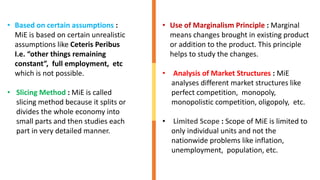
• Based on certain assumptions :
MiE is based on certain unrealistic
assumptions like Ceteris Peribus
I.e. “other things remaining
constant”, full employment, etc
which is not possible.
• Slicing Method : MiE is called
slicing method because it splits or
divides the whole economy into
small parts and then studies each
part in very detailed manner.
• Use of Marginalism Principle : Marginal
means changes brought in existing product
or addition to the product. This principle
helps to study the changes.
• Analysis of Market Structures : MiE
analyses different market structures like
perfect competition, monopoly,
monopolistic competition, oligopoly, etc.
• Limited Scope : Scope of MiE is limited to
only individual units and not the
nationwide problems like inflation,
unemployment, population, etc.
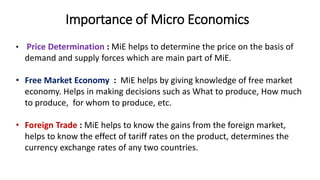
Importance of Micro Economics
• Price Determination : MiE helps to determine the price on the basis of
demand and supply forces which are main part of MiE.
• Free Market Economy : MiE helps by giving knowledge of free market
economy. Helps in making decisions such as What to produce, How much
to produce, for whom to produce, etc.
• Foreign Trade : MiE helps to know the gains from the foreign market,
helps to know the effect of tariff rates on the product, determines the
currency exchange rates of any two countries.
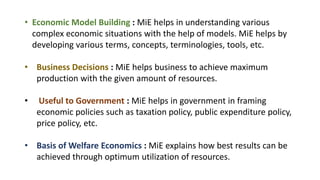
• Economic Model Building : MiE helps in understanding various
complex economic situations with the help of models. MiE helps by
developing various terms, concepts, terminologies, tools, etc.
• Business Decisions : MiE helps business to achieve maximum
production with the given amount of resources.
• Useful to Government : MiE helps in government in framing
economic policies such as taxation policy, public expenditure policy,
price policy, etc.
• Basis of Welfare Economics : MiE explains how best results can be
achieved through optimum utilization of resources.
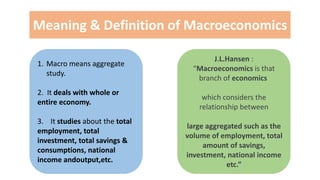
Meaning & Definition of Macroeconomics
1. Macro means aggregate
study.
2. It deals with whole or
entire economy.
3. It studies about the total
employment, total
investment, total savings &
consumptions, national
income andoutput,etc.
J.L.Hansen :
“Macroeconomics is that
branch of economics
which considers the
relationship between
large aggregated such as the
volume of employment, total
amount of savings,
investment, national income
etc.”
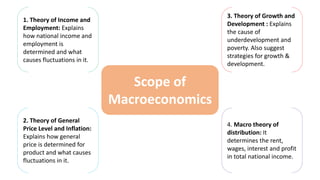
Scope of
Macroeconomics
3. Theory of Growth and
Development : Explains
the cause of
underdevelopment and
poverty. Also suggest
strategies for growth &
development.
4. Macro theory of
distribution: It
determines the rent,
wages, interest and profit
in total national income.
2. Theory of General
Price Level and Inflation:
Explains how general
price is determined for
product and what causes
fluctuations in it.
1. Theory of Income and
Employment: Explains
how national income and
employment is
determined and what
causes fluctuations in it.
Features of Macroeconomics
• Study of aggregates : MaE is concerned with the study of whole
economy. It is concerned with concept such as Aggregate Demand,
Aggregate Supply, Total Output, General Price Level, National Income,
etc.
• Lumping Method: - Lumping method is the study of whole economy.
MaE uses lumping method for the purpose of economic study. Under
lumping method we study the general price level, and not prices of
individual products.
• General Equilibrium analysis: MaE is concerned with the behaviour of
aggregates and their interdependence. It is a general equilibrium analysis
in which everything depends on everything else.
• Interdependence: MaE takes accounts of interdependence between
aggregate economic variables like how changes in one variable will make
changes in another.
• Income Theory : A major task of MaE is the determination of national
income. MaE studies the factors determining national income and the
causes of the trends in national income.
• General Price level : General Price Level is the average of prices of all
goods and services produced in an economy. Determination and
changes in General Price Level is studied in MaE.
• Policy Oriented : MaE is policy oriented. It suggests suitable
economic policies to develop and promote economic growth, rate of
employment, control of inflation and deflation, etc.
• Growth Models : MaE studies various factors that contribute to
growth & development. This growth models are useful for studying
development of economic growth.
Importance of Macroeconomics
• Functioning of an Economy : It helps us understand the functioning of a
complicated modern economic system. It describes how the economy as
a whole functions.
• Economic Fluctuations : MaE helps to know the causes of fluctuations in
price, income and employment rate. And it tries to control them or
reduce them by suitable policies.
• National Income : MaE studies about the national income in detail.
Without such study, it is not possible to frame the economic policies.
• Economic Development : MaE studies about whole economy and helps
in solving problems such as poverty, inequalities in income and wealth,
unemployment, etc by suggesting important steps.
• Performance of an Economy : MaE helps by analyzing the performance
of an economy by studying about the whole economy and not just
about the single part of an economy.
• Study of Macro Economic Variables : Study of macroeconomic
variables is conducted in MaE. Macroeconomic variables are total
income, output, employment, etc.
• Level of Employment : MaE analyses about the level of employment in
a country.
Thank You

Introduction to Micro and Macro Economics

  • 1.
    1. Introduction to MicroEconomics & Macro Economics
  • 2.
    Meaning & Definitionof Microeconomics 1. Micro means small part of a thing. 2. It deals with small part of the whole economy. 3. It only studies about the individual consumer, individual producer, price of a single product, payment of single factors, etc. “ Microeconomics consists of looking at the economy through a microscope, as it were, to see how the millions of cells in the body of economy -the individuals or households as consumers, and the individuals or firms as producers —play their part in the working of the whole economic organism.”- Professor Lerner
  • 3.
    Scope of Microeconomics Theoryof Product Pricing: It means price of a single commodity or product is decided by demand and supply of that product in the market. Theory of Factor Pricing: Factors of production means land(place), labour(humans), capital(investment), entrepreneur(businessman). Microeconomics helps to decide the rent of land, wages of labour, interest of capital and profit of entrepreneurs. Theory of Economic Welfare: It is achieved when all the resources are completely used. 1. Efficiency in production – Producing the most 2. Efficiency in consumption – Distributing the goods the most 3. Overall efficiency – Goods produced and consumed by the people.
  • 4.
    Features of Microeconomics • Studyof Individual units : Study of single/individual factory, single price, single household, etc • Price theory : a) Price theory is the central part of MiE. b) It considers price as the cause for both production & consumption. • Partial equilibrium : Equilibrium means balance between two things. It deals with the equilibrium of a consumer or producer or a firm at a same time.
  • 5.
    • Based oncertain assumptions : MiE is based on certain unrealistic assumptions like Ceteris Peribus I.e. “other things remaining constant”, full employment, etc which is not possible. • Slicing Method : MiE is called slicing method because it splits or divides the whole economy into small parts and then studies each part in very detailed manner. • Use of Marginalism Principle : Marginal means changes brought in existing product or addition to the product. This principle helps to study the changes. • Analysis of Market Structures : MiE analyses different market structures like perfect competition, monopoly, monopolistic competition, oligopoly, etc. • Limited Scope : Scope of MiE is limited to only individual units and not the nationwide problems like inflation, unemployment, population, etc.
  • 6.
    Importance of MicroEconomics • Price Determination : MiE helps to determine the price on the basis of demand and supply forces which are main part of MiE. • Free Market Economy : MiE helps by giving knowledge of free market economy. Helps in making decisions such as What to produce, How much to produce, for whom to produce, etc. • Foreign Trade : MiE helps to know the gains from the foreign market, helps to know the effect of tariff rates on the product, determines the currency exchange rates of any two countries.
  • 7.
    • Economic ModelBuilding : MiE helps in understanding various complex economic situations with the help of models. MiE helps by developing various terms, concepts, terminologies, tools, etc. • Business Decisions : MiE helps business to achieve maximum production with the given amount of resources. • Useful to Government : MiE helps in government in framing economic policies such as taxation policy, public expenditure policy, price policy, etc. • Basis of Welfare Economics : MiE explains how best results can be achieved through optimum utilization of resources.
  • 8.
    Meaning & Definitionof Macroeconomics 1. Macro means aggregate study. 2. It deals with whole or entire economy. 3. It studies about the total employment, total investment, total savings & consumptions, national income andoutput,etc. J.L.Hansen : “Macroeconomics is that branch of economics which considers the relationship between large aggregated such as the volume of employment, total amount of savings, investment, national income etc.”
  • 9.
    Scope of Macroeconomics 3. Theoryof Growth and Development : Explains the cause of underdevelopment and poverty. Also suggest strategies for growth & development. 4. Macro theory of distribution: It determines the rent, wages, interest and profit in total national income. 2. Theory of General Price Level and Inflation: Explains how general price is determined for product and what causes fluctuations in it. 1. Theory of Income and Employment: Explains how national income and employment is determined and what causes fluctuations in it.
  • 10.
    Features of Macroeconomics •Study of aggregates : MaE is concerned with the study of whole economy. It is concerned with concept such as Aggregate Demand, Aggregate Supply, Total Output, General Price Level, National Income, etc. • Lumping Method: - Lumping method is the study of whole economy. MaE uses lumping method for the purpose of economic study. Under lumping method we study the general price level, and not prices of individual products.
  • 11.
    • General Equilibriumanalysis: MaE is concerned with the behaviour of aggregates and their interdependence. It is a general equilibrium analysis in which everything depends on everything else. • Interdependence: MaE takes accounts of interdependence between aggregate economic variables like how changes in one variable will make changes in another. • Income Theory : A major task of MaE is the determination of national income. MaE studies the factors determining national income and the causes of the trends in national income.
  • 12.
    • General Pricelevel : General Price Level is the average of prices of all goods and services produced in an economy. Determination and changes in General Price Level is studied in MaE. • Policy Oriented : MaE is policy oriented. It suggests suitable economic policies to develop and promote economic growth, rate of employment, control of inflation and deflation, etc. • Growth Models : MaE studies various factors that contribute to growth & development. This growth models are useful for studying development of economic growth.
  • 13.
    Importance of Macroeconomics •Functioning of an Economy : It helps us understand the functioning of a complicated modern economic system. It describes how the economy as a whole functions. • Economic Fluctuations : MaE helps to know the causes of fluctuations in price, income and employment rate. And it tries to control them or reduce them by suitable policies. • National Income : MaE studies about the national income in detail. Without such study, it is not possible to frame the economic policies.
  • 14.
    • Economic Development: MaE studies about whole economy and helps in solving problems such as poverty, inequalities in income and wealth, unemployment, etc by suggesting important steps. • Performance of an Economy : MaE helps by analyzing the performance of an economy by studying about the whole economy and not just about the single part of an economy. • Study of Macro Economic Variables : Study of macroeconomic variables is conducted in MaE. Macroeconomic variables are total income, output, employment, etc. • Level of Employment : MaE analyses about the level of employment in a country.
  • 15.