GANDHINAGAR INSTITUTE OF TECHNOLOGY
SUBJECT :- ENGINEERING ECONOMICS AND MANGEMENT
BRANCH :- CIVIL ENGINEERING
Prepared By :- ISTIYAK PATHAN 150123106020
CHIRAG FALIYA 150123106006
PATEL KARAN 150123106017
GUIDED BY :- PROF. PRASANT PANDYA
ACTIVE LEARNING ASSIGNMENT
DIFFERENCE BETWWEN MACRO AND MICRO
ECONOMICS
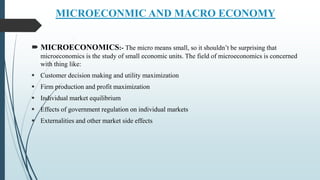
MICROECONMIC AND MACRO ECONOMY
 MICROECONOMICS:- The micro means small, so it shouldn’t be surprising that
microeconomics is the study of small economic units. The field of microeconomics is concerned
with thing like:
 Customer decision making and utility maximization
 Firm production and profit maximization
 Individual market equilibrium
 Effects of government regulation on individual markets
 Externalities and other market side effects
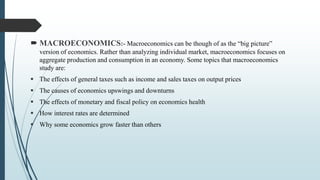
 MACROECONOMICS:- Macroeconomics can be though of as the “big picture”
version of economics. Rather than analyzing individual market, macroeconomics focuses on
aggregate production and consumption in an economy. Some topics that macroeconomics
study are:
 The effects of general taxes such as income and sales taxes on output prices
 The causes of economics upswings and downturns
 The effects of monetary and fiscal policy on economics health
 How interest rates are determined
 Why some economics grow faster than others
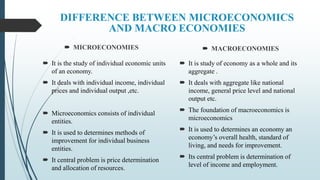
DIFFERENCE BETWEEN MICROECONOMICS
AND MACRO ECONOMIES
 MACROECONOMIES MICROECONOMIES
 It is the study of individual economic units
of an economy.
 It deals with individual income, individual
prices and individual output ,etc.
 Microeconomics consists of individual
entities.
 It is used to determines methods of
improvement for individual business
entities.
 It central problem is price determination
and allocation of resources.
 It is study of economy as a whole and its
aggregate .
 It deals with aggregate like national
income, general price level and national
output etc.
 The foundation of macroeconomics is
microeconomics
 It is used to determines an economy an
economy’s overall health, standard of
living, and needs for improvement.
 Its central problem is determination of
level of income and employment.
 Its main tools are demand and supply
of a particular commodity .
 It helps to solve the central problem of
what, how and for whom to produce
in the economy.
 It discusses how equilibrium of
consumer a produce or an industry is
attained.
 Price is the main determinate of
microeconomics problem.
 Example are :individual income,
individual saving, price determination
of a commodity, individual firm’s
output, consumer’s equilibrium,
opportunity cost etc.
 Its main tools are aggregate demand
and aggregate supply of economy as a
whole.
 it help to solve the central problem of
full employment of resources in the
economy.
 It is concerned with the determination
of equilibrium level of income and
employment of the economy.
 Income is the major determinate of
macro economics problem.
 Example are : national income ,
national saving, general price level,
aggregate demand, aggregate supply,
poverty, unemployment, inflection etc.
DIFFERENCE BETWEEN MACRO AND MICRO ECONOMICS

DIFFERENCE BETWEEN MACRO AND MICRO ECONOMICS

  • 1.
    GANDHINAGAR INSTITUTE OFTECHNOLOGY SUBJECT :- ENGINEERING ECONOMICS AND MANGEMENT BRANCH :- CIVIL ENGINEERING Prepared By :- ISTIYAK PATHAN 150123106020 CHIRAG FALIYA 150123106006 PATEL KARAN 150123106017 GUIDED BY :- PROF. PRASANT PANDYA ACTIVE LEARNING ASSIGNMENT DIFFERENCE BETWWEN MACRO AND MICRO ECONOMICS
  • 2.
    MICROECONMIC AND MACROECONOMY  MICROECONOMICS:- The micro means small, so it shouldn’t be surprising that microeconomics is the study of small economic units. The field of microeconomics is concerned with thing like:  Customer decision making and utility maximization  Firm production and profit maximization  Individual market equilibrium  Effects of government regulation on individual markets  Externalities and other market side effects
  • 3.
     MACROECONOMICS:- Macroeconomicscan be though of as the “big picture” version of economics. Rather than analyzing individual market, macroeconomics focuses on aggregate production and consumption in an economy. Some topics that macroeconomics study are:  The effects of general taxes such as income and sales taxes on output prices  The causes of economics upswings and downturns  The effects of monetary and fiscal policy on economics health  How interest rates are determined  Why some economics grow faster than others
  • 4.
    DIFFERENCE BETWEEN MICROECONOMICS ANDMACRO ECONOMIES  MACROECONOMIES MICROECONOMIES  It is the study of individual economic units of an economy.  It deals with individual income, individual prices and individual output ,etc.  Microeconomics consists of individual entities.  It is used to determines methods of improvement for individual business entities.  It central problem is price determination and allocation of resources.  It is study of economy as a whole and its aggregate .  It deals with aggregate like national income, general price level and national output etc.  The foundation of macroeconomics is microeconomics  It is used to determines an economy an economy’s overall health, standard of living, and needs for improvement.  Its central problem is determination of level of income and employment.
  • 5.
     Its maintools are demand and supply of a particular commodity .  It helps to solve the central problem of what, how and for whom to produce in the economy.  It discusses how equilibrium of consumer a produce or an industry is attained.  Price is the main determinate of microeconomics problem.  Example are :individual income, individual saving, price determination of a commodity, individual firm’s output, consumer’s equilibrium, opportunity cost etc.  Its main tools are aggregate demand and aggregate supply of economy as a whole.  it help to solve the central problem of full employment of resources in the economy.  It is concerned with the determination of equilibrium level of income and employment of the economy.  Income is the major determinate of macro economics problem.  Example are : national income , national saving, general price level, aggregate demand, aggregate supply, poverty, unemployment, inflection etc.