Introduction
To
Microeconomics
College of Applied Business
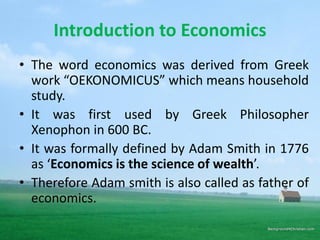
Introduction to Economics
• The word economics was derived from Greek
work “OEKONOMICUS” which means household
study.
• It was first used by Greek Philosopher
Xenophon in 600 BC.
• It was formally defined by Adam Smith in 1776
as ‘Economics is the science of wealth’.
• Therefore Adam smith is also called as father of
economics.
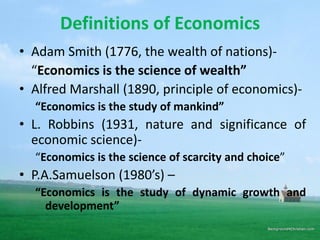
Definitions of Economics
• Adam Smith (1776, the wealth of nations)-
“Economics is the science of wealth”
• Alfred Marshall (1890, principle of economics)-
“Economics is the study of mankind”
• L. Robbins (1931, nature and significance of
economic science)-
“Economics is the science of scarcity and choice”
• P.A.Samuelson (1980’s) –
“Economics is the study of dynamic growth and
development”
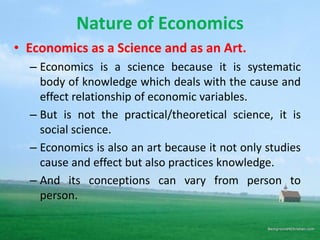
Nature of Economics
• Economics as a Science and as an Art.
– Economics is a science because it is systematic
body of knowledge which deals with the cause and
effect relationship of economic variables.
– But is not the practical/theoretical science, it is
social science.
– Economics is also an art because it not only studies
cause and effect but also practices knowledge.
– And its conceptions can vary from person to
person.
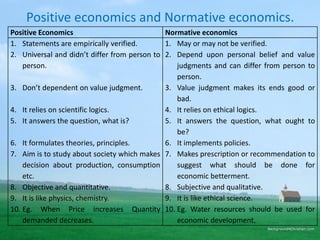
Positive economics and Normative economics.
Positive Economics Normative economics
1. Statements are empirically verified.
2. Universal and didn’t differ from person to
person.
3. Don’t dependent on value judgment.
4. It relies on scientific logics.
5. It answers the question, what is?
6. It formulates theories, principles.
7. Aim is to study about society which makes
decision about production, consumption
etc.
8. Objective and quantitative.
9. It is like physics, chemistry.
10. Eg. When Price increases Quantity
demanded decreases.
1. May or may not be verified.
2. Depend upon personal belief and value
judgments and can differ from person to
person.
3. Value judgment makes its ends good or
bad.
4. It relies on ethical logics.
5. It answers the question, what ought to
be?
6. It implements policies.
7. Makes prescription or recommendation to
suggest what should be done for
economic betterment.
8. Subjective and qualitative.
9. It is like ethical science.
10. Eg. Water resources should be used for
economic development.
Deductive and Inductive method of analysis.
• Deductive method of analysis is related to
‘General to Particular phenomenon.
• It studies general examples and derives
conclusions/theories.
• Inductive Method of analysis is related to
‘Particular to general’ phenomenon.
• It makes assumptions about certain theories
and tries to prove by using appropriate
examples.
History of Economic Thought
• Pre-Classical economic thought
– Mercantilism and Physiocracy (15-18 th century)
• Classical economic thought (1776AD-1890AD)
• Neo-classical economic thought (1890 AD-1929AD)
• Period of great depression (1929AD – 1936AD)
• Modern economic thought (1936AD -1980’s)
• Post-Modern economic thought (1980’s onwards)
Introduction to Microeconomics
• Microeconomics is derived from Greek word “Mikros”
which means small. It was first coined and used in 1933 by
German economist named Ragner Frisch.
• It is a branch of economics that studies the nature,
relationship and behavior of individual households and
firms in making decisions on the allocation of available
limited resources.
• It is a branch of economics that studies the nature,
relationship and behavior of individual households and
firms in making decisions on the allocation of limited
resources.
• It is the worm’s eye view analysis of economic variables.
Introduction to Microeconomics (contd..)
• The main objective of microeconomics is to study
principles, problems and policies related to optimal
allocation of resources.
• One of the goals of microeconomics is to
analyze market mechanisms that establish relative
prices amongst goods and services and allocation of
limited resources amongst many alternative uses.
• Microeconomics analyzes market failure, where
markets fail to produce efficient results, and describes
the theoretical conditions needed for perfect
competition.
Definitions of Microeconomics
• According to A.P. Lerner, “Microeconomics consists
of looking at the economy through microscope.”
• According to K.E. Boulding, “Microeconomics is the
study of particular firm, particular household,
individual price, wage, income, industry and
particular commodity.
Scope of Microeconomics
1. Theory of Demand and Supply
2. Theory of Consumer Behavior
3. Theory of Production
4. Theory of Product Pricing
5. Theory of Factor Pricing
6. Theory of Economic Welfare etc.
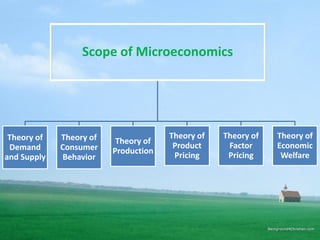
Scope of Microeconomics
Theory of
Demand
and Supply
Theory of
Consumer
Behavior
Theory of
Production
Theory of
Product
Pricing
Theory of
Factor
Pricing
Theory of
Economic
Welfare
Types of Microeconomics:
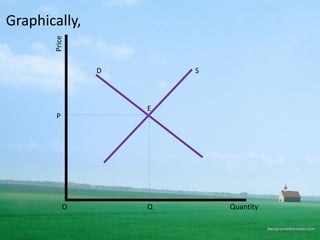
• It deals with one static equilibrium point of
individual economic units.
• It is related with study of one static point of
time from still picture point of view.
• It doesn’t involve dynamic changes of an
economy and assumes all the other things
remaining as constant.
1. Simple Micro-Statics
Graphically,
Price
O Quantity
D S
E
P
Q
2. Comparative Micro-Statics
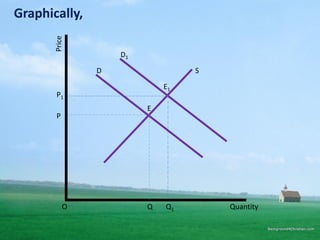
• It compares two or more static equilibrium points
of different points of time.
• Conclusion will be drawn from the comparative
study.
• Compares two still pictures.
• Does not provide the answer of the following
questions:
1. What are the causes responsible for breaking initial
equilibrium point?
2. What are the causes of attaining final equilibrium
point ?
3. What is the actual process in between them?
Price
O Quantity
D S
E
P
Q
Graphically,
D1
E1
P1
Q1
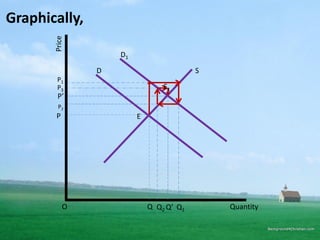
3. Micro-Dynamics
• Explains lagged relationship between
microeconomic variables.
• Analyses the equilibrium situations from
motion picture point of view.
• It is related to the period of time.
• Also explains the whole process of moving
equilibrium points.
• Answers all the questions which were not
answered by comparative micro-statics.
Graphically,
Price
O Quantity
D S
E
P
Q
D1
P1
Q1
Q2
P2
P3
P’
Q’
E1
Uses of Microeconomics:
1. To understand the operation of laissez-faire
economy.
2. Useful in business decision making:
a) Determination of price of the product.
b) Demand forecasting
c) Optimum allocation of resources
d) Managerial decisions
e) Financial decisions
3. To examine the conditions of economic welfare
4. Efficient utilization of resources
5. Useful in international trade.
6. To provide tools for economic policies.
Limitations of Microeconomics:
• Microeconomics assumes laissez-faire
economy which is not realistic.
• Microeconomics provides the partial analysis
assuming all the other things remaining the
same.
• Microeconomics can’t reflect the actual
situation of the economy.
• The policies issued for microeconomics may
not be applicable for whole economy.
• Microeconomic analysis is based on the
various unrealistic assumptions.
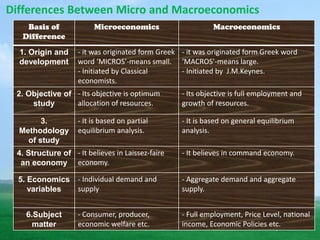
Differences Between Micro and Macroeconomics
Basis of
Difference
Microeconomics Macroeconomics
1. Origin and
development
- it was originated form Greek
word ‘MICROS’-means small.
- Initiated by Classical
economists.
- it was originated form Greek word
‘MACROS’-means large.
- Initiated by J.M.Keynes.
2. Objective of
study
- Its objective is optimum
allocation of resources.
- Its objective is full employment and
growth of resources.
3.
Methodology
of study
- It is based on partial
equilibrium analysis.
- It is based on general equilibrium
analysis.
4. Structure of
an economy
- It believes in Laissez-faire
economy.
- It believes in command economy.
5. Economics
variables
- Individual demand and
supply
- Aggregate demand and aggregate
supply.
6.Subject
matter
- Consumer, producer,
economic welfare etc.
- Full employment, Price Level, national
income, Economic Policies etc.
Interdependence between Micro and Macroeconomics
• Samuelson, “There is really no opposition between micro and
macroeconomics. Both are absolutely vital. You will be less
than half educated if you understand the one while being
ignorant of the other.”
Dependency of Micro on Macro:
1. Determination of price of the
product.
2. Determination of wage rate.
3. Determination of welfare
situation.
4. Determination of interest rate.
5. Determination of profit
margin.
6. Determination of cost of
production etc .
Dependency of Macro on Micro:
1. Determination of National
Income.
2. Determination of General
Price Level.
3. Determination of Total
consumption, saving and
Investment of an economy.
4. Determination of Per capita
Income .
5. Determination of Employment
level.
Thank You!

MICRO ECONOMICS UNIT 1 - PPT.pdf

  • 1.
  • 2.
    Introduction to Economics •The word economics was derived from Greek work “OEKONOMICUS” which means household study. • It was first used by Greek Philosopher Xenophon in 600 BC. • It was formally defined by Adam Smith in 1776 as ‘Economics is the science of wealth’. • Therefore Adam smith is also called as father of economics.
  • 3.
    Definitions of Economics •Adam Smith (1776, the wealth of nations)- “Economics is the science of wealth” • Alfred Marshall (1890, principle of economics)- “Economics is the study of mankind” • L. Robbins (1931, nature and significance of economic science)- “Economics is the science of scarcity and choice” • P.A.Samuelson (1980’s) – “Economics is the study of dynamic growth and development”
  • 4.
    Nature of Economics •Economics as a Science and as an Art. – Economics is a science because it is systematic body of knowledge which deals with the cause and effect relationship of economic variables. – But is not the practical/theoretical science, it is social science. – Economics is also an art because it not only studies cause and effect but also practices knowledge. – And its conceptions can vary from person to person.
  • 5.
    Positive economics andNormative economics. Positive Economics Normative economics 1. Statements are empirically verified. 2. Universal and didn’t differ from person to person. 3. Don’t dependent on value judgment. 4. It relies on scientific logics. 5. It answers the question, what is? 6. It formulates theories, principles. 7. Aim is to study about society which makes decision about production, consumption etc. 8. Objective and quantitative. 9. It is like physics, chemistry. 10. Eg. When Price increases Quantity demanded decreases. 1. May or may not be verified. 2. Depend upon personal belief and value judgments and can differ from person to person. 3. Value judgment makes its ends good or bad. 4. It relies on ethical logics. 5. It answers the question, what ought to be? 6. It implements policies. 7. Makes prescription or recommendation to suggest what should be done for economic betterment. 8. Subjective and qualitative. 9. It is like ethical science. 10. Eg. Water resources should be used for economic development.
  • 6.
    Deductive and Inductivemethod of analysis. • Deductive method of analysis is related to ‘General to Particular phenomenon. • It studies general examples and derives conclusions/theories. • Inductive Method of analysis is related to ‘Particular to general’ phenomenon. • It makes assumptions about certain theories and tries to prove by using appropriate examples.
  • 7.
    History of EconomicThought • Pre-Classical economic thought – Mercantilism and Physiocracy (15-18 th century) • Classical economic thought (1776AD-1890AD) • Neo-classical economic thought (1890 AD-1929AD) • Period of great depression (1929AD – 1936AD) • Modern economic thought (1936AD -1980’s) • Post-Modern economic thought (1980’s onwards)
  • 8.
    Introduction to Microeconomics •Microeconomics is derived from Greek word “Mikros” which means small. It was first coined and used in 1933 by German economist named Ragner Frisch. • It is a branch of economics that studies the nature, relationship and behavior of individual households and firms in making decisions on the allocation of available limited resources. • It is a branch of economics that studies the nature, relationship and behavior of individual households and firms in making decisions on the allocation of limited resources. • It is the worm’s eye view analysis of economic variables.
  • 9.
    Introduction to Microeconomics(contd..) • The main objective of microeconomics is to study principles, problems and policies related to optimal allocation of resources. • One of the goals of microeconomics is to analyze market mechanisms that establish relative prices amongst goods and services and allocation of limited resources amongst many alternative uses. • Microeconomics analyzes market failure, where markets fail to produce efficient results, and describes the theoretical conditions needed for perfect competition.
  • 10.
    Definitions of Microeconomics •According to A.P. Lerner, “Microeconomics consists of looking at the economy through microscope.” • According to K.E. Boulding, “Microeconomics is the study of particular firm, particular household, individual price, wage, income, industry and particular commodity.
  • 11.
    Scope of Microeconomics 1.Theory of Demand and Supply 2. Theory of Consumer Behavior 3. Theory of Production 4. Theory of Product Pricing 5. Theory of Factor Pricing 6. Theory of Economic Welfare etc.
  • 12.
    Scope of Microeconomics Theoryof Demand and Supply Theory of Consumer Behavior Theory of Production Theory of Product Pricing Theory of Factor Pricing Theory of Economic Welfare
  • 13.
    Types of Microeconomics: •It deals with one static equilibrium point of individual economic units. • It is related with study of one static point of time from still picture point of view. • It doesn’t involve dynamic changes of an economy and assumes all the other things remaining as constant. 1. Simple Micro-Statics
  • 14.
  • 15.
    2. Comparative Micro-Statics •It compares two or more static equilibrium points of different points of time. • Conclusion will be drawn from the comparative study. • Compares two still pictures. • Does not provide the answer of the following questions: 1. What are the causes responsible for breaking initial equilibrium point? 2. What are the causes of attaining final equilibrium point ? 3. What is the actual process in between them?
  • 16.
  • 17.
    3. Micro-Dynamics • Explainslagged relationship between microeconomic variables. • Analyses the equilibrium situations from motion picture point of view. • It is related to the period of time. • Also explains the whole process of moving equilibrium points. • Answers all the questions which were not answered by comparative micro-statics.
  • 18.
  • 19.
    Uses of Microeconomics: 1.To understand the operation of laissez-faire economy. 2. Useful in business decision making: a) Determination of price of the product. b) Demand forecasting c) Optimum allocation of resources d) Managerial decisions e) Financial decisions 3. To examine the conditions of economic welfare 4. Efficient utilization of resources 5. Useful in international trade. 6. To provide tools for economic policies.
  • 20.
    Limitations of Microeconomics: •Microeconomics assumes laissez-faire economy which is not realistic. • Microeconomics provides the partial analysis assuming all the other things remaining the same. • Microeconomics can’t reflect the actual situation of the economy. • The policies issued for microeconomics may not be applicable for whole economy. • Microeconomic analysis is based on the various unrealistic assumptions.
  • 21.
    Differences Between Microand Macroeconomics Basis of Difference Microeconomics Macroeconomics 1. Origin and development - it was originated form Greek word ‘MICROS’-means small. - Initiated by Classical economists. - it was originated form Greek word ‘MACROS’-means large. - Initiated by J.M.Keynes. 2. Objective of study - Its objective is optimum allocation of resources. - Its objective is full employment and growth of resources. 3. Methodology of study - It is based on partial equilibrium analysis. - It is based on general equilibrium analysis. 4. Structure of an economy - It believes in Laissez-faire economy. - It believes in command economy. 5. Economics variables - Individual demand and supply - Aggregate demand and aggregate supply. 6.Subject matter - Consumer, producer, economic welfare etc. - Full employment, Price Level, national income, Economic Policies etc.
  • 22.
    Interdependence between Microand Macroeconomics • Samuelson, “There is really no opposition between micro and macroeconomics. Both are absolutely vital. You will be less than half educated if you understand the one while being ignorant of the other.” Dependency of Micro on Macro: 1. Determination of price of the product. 2. Determination of wage rate. 3. Determination of welfare situation. 4. Determination of interest rate. 5. Determination of profit margin. 6. Determination of cost of production etc . Dependency of Macro on Micro: 1. Determination of National Income. 2. Determination of General Price Level. 3. Determination of Total consumption, saving and Investment of an economy. 4. Determination of Per capita Income . 5. Determination of Employment level.
  • 23.