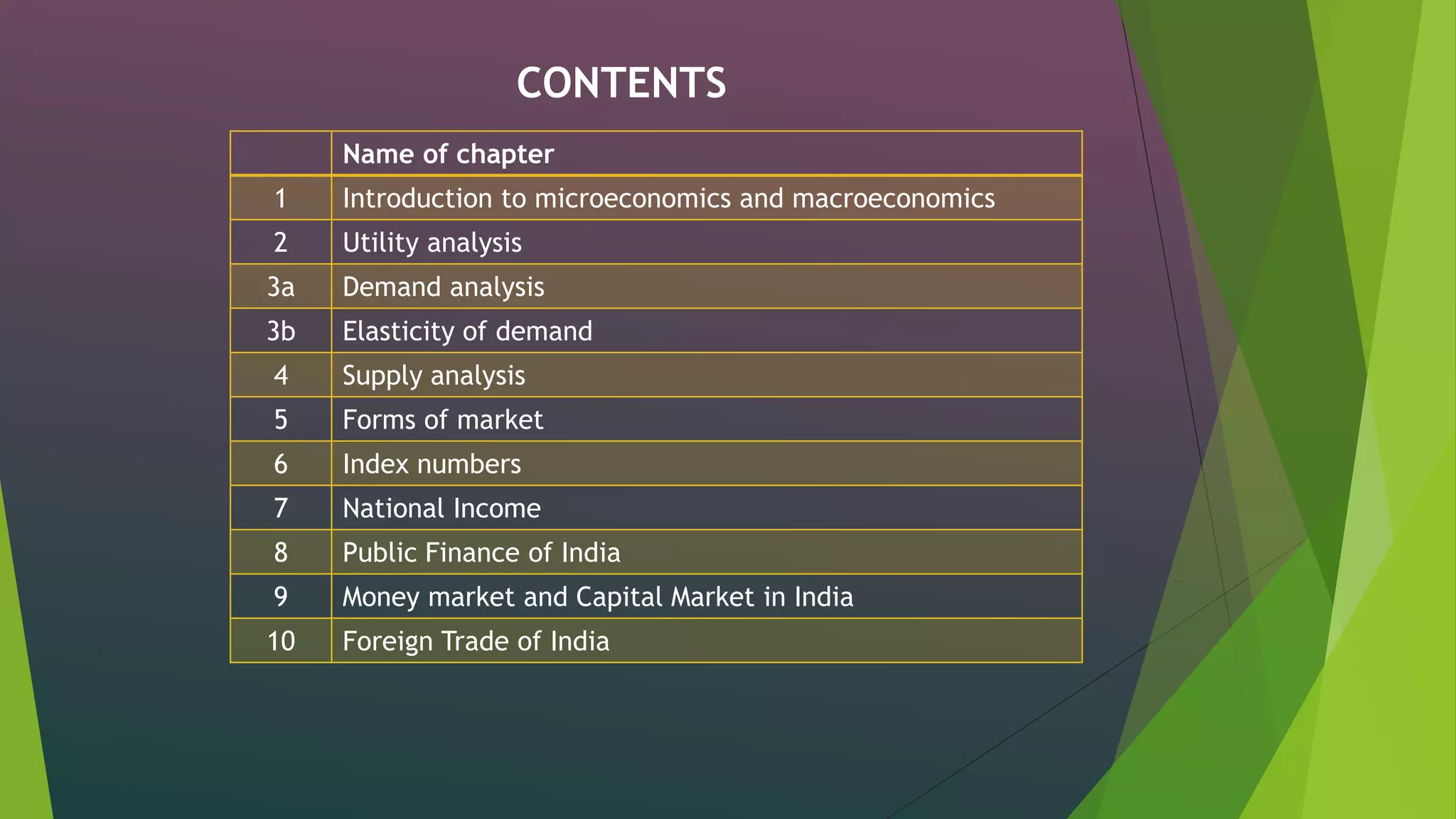
Name of chapter
1 Introduction to microeconomics and macroeconomics
2 Utility analysis
3a Demand analysis
3b Elasticity of demand
4 Supply analysis
5 Forms of market
6 Index numbers
7 National Income
8 Public Finance of India
9 Money market and Capital Market in India
10 Foreign Trade of India
CONTENTS
INTRODUCTIONTO MICROECONOMICSAND
MACROECONOMICS
Let’s recall
What is
Economics?
• Economics is a social science concerned with the production,
distribution, and consumption of goods and services.
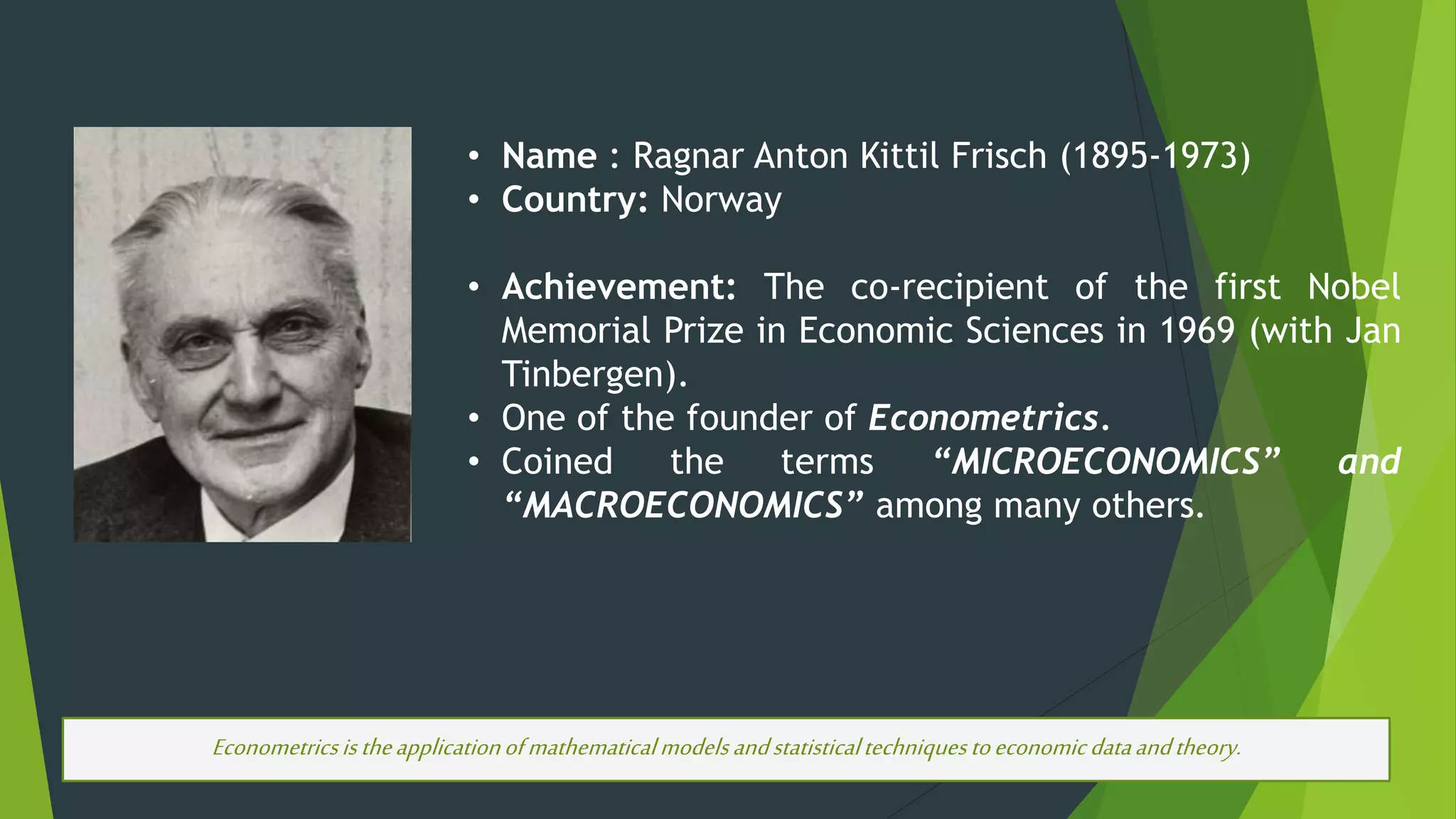
• Name : Ragnar Anton Kittil Frisch (1895-1973)
• Country: Norway
• Achievement: The co-recipient of the first Nobel
Memorial Prize in Economic Sciences in 1969 (with Jan
Tinbergen).
• One of the founder of Econometrics.
• Coined the terms “MICROECONOMICS” and
“MACROECONOMICS” among many others.
Econometricsistheapplicationofmathematicalmodelsandstatisticaltechniquestoeconomicdataandtheory.
History of Economics
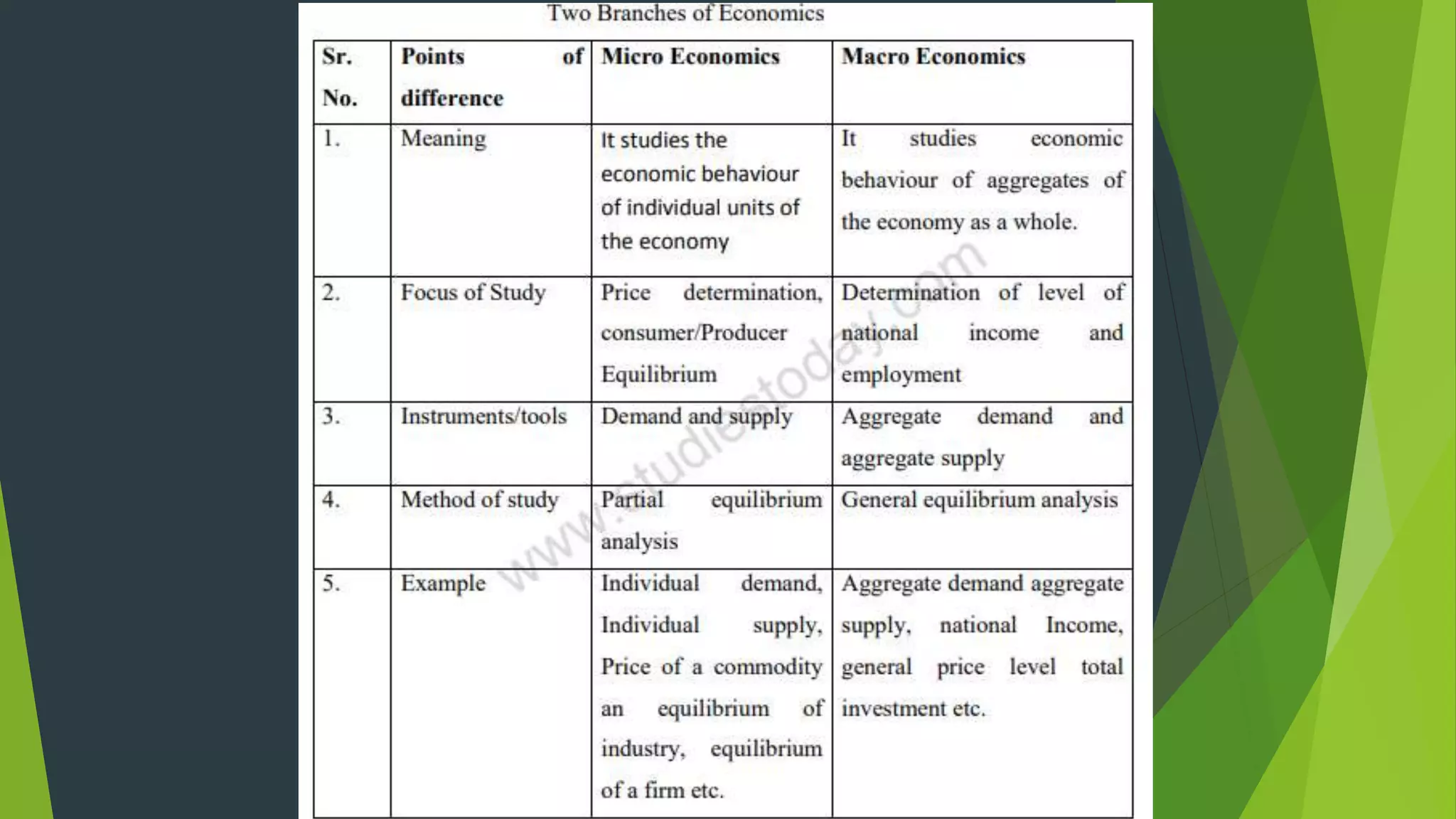
Micro Economics Macro Economics
Derived from Greek word- Mikros meaning small or
millionth part.
Derived from Greek word- Makros meaning
large.
This approach was developed first and is known as
traditional approach.
Existed since 16th century even before
microeconomics, however was popularised after
the Great Depression of 1930s. It is therefore
known as the modern approach.
Popular economists- Adam Smith, Prof. Alfred
Marshall, David Ricardo, J.S. Mill, Prof.
Samuelson, J.R. Hicks, Prof Pigou etc.
Popular economists- J.M. Keynes, Malthus,
Walrus, Irwin Fisher etc.
Mainly popularised by Prof. Alfred Marshall in his
book ‘Principles of Economics’ published in 1890.
Mainly popularised by John Maynard Keynes in
his book “The General Theory of Employment,
Interest and Money” in 1936.
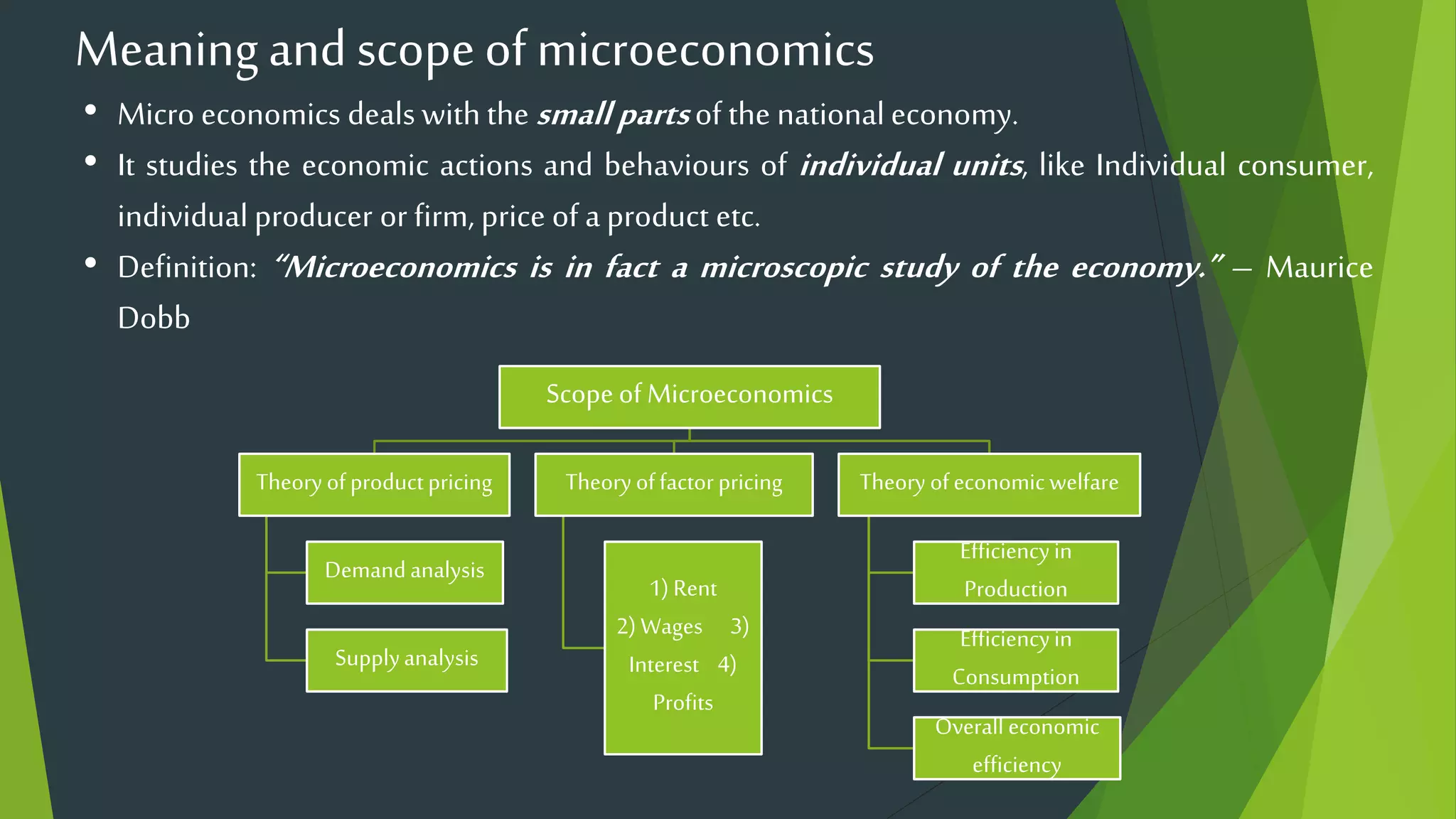
Meaningand scopeof microeconomics
• Micro economics deals with the small partsof the nationaleconomy.
• It studies the economic actions and behaviours of individual units, like Individual consumer,
individual producer or firm, price of a product etc.
• Definition: “Microeconomics is in fact a microscopic study of the economy.” – Maurice
Dobb
Scopeof Microeconomics
Theory ofproductpricing
Demandanalysis
Supplyanalysis
Theory offactorpricing
1) Rent
2) Wages 3)
Interest 4)
Profits
Theory ofeconomicwelfare
Efficiencyin
Production
Efficiencyin
Consumption
Overall economic
efficiency
To conclude:-
• Thus, Micro economicstudiestheeconomyatan individuallevel.
• The focus of Microeconomics is mainly confined to Price theory and
resource allocation.
• Itdoesnotstudyaggregatesrelatedtothewholeeconomy.
• It therefore does not study national economic problems like
unemployment, poverty, economic inequality, theory of growth theory of
business etc.
Features ofMicroeconomics
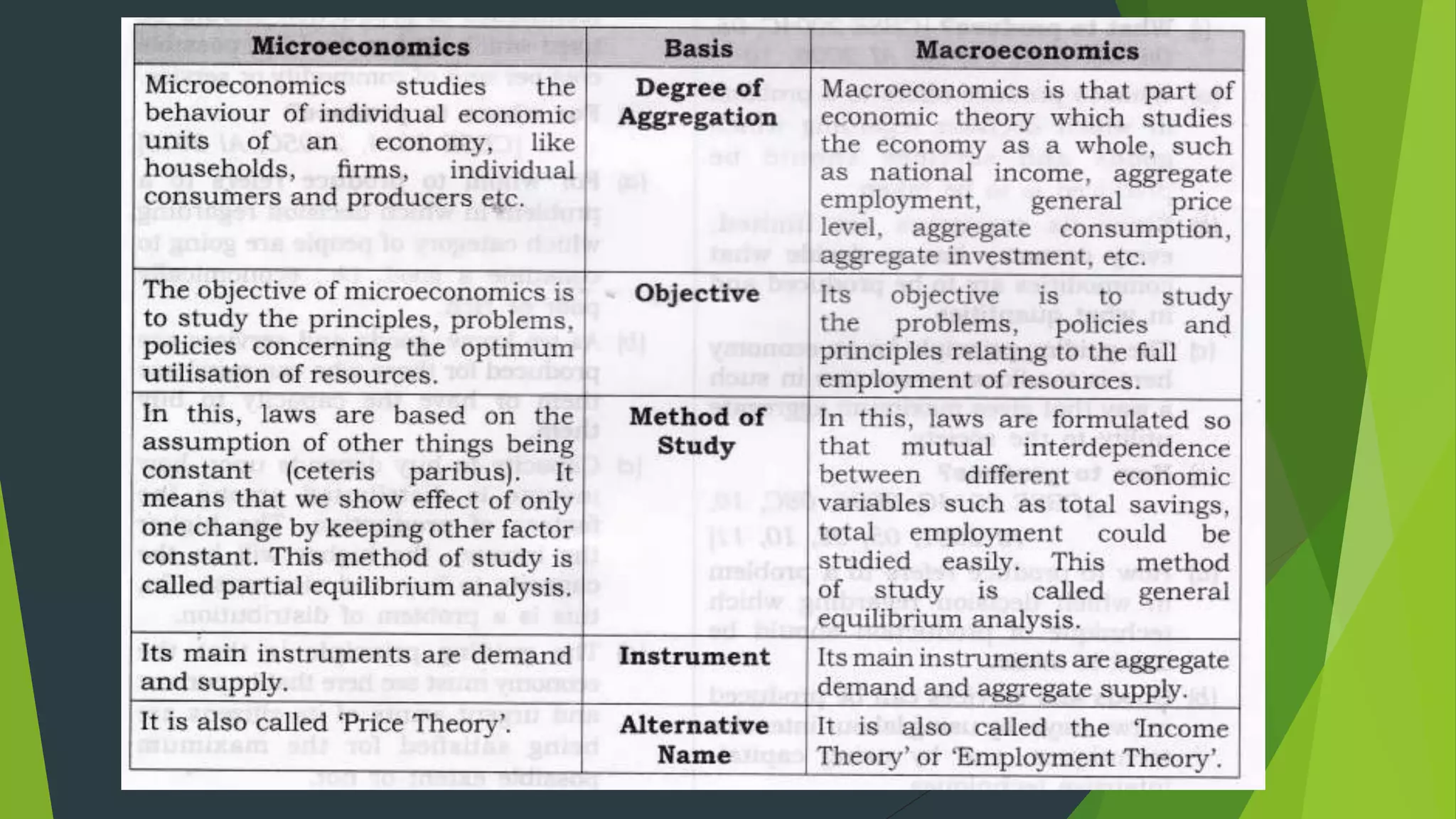
1. Study of individual economic units:
Micro economics studies the behaviour of small individual economic units like, Individual households,
individual firms, individual prices etc.
2. Price Theory : Microeconomics deals with the determination of prices of goods and services
as well of the factors of production.
3. Partial equilibrium : Equilibrium is the balance between two factors. In microeconomics we
study the equilibrium position of individual economic unit i.e. it isolates
an individual from other forces and studies its behaviour independently.
4. Based on certain assumptions:
Microeconomics begins with the fundamental assumption of “other things remaining constant”
(Ceteris Paribus)such as Perfect competition, Laissez Faire policy, full employment, etc. This makes the
analysis simpler.
5. Slicing method: Microeconomics uses slicing method to study the economics. It divides the
Whole Economy into small individual units and studies each unit separately in detail.
Individual
Firms
Individual
Industry
Individual
Household
Individual
Shop
Individual
Product
6. Use of Marginalism Principle: Marginal means the change brought about by an additional
Unit/ extra unit of commodity. Producers and consumers take economic decisions using this principle.
7. Analysis of market structure: It analyses different market structure like Perfect competition,
Monopoly, Monopolistic competition, oligopoly etc.
Importance of
Microeconomics
Price
determination
Free
market
economy
Foreign
Trade
Economic
model
building
Business
decisions
Useful to
government
Basic of
welfare
economics
Features ofMacroeconomics
1. Study of aggregates:
Macro economics studies the economy as a whole. It is concerned with concepts such as National
Income, General price level, business cycles, etc.
2. Income theory:
Macro economics studies National income (its elements, methods of measurement, social accounting)
with the help of aggregate demand and aggregate supply. It also helps to study the fluctuations in
national income that lead to inflation and deflation.
3. General equilibrium analysis:
Macro economics deals with large aggregates and their functional relationship. It deals with aggregate
demand and supply and their prices in the whole economy.
4. Interdependence:
Macro economics takes into account the interdependence between the economic variables like income,
output, employment, investments, price levels etc.
5. Lumping method:
Macro economics is the study of the economy as a whole and not its part. It is like studying the forest as
a whole and not an individual tree in particular.
MICROECONOMICS
MACROECONOMICS
6. Growth models:
Macro economics studies growth and development. It is useful in development of the growth models
which are used for studying economic development.
6. General Price level:
Macro economics studies determination and changes in general price level. It is the average of the prices of
all the goods and services produced in the economy.
7. Policy oriented:
Macro economics studies is a policy oriented science. It suggests suitable policies for economic development,
generate employment, control inflation etc.
Importance of
Macroeconomics
Functioning of
an economy
Economic
fluctuations
National
Income
Economic
development
Performance
of an economy
Study of
macroeconomi
c variables
Level of
employment
1 Intro to Microeconomics and Macroeconomics

1 Intro to Microeconomics and Macroeconomics

  • 1.
    Name of chapter 1Introduction to microeconomics and macroeconomics 2 Utility analysis 3a Demand analysis 3b Elasticity of demand 4 Supply analysis 5 Forms of market 6 Index numbers 7 National Income 8 Public Finance of India 9 Money market and Capital Market in India 10 Foreign Trade of India CONTENTS
  • 2.
  • 3.
  • 4.
    • Economics isa social science concerned with the production, distribution, and consumption of goods and services.
  • 5.
    • Name :Ragnar Anton Kittil Frisch (1895-1973) • Country: Norway • Achievement: The co-recipient of the first Nobel Memorial Prize in Economic Sciences in 1969 (with Jan Tinbergen). • One of the founder of Econometrics. • Coined the terms “MICROECONOMICS” and “MACROECONOMICS” among many others. Econometricsistheapplicationofmathematicalmodelsandstatisticaltechniquestoeconomicdataandtheory.
  • 6.
    History of Economics MicroEconomics Macro Economics Derived from Greek word- Mikros meaning small or millionth part. Derived from Greek word- Makros meaning large. This approach was developed first and is known as traditional approach. Existed since 16th century even before microeconomics, however was popularised after the Great Depression of 1930s. It is therefore known as the modern approach. Popular economists- Adam Smith, Prof. Alfred Marshall, David Ricardo, J.S. Mill, Prof. Samuelson, J.R. Hicks, Prof Pigou etc. Popular economists- J.M. Keynes, Malthus, Walrus, Irwin Fisher etc. Mainly popularised by Prof. Alfred Marshall in his book ‘Principles of Economics’ published in 1890. Mainly popularised by John Maynard Keynes in his book “The General Theory of Employment, Interest and Money” in 1936.
  • 7.
    Meaningand scopeof microeconomics •Micro economics deals with the small partsof the nationaleconomy. • It studies the economic actions and behaviours of individual units, like Individual consumer, individual producer or firm, price of a product etc. • Definition: “Microeconomics is in fact a microscopic study of the economy.” – Maurice Dobb Scopeof Microeconomics Theory ofproductpricing Demandanalysis Supplyanalysis Theory offactorpricing 1) Rent 2) Wages 3) Interest 4) Profits Theory ofeconomicwelfare Efficiencyin Production Efficiencyin Consumption Overall economic efficiency
  • 8.
    To conclude:- • Thus,Micro economicstudiestheeconomyatan individuallevel. • The focus of Microeconomics is mainly confined to Price theory and resource allocation. • Itdoesnotstudyaggregatesrelatedtothewholeeconomy. • It therefore does not study national economic problems like unemployment, poverty, economic inequality, theory of growth theory of business etc.
  • 9.
    Features ofMicroeconomics 1. Studyof individual economic units: Micro economics studies the behaviour of small individual economic units like, Individual households, individual firms, individual prices etc.
  • 10.
    2. Price Theory: Microeconomics deals with the determination of prices of goods and services as well of the factors of production. 3. Partial equilibrium : Equilibrium is the balance between two factors. In microeconomics we study the equilibrium position of individual economic unit i.e. it isolates an individual from other forces and studies its behaviour independently.
  • 11.
    4. Based oncertain assumptions: Microeconomics begins with the fundamental assumption of “other things remaining constant” (Ceteris Paribus)such as Perfect competition, Laissez Faire policy, full employment, etc. This makes the analysis simpler. 5. Slicing method: Microeconomics uses slicing method to study the economics. It divides the Whole Economy into small individual units and studies each unit separately in detail. Individual Firms Individual Industry Individual Household Individual Shop Individual Product
  • 12.
    6. Use ofMarginalism Principle: Marginal means the change brought about by an additional Unit/ extra unit of commodity. Producers and consumers take economic decisions using this principle. 7. Analysis of market structure: It analyses different market structure like Perfect competition, Monopoly, Monopolistic competition, oligopoly etc.
  • 13.
  • 14.
    Features ofMacroeconomics 1. Studyof aggregates: Macro economics studies the economy as a whole. It is concerned with concepts such as National Income, General price level, business cycles, etc. 2. Income theory: Macro economics studies National income (its elements, methods of measurement, social accounting) with the help of aggregate demand and aggregate supply. It also helps to study the fluctuations in national income that lead to inflation and deflation.
  • 15.
    3. General equilibriumanalysis: Macro economics deals with large aggregates and their functional relationship. It deals with aggregate demand and supply and their prices in the whole economy. 4. Interdependence: Macro economics takes into account the interdependence between the economic variables like income, output, employment, investments, price levels etc.
  • 16.
    5. Lumping method: Macroeconomics is the study of the economy as a whole and not its part. It is like studying the forest as a whole and not an individual tree in particular. MICROECONOMICS MACROECONOMICS 6. Growth models: Macro economics studies growth and development. It is useful in development of the growth models which are used for studying economic development.
  • 17.
    6. General Pricelevel: Macro economics studies determination and changes in general price level. It is the average of the prices of all the goods and services produced in the economy. 7. Policy oriented: Macro economics studies is a policy oriented science. It suggests suitable policies for economic development, generate employment, control inflation etc.
  • 18.
    Importance of Macroeconomics Functioning of aneconomy Economic fluctuations National Income Economic development Performance of an economy Study of macroeconomi c variables Level of employment