


Unit – 1
(10 Marks)
Chapter – 1
Introduction-
Macroeconomics
Introduction
 Meaning of Macroeconomics
● Macroeconomics is the study of aggregates or
averages covering the entire economy such as
national income, full employment, aggregate
demand etc.
● It is primarily concerned with the study of
relationship between economic aggregates.
• J.M.Keynes an eminent economist, has played
an important role in the development of
economics. He is called, “The Father of Modern
Macroeconomics.”
• Macroeconomics is also alternatively called
Theory of Income and Employment.
• Under Macroeconomics, we try to understand
how the level of income and employment is
determined and how employment can be
removed.
• In real terms, Macroeconomics deals with the
economy in its totality.
• The method of study used here is “General
Equilibrium Analysis” according to which all the
factors are considered as interdependent and a
change in one will lead to change in others.
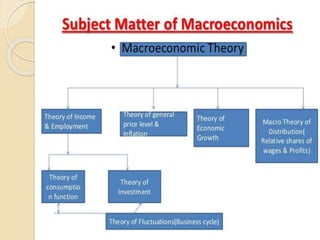
Scope/Subject Matter of
Macroeconomics
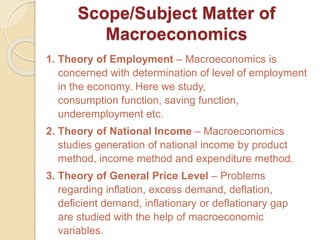
1. Theory of Employment – Macroeconomics is
concerned with determination of level of employment
in the economy. Here we study,
consumption function, saving function,
underemployment etc.
2. Theory of National Income – Macroeconomics
studies generation of national income by product
method, income method and expenditure method.
3. Theory of General Price Level – Problems
regarding inflation, excess demand, deflation,
deficient demand, inflationary or deflationary gap
are studied with the help of macroeconomic
variables.
4. Theory of Money – Macroeconomics explains
functions of money, components of money supply.
Banking also plays an important role in
understanding various aspects of macroeconomic
problems like inflation, deflation etc.
5. Theory of International Trade –Macroeconomics
studies economic transactions between two or
more countries, balance of payment position of
the country, determination of exchange rate etc.
6. Theory of Economic Growth – Macroeconomics
studies fuller utilisation of resources and their
growth to achieve the objective of economic
growth ultimately.
▪ It provides measures to understand the
calculation of national income of the country. It
helps us to understand if there were leakages
and injections to the circular flow of income.
▪ Formulation of govt. budget, policies regarding
control of inflation and deflation becomes easier
with the help of various macroeconomic
aggregates like govt. revenue expenditure,
excess or deficient demand etc.
▪ It facilitates international comparisons by
providing information about aggregate demand
and supply, surplus and deficit balance of
payment etc.
Importance of Macroeconomics
▪ It helps to coordinate various policies and
measures at macro level to solve economic
problems like poverty , unemployment, inflationary
or deflationary gaps etc.
Microeconomics &
Macroeconomics: Interdependence
• Changes in microeconomic variables have an
impact on macroeconomic variables and vice
versa. It implies that since micro is a part of
macro, thus microeconomics and
macroeconomics thought different in their
approach, do depend on each other.
• Both microeconomics and macroeconomics are
interdependent. Microeconomics is not always
restricted to individual units and also
Macroeconomics deals with the aggregates at
smaller level.
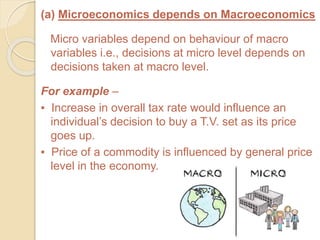
(a) Microeconomics depends on Macroeconomics
Micro variables depend on behaviour of macro
variables i.e., decisions at micro level depends on
decisions taken at macro level.
For example –
▪ Increase in overall tax rate would influence an
individual’s decision to buy a T.V. set as its price
goes up.
▪ Price of a commodity is influenced by general price
level in the economy.
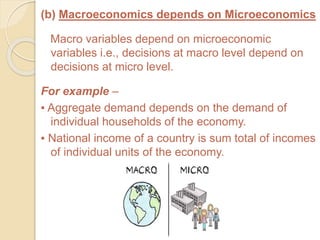
(b) Macroeconomics depends on Microeconomics
Macro variables depend on microeconomic
variables i.e., decisions at macro level depend on
decisions at micro level.
For example –
▪ Aggregate demand depends on the demand of
individual households of the economy.
▪ National income of a country is sum total of incomes
of individual units of the economy.
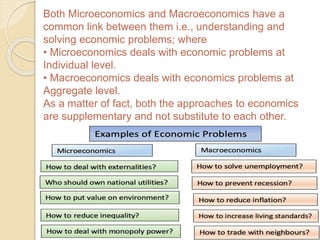
Both Microeconomics and Macroeconomics have a
common link between them i.e., understanding and
solving economic problems; where
• Microeconomics deals with economic problems at
Individual level.
• Macroeconomics deals with economics problems at
Aggregate level.
As a matter of fact, both the approaches to economics
are supplementary and not substitute to each other.
Presented by –
Ritvik Tolumbia
CS, CWA, M.Com (ABST), M.A (Eco), B.Ed
Author & Faculty of Commerce

Unit 1 introduction - Macroeconomics

  • 1.
    Unit – 1 (10Marks) Chapter – 1 Introduction- Macroeconomics
  • 3.
    Introduction  Meaning ofMacroeconomics ● Macroeconomics is the study of aggregates or averages covering the entire economy such as national income, full employment, aggregate demand etc. ● It is primarily concerned with the study of relationship between economic aggregates.
  • 4.
    • J.M.Keynes aneminent economist, has played an important role in the development of economics. He is called, “The Father of Modern Macroeconomics.” • Macroeconomics is also alternatively called Theory of Income and Employment. • Under Macroeconomics, we try to understand how the level of income and employment is determined and how employment can be removed. • In real terms, Macroeconomics deals with the economy in its totality. • The method of study used here is “General Equilibrium Analysis” according to which all the factors are considered as interdependent and a change in one will lead to change in others.
  • 5.
    Scope/Subject Matter of Macroeconomics 1.Theory of Employment – Macroeconomics is concerned with determination of level of employment in the economy. Here we study, consumption function, saving function, underemployment etc. 2. Theory of National Income – Macroeconomics studies generation of national income by product method, income method and expenditure method. 3. Theory of General Price Level – Problems regarding inflation, excess demand, deflation, deficient demand, inflationary or deflationary gap are studied with the help of macroeconomic variables.
  • 6.
    4. Theory ofMoney – Macroeconomics explains functions of money, components of money supply. Banking also plays an important role in understanding various aspects of macroeconomic problems like inflation, deflation etc. 5. Theory of International Trade –Macroeconomics studies economic transactions between two or more countries, balance of payment position of the country, determination of exchange rate etc. 6. Theory of Economic Growth – Macroeconomics studies fuller utilisation of resources and their growth to achieve the objective of economic growth ultimately.
  • 8.
    ▪ It providesmeasures to understand the calculation of national income of the country. It helps us to understand if there were leakages and injections to the circular flow of income. ▪ Formulation of govt. budget, policies regarding control of inflation and deflation becomes easier with the help of various macroeconomic aggregates like govt. revenue expenditure, excess or deficient demand etc. ▪ It facilitates international comparisons by providing information about aggregate demand and supply, surplus and deficit balance of payment etc. Importance of Macroeconomics
  • 9.
    ▪ It helpsto coordinate various policies and measures at macro level to solve economic problems like poverty , unemployment, inflationary or deflationary gaps etc.
  • 10.
    Microeconomics & Macroeconomics: Interdependence •Changes in microeconomic variables have an impact on macroeconomic variables and vice versa. It implies that since micro is a part of macro, thus microeconomics and macroeconomics thought different in their approach, do depend on each other. • Both microeconomics and macroeconomics are interdependent. Microeconomics is not always restricted to individual units and also Macroeconomics deals with the aggregates at smaller level.
  • 11.
    (a) Microeconomics dependson Macroeconomics Micro variables depend on behaviour of macro variables i.e., decisions at micro level depends on decisions taken at macro level. For example – ▪ Increase in overall tax rate would influence an individual’s decision to buy a T.V. set as its price goes up. ▪ Price of a commodity is influenced by general price level in the economy.
  • 12.
    (b) Macroeconomics dependson Microeconomics Macro variables depend on microeconomic variables i.e., decisions at macro level depend on decisions at micro level. For example – ▪ Aggregate demand depends on the demand of individual households of the economy. ▪ National income of a country is sum total of incomes of individual units of the economy.
  • 13.
    Both Microeconomics andMacroeconomics have a common link between them i.e., understanding and solving economic problems; where • Microeconomics deals with economic problems at Individual level. • Macroeconomics deals with economics problems at Aggregate level. As a matter of fact, both the approaches to economics are supplementary and not substitute to each other.
  • 14.
    Presented by – RitvikTolumbia CS, CWA, M.Com (ABST), M.A (Eco), B.Ed Author & Faculty of Commerce