WHAT IS
ECONOMICS ?
Ever wonder why food costs rise when gas prices
spike? Ever question why U.S. politicians worry
when other countries talk of going bankrupt? Ever
wonder why you can’t get a good interest rate on
your savings account? All of these phenomena can
be explained through economics.
Economics is the study of the production and
consumption of goods and the transfer of wealth
to produce and obtain those goods. Economics
explains how people interact within markets to get
what they want or accomplish certain goals. Since
Economics is often regarded as the
queen of social sciences. It has acquired
a place of unprecedented importance in
recent years in view of fact that is
explains some of the very important
issues faced by individuals as well as by
the society .It is essential and
appropriate as a starting point to know
what economics is all about or what the
subject matter of economics is
.Economics as a social science deals with
the economic questions. It seeks to
Economics is divided into two broad
categories :
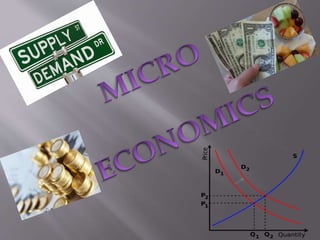
 MICRO ECONOMICS
 MACRO ECONOMICS
Let us discuss about these both in detail in the
following slides
Microeconomics is the study of the
behaviour of individual economic units.
It refers to the study of scarcity and
choice problems facing an individual
economic unit. For instance economic
activities or choice problems
concerning a consumer or a producer or
an industry and the study of individual
income or the determination of
product price…
1.It provides better understanding of
the decision processes of producers
and the consumers in the economy.
2.It is helpful in efficient allocation of
scarce resources among competing
ends in the economy.
3.It explains the conditions of efficiency
in consumption and production.
4.It helps in examining and in suggesting
conditions for welfare optimization or
economic efficiency in a perfectly
competitive market.
Macro economic is the study of aggregates covering
the entire economy , For instance, total employment,
national income, national output, total investments,
total consumption, total savings, aggregate supply,
aggregate demand and general price level, wage level
and cost structure come under the scope of macro
economics. In other words, it is aggregative economics
which examine the inter relations among various
aggregates , their determination and causes of
fluctuations in them .Thus ,in the words of Prof
.Ackley:”Macro economic deals with economic affairs
‘in the large’, it concerns the overall dimensions of
economic life”. The central problem of macro
economics being the problem of determination of
1. It helps us understand the functioning of a complicated
modern economic system. It describes how the economy
as a whole functions and how the level of national income
and employment is determined on the basis of aggregate
demand and aggregate supply.
2. It helps to achieve the goal of economic growth, a higher
GDP level, and higher level of employment. It analyses the
forces which determine economic growth of a country
and explains how to reach the highest state of economic
growth and sustain it.
3. It helps to bring stability in price level and analyses
fluctuations in business activities. It suggests policy
measures to control inflation and deflation.
4. It explains factors which determine balance of payments.
At the same time, it identifies causes of deficit in
1. Microeconomics is the study of particular firm,
particular household, individual prices, wages, incomes,
individual industries, and individual commodities whereas
Macroeconomics deals not with individual quantities as
such but with aggregates of these quantities not with
individual income but with national income, not with
individual prices but with the price level not with
individual output but with national output.
2. What implies to an individual firm or industry may not
be applicable at the aggregate level.
3. Micro economics primarily concerns the allocation of
resources by an individual economic unit . Macro
economic on the other hand is the study of relations
between economic aggregates
5. The central problem in micro economics is price determination
while the central problem in macro economics is income and
employment determination
6. Main tools of micro economics are demand and supply while the
main tools of macro economics are aggregate demand and
aggregate supply.
7. Micro economics discusses how equilibrium of a consumer, a
producer or an industry is attained. Macroeconomics is
concerned with the determination of equilibrium level of income
and employment of the economy.
8. Price is the main determinant of microeconomic problems.
Income is the major determinant of macroeconomic problems.
9. Examples of Microeconomics: individual income, individual
savings, price determination of a commodity, individual firm's
output, consumer's equilibrium. Examples of Macroeconomics:
For me, economics is about the world around us; it’s
current; it’s always changing; it’s always interesting.
It’s the subject that allows you study Tesco’s and
ASDA’s methods of competition one day, and learn
about the environment and pollution permits the next.
It’s about the modern world; it’s about how we behave,
how businesses behave and how the government
behaves. Economics teaches how to make well-
informed decisions. A large part of the subject is
decision making: what should the government do to cut
the budget deficit; what should a business do to raise
profit margins. It teaches us how to go about making
choices, which is vitally important in business. I am of
the belief that everyone needs to know what is going

Economics

  • 2.
    WHAT IS ECONOMICS ? Everwonder why food costs rise when gas prices spike? Ever question why U.S. politicians worry when other countries talk of going bankrupt? Ever wonder why you can’t get a good interest rate on your savings account? All of these phenomena can be explained through economics. Economics is the study of the production and consumption of goods and the transfer of wealth to produce and obtain those goods. Economics explains how people interact within markets to get what they want or accomplish certain goals. Since
  • 3.
    Economics is oftenregarded as the queen of social sciences. It has acquired a place of unprecedented importance in recent years in view of fact that is explains some of the very important issues faced by individuals as well as by the society .It is essential and appropriate as a starting point to know what economics is all about or what the subject matter of economics is .Economics as a social science deals with the economic questions. It seeks to
  • 4.
    Economics is dividedinto two broad categories :  MICRO ECONOMICS  MACRO ECONOMICS Let us discuss about these both in detail in the following slides
  • 6.
    Microeconomics is thestudy of the behaviour of individual economic units. It refers to the study of scarcity and choice problems facing an individual economic unit. For instance economic activities or choice problems concerning a consumer or a producer or an industry and the study of individual income or the determination of product price…
  • 8.
    1.It provides betterunderstanding of the decision processes of producers and the consumers in the economy. 2.It is helpful in efficient allocation of scarce resources among competing ends in the economy. 3.It explains the conditions of efficiency in consumption and production. 4.It helps in examining and in suggesting conditions for welfare optimization or economic efficiency in a perfectly competitive market.
  • 10.
    Macro economic isthe study of aggregates covering the entire economy , For instance, total employment, national income, national output, total investments, total consumption, total savings, aggregate supply, aggregate demand and general price level, wage level and cost structure come under the scope of macro economics. In other words, it is aggregative economics which examine the inter relations among various aggregates , their determination and causes of fluctuations in them .Thus ,in the words of Prof .Ackley:”Macro economic deals with economic affairs ‘in the large’, it concerns the overall dimensions of economic life”. The central problem of macro economics being the problem of determination of
  • 11.
    1. It helpsus understand the functioning of a complicated modern economic system. It describes how the economy as a whole functions and how the level of national income and employment is determined on the basis of aggregate demand and aggregate supply. 2. It helps to achieve the goal of economic growth, a higher GDP level, and higher level of employment. It analyses the forces which determine economic growth of a country and explains how to reach the highest state of economic growth and sustain it. 3. It helps to bring stability in price level and analyses fluctuations in business activities. It suggests policy measures to control inflation and deflation. 4. It explains factors which determine balance of payments. At the same time, it identifies causes of deficit in
  • 12.
    1. Microeconomics isthe study of particular firm, particular household, individual prices, wages, incomes, individual industries, and individual commodities whereas Macroeconomics deals not with individual quantities as such but with aggregates of these quantities not with individual income but with national income, not with individual prices but with the price level not with individual output but with national output. 2. What implies to an individual firm or industry may not be applicable at the aggregate level. 3. Micro economics primarily concerns the allocation of resources by an individual economic unit . Macro economic on the other hand is the study of relations between economic aggregates
  • 13.
    5. The centralproblem in micro economics is price determination while the central problem in macro economics is income and employment determination 6. Main tools of micro economics are demand and supply while the main tools of macro economics are aggregate demand and aggregate supply. 7. Micro economics discusses how equilibrium of a consumer, a producer or an industry is attained. Macroeconomics is concerned with the determination of equilibrium level of income and employment of the economy. 8. Price is the main determinant of microeconomic problems. Income is the major determinant of macroeconomic problems. 9. Examples of Microeconomics: individual income, individual savings, price determination of a commodity, individual firm's output, consumer's equilibrium. Examples of Macroeconomics:
  • 14.
    For me, economicsis about the world around us; it’s current; it’s always changing; it’s always interesting. It’s the subject that allows you study Tesco’s and ASDA’s methods of competition one day, and learn about the environment and pollution permits the next. It’s about the modern world; it’s about how we behave, how businesses behave and how the government behaves. Economics teaches how to make well- informed decisions. A large part of the subject is decision making: what should the government do to cut the budget deficit; what should a business do to raise profit margins. It teaches us how to go about making choices, which is vitally important in business. I am of the belief that everyone needs to know what is going