Date:4/5/2021 www. qadricohs.edu.pk FB Page: Qadri College of Health Sciences, Karachi, Sindh, Pakistan. 1
QADRI COLLEGE OF HEALTH SCIENCES, KARACHI
Generic BScN
Subject: Microbiology
Year. 1 Semester. 1
Theory: 2.5 + Skill/Lab: 0.5 = Total 3 Credit Hours
An Introduction to Microbiology
Date:4/5/2021 www. qadricohs.edu.pk FB Page: Qadri College of Health Sciences, Karachi, Sindh, Pakistan. 2
COURSE DESCRIPTION:
• This course is designed to furnish the
learners with the knowledge of besic
concepts and scientific principles of
Microbiology.
• It is facilitates the learners to learn the
application of principles of
Microbiology in hospital and
community environment
Date:4/5/2021 www. qadricohs.edu.pk FB Page: Qadri College of Health Sciences, Karachi, Sindh, Pakistan. 3
COURSE OBJECTIVES:
By the completion of the course,
learners will be able to:
1. Explain the necessity of the
knowledge of Microbiology needed
when providing nursing care to the
clients.
Date:4/5/2021 www. qadricohs.edu.pk FB Page: Qadri College of Health Sciences, Karachi, Sindh, Pakistan. 4
COURSE OBJECTIVES:
2. Use basic principles of
Microbiology in nursing practice, in
a hospital and a community
environment.
3. Demonstrate the skills learnt in
the laboratory to carryout simple
laboratory experiments.
Date:4/5/2021 www. qadricohs.edu.pk FB Page: Qadri College of Health Sciences, Karachi, Sindh, Pakistan. 5
An Introduction to Microbiology
Teaching / Learning Strategies:
Lecture, discussion, small
group projects, group
discussion, presentation, self
study, laboratory work and
demonstration, Pre/Post tests.
Date:4/5/2021 www. qadricohs.edu.pk FB Page: Qadri College of Health Sciences, Karachi, Sindh, Pakistan. 6
An Introduction to Microbiology
Evaluation Criteria:
Test (s) 40%
Lab Assessment 15%
Assignment 15%
Final Exam 30%
Total 100%
Date:4/5/2021 www. qadricohs.edu.pk FB Page: Qadri College of Health Sciences, Karachi, Sindh, Pakistan. 7
An Introduction to Microbiology
Faculty: Aftab H. Abbasi
RN, DCHN, BSN, MA, LL.B
Lecturer Nursing
Qadri College of Health Sciences
Karachi
Date:4/5/2021 www. qadricohs.edu.pk FB Page: Qadri College of Health Sciences, Karachi, Sindh, Pakistan. 8
QADRI COLLEGE OF HEALTH SCIENCES, KARACHI
An Introduction to Microbiology
Date:4/5/2021 www. qadricohs.edu.pk FB Page: Qadri College of Health Sciences, Karachi, Sindh, Pakistan. 9
Unit 1: INTRODUCTION TO MICROBIOLOGY
Definition of Microbiology:
The study of living things too
small to
be seen without magnification.
Microorganisms or microbes:
These microscopic organisms
Commonly called “germs,viruses,
agents…”
but not all cause disease.
And many more are useful or
essential for human life.
Date:4/5/2021 www. qadricohs.edu.pk FB Page: Qadri College of Health Sciences, Karachi, Sindh, Pakistan. 10
Unit 1: INTRODUCTION TO MICROBIOLOGY
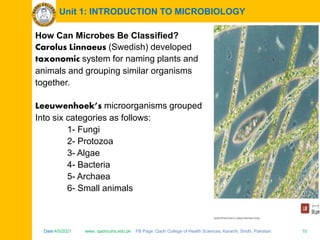
How Can Microbes Be Classified?
Carolus Linnaeus (Swedish) developed
taxonomic system for naming plants and
animals and grouping similar organisms
together.
Leeuwenhoek’s microorganisms grouped
Into six categories as follows:
1- Fungi
2- Protozoa
3- Algae
4- Bacteria
5- Archaea
6- Small animals
Date:4/5/2021 www. qadricohs.edu.pk FB Page: Qadri College of Health Sciences, Karachi, Sindh, Pakistan. 11
Unit 1: INTRODUCTION TO MICROBIOLOGY
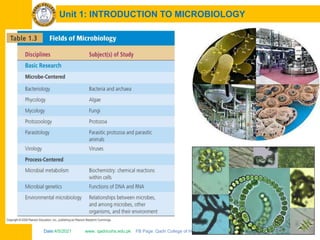
Fungi
– Eukaryotic (have membrane-bound
nucleus)
– Obtain food from other organisms.
– Possess cell walls.
– Composed of:
• Molds – multicellular; have
hyphae; reproduce by sexual
and asexual spores.
• Yeasts – unicellular; reproduce
asexually by budding; some
produce sexual spores.
Date:4/5/2021 www. qadricohs.edu.pk FB Page: Qadri College of Health Sciences, Karachi, Sindh, Pakistan. 12
Unit 1: INTRODUCTION TO MICROBIOLOGY
Protozoa
– Single-celled eukaryotes.
– Similar to animals in nutrient needs
and cellular structure.
– Live freely in water; some live in
animal hosts.
– Asexual (most) and sexual
reproduction.
– Most are capable of locomotion by
• Pseudopodia – cell extensions that
flow in direction of travel
• Cilia – numerous, short, hairlike
protrusions that propel organisms
through environment.
• Flagella – extensions of a cell that
are fewer, longer, and more
whiplike than cilia.
Date:4/5/2021 www. qadricohs.edu.pk FB Page: Qadri College of Health Sciences, Karachi, Sindh, Pakistan. 13
Unit 1: INTRODUCTION TO MICROBIOLOGY
Algae
– Unicellular or
multicellular.
– Photosynthetic.
– Simple reproductive
structures.
– Categorized on the
basis of pigmentation,
storage products, and
composition of cell wall.
Date:4/5/2021 www. qadricohs.edu.pk FB Page: Qadri College of Health Sciences, Karachi, Sindh, Pakistan. 14
Unit 1: INTRODUCTION TO MICROBIOLOGY
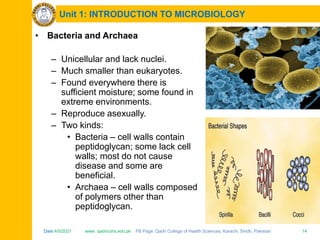
• Bacteria and Archaea
– Unicellular and lack nuclei.
– Much smaller than eukaryotes.
– Found everywhere there is
sufficient moisture; some found in
extreme environments.
– Reproduce asexually.
– Two kinds:
• Bacteria – cell walls contain
peptidoglycan; some lack cell
walls; most do not cause
disease and some are
beneficial.
• Archaea – cell walls composed
of polymers other than
peptidoglycan.
Date:4/5/2021 www. qadricohs.edu.pk FB Page: Qadri College of Health Sciences, Karachi, Sindh, Pakistan. 15
Unit 1: INTRODUCTION TO MICROBIOLOGY
Date:4/5/2021 www. qadricohs.edu.pk FB Page: Qadri College of Health Sciences, Karachi, Sindh, Pakistan. 16
Unit 1: INTRODUCTION TO MICROBIOLOGY
Date:4/5/2021 www. qadricohs.edu.pk FB Page: Qadri College of Health Sciences, Karachi, Sindh, Pakistan. 17
Unit 1: INTRODUCTION TO MICROBIOLOGY
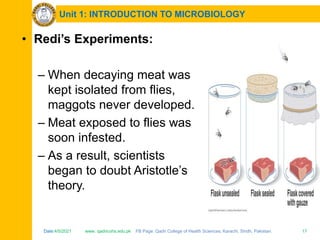
• Redi’s Experiments:
– When decaying meat was
kept isolated from flies,
maggots never developed.
– Meat exposed to flies was
soon infested.
– As a result, scientists
began to doubt Aristotle’s
theory.
Date:4/5/2021 www. qadricohs.edu.pk FB Page: Qadri College of Health Sciences, Karachi, Sindh, Pakistan. 18
Unit 1: INTRODUCTION TO MICROBIOLOGY
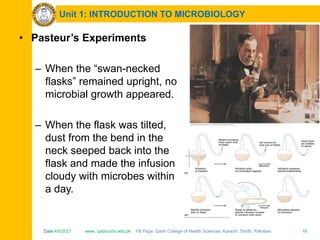
• Pasteur’s Experiments
– When the “swan-necked
flasks” remained upright, no
microbial growth appeared.
– When the flask was tilted,
dust from the bend in the
neck seeped back into the
flask and made the infusion
cloudy with microbes within
a day.
Date:4/5/2021 www. qadricohs.edu.pk FB Page: Qadri College of Health Sciences, Karachi, Sindh, Pakistan. 19
Unit 1: INTRODUCTION TO MICROBIOLOGY
• What Causes
Disease?
– Pasteur developed
germ theory of
disease.
– Robert Koch
studied causative
agents of disease
• Anthrax
• Examined
colonies of
microorganisms
Date:4/5/2021 www. qadricohs.edu.pk FB Page: Qadri College of Health Sciences, Karachi, Sindh, Pakistan. 20
Unit 1: INTRODUCTION TO MICROBIOLOGY
• Koch’s Experiments
– Simple staining techniques.
– First photomicrograph of bacteria.
– First photomicrograph of bacteria
in diseased tissue.
– Techniques for estimating
CFU/ml.
– Use of steam to sterilize media.
– Use of Petri dishes.
– Aseptic techniques.
– Bacteria as distinct species.
– Koch’s Postulates.
Date:4/5/2021 www. qadricohs.edu.pk FB Page: Qadri College of Health Sciences, Karachi, Sindh, Pakistan. 21
Unit 1: INTRODUCTION TO MICROBIOLOGY
Date:4/5/2021 www. qadricohs.edu.pk FB Page: Qadri College of Health Sciences, Karachi, Sindh, Pakistan. 22
Unit 1: INTRODUCTION TO MICROBIOLOGY
• How Can We Prevent
Infection and Disease?
– Semmelweis’s
handwashing.
– Lister’s antiseptic
technique.
– Nightingale and nursing.
– Snow – infection control
and epidemiology.
– Jenner’s vaccine – field of
immunology.
– Ehrlich’s “magic bullets” –
field of chemotherapy.
Date:4/5/2021 www. qadricohs.edu.pk FB Page: Qadri College of Health Sciences, Karachi, Sindh, Pakistan. 23
Unit 1: INTRODUCTION TO MICROBIOLOGY
Date:4/5/2021 www. qadricohs.edu.pk FB Page: Qadri College of Health Sciences, Karachi, Sindh, Pakistan. 24
Unit 1: INTRODUCTION TO MICROBIOLOGY
• What Are the Basic Chemical Reactions
of Life?
– Biochemistry:
• Began with Pasteur’s work on
fermentation and Buchner’s
discovery of enzymes in yeast
extract.
• Kluyver and van Niel – microbes
used as model systems for
biochemical reactions.
• Practical applications:
– Design of herbicides and
pesticides.
– Diagnosis of illnesses and
monitoring of patients’
responses to treatment.
– Treatment of metabolic
diseases.
– Drug design.
Date:4/5/2021 www. qadricohs.edu.pk FB Page: Qadri College of Health Sciences, Karachi, Sindh, Pakistan. 25
Unit 1: INTRODUCTION TO MICROBIOLOGY
• What Role Do
Microorganisms
Play in the
Environment?
– Bioremediation
uses living
bacteria, fungi, and
algae to detoxify
polluted
environments.
– Recycling of
chemicals such as
carbon, nitrogen,
and sulfur.
Date:4/5/2021 www. qadricohs.edu.pk FB Page: Qadri College of Health Sciences, Karachi, Sindh, Pakistan. 26
Unit 1: INTRODUCTION TO MICROBIOLOGY
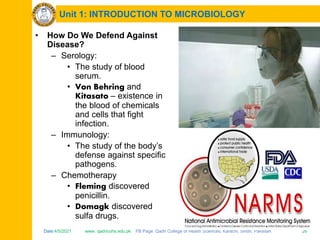
• How Do We Defend Against
Disease?
– Serology:
• The study of blood
serum.
• Von Behring and
Kitasato – existence in
the blood of chemicals
and cells that fight
infection.
– Immunology:
• The study of the body’s
defense against specific
pathogens.
– Chemotherapy
• Fleming discovered
penicillin.
• Domagk discovered
sulfa drugs.
Date:4/5/2021 www. qadricohs.edu.pk FB Page: Qadri College of Health Sciences, Karachi, Sindh, Pakistan. 27
Unit 1: INTRODUCTION TO MICROBIOLOGY
What characteristics must an organism
have in order
to considered alive?
 Metabolism: Transformation of energy
by converting chemicals and energy
into cellular components (anabolism)
and decomposing organic matter
(catabolism). Living things require
energy to maintain internal organization
(homeostasis) and to produce the other
phenomena associated with life.
 Reproduction: The ability to produce
new individual organisms either
asexually, from a single parent
organism, or sexually, from at least two
parent organisms.
Date:4/5/2021 www. qadricohs.edu.pk FB Page: Qadri College of Health Sciences, Karachi, Sindh, Pakistan. 28
Unit 1: INTRODUCTION TO MICROBIOLOGY

Micriobilogy introduction

  • 1.
    Date:4/5/2021 www. qadricohs.edu.pkFB Page: Qadri College of Health Sciences, Karachi, Sindh, Pakistan. 1 Date:4/5/2021 www. qadricohs.edu.pk FB Page: Qadri College of Health Sciences, Karachi, Sindh, Pakistan. 1 QADRI COLLEGE OF HEALTH SCIENCES, KARACHI Generic BScN Subject: Microbiology Year. 1 Semester. 1 Theory: 2.5 + Skill/Lab: 0.5 = Total 3 Credit Hours An Introduction to Microbiology
  • 2.
    Date:4/5/2021 www. qadricohs.edu.pkFB Page: Qadri College of Health Sciences, Karachi, Sindh, Pakistan. 2 Date:4/5/2021 www. qadricohs.edu.pk FB Page: Qadri College of Health Sciences, Karachi, Sindh, Pakistan. 2 COURSE DESCRIPTION: • This course is designed to furnish the learners with the knowledge of besic concepts and scientific principles of Microbiology. • It is facilitates the learners to learn the application of principles of Microbiology in hospital and community environment
  • 3.
    Date:4/5/2021 www. qadricohs.edu.pkFB Page: Qadri College of Health Sciences, Karachi, Sindh, Pakistan. 3 Date:4/5/2021 www. qadricohs.edu.pk FB Page: Qadri College of Health Sciences, Karachi, Sindh, Pakistan. 3 COURSE OBJECTIVES: By the completion of the course, learners will be able to: 1. Explain the necessity of the knowledge of Microbiology needed when providing nursing care to the clients.
  • 4.
    Date:4/5/2021 www. qadricohs.edu.pkFB Page: Qadri College of Health Sciences, Karachi, Sindh, Pakistan. 4 Date:4/5/2021 www. qadricohs.edu.pk FB Page: Qadri College of Health Sciences, Karachi, Sindh, Pakistan. 4 COURSE OBJECTIVES: 2. Use basic principles of Microbiology in nursing practice, in a hospital and a community environment. 3. Demonstrate the skills learnt in the laboratory to carryout simple laboratory experiments.
  • 5.
    Date:4/5/2021 www. qadricohs.edu.pkFB Page: Qadri College of Health Sciences, Karachi, Sindh, Pakistan. 5 Date:4/5/2021 www. qadricohs.edu.pk FB Page: Qadri College of Health Sciences, Karachi, Sindh, Pakistan. 5 An Introduction to Microbiology Teaching / Learning Strategies: Lecture, discussion, small group projects, group discussion, presentation, self study, laboratory work and demonstration, Pre/Post tests.
  • 6.
    Date:4/5/2021 www. qadricohs.edu.pkFB Page: Qadri College of Health Sciences, Karachi, Sindh, Pakistan. 6 Date:4/5/2021 www. qadricohs.edu.pk FB Page: Qadri College of Health Sciences, Karachi, Sindh, Pakistan. 6 An Introduction to Microbiology Evaluation Criteria: Test (s) 40% Lab Assessment 15% Assignment 15% Final Exam 30% Total 100%
  • 7.
    Date:4/5/2021 www. qadricohs.edu.pkFB Page: Qadri College of Health Sciences, Karachi, Sindh, Pakistan. 7 Date:4/5/2021 www. qadricohs.edu.pk FB Page: Qadri College of Health Sciences, Karachi, Sindh, Pakistan. 7 An Introduction to Microbiology Faculty: Aftab H. Abbasi RN, DCHN, BSN, MA, LL.B Lecturer Nursing Qadri College of Health Sciences Karachi
  • 8.
    Date:4/5/2021 www. qadricohs.edu.pkFB Page: Qadri College of Health Sciences, Karachi, Sindh, Pakistan. 8 Date:4/5/2021 www. qadricohs.edu.pk FB Page: Qadri College of Health Sciences, Karachi, Sindh, Pakistan. 8 QADRI COLLEGE OF HEALTH SCIENCES, KARACHI An Introduction to Microbiology
  • 9.
    Date:4/5/2021 www. qadricohs.edu.pkFB Page: Qadri College of Health Sciences, Karachi, Sindh, Pakistan. 9 Unit 1: INTRODUCTION TO MICROBIOLOGY Definition of Microbiology: The study of living things too small to be seen without magnification. Microorganisms or microbes: These microscopic organisms Commonly called “germs,viruses, agents…” but not all cause disease. And many more are useful or essential for human life.
  • 10.
    Date:4/5/2021 www. qadricohs.edu.pkFB Page: Qadri College of Health Sciences, Karachi, Sindh, Pakistan. 10 Unit 1: INTRODUCTION TO MICROBIOLOGY How Can Microbes Be Classified? Carolus Linnaeus (Swedish) developed taxonomic system for naming plants and animals and grouping similar organisms together. Leeuwenhoek’s microorganisms grouped Into six categories as follows: 1- Fungi 2- Protozoa 3- Algae 4- Bacteria 5- Archaea 6- Small animals
  • 11.
    Date:4/5/2021 www. qadricohs.edu.pkFB Page: Qadri College of Health Sciences, Karachi, Sindh, Pakistan. 11 Unit 1: INTRODUCTION TO MICROBIOLOGY Fungi – Eukaryotic (have membrane-bound nucleus) – Obtain food from other organisms. – Possess cell walls. – Composed of: • Molds – multicellular; have hyphae; reproduce by sexual and asexual spores. • Yeasts – unicellular; reproduce asexually by budding; some produce sexual spores.
  • 12.
    Date:4/5/2021 www. qadricohs.edu.pkFB Page: Qadri College of Health Sciences, Karachi, Sindh, Pakistan. 12 Unit 1: INTRODUCTION TO MICROBIOLOGY Protozoa – Single-celled eukaryotes. – Similar to animals in nutrient needs and cellular structure. – Live freely in water; some live in animal hosts. – Asexual (most) and sexual reproduction. – Most are capable of locomotion by • Pseudopodia – cell extensions that flow in direction of travel • Cilia – numerous, short, hairlike protrusions that propel organisms through environment. • Flagella – extensions of a cell that are fewer, longer, and more whiplike than cilia.
  • 13.
    Date:4/5/2021 www. qadricohs.edu.pkFB Page: Qadri College of Health Sciences, Karachi, Sindh, Pakistan. 13 Unit 1: INTRODUCTION TO MICROBIOLOGY Algae – Unicellular or multicellular. – Photosynthetic. – Simple reproductive structures. – Categorized on the basis of pigmentation, storage products, and composition of cell wall.
  • 14.
    Date:4/5/2021 www. qadricohs.edu.pkFB Page: Qadri College of Health Sciences, Karachi, Sindh, Pakistan. 14 Unit 1: INTRODUCTION TO MICROBIOLOGY • Bacteria and Archaea – Unicellular and lack nuclei. – Much smaller than eukaryotes. – Found everywhere there is sufficient moisture; some found in extreme environments. – Reproduce asexually. – Two kinds: • Bacteria – cell walls contain peptidoglycan; some lack cell walls; most do not cause disease and some are beneficial. • Archaea – cell walls composed of polymers other than peptidoglycan.
  • 15.
    Date:4/5/2021 www. qadricohs.edu.pkFB Page: Qadri College of Health Sciences, Karachi, Sindh, Pakistan. 15 Unit 1: INTRODUCTION TO MICROBIOLOGY
  • 16.
    Date:4/5/2021 www. qadricohs.edu.pkFB Page: Qadri College of Health Sciences, Karachi, Sindh, Pakistan. 16 Unit 1: INTRODUCTION TO MICROBIOLOGY
  • 17.
    Date:4/5/2021 www. qadricohs.edu.pkFB Page: Qadri College of Health Sciences, Karachi, Sindh, Pakistan. 17 Unit 1: INTRODUCTION TO MICROBIOLOGY • Redi’s Experiments: – When decaying meat was kept isolated from flies, maggots never developed. – Meat exposed to flies was soon infested. – As a result, scientists began to doubt Aristotle’s theory.
  • 18.
    Date:4/5/2021 www. qadricohs.edu.pkFB Page: Qadri College of Health Sciences, Karachi, Sindh, Pakistan. 18 Unit 1: INTRODUCTION TO MICROBIOLOGY • Pasteur’s Experiments – When the “swan-necked flasks” remained upright, no microbial growth appeared. – When the flask was tilted, dust from the bend in the neck seeped back into the flask and made the infusion cloudy with microbes within a day.
  • 19.
    Date:4/5/2021 www. qadricohs.edu.pkFB Page: Qadri College of Health Sciences, Karachi, Sindh, Pakistan. 19 Unit 1: INTRODUCTION TO MICROBIOLOGY • What Causes Disease? – Pasteur developed germ theory of disease. – Robert Koch studied causative agents of disease • Anthrax • Examined colonies of microorganisms
  • 20.
    Date:4/5/2021 www. qadricohs.edu.pkFB Page: Qadri College of Health Sciences, Karachi, Sindh, Pakistan. 20 Unit 1: INTRODUCTION TO MICROBIOLOGY • Koch’s Experiments – Simple staining techniques. – First photomicrograph of bacteria. – First photomicrograph of bacteria in diseased tissue. – Techniques for estimating CFU/ml. – Use of steam to sterilize media. – Use of Petri dishes. – Aseptic techniques. – Bacteria as distinct species. – Koch’s Postulates.
  • 21.
    Date:4/5/2021 www. qadricohs.edu.pkFB Page: Qadri College of Health Sciences, Karachi, Sindh, Pakistan. 21 Unit 1: INTRODUCTION TO MICROBIOLOGY
  • 22.
    Date:4/5/2021 www. qadricohs.edu.pkFB Page: Qadri College of Health Sciences, Karachi, Sindh, Pakistan. 22 Unit 1: INTRODUCTION TO MICROBIOLOGY • How Can We Prevent Infection and Disease? – Semmelweis’s handwashing. – Lister’s antiseptic technique. – Nightingale and nursing. – Snow – infection control and epidemiology. – Jenner’s vaccine – field of immunology. – Ehrlich’s “magic bullets” – field of chemotherapy.
  • 23.
    Date:4/5/2021 www. qadricohs.edu.pkFB Page: Qadri College of Health Sciences, Karachi, Sindh, Pakistan. 23 Unit 1: INTRODUCTION TO MICROBIOLOGY
  • 24.
    Date:4/5/2021 www. qadricohs.edu.pkFB Page: Qadri College of Health Sciences, Karachi, Sindh, Pakistan. 24 Unit 1: INTRODUCTION TO MICROBIOLOGY • What Are the Basic Chemical Reactions of Life? – Biochemistry: • Began with Pasteur’s work on fermentation and Buchner’s discovery of enzymes in yeast extract. • Kluyver and van Niel – microbes used as model systems for biochemical reactions. • Practical applications: – Design of herbicides and pesticides. – Diagnosis of illnesses and monitoring of patients’ responses to treatment. – Treatment of metabolic diseases. – Drug design.
  • 25.
    Date:4/5/2021 www. qadricohs.edu.pkFB Page: Qadri College of Health Sciences, Karachi, Sindh, Pakistan. 25 Unit 1: INTRODUCTION TO MICROBIOLOGY • What Role Do Microorganisms Play in the Environment? – Bioremediation uses living bacteria, fungi, and algae to detoxify polluted environments. – Recycling of chemicals such as carbon, nitrogen, and sulfur.
  • 26.
    Date:4/5/2021 www. qadricohs.edu.pkFB Page: Qadri College of Health Sciences, Karachi, Sindh, Pakistan. 26 Unit 1: INTRODUCTION TO MICROBIOLOGY • How Do We Defend Against Disease? – Serology: • The study of blood serum. • Von Behring and Kitasato – existence in the blood of chemicals and cells that fight infection. – Immunology: • The study of the body’s defense against specific pathogens. – Chemotherapy • Fleming discovered penicillin. • Domagk discovered sulfa drugs.
  • 27.
    Date:4/5/2021 www. qadricohs.edu.pkFB Page: Qadri College of Health Sciences, Karachi, Sindh, Pakistan. 27 Unit 1: INTRODUCTION TO MICROBIOLOGY What characteristics must an organism have in order to considered alive?  Metabolism: Transformation of energy by converting chemicals and energy into cellular components (anabolism) and decomposing organic matter (catabolism). Living things require energy to maintain internal organization (homeostasis) and to produce the other phenomena associated with life.  Reproduction: The ability to produce new individual organisms either asexually, from a single parent organism, or sexually, from at least two parent organisms.
  • 28.
    Date:4/5/2021 www. qadricohs.edu.pkFB Page: Qadri College of Health Sciences, Karachi, Sindh, Pakistan. 28 Date:4/5/2021 www. qadricohs.edu.pk FB Page: Qadri College of Health Sciences, Karachi, Sindh, Pakistan. 28 Unit 1: INTRODUCTION TO MICROBIOLOGY