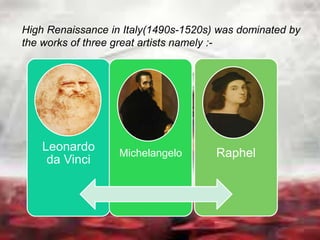
High Renaissance in Italy(1490s-1520s) was dominated by
the works of three great artists namely :-
Leonardo
da Vinci
Michelangelo Raphel
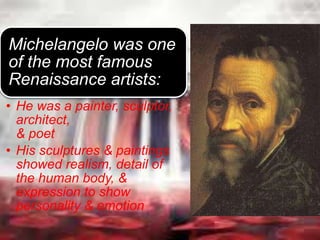
Michelangelo was one
of the most famous
Renaissance artists:
• He was a painter, sculptor,
architect,
& poet
• His sculptures & paintings
showed realism, detail of
the human body, &
expression to show
personality & emotion
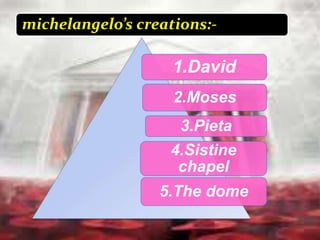
1.David
2.Moses
3.Pieta
4.Sistine
chapel
5.The dome
michelangelo’s creations:-
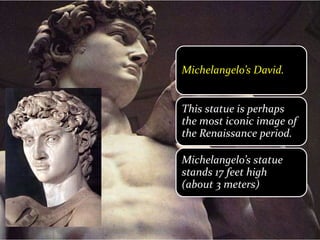
Michelangelo’s David.
This statue is perhaps
the most iconic image of
the Renaissance period.
Michelangelo’s statue
stands 17 feet high
(about 3 meters)
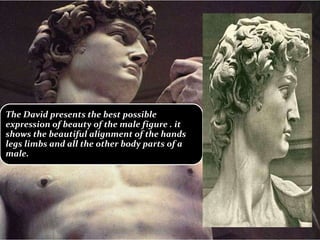
The David presents the best possible
expression of beauty of the male figure . it
shows the beautiful alignment of the hands
legs limbs and all the other body parts of a
male.
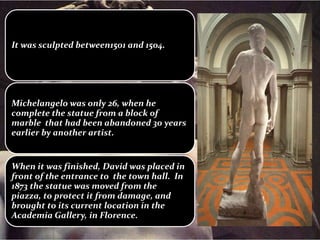
It was sculpted between1501 and 1504.
Michelangelo was only 26, when he
complete the statue from a block of
marble that had been abandoned 30 years
earlier by another artist.
When it was finished, David was placed in
front of the entrance to the town hall. In
1873 the statue was moved from the
piazza, to protect it from damage, and
brought to its current location in the
Academia Gallery, in Florence.
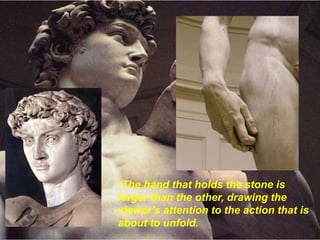
•The hand that holds the stone is
larger than the other, drawing the
viewer’s attention to the action that is
about to unfold.
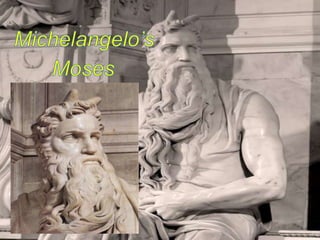
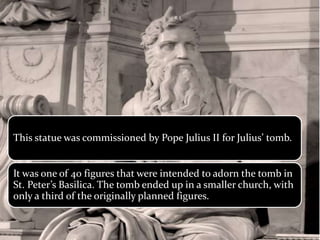
This statue was commissioned by Pope Julius II for Julius’ tomb.
It was one of 40 figures that were intended to adorn the tomb in
St. Peter’s Basilica. The tomb ended up in a smaller church, with
only a third of the originally planned figures.
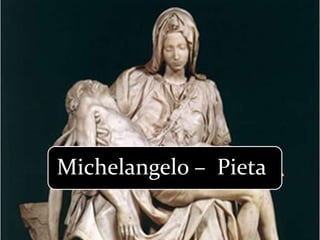
Michelangelo – Pieta
•Pieta means ‘Pity,’ and this is certainly the
emotion that this magnificent sculpture evokes.
• We feel pity for Christ’s suffering, but also for his
grieving mother, who holds her son’s body in an
attitude of quiet acceptance.
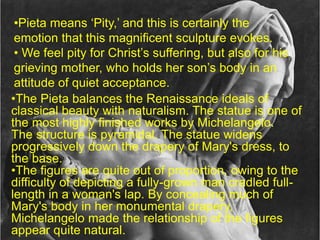
•The Pieta balances the Renaissance ideals of
classical beauty with naturalism. The statue is one of
the most highly finished works by Michelangelo.
The structure is pyramidal. The statue widens
progressively down the drapery of Mary's dress, to
the base.
•The figures are quite out of proportion, owing to the
difficulty of depicting a fully-grown man cradled full-
length in a woman's lap. By concealing much of
Mary's body in her monumental drapery,
Michelangelo made the relationship of the figures
appear quite natural.
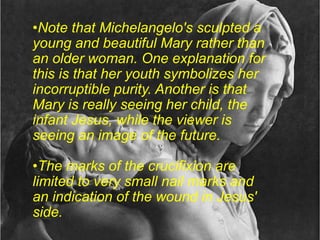
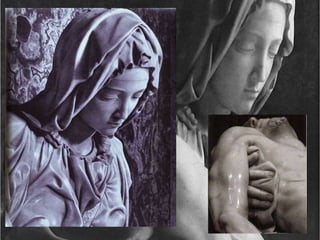
•Note that Michelangelo's sculpted a
young and beautiful Mary rather than
an older woman. One explanation for
this is that her youth symbolizes her
incorruptible purity. Another is that
Mary is really seeing her child, the
infant Jesus, while the viewer is
seeing an image of the future.
•The marks of the crucifixion are
limited to very small nail marks and
an indication of the wound in Jesus'
side.
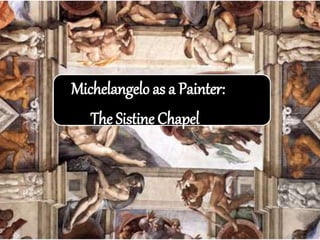
Michelangelo as a Painter:
The Sistine Chapel
The Sistine Chapel is located in the Vatican City
in Rome, attached to St. Peter’s Basilica, the papal apartments
and the vast complex of buildings that make up the Vatican
museums.
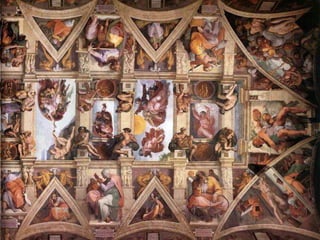
Michelangelo was commissioned by Pope Julius II to paint the
ceiling of the chapel. He resisted, as he preferred sculpture to
painting, but had to do as he was told.
The works are frescoes, (painted into fresh plaster) and they
cover about 4,000 square meters of ceiling.
Michelangelo built scaffolding so that he could work on his
back, and laboured over the frescoes from 1508 to1512.
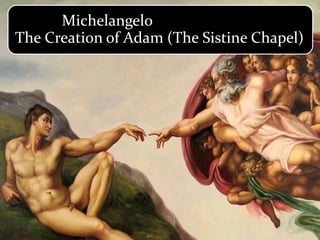
Michelangelo
The Creation of Adam (The Sistine Chapel)
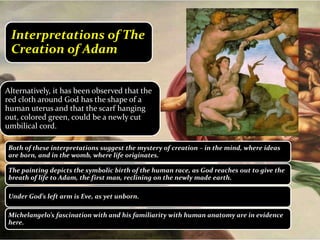
Both of these interpretations suggest the mystery of creation – in the mind, where ideas
are born, and in the womb, where life originates.
The painting depicts the symbolic birth of the human race, as God reaches out to give the
breath of life to Adam, the first man, reclining on the newly made earth.
Under God’s left arm is Eve, as yet unborn.
Michelangelo’s fascination with and his familiarity with human anatomy are in evidence
here.
Alternatively, it has been observed that the
red cloth around God has the shape of a
human uterus and that the scarf hanging
out, colored green, could be a newly cut
umbilical cord.
Interpretations of The
Creation of Adam
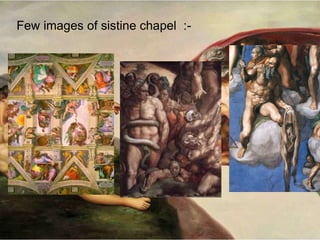
Few images of sistine chapel :-
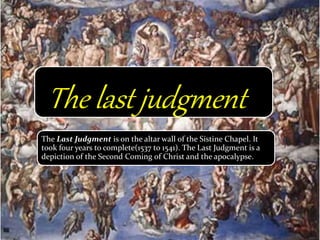
The Last Judgment is on the altar wall of the Sistine Chapel. It
took four years to complete(1537 to 1541). The Last Judgment is a
depiction of the Second Coming of Christ and the apocalypse.
The last judgment
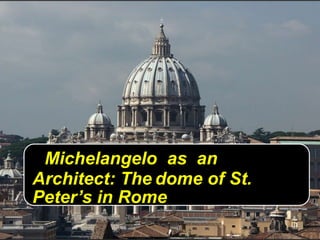
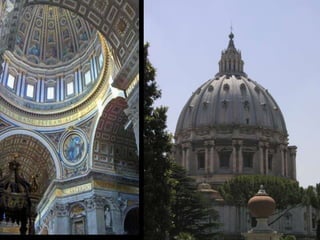
Michelangelo as an
Architect: The dome of St.
Peter’s in Rome
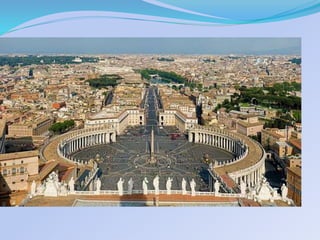
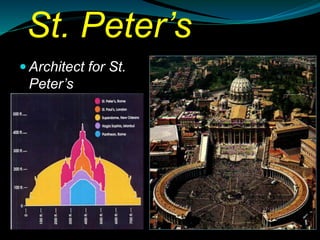
St. Peter’s
 Architect for St.
Peter’s
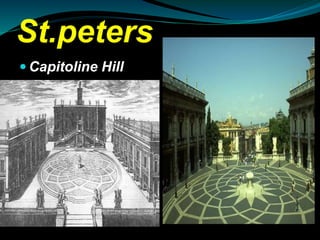
St.peters
 Capitoline Hill
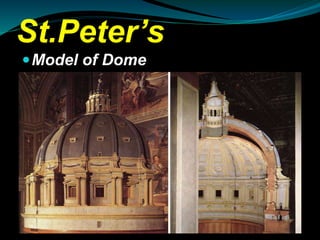
St.Peter’s
Model of Dome
high renaissance

high renaissance

  • 2.
    High Renaissance inItaly(1490s-1520s) was dominated by the works of three great artists namely :- Leonardo da Vinci Michelangelo Raphel
  • 4.
    Michelangelo was one ofthe most famous Renaissance artists: • He was a painter, sculptor, architect, & poet • His sculptures & paintings showed realism, detail of the human body, & expression to show personality & emotion
  • 5.
  • 6.
    Michelangelo’s David. This statueis perhaps the most iconic image of the Renaissance period. Michelangelo’s statue stands 17 feet high (about 3 meters)
  • 7.
    The David presentsthe best possible expression of beauty of the male figure . it shows the beautiful alignment of the hands legs limbs and all the other body parts of a male.
  • 8.
    It was sculptedbetween1501 and 1504. Michelangelo was only 26, when he complete the statue from a block of marble that had been abandoned 30 years earlier by another artist. When it was finished, David was placed in front of the entrance to the town hall. In 1873 the statue was moved from the piazza, to protect it from damage, and brought to its current location in the Academia Gallery, in Florence.
  • 9.
    •The hand thatholds the stone is larger than the other, drawing the viewer’s attention to the action that is about to unfold.
  • 11.
    This statue wascommissioned by Pope Julius II for Julius’ tomb. It was one of 40 figures that were intended to adorn the tomb in St. Peter’s Basilica. The tomb ended up in a smaller church, with only a third of the originally planned figures.
  • 13.
  • 14.
    •Pieta means ‘Pity,’and this is certainly the emotion that this magnificent sculpture evokes. • We feel pity for Christ’s suffering, but also for his grieving mother, who holds her son’s body in an attitude of quiet acceptance. •The Pieta balances the Renaissance ideals of classical beauty with naturalism. The statue is one of the most highly finished works by Michelangelo. The structure is pyramidal. The statue widens progressively down the drapery of Mary's dress, to the base. •The figures are quite out of proportion, owing to the difficulty of depicting a fully-grown man cradled full- length in a woman's lap. By concealing much of Mary's body in her monumental drapery, Michelangelo made the relationship of the figures appear quite natural.
  • 15.
    •Note that Michelangelo'ssculpted a young and beautiful Mary rather than an older woman. One explanation for this is that her youth symbolizes her incorruptible purity. Another is that Mary is really seeing her child, the infant Jesus, while the viewer is seeing an image of the future. •The marks of the crucifixion are limited to very small nail marks and an indication of the wound in Jesus' side.
  • 17.
    Michelangelo as aPainter: The Sistine Chapel
  • 18.
    The Sistine Chapelis located in the Vatican City in Rome, attached to St. Peter’s Basilica, the papal apartments and the vast complex of buildings that make up the Vatican museums. Michelangelo was commissioned by Pope Julius II to paint the ceiling of the chapel. He resisted, as he preferred sculpture to painting, but had to do as he was told. The works are frescoes, (painted into fresh plaster) and they cover about 4,000 square meters of ceiling. Michelangelo built scaffolding so that he could work on his back, and laboured over the frescoes from 1508 to1512.
  • 19.
    Michelangelo The Creation ofAdam (The Sistine Chapel)
  • 20.
    Both of theseinterpretations suggest the mystery of creation – in the mind, where ideas are born, and in the womb, where life originates. The painting depicts the symbolic birth of the human race, as God reaches out to give the breath of life to Adam, the first man, reclining on the newly made earth. Under God’s left arm is Eve, as yet unborn. Michelangelo’s fascination with and his familiarity with human anatomy are in evidence here. Alternatively, it has been observed that the red cloth around God has the shape of a human uterus and that the scarf hanging out, colored green, could be a newly cut umbilical cord. Interpretations of The Creation of Adam
  • 21.
    Few images ofsistine chapel :-
  • 22.
    The Last Judgmentis on the altar wall of the Sistine Chapel. It took four years to complete(1537 to 1541). The Last Judgment is a depiction of the Second Coming of Christ and the apocalypse. The last judgment
  • 24.
    Michelangelo as an Architect:The dome of St. Peter’s in Rome
  • 27.
    St. Peter’s  Architectfor St. Peter’s
  • 28.
  • 29.