"Father and Master of All
the Arts"
MICHELANGELO
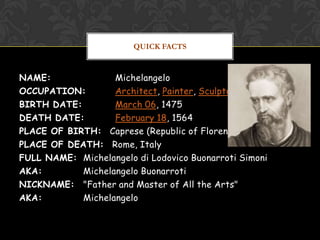
NAME: Michelangelo
OCCUPATION: Architect, Painter, Sculptor,Poet
BIRTH DATE: March 06, 1475
DEATH DATE: February 18, 1564
PLACE OF BIRTH: Caprese (Republic of Florence), Italy
PLACE OF DEATH: Rome, Italy
FULL NAME: Michelangelo di Lodovico Buonarroti Simoni
AKA: Michelangelo Buonarroti
NICKNAME: "Father and Master of All the Arts"
AKA: Michelangelo
QUICK FACTS
Michelangelo was born on March 6, 1475, in Caprese, Italy. Born to a
family of moderate means in the banking business, Michelangelo became
an apprentice to a painter before studying in the sculpture gardens of the
powerful Medici family. What followed was a remarkable career as an
artist in the Italian Renaissance, recognized in his own time for his artistic
virtuosity. His works include the "David" and "Pieta" statues and the
ceiling paintings of Rome's Sistine Chapel, including the "Last Judgment."
Although he always considered himself a Florentine, Michelangelo lived
most of his life in Rome, where he died in 1564, at age 88.
MICHELANGELO
Not long after Michelangelo's relocation to Rome in 1498, his fledgling career
was bolstered by another cardinal, Jean Bilhères de Lagraulas, a representative of
the French King Charles VIII to the pope. Michelangelo's "Pieta," a sculpture of
Mary holding the dead Jesus across her lap, was finished in less than one year, and
was erected in the church of the cardinal's tomb. At six feet wide and nearly as
tall, the statue has been moved five times since, to its present place of
prominence St. Peter's Basilica in Vatican City.
Carved from a single piece of Carrara marble, the fluidity of the fabric, positions
of the subjects, and "movement" of the skin of thePiet—meaning "pity" or
"compassion"—created awe for its early spectators. Today, the "Pieta" remains an
incredibly revered work. Michelangelo was just 25 years old at the time.
THE 'PIETA' AND THE 'DAVID'
Legend has it that he overheard pilgrims attribute the work to another
sculptor, so he boldly carved his signature in the sash across Mary's chest. It is
the only work to bear his name.
By the time Michelangelo returned to Florence, he had become something of an
art star. He took over a commission for a statue of "David," which two prior
sculptors had previously attempted and abandoned, and turned the 17-foot piece
of marble into a dominating figure. The strength of the statue's
sinews, vulnerability of its nakedness, humanity of expression and overall
courage made the "David" a prized representative of the city of Florence.
THE 'PIETA' AND THE 'DAVID'
Several commissions followed, including an ambitious project for the tomb of
Pope Julius II, but that was interrupted when he asked Michelangelo to switch
from sculpting to painting to decorate the ceiling of the Sistine Chapel.
The project fueled Michelangelo’s imagination, and the original plan for 12
apostles morphed into more than 300 figures on the ceiling of the sacred space.
(The work later had to be completely removed soon after due to an infectious
fungus in the plaster, and then recreated.) Michelangelo fired all of his
assistants, whom he deemed inept, and completed the 65-foot ceiling
alone, spending endless hours on his back and guarding the project jealously until
revealing the finished work, on October 31, 1512.
ART AND ARCHITECTURE
The resulting masterpiece is a transcendent example of High Renaissance art
incorporating the Christian symbology, prophecy and humanist principles that
Michelangelo had absorbed during his youth. The vivid vignettes of Michelangelo's
Sistine ceiling produce a kaleidoscope effect, with the most iconic image being
the "Creation of Adam, " a portrayal of God touching the finger of man. Rival
Roman painter Raphael evidently altered his style after seeing the work.
Although he continued to sculpt and paint throughout his life, the physical rigor of
painting the chapel had taken it’s toll on Michelangelo, and he soon turned his focus
toward architecture.
Michelangelo continued to work on the tomb of Julius II for the next several decades.
He also designed the Medici Chapel and the Laurentian Library—located opposite
the Basilica San Lorenzo in Florence—to house the Medici book collection. These
buildings are considered a turning point in architectural history. But Michelangelo's
crowning glory in this field came when he was made chief architect of St. Peter's
Basilica in 1546.
ART AND ARCHITECTURE
Following a brief illness, Michelangelo died on February 18, 1564—just weeks
before his 89th birthday—at his home in Macel de'Corvi, Rome. A nephew bore
his body back to Florence, where he was revered by the public as the "father and
master of all the arts," and was laid to rest at the Basilica di Santa Croce—his
chosen place of burial.
Unlike many artists, Michelangelo achieved fame and wealth during his lifetime.
He also had the peculiar distinction of living to see the publication of two
biographies about his life (written by Giorgio Vasari and Ascanio Condivi).
Appreciation of Michelangelo's artistic mastery has endured for centuries, and his
name has become synonymous with the best of the Italian Renaissance.
DEATH AND LEGACY

Michelangelo

  • 1.
    "Father and Masterof All the Arts" MICHELANGELO
  • 2.
    NAME: Michelangelo OCCUPATION: Architect,Painter, Sculptor,Poet BIRTH DATE: March 06, 1475 DEATH DATE: February 18, 1564 PLACE OF BIRTH: Caprese (Republic of Florence), Italy PLACE OF DEATH: Rome, Italy FULL NAME: Michelangelo di Lodovico Buonarroti Simoni AKA: Michelangelo Buonarroti NICKNAME: "Father and Master of All the Arts" AKA: Michelangelo QUICK FACTS
  • 3.
    Michelangelo was bornon March 6, 1475, in Caprese, Italy. Born to a family of moderate means in the banking business, Michelangelo became an apprentice to a painter before studying in the sculpture gardens of the powerful Medici family. What followed was a remarkable career as an artist in the Italian Renaissance, recognized in his own time for his artistic virtuosity. His works include the "David" and "Pieta" statues and the ceiling paintings of Rome's Sistine Chapel, including the "Last Judgment." Although he always considered himself a Florentine, Michelangelo lived most of his life in Rome, where he died in 1564, at age 88. MICHELANGELO
  • 4.
    Not long afterMichelangelo's relocation to Rome in 1498, his fledgling career was bolstered by another cardinal, Jean Bilhères de Lagraulas, a representative of the French King Charles VIII to the pope. Michelangelo's "Pieta," a sculpture of Mary holding the dead Jesus across her lap, was finished in less than one year, and was erected in the church of the cardinal's tomb. At six feet wide and nearly as tall, the statue has been moved five times since, to its present place of prominence St. Peter's Basilica in Vatican City. Carved from a single piece of Carrara marble, the fluidity of the fabric, positions of the subjects, and "movement" of the skin of thePiet—meaning "pity" or "compassion"—created awe for its early spectators. Today, the "Pieta" remains an incredibly revered work. Michelangelo was just 25 years old at the time. THE 'PIETA' AND THE 'DAVID'
  • 5.
    Legend has itthat he overheard pilgrims attribute the work to another sculptor, so he boldly carved his signature in the sash across Mary's chest. It is the only work to bear his name. By the time Michelangelo returned to Florence, he had become something of an art star. He took over a commission for a statue of "David," which two prior sculptors had previously attempted and abandoned, and turned the 17-foot piece of marble into a dominating figure. The strength of the statue's sinews, vulnerability of its nakedness, humanity of expression and overall courage made the "David" a prized representative of the city of Florence. THE 'PIETA' AND THE 'DAVID'
  • 6.
    Several commissions followed,including an ambitious project for the tomb of Pope Julius II, but that was interrupted when he asked Michelangelo to switch from sculpting to painting to decorate the ceiling of the Sistine Chapel. The project fueled Michelangelo’s imagination, and the original plan for 12 apostles morphed into more than 300 figures on the ceiling of the sacred space. (The work later had to be completely removed soon after due to an infectious fungus in the plaster, and then recreated.) Michelangelo fired all of his assistants, whom he deemed inept, and completed the 65-foot ceiling alone, spending endless hours on his back and guarding the project jealously until revealing the finished work, on October 31, 1512. ART AND ARCHITECTURE
  • 7.
    The resulting masterpieceis a transcendent example of High Renaissance art incorporating the Christian symbology, prophecy and humanist principles that Michelangelo had absorbed during his youth. The vivid vignettes of Michelangelo's Sistine ceiling produce a kaleidoscope effect, with the most iconic image being the "Creation of Adam, " a portrayal of God touching the finger of man. Rival Roman painter Raphael evidently altered his style after seeing the work. Although he continued to sculpt and paint throughout his life, the physical rigor of painting the chapel had taken it’s toll on Michelangelo, and he soon turned his focus toward architecture. Michelangelo continued to work on the tomb of Julius II for the next several decades. He also designed the Medici Chapel and the Laurentian Library—located opposite the Basilica San Lorenzo in Florence—to house the Medici book collection. These buildings are considered a turning point in architectural history. But Michelangelo's crowning glory in this field came when he was made chief architect of St. Peter's Basilica in 1546. ART AND ARCHITECTURE
  • 8.
    Following a briefillness, Michelangelo died on February 18, 1564—just weeks before his 89th birthday—at his home in Macel de'Corvi, Rome. A nephew bore his body back to Florence, where he was revered by the public as the "father and master of all the arts," and was laid to rest at the Basilica di Santa Croce—his chosen place of burial. Unlike many artists, Michelangelo achieved fame and wealth during his lifetime. He also had the peculiar distinction of living to see the publication of two biographies about his life (written by Giorgio Vasari and Ascanio Condivi). Appreciation of Michelangelo's artistic mastery has endured for centuries, and his name has become synonymous with the best of the Italian Renaissance. DEATH AND LEGACY