Dewatering Process
and Its Techniques in
Building Projects
GROUP THREE
Definition
 Dewatering is defined the process or term for the control of ground water by
pumping to lower ground water level to allow excavation to be done in a dry and
stable condition
 Also known as Construction Dewatering in Construction Sites
Causes of Surface Water on
Construction Sites
Water which accumulate in trenches on the construction sites due to
 Rain
 Washing of Plants
 Water table close to surface
 Concreting
Factors affecting the choice of dewatering methods
 The nature and permeability of the ground.
 The extent of the area to be dewatered
 The depth of the water table below ground level and the amount by which it has to
be lowered.
 The proposed methods of excavation and ground support
 The proximity of existing structures, the proximity of water courses
Dewatering Techniques
Pumping Methods
• Sump Pumping
• Shallow well pumps
• Well points
• Deep wells
Exclusion Methods
• Ground Freezing
• Sheet filling
• Slurry trench cut-off walls with bentonite
• Impervious soil barrier
• Grouted cut-offs
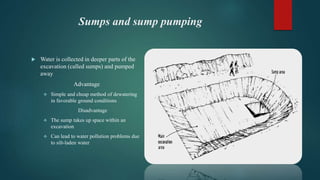
Sumps and sump pumping
 Water is collected in deeper parts of the
excavation (called sumps) and pumped
away
Advantage
 Simple and cheap method of dewatering
in favorable ground conditions
Disadvantage
 The sump takes up space within an
excavation
 Can lead to water pollution problems due
to silt-laden water
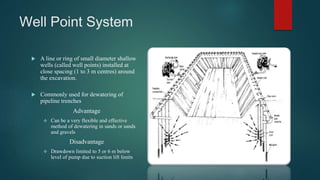
Well Point System
 A line or ring of small diameter shallow
wells (called well points) installed at
close spacing (1 to 3 m centres) around
the excavation.
 Commonly used for dewatering of
pipeline trenches
Advantage
 Can be a very flexible and effective
method of dewatering in sands or sands
and gravels
Disadvantage
 Drawdown limited to 5 or 6 m below
level of pump due to suction lift limits
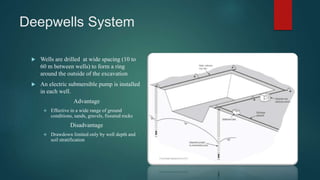
Deepwells System
 Wells are drilled at wide spacing (10 to
60 m between wells) to form a ring
around the outside of the excavation
 An electric submersible pump is installed
in each well.
Advantage
 Effective in a wide range of ground
conditions, sands, gravels, fissured rocks
Disadvantage
 Drawdown limited only by well depth and
soil stratification
Shallow Wells
 Shallow-bored wells are suitable for sandy gravels and water-bearing rocks for
depths not in excess of 5 meters and the principle upon which they operate is
similar to that of the well point system.
Advantage
 It is used to extract large quantities of water from a single hole
Disadvantage
 The limiting depth to which this method is employed is about 8 m
Ground Freezing
 Freezing process involves the circulation of a coolant through a series of pipes
inserted into the ground so as to solidify the soil water into ice creating a strong
impermeable barrier
Advantage
 The method is suitable for all types of subsoil with a moisture content in excess of 8% of the
voids
 The method will give the soil temporary extra mechanical strength
Disadvantage
 it can cause ground heave especially in clays and silts
Sheet Piling around the Excavation
 The method is used to form a barrier or cut-off wall to the flow of groundwater.
The sheet piling can be of a permanent nature, being constructed to act as a
retaining wall, or it can be a temporary enclosure to excavation works
Eductor System (Grout Injection)
 Grouts of all kinds are usually injected into the subsoil by pumping in the mixture
at high pressure through tubes adequately spaced apart depending on the type of
grout and the nature of soil
Advantages
 Effective in stabilising fine soils (silts, silty sands) by reducing pore water pressures
 Suitable when well yields are low
Disadvantages
 Drawdown generally limited to 25 to 30 m below pump level
 Some grouts are only able to reduce the permeability of the soil but will not increase the soil’s
stability
Thank you for your attention
GROUP THREE

Dewatering process and control in building projects

  • 1.
    Dewatering Process and ItsTechniques in Building Projects GROUP THREE
  • 2.
    Definition  Dewatering isdefined the process or term for the control of ground water by pumping to lower ground water level to allow excavation to be done in a dry and stable condition  Also known as Construction Dewatering in Construction Sites
  • 3.
    Causes of SurfaceWater on Construction Sites Water which accumulate in trenches on the construction sites due to  Rain  Washing of Plants  Water table close to surface  Concreting
  • 4.
    Factors affecting thechoice of dewatering methods  The nature and permeability of the ground.  The extent of the area to be dewatered  The depth of the water table below ground level and the amount by which it has to be lowered.  The proposed methods of excavation and ground support  The proximity of existing structures, the proximity of water courses
  • 5.
    Dewatering Techniques Pumping Methods •Sump Pumping • Shallow well pumps • Well points • Deep wells Exclusion Methods • Ground Freezing • Sheet filling • Slurry trench cut-off walls with bentonite • Impervious soil barrier • Grouted cut-offs
  • 6.
    Sumps and sumppumping  Water is collected in deeper parts of the excavation (called sumps) and pumped away Advantage  Simple and cheap method of dewatering in favorable ground conditions Disadvantage  The sump takes up space within an excavation  Can lead to water pollution problems due to silt-laden water
  • 7.
    Well Point System A line or ring of small diameter shallow wells (called well points) installed at close spacing (1 to 3 m centres) around the excavation.  Commonly used for dewatering of pipeline trenches Advantage  Can be a very flexible and effective method of dewatering in sands or sands and gravels Disadvantage  Drawdown limited to 5 or 6 m below level of pump due to suction lift limits
  • 8.
    Deepwells System  Wellsare drilled at wide spacing (10 to 60 m between wells) to form a ring around the outside of the excavation  An electric submersible pump is installed in each well. Advantage  Effective in a wide range of ground conditions, sands, gravels, fissured rocks Disadvantage  Drawdown limited only by well depth and soil stratification
  • 9.
    Shallow Wells  Shallow-boredwells are suitable for sandy gravels and water-bearing rocks for depths not in excess of 5 meters and the principle upon which they operate is similar to that of the well point system. Advantage  It is used to extract large quantities of water from a single hole Disadvantage  The limiting depth to which this method is employed is about 8 m
  • 10.
    Ground Freezing  Freezingprocess involves the circulation of a coolant through a series of pipes inserted into the ground so as to solidify the soil water into ice creating a strong impermeable barrier Advantage  The method is suitable for all types of subsoil with a moisture content in excess of 8% of the voids  The method will give the soil temporary extra mechanical strength Disadvantage  it can cause ground heave especially in clays and silts
  • 11.
    Sheet Piling aroundthe Excavation  The method is used to form a barrier or cut-off wall to the flow of groundwater. The sheet piling can be of a permanent nature, being constructed to act as a retaining wall, or it can be a temporary enclosure to excavation works
  • 12.
    Eductor System (GroutInjection)  Grouts of all kinds are usually injected into the subsoil by pumping in the mixture at high pressure through tubes adequately spaced apart depending on the type of grout and the nature of soil Advantages  Effective in stabilising fine soils (silts, silty sands) by reducing pore water pressures  Suitable when well yields are low Disadvantages  Drawdown generally limited to 25 to 30 m below pump level  Some grouts are only able to reduce the permeability of the soil but will not increase the soil’s stability
  • 13.
    Thank you foryour attention GROUP THREE