www.preene.com
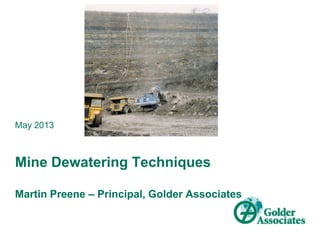
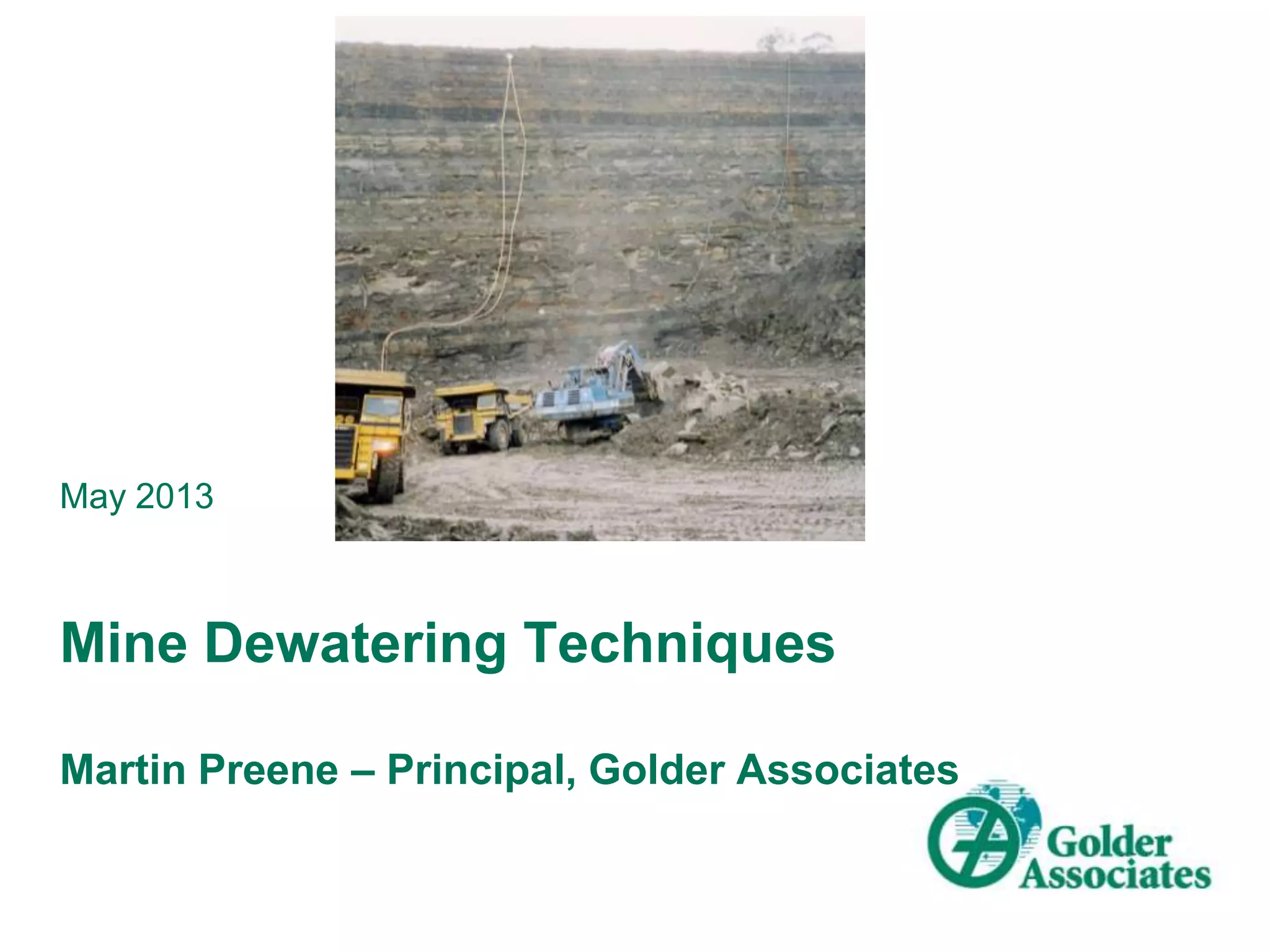
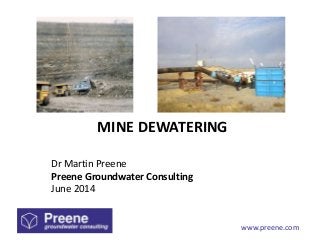
MINE DEWATERING
Dr Martin Preene
Preene Groundwater Consulting
June 2014
www.preene.com
SYNOPSIS
Synopsis
• Water management for mining
• Approaches to groundwater control
• Examples of mine dewatering technology
– Open pit
– Underground
– Shafts
www.preene.com
PRACTICE PROFILE
Preene Groundwater Consulting is the Professional Practice of
Dr Martin Preene and provides specialist advice and design
services in the fields of dewatering, groundwater engineering
and hydrogeology to clients worldwide
Dr Martin Preene has more than 25 years’ experience on
projects worldwide in the investigation, design, installation and
operation of groundwater control and dewatering systems. He is
widely published on dewatering and groundwater control and is
the author of the UK industry guidance on dewatering (CIRIA
Report C515 Groundwater Control Design and Practice) as well
as a dewatering text book (Groundwater Lowering in
Construction: A Practical Guide to Dewatering)
www.preene.com
MINE DEWATERING
There are 3 aspects to the design and implementation of mine
dewatering
An understanding of:
• Hydrogeology
• Dewatering technology
• Environmental sensitivities
www.preene.com
MINE DEWATERING
There are 3 aspects to the design and implementation of mine
dewatering
An understanding of:
• Hydrogeology
• Dewatering technology
• Environmental sensitivities
www.preene.com
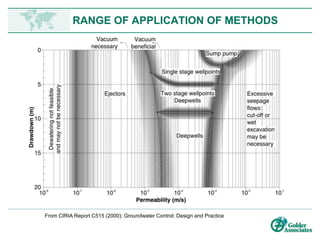
RANGE OF APPLICATION OF METHODS
From CIRIA Report C515 (2000): Groundwater Control: Design and Practice
www.preene.com
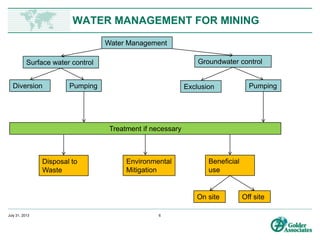
WATER MANAGEMENT FOR MINING
Water Management
Treatment if necessary
PumpingExclusion
Groundwater controlSurface water control
Diversion Pumping
Disposal to
Waste
Environmental
Mitigation
Beneficial
use
On site Off site
www.preene.com
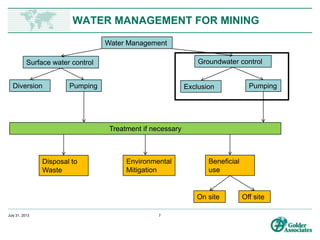
WATER MANAGEMENT FOR MINING
Water Management
Treatment if necessary
PumpingExclusion
Groundwater controlSurface water control
Diversion Pumping
Disposal to
Waste
Environmental
Mitigation
Beneficial
use
On site Off site
www.preene.com
GROUNDWATER CONTROL
Two main philosophies of groundwater control
• Exclusion: Physical cut-off walls
• Pumping: Arrays of wells or sumps (dewatering)
www.preene.com
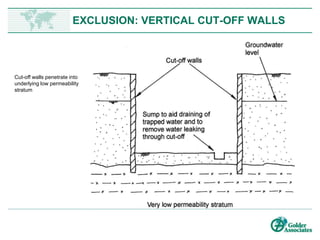
EXCLUSION: VERTICAL CUT-OFF WALLS
Cut-off walls penetrate
into underlying low
permeability stratum
www.preene.com
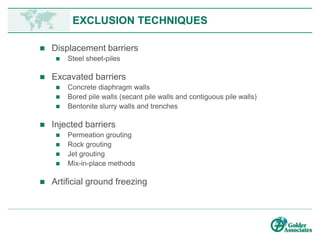
EXCLUSION TECHNIQUES
• Displacement barriers
– Steel sheet-piles
• Excavated barriers
– Concrete diaphragm walls
– Bored pile walls (secant pile walls and contiguous pile walls)
– Bentonite slurry walls and trenches
• Injected barriers
– Permeation grouting
– Rock grouting
– Jet grouting
– Mix-in-place methods
• Artificial ground freezing
www.preene.com
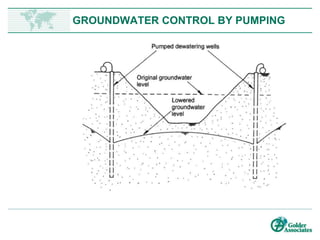
GROUNDWATER CONTROL BY PUMPING
www.preene.com
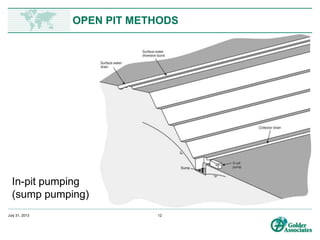
OPEN PIT METHODS
In-pit pumping
(sump pumping)
www.preene.com
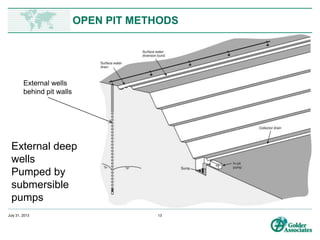
OPEN PIT METHODS
External deep wells
Pumped by
submersible pumps
External wells
behind pit
walls
www.preene.com
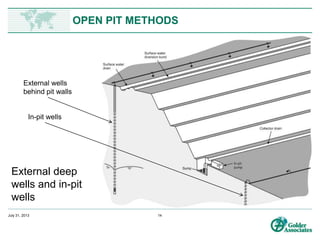
OPEN PIT METHODS
External deep wells
and in-pit wells
External wells
behind pit
walls
In-pit
wells
www.preene.com
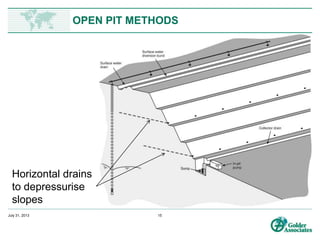
OPEN PIT METHODS
Horizontal
drains
to depressurise
slopes
www.preene.com
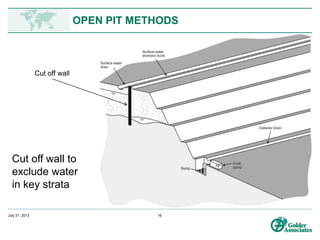
OPEN PIT METHODS
Cut off wall to
exclude water
in key strata
Cut off wall
www.preene.com
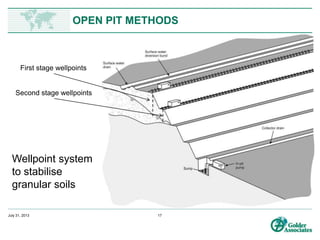
OPEN PIT METHODS
Wellpoint system
to stabilise
granular soils
First stage wellpoints
Second stage wellpoints
www.preene.com
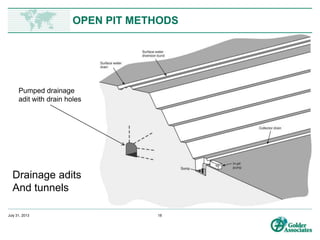
OPEN PIT METHODS
Drainage adits
And tunnels
Pumped drainage
adit with drain holes
www.preene.com
UNDERGROUND METHODS
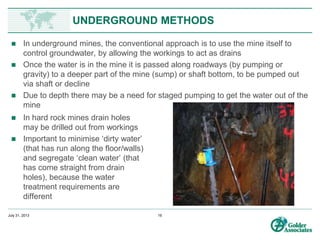
• In underground mines, the conventional approach is to use the mine itself to
control groundwater, by allowing the workings to act as drains
• Once the water is in the mine it is passed along roadways (by pumping or gravity)
to a deeper part of the mine (sump) or shaft bottom, to be pumped out via shaft
or decline
• Due to depth there may be a need for staged pumping to get the water out of the
mine
• In hard rock mines drain holes may be
drilled out from workings
• Important to minimise ‘dirty water’
(that has run along the floor/walls)
and segregate ‘clean water’ (that has
come straight from drain holes),
because the water treatment
requirements are different
www.preene.com
UNDERGROUND METHODS
• Where fractured or water bearing zones are encountered,
exclusion methods can be used to reduce water inflows.
Grouting to seal inflow pathways is the most common
approach
• Grouting may be:
– Planned or responsive
– From surface (limited depth) or from workings (interferes with mining)
• Most common type of grout is cementitious based grouts, but
problems with grouting through flowing water and may be
washed out before they set
• Specialist chemical ‘water stopping’ polyurethane grouts are
available to deal with flowing water but are expensive
www.preene.com
SHAFT SINKING METHODS
• Deep shafts for mining present particular problems:
– Depth
– Limited space and complex working sequence
– May pass through multiple aquifers
• Common to use the exclusion approach
– Cementitious grouting (cover grouting)
– Artificial ground freezing
• Rare to use external pumped wells apart from for shallow depths through
granular soils
• Even with exclusion methods there is a need to remove water from shaft
bottom
– Too deep to pump in one lift
– Water often bailed out in hoisting kibble
www.preene.com
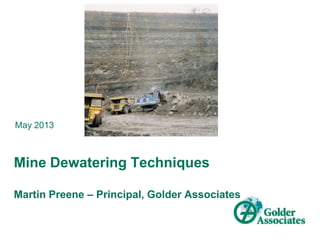
MINE DEWATERING
Dr Martin Preene
Preene Groundwater Consulting
June 2014

Mine dewatering techniques

  • 1.
    www.preene.com MINE DEWATERING Dr MartinPreene Preene Groundwater Consulting June 2014
  • 2.
    www.preene.com SYNOPSIS Synopsis • Water managementfor mining • Approaches to groundwater control • Examples of mine dewatering technology – Open pit – Underground – Shafts
  • 3.
    www.preene.com PRACTICE PROFILE Preene GroundwaterConsulting is the Professional Practice of Dr Martin Preene and provides specialist advice and design services in the fields of dewatering, groundwater engineering and hydrogeology to clients worldwide Dr Martin Preene has more than 25 years’ experience on projects worldwide in the investigation, design, installation and operation of groundwater control and dewatering systems. He is widely published on dewatering and groundwater control and is the author of the UK industry guidance on dewatering (CIRIA Report C515 Groundwater Control Design and Practice) as well as a dewatering text book (Groundwater Lowering in Construction: A Practical Guide to Dewatering)
  • 4.
    www.preene.com MINE DEWATERING There are3 aspects to the design and implementation of mine dewatering An understanding of: • Hydrogeology • Dewatering technology • Environmental sensitivities
  • 5.
    www.preene.com MINE DEWATERING There are3 aspects to the design and implementation of mine dewatering An understanding of: • Hydrogeology • Dewatering technology • Environmental sensitivities
  • 6.
    www.preene.com RANGE OF APPLICATIONOF METHODS From CIRIA Report C515 (2000): Groundwater Control: Design and Practice
  • 7.
    www.preene.com WATER MANAGEMENT FORMINING Water Management Treatment if necessary PumpingExclusion Groundwater controlSurface water control Diversion Pumping Disposal to Waste Environmental Mitigation Beneficial use On site Off site
  • 8.
    www.preene.com WATER MANAGEMENT FORMINING Water Management Treatment if necessary PumpingExclusion Groundwater controlSurface water control Diversion Pumping Disposal to Waste Environmental Mitigation Beneficial use On site Off site
  • 9.
    www.preene.com GROUNDWATER CONTROL Two mainphilosophies of groundwater control • Exclusion: Physical cut-off walls • Pumping: Arrays of wells or sumps (dewatering)
  • 10.
    www.preene.com EXCLUSION: VERTICAL CUT-OFFWALLS Cut-off walls penetrate into underlying low permeability stratum
  • 11.
    www.preene.com EXCLUSION TECHNIQUES • Displacementbarriers – Steel sheet-piles • Excavated barriers – Concrete diaphragm walls – Bored pile walls (secant pile walls and contiguous pile walls) – Bentonite slurry walls and trenches • Injected barriers – Permeation grouting – Rock grouting – Jet grouting – Mix-in-place methods • Artificial ground freezing
  • 12.
  • 13.
  • 14.
    www.preene.com OPEN PIT METHODS Externaldeep wells Pumped by submersible pumps External wells behind pit walls
  • 15.
    www.preene.com OPEN PIT METHODS Externaldeep wells and in-pit wells External wells behind pit walls In-pit wells
  • 16.
  • 17.
    www.preene.com OPEN PIT METHODS Cutoff wall to exclude water in key strata Cut off wall
  • 18.
    www.preene.com OPEN PIT METHODS Wellpointsystem to stabilise granular soils First stage wellpoints Second stage wellpoints
  • 19.
    www.preene.com OPEN PIT METHODS Drainageadits And tunnels Pumped drainage adit with drain holes
  • 20.
    www.preene.com UNDERGROUND METHODS • Inunderground mines, the conventional approach is to use the mine itself to control groundwater, by allowing the workings to act as drains • Once the water is in the mine it is passed along roadways (by pumping or gravity) to a deeper part of the mine (sump) or shaft bottom, to be pumped out via shaft or decline • Due to depth there may be a need for staged pumping to get the water out of the mine • In hard rock mines drain holes may be drilled out from workings • Important to minimise ‘dirty water’ (that has run along the floor/walls) and segregate ‘clean water’ (that has come straight from drain holes), because the water treatment requirements are different
  • 21.
    www.preene.com UNDERGROUND METHODS • Wherefractured or water bearing zones are encountered, exclusion methods can be used to reduce water inflows. Grouting to seal inflow pathways is the most common approach • Grouting may be: – Planned or responsive – From surface (limited depth) or from workings (interferes with mining) • Most common type of grout is cementitious based grouts, but problems with grouting through flowing water and may be washed out before they set • Specialist chemical ‘water stopping’ polyurethane grouts are available to deal with flowing water but are expensive
  • 22.
    www.preene.com SHAFT SINKING METHODS •Deep shafts for mining present particular problems: – Depth – Limited space and complex working sequence – May pass through multiple aquifers • Common to use the exclusion approach – Cementitious grouting (cover grouting) – Artificial ground freezing • Rare to use external pumped wells apart from for shallow depths through granular soils • Even with exclusion methods there is a need to remove water from shaft bottom – Too deep to pump in one lift – Water often bailed out in hoisting kibble
  • 23.
    www.preene.com MINE DEWATERING Dr MartinPreene Preene Groundwater Consulting June 2014