WELCOME TO
PROJECT DEWATERING LIMITED
P
roject Dewatering Limited is a leading specialist
dewatering subcontractor operating in the UK, Ireland
and across Europe, offering clients professional,
cost-effective solutions to groundwater engineering.
We have highly skilled and reliable design, estimating and operation
teams, with the technical ability needed to undertake wide scale
design, installation and maintenance of dewatering projects.
We are committed to:
•	 Providing innovative, tailor made, reliable solutions
•	 Investing in the expertise of our staff
•	 Underpinning all of our work with high quality, consistent,
transparent processes
Our particular expertise in monitoring and control systems
allows us to provide fully instrumented pumping tests,
automated treatment and remediation plants, and borehole
pumping systems for both water supply and ground-source
energy purposes. For a truly comprehensive service we combine
this with hydrogeological, geotechnical, mechanical and
electrical engineering disciplines.
For projects outside of the UK and Ireland we draw upon our
in-house capability, supported by the extensive resources of
our parent company, Hӧlscher Wasserbau GmbH, which is an
international market leading dewatering company. We benefit
from sharing best practices from across the Hӧlscher Wasserbau
group, which provides a wealth of experience in all types of
ground conditions and construction environments.
CALL US TODAY for Free initial advice 01473 658 807
DESIGN
We design cost-effective dewatering systems specific to
your site and ground conditions. We have expertise in the
following areas:
•	 Assessment of Site Investigation reports
•	 Analysis of pumping test data to estimate soil
permeability, aquifer storage and boundary conditions
•	 Design by various methods, including 2-dimensional
and 3-dimensional groundwater models to
determine flowrates, flowpath travel times,
contaminant migration risks and recharge rates
•	 Design of wells to ensure maximum yield while
eliminating pumping of fines
•	 Validation of dewatering design, using early
pumping monitoring data
•	 Calculation of theoretical settlements that may
result from dewatering
•	 Production of detailed design drawings in AutoCAD
EARLY CONTRACTOR INVOLVEMENT (ECI)
We understand that getting involved at the earliest stage
of any construction project is beneficial to all parties and
if dewatering is factored into any project at the initial
stages, substantial amounts of time and money can be
saved through careful planning and co-ordination. Early
Contractor Involvement (ECI) enables us to get a better
understanding of your requirements, and to develop
reliable and workable solutions based on solid technological
knowledge and know-how.
Early factoring of dewatering will:
•	 Provide time to determine important information
and develop innovative solutions
•	 Allow for planning and preparation, ensuring
critical construction events are factored in and
controlled
•	 Ensure the right team and expertise for the job
at hand
•	 Allow time for pumping tests or trials to be carried
out, thereby reducing risk at later stages
•	 Ensure proper measures are put in place to monitor
and manage stakeholder expectations
GROUNDWATER MODELLING
PUMPING TEST ANALYSIS
PUMPED WELL: PW1
TEST: 72 HR CONSTANT RATE TEST
FLOWRATE: 12.4 L/S
An example output of a 3D groundwater model is shown for
a dewatering system required for the construction of three
shafts, with contours displaying groundwater levels. The
model is used to predict required pumping rates, along with
both internal and remote external drawdown, calibrated with
pumping test data and then validated with monitoring data
from the system operation.
An example of pumping test data analysis for a project
involving deep chalk well dewatering, with potential for under-
drainage of the overlying Thanet Sands in the London Basin.
Chalk
Thanet Sand
0.0
0.5
1.0
1.5
2.0
2.5
3.0
3.5
4.0
4.5
5.0
1 10 100 1000
Drawdown(m)
Distance from pumped well (m)
PORTFOLIO & SECTORS
CALL US TODAY for Free initial advice 01473 658 807
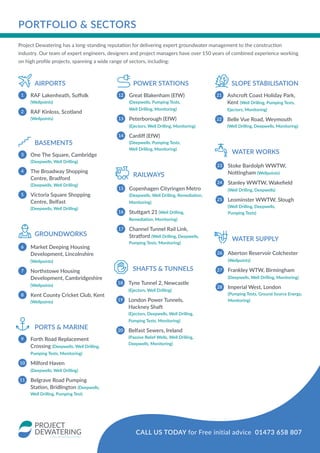
Project Dewatering has a long-standing reputation for delivering expert groundwater management to the construction
industry. Our team of expert engineers, designers and project managers have over 150 years of combined experience working
on high profile projects, spanning a wide range of sectors, including:
1 	 RAF Lakenheath, Suffolk
(Wellpoints)
2 	 RAF Kinloss, Scotland
(Wellpoints)
9 	 Forth Road Replacement
Crossing (Deepwells, Well Drilling,
Pumping Tests, Monitoring)
10 	 Milford Haven
(Deepwells, Well Drilling)
11 	 Belgrave Road Pumping
Station, Bridlington (Deepwells,
Well Drilling, Pumping Test)
18 	 Tyne Tunnel 2, Newcastle
(Ejectors, Well Drilling)
19 	 London Power Tunnels,
Hackney Shaft
(Ejectors, Deepwells, Well Drilling,
Pumping Tests, Monitoring)
20 	 Belfast Sewers, Ireland
(Passive Relief Wells, Well Drilling,
Deepwells, Monitoring)
3 	 One The Square, Cambridge
(Deepwells, Well Drilling)
4 	 The Broadway Shopping
Centre, Bradford
(Deepwells, Well Drilling)
5 	 Victoria Square Shopping
Centre, Belfast
(Deepwells, Well Drilling)
12 	 Great Blakenham (EfW)
(Deepwells, Pumping Tests,
Well Drilling, Monitoring)
13 	 Peterborough (EfW)
(Ejectors, Well Drilling, Monitoring)
14 	 Cardiff (EfW)
(Deepwells, Pumping Tests,
Well Drilling, Monitoring)
21 	 Ashcroft Coast Holiday Park,
Kent (Well Drilling, Pumping Tests,
Ejectors, Monitoring)
22 	 Belle Vue Road, Weymouth
(Well Drilling, Deepwells, Monitoring)
6 	 Market Deeping Housing
Development, Lincolnshire
(Wellpoints)
7 	 Northstowe Housing
Development, Cambridgeshire
(Wellpoints)
8 	 Kent County Cricket Club, Kent
(Wellpoints)
15 	 Copenhagen Cityringen Metro
(Deepwells, Well Drilling, Remediation,
Monitoring)
16 	 Stuttgart 21 (Well Drilling,
Remediation, Monitoring)
17 	 Channel Tunnel Rail Link,
Stratford (Well Drilling, Deepwells,
Pumping Tests, Monitoring)
23 	 Stoke Bardolph WWTW,
Nottingham (Wellpoints)
24 	 Stanley WWTW, Wakefield
(Well Drilling, Deepwells)
25 	 Leominster WWTW, Slough
(Well Drilling, Deepwells,
Pumping Tests)
26 	 Aberton Reservoir Colchester
(Wellpoints)
27 	 Frankley WTW, Birmingham
(Deepwells, Well Drilling, Monitoring)
28 	 Imperial West, London
(Pumping Tests, Ground Source Energy,
Monitoring)
AIRPORTS
PORTS & MARINE
SHAFTS & TUNNELS
BASEMENTS
POWER STATIONS SLOPE STABILISATION
GROUNDWORKS
RAILWAYS
WATER WORKS
WATER SUPPLY
15
16
1
2
3
4
5
17
6
7
8
9
10
11
12
13
14
18
19
20
21
22
23
24
25
26
27
28
D
eepwells are used for dewatering
of excavations when drawdown
is required below 6m depth and
permeability of the targeted soil is moderate
to high. In addition, deepwells may be used to
underdrain less permeable overlying strata in
certain ground conditions.
An array of deepwells is installed either
internally or externally, and may work to control
groundwater in conjunction with a physical
cut-off wall, such as a sheet-pile, secant-pile, or
diaphragm wall. Each deepwell typically consists of
a borehole, lined with a slotted screen and annular
filter pack through the target stratum. An electric
submersible pump is installed within the liner
close to the base of the well and connected to the
surface via a riser pipe. Water is then pumped into
a common header main before being discharged or
recharged back to the ground.
As water is pumped from a deepwell, a hydraulic
gradient is formed and water flows into the well,
forming a cone of depression around it, in which
there is little or no water remaining in the pore
spaces of the surrounding soil.
Deepwells are typically drilled using cable
percussive or rotary drilling methods, usually
terminating in a 300mm or 250mm bore. In
competent ground, such as chalk or sandstone,
wells may be installed with an open-hole section
as per a traditional water supply well.
ADAPTABLE
Where soil permeability is low, it is common to
seal the well and apply a vacuum to improve the
well yield and the overall drawdown of a system.
Experience shows that applying a vacuum to a
low yielding well, such as the one installed in
the Lambeth Group in London, can improve the
rate of extraction by 50%. For depths in excess
of 45-50m, vacuum deepwells are usually more
efficient than ejectors wells.
Where there is a need to minimise external of
remote drawdowns, maybe due to settlement
concerns or risk of contaminant migration, water
can be recharged back to ground using recharge
or reinjection wells. These wells are very similar
in design to a deepwell, but often recharge the
water to different strata.
DEEPWELLS
CALL US TODAY for Free initial advice 01473 658 807
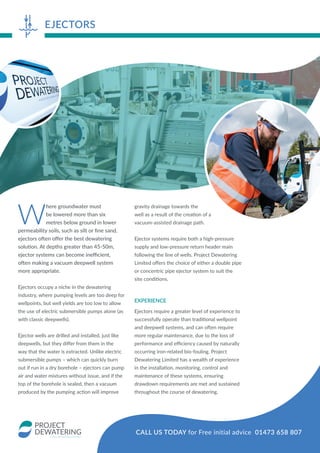
W
here groundwater must
be lowered more than six
metres below ground in lower
permeability soils, such as silt or fine sand,
ejectors often offer the best dewatering
solution. At depths greater than 45-50m,
ejector systems can become inefficient,
often making a vacuum deepwell system
more appropriate.
Ejectors occupy a niche in the dewatering
industry, where pumping levels are too deep for
wellpoints, but well yields are too low to allow
the use of electric submersible pumps alone (as
with classic deepwells).
Ejector wells are drilled and installed, just like
deepwells, but they differ from them in the
way that the water is extracted. Unlike electric
submersible pumps – which can quickly burn
out if run in a dry borehole – ejectors can pump
air and water mixtures without issue, and if the
top of the borehole is sealed, then a vacuum
produced by the pumping action will improve
gravity drainage towards the
well as a result of the creation of a
vacuum-assisted drainage path.
Ejector systems require both a high-pressure
supply and low-pressure return header main
following the line of wells. Project Dewatering
Limited offers the choice of either a double pipe
or concentric pipe ejector system to suit the
site conditions.
EXPERIENCE
Ejectors require a greater level of experience to
successfully operate than traditional wellpoint
and deepwell systems, and can often require
more regular maintenance, due to the loss of
performance and efficiency caused by naturally
occurring iron-related bio-fouling. Project
Dewatering Limited has a wealth of experience
in the installation, monitoring, control and
maintenance of these systems, ensuring
drawdown requirements are met and sustained
throughout the course of dewatering.
EJECTORS
CALL US TODAY for Free initial advice 01473 658 807
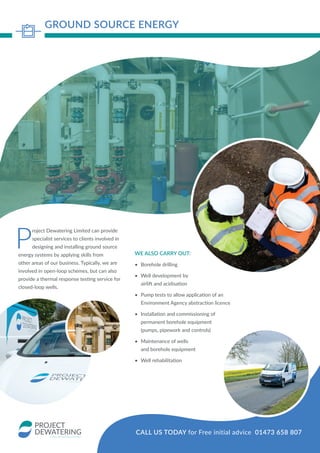
P
roject Dewatering Limited can provide
specialist services to clients involved in
designing and installing ground source
energy systems by applying skills from
other areas of our business. Typically, we are
involved in open-loop schemes, but can also
provide a thermal response testing service for
closed-loop wells.
WE ALSO CARRY OUT:
•	 Borehole drilling
•	 Well development by
airlift and acidisation
•	 Pump tests to allow application of an
Environment Agency abstraction licence
•	 Installation and commissioning of
permanent borehole equipment
(pumps, pipework and controls)
•	 Maintenance of wells
and borehole equipment
•	 Well rehabilitation
GROUND SOURCE ENERGY
CALL US TODAY for Free initial advice 01473 658 807
H
orizontal dewatering is typically
used in projects with shallow
linear configurations (railway lines,
motorways etc.) or long, narrow excavations.
Horizontal dewatering is normally carried out utilising
drainage lines from 80 to 100mm in diameterwhich
are installed around the site at depths to 6 meters
dependent on local circumstances. The trenches
for the drainage lines are excavated using trenching
machines with mounted rotary cutting chains which
create a trench approx. 30 cm wide to the desired
depth. The drainage lines are installed at the base of
the trench as the trench is excavated.
The trench is then backfilled. If the aquifer
at the site has low permeability, filter
gravel can be backfilled instead of soil at
certain depths to increase drainage capacity.
The installed drainage lines are then connected
to a vacuum piston pump which creates the
negative pressure gradient required for water
transfer. The partial vacuum achieved can range
up to 0.9 bar (13 psi).
The collected groundwater is conveyed through
the vacuum piston pump and from there to an
outlet line leading suitable discharge point.
HORIZONTAL DEWATERING
CALL US TODAY for Free initial advice 01473 658 807
Dewatering trench:
side cross-section
Dewatering trench:
front cross-section
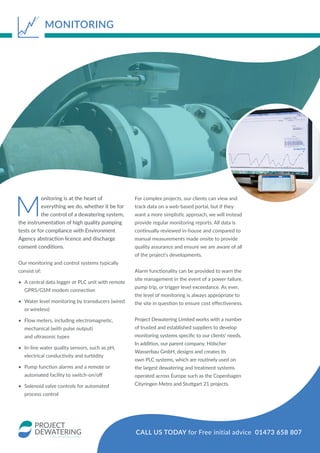
M
onitoring is at the heart of
everything we do, whether it be for
the control of a dewatering system,
the instrumentation of high quality pumping
tests or for compliance with Environment
Agency abstraction licence and discharge
consent conditions.
Our monitoring and control systems typically
consist of:
• 	A central data logger or PLC unit with remote
GPRS/GSM modem connection
• 	Water level monitoring by transducers (wired
or wireless)
• 	Flow meters, including electromagnetic,
mechanical (with pulse output)
and ultrasonic types
• 	In-line water quality sensors, such as pH,
electrical conductivity and turbidity
• 	Pump function alarms and a remote or
automated facility to switch-on/off
• 	Solenoid valve controls for automated
process control
For complex projects, our clients can view and
track data on a web-based portal, but if they
want a more simplistic approach, we will instead
provide regular monitoring reports. All data is
continually reviewed in-house and compared to
manual measurements made onsite to provide
quality assurance and ensure we are aware of all
of the project’s developments.
Alarm functionality can be provided to warn the
site management in the event of a power failure,
pump trip, or trigger level exceedance. As ever,
the level of monitoring is always appropriate to
the site in question to ensure cost effectiveness.
Project Dewatering Limited works with a number
of trusted and established suppliers to develop
monitoring systems specific to our clients’ needs.
In addition, our parent company, Hӧlscher
Wasserbau GmbH, designs and creates its
own PLC systems, which are routinely used on
the largest dewatering and treatment systems
operated across Europe such as the Copenhagen
Cityringen Metro and Stuttgart 21 projects.
MONITORING
CALL US TODAY for Free initial advice 01473 658 807
P
roject Dewatering Limited carries out
pumping tests (or aquifer tests) to
evaluate an aquifer by stimulating it
through constant pumping, and observing
the response (drawdown) in an array of
observation wells. From the results, it is
possible to determine the hydrogeological
characteristics of the ground, which can be
used for further design work.
The resulting data can be used to:
•	 Determine the hydraulic properties of an
aquifer or aquifers for both dewatering design
and water supply investigations
•	 Determine potential for under drainage,
hydraulic connectivity between layers, and
possibly indicate anisotropic permeability that
may impact cut-off wall depth design
•	 Determine spatial effects of pumping,
including distance of influence
•	 Assess the hydraulic behaviour of a
well to assist future well design optimisation
•	 Provide information on water quality and its
variability with time
We offer a comprehensive, high-quality pumping
test service, carried out to Standard
BS EN ISO 22282-4:2012. Our tests are
instrumented with water level transducers
and electromagnetic flow meters to provide
automated monitoring, with manual
measurements provided for confirmation of
data. We provide a detailed factual report as
standard, and can also offer interpretative
reports (with groundwater modelling) as part of
our in-house design service.
For dewatering projects, the cost of carrying
out an initial survey is typically far less than
that of dealing with unforeseen hydrogeological
conditions encountered once site work begins.
PUMPING TESTS
CALL US TODAY for Free initial advice 01473 658 807
T
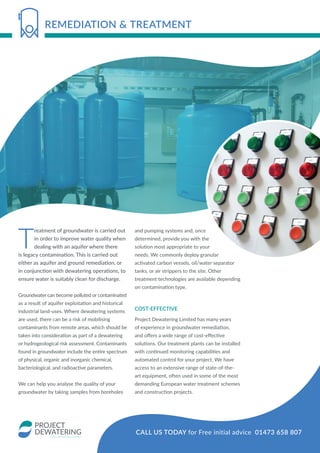
reatment of groundwater is carried out
in order to improve water quality when
dealing with an aquifer where there
is legacy contamination. This is carried out
either as aquifer and ground remediation, or
in conjunction with dewatering operations, to
ensure water is suitably clean for discharge.
Groundwater can become polluted or contaminated
as a result of aquifer exploitation and historical
industrial land-uses. Where dewatering systems
are used, there can be a risk of mobilising
contaminants from remote areas, which should be
taken into consideration as part of a dewatering
or hydrogeological risk assessment. Contaminants
found in groundwater include the entire spectrum
of physical, organic and inorganic chemical,
bacteriological, and radioactive parameters.
We can help you analyse the quality of your
groundwater by taking samples from boreholes
and pumping systems and, once
determined, provide you with the
solution most appropriate to your
needs. We commonly deploy granular
activated carbon vessels, oil/water separator
tanks, or air strippers to the site. Other
treatment technologies are available depending
on contamination type.
COST-EFFECTIVE
Project Dewatering Limited has many years
of experience in groundwater remediation,
and offers a wide range of cost-effective
solutions. Our treatment plants can be installed
with continued monitoring capabilities and
automated control for your project. We have
access to an extensive range of state-of-the-
art equipment, often used in some of the most
demanding European water treatment schemes
and construction projects.
REMEDIATION & TREATMENT
CALL US TODAY for Free initial advice 01473 658 807
P
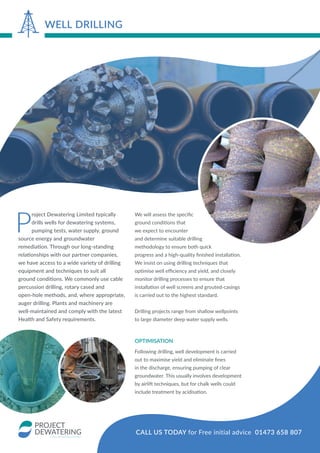
roject Dewatering Limited typically
drills wells for dewatering systems,
pumping tests, water supply, ground
source energy and groundwater
remediation. Through our long-standing
relationships with our partner companies,
we have access to a wide variety of drilling
equipment and techniques to suit all
ground conditions. We commonly use cable
percussion drilling, rotary cased and
open-hole methods, and, where appropriate,
auger drilling. Plants and machinery are
well-maintained and comply with the latest
Health and Safety requirements.
We will assess the specific
ground conditions that
we expect to encounter
and determine suitable drilling
methodology to ensure both quick
progress and a high-quality finished installation.
We insist on using drilling techniques that
optimise well efficiency and yield, and closely
monitor drilling processes to ensure that
installation of well screens and grouted-casings
is carried out to the highest standard.
Drilling projects range from shallow wellpoints
to large diameter deep water supply wells.
OPTIMISATION
Following drilling, well development is carried
out to maximise yield and eliminate fines
in the discharge, ensuring pumping of clear
groundwater. This usually involves development
by airlift techniques, but for chalk wells could
include treatment by acidisation.
WELL DRILLING
CALL US TODAY for Free initial advice 01473 658 807
W
ellpoints are small-diameter,
closely-spaced shallow wells,
which offer a highly economic and
versatile method of groundwater control, where
drawdown requirements are less than 5-6 m
depth. Wellpoints are pumped using specialist
surface vacuum pumps, and are particularly
effective in stratified and fine-graded soils,
and also have the advantage of being installed
comparatively quickly, making them ideal for
dynamic sites, such as pipeline installation, where
many metres of pipe can be laid in a single shift.
Each wellpoint consists of a small diameter riser
(typically 38 to 50 mm), with a slotted filter at
the base. Typically, they are installed around
the perimeter of an excavation, or parallel to
a pipeline trench, by either jetting, augering or
traditional drilling techniques.
As vacuum and flow is generated by a surface pump,
limiting drawdown to 5-6m depth, a second stage
ofwellpoints can be installed at a lower level for
greater depths. Commonly, wellpoints are regarded
as ‘disposable’, but steel self-jetted wellpoints can
often be retrieved after pumps are turned-off.
We offer a wide variety of wellpoint
installation methods, providing our clients
with significant advantages:
•	 Wellpoints can be installed quickly in most
ground conditions
•	 They are easy to maintain
•	 They can be used for both large and
small-scale projects
•	 Steel self-jetting wellpoints can also be
deployed, which are both re-usable and
advantageous in environments with limited
headroom
•	 Wellpoints can be installed within tunnels
and cross-passages to depressurise confined
layers encountered during construction
Where difficult ground conditions exist, such as
open gravel or overlying firm clays, wellpoints
can be installed using a small rotary drilling rig,
with either temporary casing, or traditional
and hollow-stem augers. By adopting the most
appropriate installation methodology for the
ground conditions at hand, we can ensure
optimal installation times for our clients.
WELLPOINTS
CALL US TODAY for Free initial advice 01473 658 807
MEET THE TEAM
MARC BEVAN
Managing Director
Marc is an expert in the field of dewatering and is
responsible for the development of the company’s
technical and operational capabilities, as well as the
design of dewatering systems. Marc is also responsible
for the overall management of the company’s UK
development, while working closely with parent
company, Hölscher Wasserbau.
MICHAEL CRONEY
Contracts Manager
Michael is responsible for overseeing day-to-day
company operations, allocating resources and
administering contracts. With a great combination
of hands-on experience and a sound understanding
of dewatering processes, he enjoys finding practical
solutions to any groundwater control issue.
PHILL REAY
Environmental Manager
Specialising in Environmental Management, Phill oversees
projects to ensure PDL’s environmental performance
is constantly monitored and improved. His expertise in
management system implementation and groundwater
treatment plays a key role in the continued growth of the
company’s profile within the UK dewatering market.
ALEX DEL VECCIO MBA
Business Development Manager
Alex is responsible for identifying opportunities,
raising company profile and building long-term working
relationships with clients. Alex has over 10 years’ experience
working within the Hazardous Waste and Bio Remediation
industries, where he was responsible for offering both in and
ex situ solutions to contaminated land issues for clients.
TIM ROEDER
International Division Director
Tim is an expert in all fields of Civil Engineering, with
specialist knowledge of dewatering. Appointed Director
of the International Division of Hölscher Wasserbau in
2008, he oversees the operational aspects of Hölscher
Wasserbau’s international growth and ensures that the
additional expertise available to Project Dewatering is
widely accessible to its UK client base.
CARL GAWTRY
Operations Manager
Carl reports directly to Dr Marc Bevan, and works
alongside the Project Delivery team. With over two
decades of experience in drilling procedures and operations
management, his main tasks are managing collaborative well
drilling projects in partnership with Hölscher Wasserbau and
finding innovative solutions to introduce to the UK market.
WHAT OUR CLIENTS HAVE TO SAY...
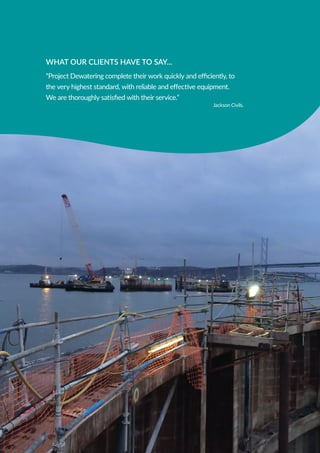
“Project Dewatering complete their work quickly and efficiently, to
the very highest standard, with reliable and effective equipment.
We are thoroughly satisfied with their service.”
Jackson Civils.
Unit 3, The Old Wireless Station, Great Bricett, Ipswich, Suffolk, IP7 7DS
REGISTERED COMPANY NO. 03809255
01473 658 807 • enquiries@project-dewatering.co.uk
www.project-dewatering.co.uk

Project Dewatering Ltd 2016

  • 2.
    WELCOME TO PROJECT DEWATERINGLIMITED P roject Dewatering Limited is a leading specialist dewatering subcontractor operating in the UK, Ireland and across Europe, offering clients professional, cost-effective solutions to groundwater engineering. We have highly skilled and reliable design, estimating and operation teams, with the technical ability needed to undertake wide scale design, installation and maintenance of dewatering projects. We are committed to: • Providing innovative, tailor made, reliable solutions • Investing in the expertise of our staff • Underpinning all of our work with high quality, consistent, transparent processes Our particular expertise in monitoring and control systems allows us to provide fully instrumented pumping tests, automated treatment and remediation plants, and borehole pumping systems for both water supply and ground-source energy purposes. For a truly comprehensive service we combine this with hydrogeological, geotechnical, mechanical and electrical engineering disciplines. For projects outside of the UK and Ireland we draw upon our in-house capability, supported by the extensive resources of our parent company, Hӧlscher Wasserbau GmbH, which is an international market leading dewatering company. We benefit from sharing best practices from across the Hӧlscher Wasserbau group, which provides a wealth of experience in all types of ground conditions and construction environments.
  • 3.
    CALL US TODAYfor Free initial advice 01473 658 807 DESIGN We design cost-effective dewatering systems specific to your site and ground conditions. We have expertise in the following areas: • Assessment of Site Investigation reports • Analysis of pumping test data to estimate soil permeability, aquifer storage and boundary conditions • Design by various methods, including 2-dimensional and 3-dimensional groundwater models to determine flowrates, flowpath travel times, contaminant migration risks and recharge rates • Design of wells to ensure maximum yield while eliminating pumping of fines • Validation of dewatering design, using early pumping monitoring data • Calculation of theoretical settlements that may result from dewatering • Production of detailed design drawings in AutoCAD EARLY CONTRACTOR INVOLVEMENT (ECI) We understand that getting involved at the earliest stage of any construction project is beneficial to all parties and if dewatering is factored into any project at the initial stages, substantial amounts of time and money can be saved through careful planning and co-ordination. Early Contractor Involvement (ECI) enables us to get a better understanding of your requirements, and to develop reliable and workable solutions based on solid technological knowledge and know-how. Early factoring of dewatering will: • Provide time to determine important information and develop innovative solutions • Allow for planning and preparation, ensuring critical construction events are factored in and controlled • Ensure the right team and expertise for the job at hand • Allow time for pumping tests or trials to be carried out, thereby reducing risk at later stages • Ensure proper measures are put in place to monitor and manage stakeholder expectations GROUNDWATER MODELLING PUMPING TEST ANALYSIS PUMPED WELL: PW1 TEST: 72 HR CONSTANT RATE TEST FLOWRATE: 12.4 L/S An example output of a 3D groundwater model is shown for a dewatering system required for the construction of three shafts, with contours displaying groundwater levels. The model is used to predict required pumping rates, along with both internal and remote external drawdown, calibrated with pumping test data and then validated with monitoring data from the system operation. An example of pumping test data analysis for a project involving deep chalk well dewatering, with potential for under- drainage of the overlying Thanet Sands in the London Basin. Chalk Thanet Sand 0.0 0.5 1.0 1.5 2.0 2.5 3.0 3.5 4.0 4.5 5.0 1 10 100 1000 Drawdown(m) Distance from pumped well (m)
  • 4.
    PORTFOLIO & SECTORS CALLUS TODAY for Free initial advice 01473 658 807 Project Dewatering has a long-standing reputation for delivering expert groundwater management to the construction industry. Our team of expert engineers, designers and project managers have over 150 years of combined experience working on high profile projects, spanning a wide range of sectors, including: 1 RAF Lakenheath, Suffolk (Wellpoints) 2 RAF Kinloss, Scotland (Wellpoints) 9 Forth Road Replacement Crossing (Deepwells, Well Drilling, Pumping Tests, Monitoring) 10 Milford Haven (Deepwells, Well Drilling) 11 Belgrave Road Pumping Station, Bridlington (Deepwells, Well Drilling, Pumping Test) 18 Tyne Tunnel 2, Newcastle (Ejectors, Well Drilling) 19 London Power Tunnels, Hackney Shaft (Ejectors, Deepwells, Well Drilling, Pumping Tests, Monitoring) 20 Belfast Sewers, Ireland (Passive Relief Wells, Well Drilling, Deepwells, Monitoring) 3 One The Square, Cambridge (Deepwells, Well Drilling) 4 The Broadway Shopping Centre, Bradford (Deepwells, Well Drilling) 5 Victoria Square Shopping Centre, Belfast (Deepwells, Well Drilling) 12 Great Blakenham (EfW) (Deepwells, Pumping Tests, Well Drilling, Monitoring) 13 Peterborough (EfW) (Ejectors, Well Drilling, Monitoring) 14 Cardiff (EfW) (Deepwells, Pumping Tests, Well Drilling, Monitoring) 21 Ashcroft Coast Holiday Park, Kent (Well Drilling, Pumping Tests, Ejectors, Monitoring) 22 Belle Vue Road, Weymouth (Well Drilling, Deepwells, Monitoring) 6 Market Deeping Housing Development, Lincolnshire (Wellpoints) 7 Northstowe Housing Development, Cambridgeshire (Wellpoints) 8 Kent County Cricket Club, Kent (Wellpoints) 15 Copenhagen Cityringen Metro (Deepwells, Well Drilling, Remediation, Monitoring) 16 Stuttgart 21 (Well Drilling, Remediation, Monitoring) 17 Channel Tunnel Rail Link, Stratford (Well Drilling, Deepwells, Pumping Tests, Monitoring) 23 Stoke Bardolph WWTW, Nottingham (Wellpoints) 24 Stanley WWTW, Wakefield (Well Drilling, Deepwells) 25 Leominster WWTW, Slough (Well Drilling, Deepwells, Pumping Tests) 26 Aberton Reservoir Colchester (Wellpoints) 27 Frankley WTW, Birmingham (Deepwells, Well Drilling, Monitoring) 28 Imperial West, London (Pumping Tests, Ground Source Energy, Monitoring) AIRPORTS PORTS & MARINE SHAFTS & TUNNELS BASEMENTS POWER STATIONS SLOPE STABILISATION GROUNDWORKS RAILWAYS WATER WORKS WATER SUPPLY
  • 5.
  • 6.
    D eepwells are usedfor dewatering of excavations when drawdown is required below 6m depth and permeability of the targeted soil is moderate to high. In addition, deepwells may be used to underdrain less permeable overlying strata in certain ground conditions. An array of deepwells is installed either internally or externally, and may work to control groundwater in conjunction with a physical cut-off wall, such as a sheet-pile, secant-pile, or diaphragm wall. Each deepwell typically consists of a borehole, lined with a slotted screen and annular filter pack through the target stratum. An electric submersible pump is installed within the liner close to the base of the well and connected to the surface via a riser pipe. Water is then pumped into a common header main before being discharged or recharged back to the ground. As water is pumped from a deepwell, a hydraulic gradient is formed and water flows into the well, forming a cone of depression around it, in which there is little or no water remaining in the pore spaces of the surrounding soil. Deepwells are typically drilled using cable percussive or rotary drilling methods, usually terminating in a 300mm or 250mm bore. In competent ground, such as chalk or sandstone, wells may be installed with an open-hole section as per a traditional water supply well. ADAPTABLE Where soil permeability is low, it is common to seal the well and apply a vacuum to improve the well yield and the overall drawdown of a system. Experience shows that applying a vacuum to a low yielding well, such as the one installed in the Lambeth Group in London, can improve the rate of extraction by 50%. For depths in excess of 45-50m, vacuum deepwells are usually more efficient than ejectors wells. Where there is a need to minimise external of remote drawdowns, maybe due to settlement concerns or risk of contaminant migration, water can be recharged back to ground using recharge or reinjection wells. These wells are very similar in design to a deepwell, but often recharge the water to different strata. DEEPWELLS CALL US TODAY for Free initial advice 01473 658 807
  • 7.
    W here groundwater must belowered more than six metres below ground in lower permeability soils, such as silt or fine sand, ejectors often offer the best dewatering solution. At depths greater than 45-50m, ejector systems can become inefficient, often making a vacuum deepwell system more appropriate. Ejectors occupy a niche in the dewatering industry, where pumping levels are too deep for wellpoints, but well yields are too low to allow the use of electric submersible pumps alone (as with classic deepwells). Ejector wells are drilled and installed, just like deepwells, but they differ from them in the way that the water is extracted. Unlike electric submersible pumps – which can quickly burn out if run in a dry borehole – ejectors can pump air and water mixtures without issue, and if the top of the borehole is sealed, then a vacuum produced by the pumping action will improve gravity drainage towards the well as a result of the creation of a vacuum-assisted drainage path. Ejector systems require both a high-pressure supply and low-pressure return header main following the line of wells. Project Dewatering Limited offers the choice of either a double pipe or concentric pipe ejector system to suit the site conditions. EXPERIENCE Ejectors require a greater level of experience to successfully operate than traditional wellpoint and deepwell systems, and can often require more regular maintenance, due to the loss of performance and efficiency caused by naturally occurring iron-related bio-fouling. Project Dewatering Limited has a wealth of experience in the installation, monitoring, control and maintenance of these systems, ensuring drawdown requirements are met and sustained throughout the course of dewatering. EJECTORS CALL US TODAY for Free initial advice 01473 658 807
  • 8.
    P roject Dewatering Limitedcan provide specialist services to clients involved in designing and installing ground source energy systems by applying skills from other areas of our business. Typically, we are involved in open-loop schemes, but can also provide a thermal response testing service for closed-loop wells. WE ALSO CARRY OUT: • Borehole drilling • Well development by airlift and acidisation • Pump tests to allow application of an Environment Agency abstraction licence • Installation and commissioning of permanent borehole equipment (pumps, pipework and controls) • Maintenance of wells and borehole equipment • Well rehabilitation GROUND SOURCE ENERGY CALL US TODAY for Free initial advice 01473 658 807
  • 9.
    H orizontal dewatering istypically used in projects with shallow linear configurations (railway lines, motorways etc.) or long, narrow excavations. Horizontal dewatering is normally carried out utilising drainage lines from 80 to 100mm in diameterwhich are installed around the site at depths to 6 meters dependent on local circumstances. The trenches for the drainage lines are excavated using trenching machines with mounted rotary cutting chains which create a trench approx. 30 cm wide to the desired depth. The drainage lines are installed at the base of the trench as the trench is excavated. The trench is then backfilled. If the aquifer at the site has low permeability, filter gravel can be backfilled instead of soil at certain depths to increase drainage capacity. The installed drainage lines are then connected to a vacuum piston pump which creates the negative pressure gradient required for water transfer. The partial vacuum achieved can range up to 0.9 bar (13 psi). The collected groundwater is conveyed through the vacuum piston pump and from there to an outlet line leading suitable discharge point. HORIZONTAL DEWATERING CALL US TODAY for Free initial advice 01473 658 807 Dewatering trench: side cross-section Dewatering trench: front cross-section
  • 10.
    M onitoring is atthe heart of everything we do, whether it be for the control of a dewatering system, the instrumentation of high quality pumping tests or for compliance with Environment Agency abstraction licence and discharge consent conditions. Our monitoring and control systems typically consist of: • A central data logger or PLC unit with remote GPRS/GSM modem connection • Water level monitoring by transducers (wired or wireless) • Flow meters, including electromagnetic, mechanical (with pulse output) and ultrasonic types • In-line water quality sensors, such as pH, electrical conductivity and turbidity • Pump function alarms and a remote or automated facility to switch-on/off • Solenoid valve controls for automated process control For complex projects, our clients can view and track data on a web-based portal, but if they want a more simplistic approach, we will instead provide regular monitoring reports. All data is continually reviewed in-house and compared to manual measurements made onsite to provide quality assurance and ensure we are aware of all of the project’s developments. Alarm functionality can be provided to warn the site management in the event of a power failure, pump trip, or trigger level exceedance. As ever, the level of monitoring is always appropriate to the site in question to ensure cost effectiveness. Project Dewatering Limited works with a number of trusted and established suppliers to develop monitoring systems specific to our clients’ needs. In addition, our parent company, Hӧlscher Wasserbau GmbH, designs and creates its own PLC systems, which are routinely used on the largest dewatering and treatment systems operated across Europe such as the Copenhagen Cityringen Metro and Stuttgart 21 projects. MONITORING CALL US TODAY for Free initial advice 01473 658 807
  • 11.
    P roject Dewatering Limitedcarries out pumping tests (or aquifer tests) to evaluate an aquifer by stimulating it through constant pumping, and observing the response (drawdown) in an array of observation wells. From the results, it is possible to determine the hydrogeological characteristics of the ground, which can be used for further design work. The resulting data can be used to: • Determine the hydraulic properties of an aquifer or aquifers for both dewatering design and water supply investigations • Determine potential for under drainage, hydraulic connectivity between layers, and possibly indicate anisotropic permeability that may impact cut-off wall depth design • Determine spatial effects of pumping, including distance of influence • Assess the hydraulic behaviour of a well to assist future well design optimisation • Provide information on water quality and its variability with time We offer a comprehensive, high-quality pumping test service, carried out to Standard BS EN ISO 22282-4:2012. Our tests are instrumented with water level transducers and electromagnetic flow meters to provide automated monitoring, with manual measurements provided for confirmation of data. We provide a detailed factual report as standard, and can also offer interpretative reports (with groundwater modelling) as part of our in-house design service. For dewatering projects, the cost of carrying out an initial survey is typically far less than that of dealing with unforeseen hydrogeological conditions encountered once site work begins. PUMPING TESTS CALL US TODAY for Free initial advice 01473 658 807
  • 12.
    T reatment of groundwateris carried out in order to improve water quality when dealing with an aquifer where there is legacy contamination. This is carried out either as aquifer and ground remediation, or in conjunction with dewatering operations, to ensure water is suitably clean for discharge. Groundwater can become polluted or contaminated as a result of aquifer exploitation and historical industrial land-uses. Where dewatering systems are used, there can be a risk of mobilising contaminants from remote areas, which should be taken into consideration as part of a dewatering or hydrogeological risk assessment. Contaminants found in groundwater include the entire spectrum of physical, organic and inorganic chemical, bacteriological, and radioactive parameters. We can help you analyse the quality of your groundwater by taking samples from boreholes and pumping systems and, once determined, provide you with the solution most appropriate to your needs. We commonly deploy granular activated carbon vessels, oil/water separator tanks, or air strippers to the site. Other treatment technologies are available depending on contamination type. COST-EFFECTIVE Project Dewatering Limited has many years of experience in groundwater remediation, and offers a wide range of cost-effective solutions. Our treatment plants can be installed with continued monitoring capabilities and automated control for your project. We have access to an extensive range of state-of-the- art equipment, often used in some of the most demanding European water treatment schemes and construction projects. REMEDIATION & TREATMENT CALL US TODAY for Free initial advice 01473 658 807
  • 13.
    P roject Dewatering Limitedtypically drills wells for dewatering systems, pumping tests, water supply, ground source energy and groundwater remediation. Through our long-standing relationships with our partner companies, we have access to a wide variety of drilling equipment and techniques to suit all ground conditions. We commonly use cable percussion drilling, rotary cased and open-hole methods, and, where appropriate, auger drilling. Plants and machinery are well-maintained and comply with the latest Health and Safety requirements. We will assess the specific ground conditions that we expect to encounter and determine suitable drilling methodology to ensure both quick progress and a high-quality finished installation. We insist on using drilling techniques that optimise well efficiency and yield, and closely monitor drilling processes to ensure that installation of well screens and grouted-casings is carried out to the highest standard. Drilling projects range from shallow wellpoints to large diameter deep water supply wells. OPTIMISATION Following drilling, well development is carried out to maximise yield and eliminate fines in the discharge, ensuring pumping of clear groundwater. This usually involves development by airlift techniques, but for chalk wells could include treatment by acidisation. WELL DRILLING CALL US TODAY for Free initial advice 01473 658 807
  • 14.
    W ellpoints are small-diameter, closely-spacedshallow wells, which offer a highly economic and versatile method of groundwater control, where drawdown requirements are less than 5-6 m depth. Wellpoints are pumped using specialist surface vacuum pumps, and are particularly effective in stratified and fine-graded soils, and also have the advantage of being installed comparatively quickly, making them ideal for dynamic sites, such as pipeline installation, where many metres of pipe can be laid in a single shift. Each wellpoint consists of a small diameter riser (typically 38 to 50 mm), with a slotted filter at the base. Typically, they are installed around the perimeter of an excavation, or parallel to a pipeline trench, by either jetting, augering or traditional drilling techniques. As vacuum and flow is generated by a surface pump, limiting drawdown to 5-6m depth, a second stage ofwellpoints can be installed at a lower level for greater depths. Commonly, wellpoints are regarded as ‘disposable’, but steel self-jetted wellpoints can often be retrieved after pumps are turned-off. We offer a wide variety of wellpoint installation methods, providing our clients with significant advantages: • Wellpoints can be installed quickly in most ground conditions • They are easy to maintain • They can be used for both large and small-scale projects • Steel self-jetting wellpoints can also be deployed, which are both re-usable and advantageous in environments with limited headroom • Wellpoints can be installed within tunnels and cross-passages to depressurise confined layers encountered during construction Where difficult ground conditions exist, such as open gravel or overlying firm clays, wellpoints can be installed using a small rotary drilling rig, with either temporary casing, or traditional and hollow-stem augers. By adopting the most appropriate installation methodology for the ground conditions at hand, we can ensure optimal installation times for our clients. WELLPOINTS CALL US TODAY for Free initial advice 01473 658 807
  • 15.
    MEET THE TEAM MARCBEVAN Managing Director Marc is an expert in the field of dewatering and is responsible for the development of the company’s technical and operational capabilities, as well as the design of dewatering systems. Marc is also responsible for the overall management of the company’s UK development, while working closely with parent company, Hölscher Wasserbau. MICHAEL CRONEY Contracts Manager Michael is responsible for overseeing day-to-day company operations, allocating resources and administering contracts. With a great combination of hands-on experience and a sound understanding of dewatering processes, he enjoys finding practical solutions to any groundwater control issue. PHILL REAY Environmental Manager Specialising in Environmental Management, Phill oversees projects to ensure PDL’s environmental performance is constantly monitored and improved. His expertise in management system implementation and groundwater treatment plays a key role in the continued growth of the company’s profile within the UK dewatering market. ALEX DEL VECCIO MBA Business Development Manager Alex is responsible for identifying opportunities, raising company profile and building long-term working relationships with clients. Alex has over 10 years’ experience working within the Hazardous Waste and Bio Remediation industries, where he was responsible for offering both in and ex situ solutions to contaminated land issues for clients. TIM ROEDER International Division Director Tim is an expert in all fields of Civil Engineering, with specialist knowledge of dewatering. Appointed Director of the International Division of Hölscher Wasserbau in 2008, he oversees the operational aspects of Hölscher Wasserbau’s international growth and ensures that the additional expertise available to Project Dewatering is widely accessible to its UK client base. CARL GAWTRY Operations Manager Carl reports directly to Dr Marc Bevan, and works alongside the Project Delivery team. With over two decades of experience in drilling procedures and operations management, his main tasks are managing collaborative well drilling projects in partnership with Hölscher Wasserbau and finding innovative solutions to introduce to the UK market.
  • 16.
    WHAT OUR CLIENTSHAVE TO SAY... “Project Dewatering complete their work quickly and efficiently, to the very highest standard, with reliable and effective equipment. We are thoroughly satisfied with their service.” Jackson Civils.
  • 17.
    Unit 3, TheOld Wireless Station, Great Bricett, Ipswich, Suffolk, IP7 7DS REGISTERED COMPANY NO. 03809255 01473 658 807 • enquiries@project-dewatering.co.uk www.project-dewatering.co.uk