PRESENTED BY : RAVIKIRAN KATTOLI
 Cement concrete is an inherently porous material and as
such, it has a low tensile strength.
 It exhibits a tendency to cracks and can deteriorate under the
influence of severe chemicals in the atmosphere or in
Solution.
 Concrete polymer materials have been developed during the
last fifteen years in a number of laboratories around the
world.
 For applications as a constructional material offering the
potential advantages of a higher strength, water tightness,
and improved durability and resistance to freeze-thaw cycles
over normal portland cement concrete.
 The production of polymer-concrete composites involves the
introduction of chemicals within the pores of the concrete
and their polymerization.
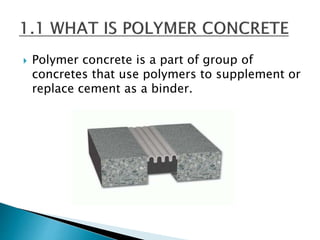
 Polymer concrete is a part of group of
concretes that use polymers to supplement or
replace cement as a binder.
The composites using polymer can be:
 1. Polymer concrete (PC), when the binder is a
polymer that replaces the cement paste
 2. Polymer modified concrete (PMC), when the
polymer is mixed along with cement
 3. Polymer impregnated concrete (PIC), when the
cement concrete is treated by soaking and
polymerization.
 4. Partially Impregnated And Surface coated
polymer concrete.
 Polymer concrete is a composite material which results
from polymerization of a monomer and aggregate
mixture. The polymerized monomer acts as binder for
the aggregates and the resulting composite is called
“Polymer Concrete.”
 Two techniques are used to mix monomer with aggregate.
 The first is the conventional method of adding monomer to
dry aggregate and stirring until a uniform blend is achieved.
 The second technique consists of placing the monomer in the
specimen mould and then gradually adding aggregate to the
monomer. The mixture is Consolidated by mechnical
Vibration.
 Rapid curing at ambient temperatures
 Good long-term durability with respect to freeze and
thaw cycles
 Low permeability to water and aggressive solutions
 Good resistance against corrosion
DISADVANTAGES
It tends to be brittle in nature i.e. if fiber
reinforcement is not provided in some polymer
concrete cases they tend to develop cracks.
Among the disadvantages is their high cost.
 It is also known as polymer cement concrete
 Polymer modified concrete is gaining
popularity because of its ease of handling,
economy and satisfactory results
 Low water absorption and permeability make
it an effective material for use in hydraulic
structures as well.
 It has the property of setting quickly.
 The most impressive characteristics of PMC
are its ability to bond strongly with old
concrete, and to resist the entry of water and
aggressive solutions.
 Epoxy resin produced a concrete that showed
some superior charecteristics over ordinary
Portland cement.
DISADVANTAGE
Modest improvement of strength and durability
 Polymer-Impregnated Concrete (PIC) is generally, a
precast and hydrated portland cement concrete, which
has been cleaned, dried (eventually evacuated) and
impregnated with a low viscosity monomer (eventually
soaked under pressure) before being polymerized.
 The most appreciable improvements in the structural
and durability properties have been obtained with PIC.
 The unique feature of impregnating concrete is that a
large part of the voids volume in the capillary pores is
filled with the polymer and forms a continuous internal
reinforcing structure which is thus responsible for the
remarkable improvement in strength and durability.
 The mechanical and chemical resistant properties of PIC
composites are superior to the conventional cement
mortar.
 Porosity of the conventional cement mortar is greatly
reduced when it is impregnated with polymers thereby
increasing its durability.
 The presence of the polymer in a PIC not only
envelopes the cement mortar but also seals the voids
formed during the cement hydration.
 Compressive strength increases and is different for
different composition and on type of polymers used.
 Tensile strength increases and is different for different
composition and on type of polymers used.
 The partially impregnated concrete can be easily
produced by initially soaking the dried specimens
in the liquid monomer ,then sealing them by
keeping them under hot water at 70°c to prevent or
minimize loss due to evaporation.
 Partial impregnation may be sufficient in situations
where the major requirement is surface resistance
against chemical and mechanical attack in addition
to increase in its strength.
 The depth of monomer penetration depends upon
Pore structure
Duration of soaking
Viscosity of the monomer
 It reduces freeze thaw deterioration,
corrosion
 Increase in tensile strength
 Increase in compressive strength
 Increase in modulus of elasticity
 Resistance to acid attack
 It improves the durability of concrete
 Less pores
 structural floors
 swimming pools
 Pipes
 storage tanks for distilled water
 anti-abrasive surface
 marine structures
 tunnel liners
 telephone cable ducts
 Curing time studies on polymer concrete have
established that it achieves around 70% of its
strength after a curing of one day at room
temperature.
 Durability studies on polymer concrete have
established its superiority over conventional
cement concrete.
 Exposure to water, chemical agents etc. has very
less deleterious effect on properties of polymer
concrete when compared to cement concrete.
 Polymers in Concrete, American Concrete Institute
Publications SP-40, Detroit, Michigan 1973, SP-58, Detroit,
1978 2. Concrete-Polymer Materials, Five Topical Reports,
Brookhaven National Loboratory and USSR 1968-1973
 State-of-the-Art Report, Polymers in Concrete, ACI
Committee, 548 Report, American Concrete Institute, Detroit,
Michigan, 1977
 PATUROEV, V.V., Technology of Polymer Concretes, Stroyzdat
Press, USSR, 1977
 P.K. Mehta And P.J.M. Monteiro, Concrete: Microstructure,
Properties, And Materials
 Concrete Technology By M.S.Shetty

Polymer concrete

  • 1.
    PRESENTED BY :RAVIKIRAN KATTOLI
  • 2.
     Cement concreteis an inherently porous material and as such, it has a low tensile strength.  It exhibits a tendency to cracks and can deteriorate under the influence of severe chemicals in the atmosphere or in Solution.  Concrete polymer materials have been developed during the last fifteen years in a number of laboratories around the world.  For applications as a constructional material offering the potential advantages of a higher strength, water tightness, and improved durability and resistance to freeze-thaw cycles over normal portland cement concrete.  The production of polymer-concrete composites involves the introduction of chemicals within the pores of the concrete and their polymerization.
  • 3.
     Polymer concreteis a part of group of concretes that use polymers to supplement or replace cement as a binder.
  • 4.
    The composites usingpolymer can be:  1. Polymer concrete (PC), when the binder is a polymer that replaces the cement paste  2. Polymer modified concrete (PMC), when the polymer is mixed along with cement  3. Polymer impregnated concrete (PIC), when the cement concrete is treated by soaking and polymerization.  4. Partially Impregnated And Surface coated polymer concrete.
  • 5.
     Polymer concreteis a composite material which results from polymerization of a monomer and aggregate mixture. The polymerized monomer acts as binder for the aggregates and the resulting composite is called “Polymer Concrete.”  Two techniques are used to mix monomer with aggregate.  The first is the conventional method of adding monomer to dry aggregate and stirring until a uniform blend is achieved.  The second technique consists of placing the monomer in the specimen mould and then gradually adding aggregate to the monomer. The mixture is Consolidated by mechnical Vibration.
  • 6.
     Rapid curingat ambient temperatures  Good long-term durability with respect to freeze and thaw cycles  Low permeability to water and aggressive solutions  Good resistance against corrosion DISADVANTAGES It tends to be brittle in nature i.e. if fiber reinforcement is not provided in some polymer concrete cases they tend to develop cracks. Among the disadvantages is their high cost.
  • 7.
     It isalso known as polymer cement concrete  Polymer modified concrete is gaining popularity because of its ease of handling, economy and satisfactory results  Low water absorption and permeability make it an effective material for use in hydraulic structures as well.  It has the property of setting quickly.
  • 8.
     The mostimpressive characteristics of PMC are its ability to bond strongly with old concrete, and to resist the entry of water and aggressive solutions.  Epoxy resin produced a concrete that showed some superior charecteristics over ordinary Portland cement. DISADVANTAGE Modest improvement of strength and durability
  • 9.
     Polymer-Impregnated Concrete(PIC) is generally, a precast and hydrated portland cement concrete, which has been cleaned, dried (eventually evacuated) and impregnated with a low viscosity monomer (eventually soaked under pressure) before being polymerized.  The most appreciable improvements in the structural and durability properties have been obtained with PIC.  The unique feature of impregnating concrete is that a large part of the voids volume in the capillary pores is filled with the polymer and forms a continuous internal reinforcing structure which is thus responsible for the remarkable improvement in strength and durability.
  • 10.
     The mechanicaland chemical resistant properties of PIC composites are superior to the conventional cement mortar.  Porosity of the conventional cement mortar is greatly reduced when it is impregnated with polymers thereby increasing its durability.  The presence of the polymer in a PIC not only envelopes the cement mortar but also seals the voids formed during the cement hydration.  Compressive strength increases and is different for different composition and on type of polymers used.  Tensile strength increases and is different for different composition and on type of polymers used.
  • 11.
     The partiallyimpregnated concrete can be easily produced by initially soaking the dried specimens in the liquid monomer ,then sealing them by keeping them under hot water at 70°c to prevent or minimize loss due to evaporation.  Partial impregnation may be sufficient in situations where the major requirement is surface resistance against chemical and mechanical attack in addition to increase in its strength.  The depth of monomer penetration depends upon Pore structure Duration of soaking Viscosity of the monomer
  • 12.
     It reducesfreeze thaw deterioration, corrosion  Increase in tensile strength  Increase in compressive strength  Increase in modulus of elasticity  Resistance to acid attack  It improves the durability of concrete  Less pores
  • 13.
     structural floors swimming pools  Pipes  storage tanks for distilled water  anti-abrasive surface  marine structures  tunnel liners  telephone cable ducts
  • 14.
     Curing timestudies on polymer concrete have established that it achieves around 70% of its strength after a curing of one day at room temperature.  Durability studies on polymer concrete have established its superiority over conventional cement concrete.  Exposure to water, chemical agents etc. has very less deleterious effect on properties of polymer concrete when compared to cement concrete.
  • 15.
     Polymers inConcrete, American Concrete Institute Publications SP-40, Detroit, Michigan 1973, SP-58, Detroit, 1978 2. Concrete-Polymer Materials, Five Topical Reports, Brookhaven National Loboratory and USSR 1968-1973  State-of-the-Art Report, Polymers in Concrete, ACI Committee, 548 Report, American Concrete Institute, Detroit, Michigan, 1977  PATUROEV, V.V., Technology of Polymer Concretes, Stroyzdat Press, USSR, 1977  P.K. Mehta And P.J.M. Monteiro, Concrete: Microstructure, Properties, And Materials  Concrete Technology By M.S.Shetty